Equation Architects Slides
Equation Architects
Building Solutions with One-Step Equations
01 Project Objective
"Solve real-world and mathematical problems by writing and solving equations of the form \(x + p = q\) and \(px = q\) for cases in which \(p\), \(q\), and \(x\) are all nonnegative rational numbers."
— NCSCOS 6.EE.7
Whole Numbers
Decimals
Fractions
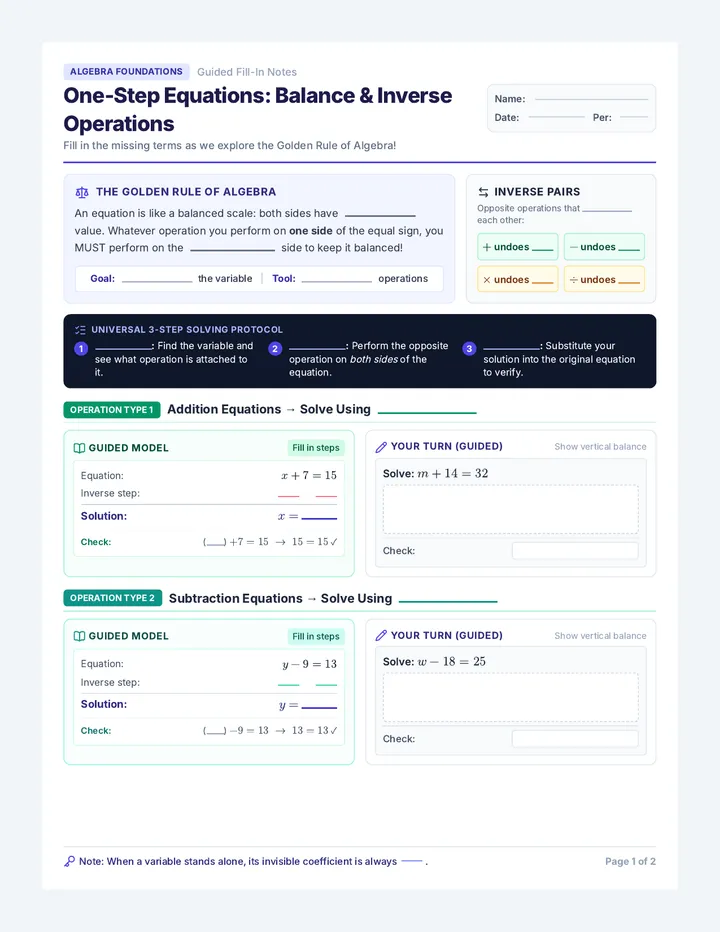
The Golden Rule of Architecture
Maintain Equilibrium
An equation is like a balance scale. Whatever you do to one side, you must do to the other.
"Keep the Scale Level!"
x + 5
12
Scale Status: Balanced
Our Blueprint Tools: Inverse Operations
What is an Inverse?
Inverse operations are operations that undo each other.
Add Subtract
Multiply Divide
Architecture Tip:
To isolate the variable (\(x\)), use the inverse of whatever is happening to it!
Isolation Protocol
Variable = Isolated
Drafting Guide: \(x + p = q\)
TARGET EQUATION
\(x + 8.5 = 20\)
1
Identify the Operation
The variable \(x\) is being added by 8.5.
2
Apply the Inverse
Subtract 8.5 from both sides of the blueprint.
3
Construct the Solution
\(x = 11.5\)
Drafting Guide: \(px = q\)
The Challenge:
\(4x = 24\)
Structural Analysis:
\(4x\) means "4 multiplied by \(x\)".
The inverse of multiplication is division.
1
Divide both sides by 4.
2
\( \frac{4x}{4} = \frac{24}{4} \)
3
\( x = 6 \)
Precision Work: Fractions
Case Study
\( \frac{x}{5} = \frac{2}{3} \)
Don't let fractions shake the foundation! The variable is being divided by 5. The inverse is multiplication.
Construction Step:
\( 5 \cdot \frac{x}{5} = \frac{2}{3} \cdot 5 \)
Final Inspection:
\( x = \frac{10}{3} \) or \( 3 \frac{1}{3} \)
Site Inspection #1
Solve for \(n\)
\( n + 14.2 = 30 \)
15.8
16.2
44.2
15.2
Site Inspection #2
Solve for \(w\)
\( \frac{2}{5}w = 10 \)
Hint: Multiply by the reciprocal!
Build Your Own
Head to your Blueprint Solver Worksheet to complete the final inspections.
SUCCESSFUL CONSTRUCTION COMPLETE
Blueprint Solver Worksheet
Blueprint Solver
Site Inspection: One-Step Equations
Architect:
Date:
Project Specs: To isolate the variable, apply the inverse operation to both sides of the equation. Ensure your final structure is balanced before submission.
01
Solve for \(x\):
\(x + 19 = 52\)
A) 71
B) 33
C) 43
D) 31
02
Solve for \(y\):
\(y - 6.4 = 15.8\)
A) 9.4
B) 21.2
C) 22.2
D) 21.4
03
Solve for \(m\):
\(8m = 96\)
A) 12
B) 104
C) 88
D) 14
04
Solve for \(p\):
\(\frac{p}{7} = 13\)
A) 1.8
B) 6
C) 91
D) 84
05
Solve for \(k\):
\(1.5k = 12\)
A) 18
B) 8
C) 10.5
D) 9
06
Solve for \(h\):
\(h + \frac{2}{3} = \frac{5}{6}\)
A) \(\frac{1}{6}\)
B) \(\frac{3}{3}\)
C) \(\frac{7}{9}\)
D) \(\frac{1}{2}\)
07
Solve for \(b\):
\(\frac{4}{5}b = 20\)
A) 16
B) 25
C) 100
D) 80
08
Real-World Analysis:
An architect is designing 4 identical office spaces. The total area of all 4 spaces is 1,240 square feet. Which equation finds the area (\(a\)) of one office space?
A) \(a + 4 = 1240\)
B) \(\frac{a}{4} = 1240\)
C) \(4a = 1240\)
D) \(a - 4 = 1240\)
Drafting Zone (Show Your Work)
Project ID: 6.EE.7.ARCH-2026 Equilibrium Standards Verified
Architect Teacher Guide
Lead Architect's Manual
Teaching Guide: Equation Architects
Standard: NCSCOS 6.EE.7
Lesson Mission
This lesson uses an architectural blueprint theme to demystify one-step equations. Students will move from visual balance models to algebraic isolation of variables using inverse operations across whole numbers, decimals, and fractions.
Prerequisites
Fluency with rational number operations; understanding variables as unknowns.
Duration
60–75 Minutes (1 Session)
Essential Questions
- "How does maintaining balance relate to solving equations?"
- "Why do we use inverse operations to isolate a variable?"
Construction Phase (Lesson Flow)
10m
The Foundation (Introduction)
Use Slides 1-3. Introduce the "Golden Rule of Architecture": Equilibrium. Use the balance scale visual to explain that the "=" sign is the fulcrum. If we add 5 to one side, the structure collapses unless we add 5 to the other.
20m
Drafting the Solution (Direct Instruction)
Use Slides 4-7. Define Inverse Operations. Explicitly model solving four types of equations. Key Emphasis: Isolate the variable by "undoing" the operation attached to it. Model vertical formatting for subtracting/adding and fractional formatting for multiplication/division.
15m
Site Inspections (Guided Practice)
Use Slides 8-9. Conduct whole-class polling or white-board checks for the decimal and fraction problems. Watch for students forgetting to align decimals or multiply by the reciprocal.
20m
Final Build (Independent Practice)
Distribute the Blueprint Solver Worksheet. Students work independently to solve the 8 EOG-style questions. Encourage them to use the "Drafting Zone" at the bottom to show all structural calculations.
Blueprint Correction Key
| Question | Answer | Work/Logic |
|---|
| 01 (Add) | B | \(52 - 19 = 33\) |
| 02 (Sub) | C | \(15.8 + 6.4 = 22.2\) |
| 03 (Mult) | A | \(96 \div 8 = 12\) |
| 04 (Div) | C | \(13 \times 7 = 91\) |