Equal Parts Teacher Script
Adapted Teacher Script • Unit 5, Day 2
Equal Parts Bridge: Sixths & Eighths
Target Profile
3rd Grade • Early 2nd Skill Level
Bridge Learning Goal
Connect fair shares (halves & fourths) to partitioning wholes into 6 and 8 equal parts, and name one equal part as 1/6 or 1/8.
Hands-On Materials
- 1 yellow hexagon + 6 green triangles
- 2 paper strips (for folding halves → fourths → eighths)
- Fraction Toolkit Resource Page & Practice Sheet
1. Launch: Fair Shares & Halves/Fourths Bridge
5 mins
SAY:
“Today we are fraction builders! Before we make bigger fractions, let’s check our fair share rule. If we share a brownie with a friend, what has to be true about the pieces?”
LISTEN:
Student says “the same size” or “equal.” Point to the Equal Parts box on the Resource Page.
DO & SAY:
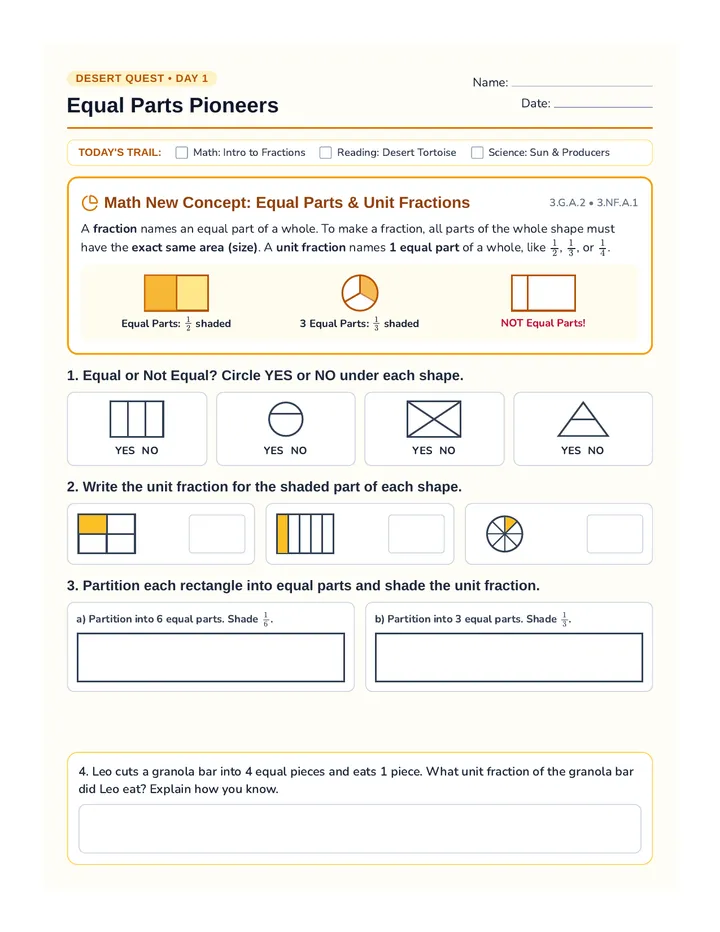
Draw a rectangle and split it into 2 equal parts. “How many equal parts make the whole? (2) If I shade 1 piece, we write 1/2. Say it with me: Top number is the 1 piece we picked. Bottom number is the 2 equal pieces in the whole.” Repeat quickly with 1/4 (split each half in half).
2nd-Grade Check: Have the student complete Part A & Part B on Page 1 of the Practice Sheet with you before moving on.
2. Concrete Bridge: Pattern Blocks & Paper Folding
7 mins
Step A: Hexagon + Green Triangles (Making Sixths)
SAY: “Cover the yellow hexagon with green triangles. Make sure there are no gaps and no overlaps. How many triangles fill the whole hexagon?” (6)
SAY: “Hold up 1 triangle. That is 1 equal part out of 6 total parts. So each triangle is 1/6! Let’s trace and label 1/6 in Part C of your sheet.”
Step B: The Halving Trick (Making Sixths & Eighths on Paper)
DO: Give the student a paper strip. Fold it in half (2 parts), then fold in half again (4 parts), then fold in half one more time (8 parts). Open it up and count the equal boxes together.
SAY: “Watch how easy it is! To make eighths (8), we start with halves, make fourths, and split each fourth in half! To make sixths (6), we split in half first, then put 3 equal parts on each side.”
Transition: “Keep your Fraction Toolkit next to you. Let’s trace the dotted guides in Part D together, then you’ll try Parts E & F!”
Equal Parts Teacher Script (Page 2) Monitoring, Error Correction & Debrief
3. Scaffolded Monitoring & Error-Correction Prompts
10 mins
Use these gentle, concrete prompts if the student gets stuck during Independent Practice (Parts D–F):
Error 1: Parts are unequal sizes (big pieces + tiny pieces)
Prompt: “If these were pizza slices, would you and I get a fair share? Point to the biggest piece and the smallest piece. Let’s use the halving dots on the edge to split it in half first, then split each side.”
Stamp: “Equal parts must be the same size.”
Error 2: Gaps, overlaps, or drawing outside the shape
Prompt: “Trace the outside edge of the whole shape with your finger. Make sure your lines go all the way from edge to edge so no piece is left out.”
Stamp: “Equal parts fill the entire whole with no gaps.”
Error 3: Labels each part as “6” or “8” instead of “1/6” or “1/8”
Prompt: “Put your finger on just one piece. How many pieces are you touching? (1) That goes on top. Now count all the equal pieces in the whole. (6) That goes on the bottom. So one piece is 1/6.”
Stamp: “1 part on top, total equal parts on the bottom.”
Error 4: Confuses the “whole” vs. a “unit fraction”
Prompt: “Show me the whole rectangle with both hands. Now point to just 1 unit fraction with one finger. Say: ‘This 1 piece is 1/8 of the whole.’”
4. Debrief & Adapted Check-In (Page 3)
5–8 mins
DEBRIEF:
“Look at your Unit Fraction Chart on the Resource Page. When we cut a whole into more pieces—from halves (2) to sixths (6) to eighths (8)—what happens to the size of each piece?” (They get smaller!)
CHECK-IN:
Have the student complete Page 3 (Check-In) independently. Read the directions aloud if needed so reading doesn’t block math understanding.
Adapted Check-In Answer Key (Page 3)
- Q1 (Circle sixths): Top-left rectangle (6 equal parts) and Bottom-left circle (6 equal parts). (Top-right triangle has unequal parts; bottom-right rectangle has 8 parts.)
- Q2 (Label): Each part in both shapes is labeled 1/8.
- Q3a (Renata): No. Bottom number should be 8 because there are 8 equal parts in the whole.
- Q3b (Brieon): No. Each part is 1 equal part out of 8 total parts, so each part should be labeled 1/8.
Fraction Builders Practice
Fraction Builders Practice
Part 1: Fair Shares & Pattern Block Bridge
Name: _________________________
Date: _______________
A. Fair Shares Check
Look at each shape. Are all the parts the same size? Circle Equal or Not Equal.
Equal / Not Equal
Equal / Not Equal
Equal / Not Equal
Equal / Not Equal
B. Halves & Fourths Warm-Up
Count the equal parts in each whole. Write the unit fraction for 1 equal part in the box.
Total equal parts: ______
1 part =
Total equal parts: ______
1 part =
C. Hexagon Pattern Block Bridge
Use your 6 green triangles to cover the hexagon. Trace the dotted lines to show the 6 equal parts. Write 1/6 inside each triangle!
My Hexagon Check:
1. How many equal parts?
2. Each equal part is:
Fraction Builders Practice
Part 2: Building Sixths & Eighths
D. Trace & Label Sixths (6 Equal Parts)
Trace the dotted lines to split each whole into 6 equal parts. Write the unit fraction in each part.
E. Your Turn! Partition into Sixths (6 Equal Parts)
Connect the guide dots to split each shape into 6 equal parts. Label each part with its unit fraction.
F. Your Turn! Partition into Eighths (8 Equal Parts)
Tip: Split in half, then fourths, then split each fourth in half! Label each equal part.
My Fraction Check-In
Show what you know about sixths and eighths!
Name: ________________________
1. Circle the 2 shapes that show SIXTHS (6 equal parts).
2. Count the equal parts. Write the unit fraction in each part.
3. Fraction Detectives! Check Renata’s and Brieon’s work.
a) Renata labeled each part 1/6.
Did she label it right? Yes / No
1/6 1/6 1/6 1/6 1/6 1/6 1/6 1/6
Renata needs to change the bottom number to ________ because there are ________ equal parts in the whole.
b) Brieon labeled each part 8.
Did he label it right? Yes / No
8 8 8 8
Each part is ________ equal part out of ________ total parts, so each part should be labeled ________.