Cosmic Orbit Slides
Grade 6-8 Math Lab
45-Minute Discovery
Modular Geometry & Number Theory
COSMIC ORBIT CYCLES
What happens when skip counting leaves the flat number line and wraps into an orbital ring? Discover star polygons, modular clocks, and the secret power of coprimes.
Repeated Addition
Cyclic steps around a loop
Star Polygons
Geometric orbits from math
Coprime Power
The universal orbit law
THE HOOK
Three Probes on a 12-Node Orbital Ring (0 to 11)
RING SIZE = 12
Probe Alpha Step +3
0 → 3 → 6 → 9 → 0
Nodes: 4 of 12 (Square)
× Trapped in 4-step loop
Probe Beta Step +4
0 → 4 → 8 → 0
Nodes: 3 of 12 (Triangle)
× Trapped in 3-step loop
Probe Gamma Step +5
0 → 5 → 10 → 3 → 8 → 1 → 6 → ... → 0
Nodes: ALL 12 of 12
✓ 12-Point Star! {12/5}
Central Puzzle: Why does step +5 visit every single station, while steps +3 and +4 get locked in short sub-loops?
MODULAR MATH
How Modular Clocks Wrap Around
REMAINDER ARITHMETIC
The Wrap-Around Rule
In ring size \(N = 12\), numbers wrap around when they reach or exceed 12. We take the remainder:
\(7 + 5 = 12\) \(12 \equiv 0 \pmod{12}\)
\(10 + 5 = 15\) \(15 \equiv 3 \pmod{12}\)
Think of a standard clock: 5 hours after 10 o'clock is 3 o'clock!
Repeated Addition Formula
Step \(k\) lands on station:
\(\text{Node} = (k \times \text{Step}) \pmod N\)
The orbit returns to 0 on jump \(k\) whenever \(k \times \text{Step}\) is a multiple of \(N\).
The smallest positive jump where this happens is the cycle length!
Cycle Length: \(\text{Steps to return to 0} = \frac{\text{LCM}(N, \text{Step})}{\text{Step}} = \frac{N}{\gcd(N, \text{Step})}\)
THE LAW
The Greatest Common Factor (GCD) Law
COPRIME POWER
Comparing Factors with 12
\(\gcd(12, 2) = 2\) 6 nodes (Hexagon)
\(\gcd(12, 3) = 3\) 4 nodes (Square)
\(\gcd(12, 4) = 4\) 3 nodes (Triangle)
\(\gcd(12, 5) = 1\) 12 nodes (Star!)
The Universal Orbit Rule
A skip step visits EVERY node on a dial if and only if the step size and dial size are coprime:
\(\gcd(\text{Dial Size}, \text{Step Size}) = 1\)
If \(\gcd > 1\), the probe gets trapped in a polygon with \(\frac{N}{\gcd}\) vertices.
Test Your Intuition: On a 10-node dial (0-9), will step +3 visit every node? ✓ YES: \(\gcd(10, 3) = 1\)
MISSION BRIEF
Your Discovery Lab: 4-Phase Flight Plan
25 MINUTES WORK TIME
1
Draw Star Trails
Use a straightedge to connect skip counts on the 12-dial and 10-dial.
2
Record Orbit Matrix
Log nodes visited, count total steps, and classify: polygon or universal star?
3
Test the Coprime Rule
Predict behavior on a 16-node ring before connecting any points.
4
Crack Space Beacon
Decode a deep-space message scrambled by modular skip counting.
Use different colored pencils for each probe to see the interlocking patterns!
READY, SET, EXPLORE!
REAL WORLD
Where Modular Skip Counting Governs Reality
APPLICATIONS
Mechanical Gears
Engineers give gears coprime tooth counts so every tooth meets all opposite teeth, preventing localized wear and catastrophic failure.
Even Wear Engineering
Prime Cicadas
Periodical cicadas emerge every 13 or 17 years. Because these are primes, predators with 2, 3, 4, 5, or 6 year cycles rarely synchronize.
Survival by Coprimes
RSA Cryptography
Internet encryption scrambles data using giant prime clocks. Modular repeated multiplication guarantees only the keyholder can decrypt.
Data Security Systems
Exit Question: On a 20-node dial, which step sizes produce a universal star?
Coprimes: 1, 3, 7, 9, 11, 13, 17, 19
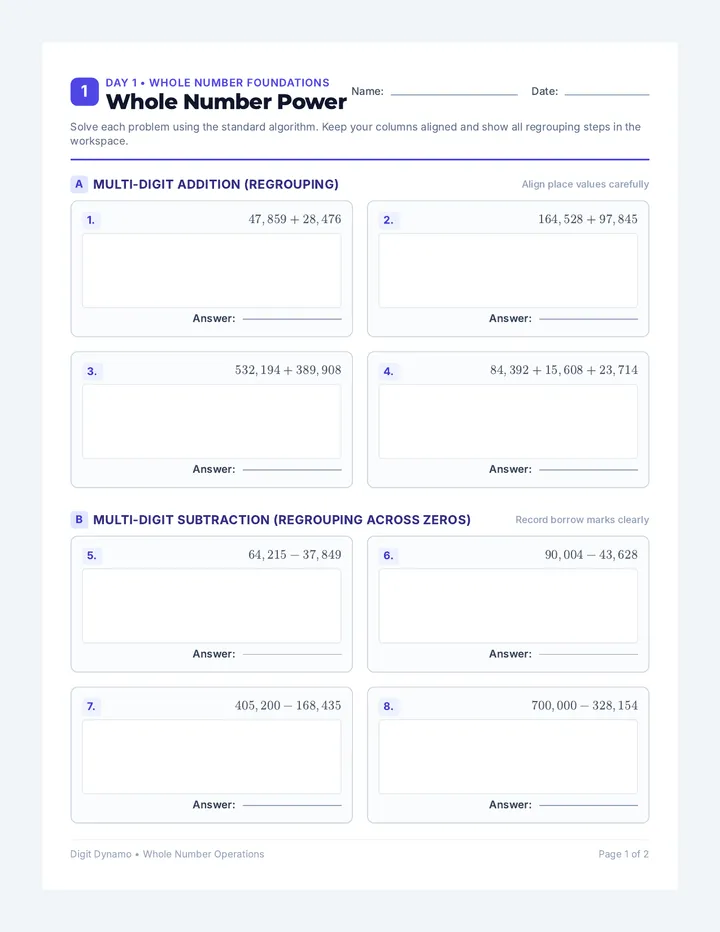
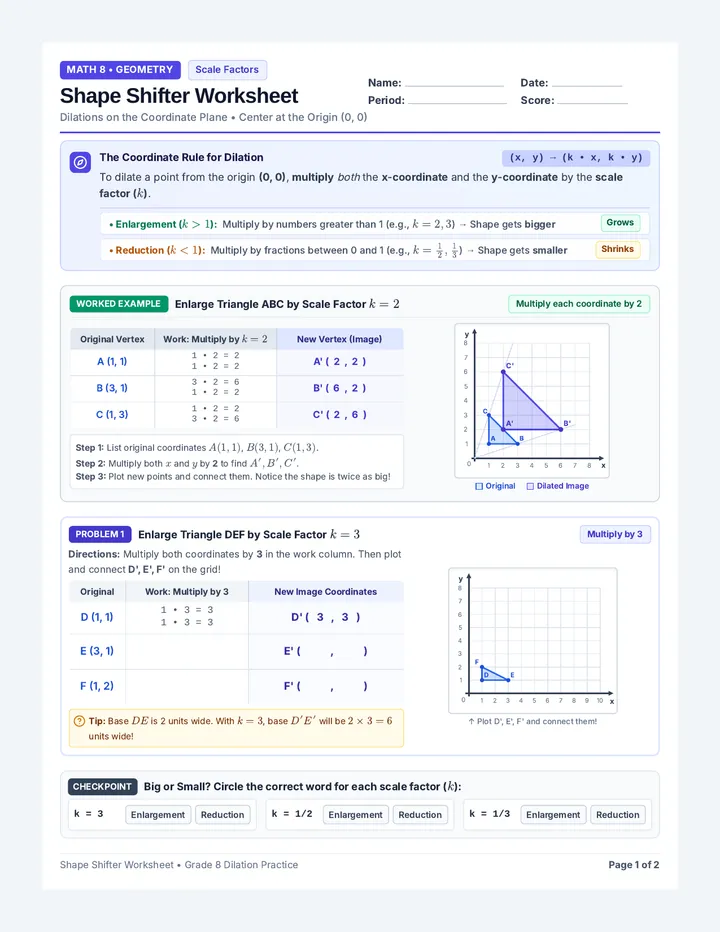
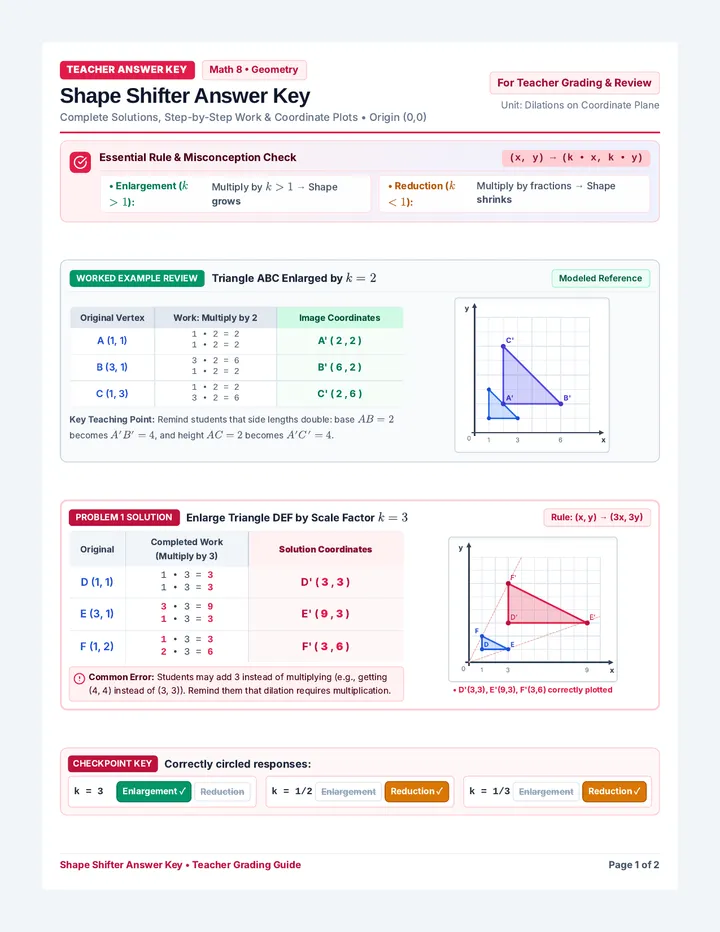
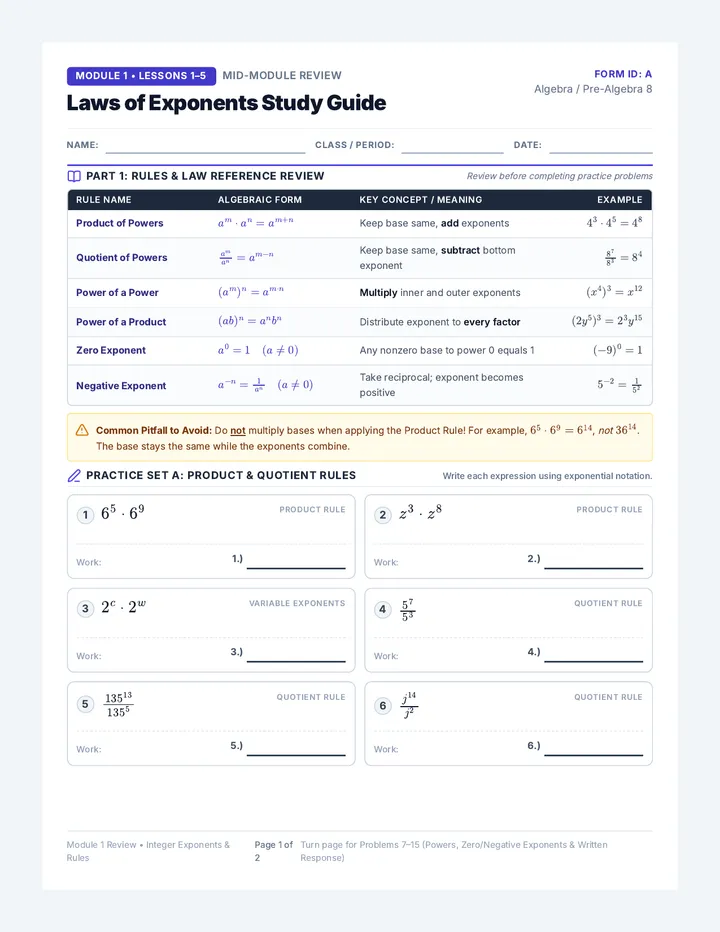
Cosmic Orbit Activity Sheet
Math Lab Modular Number Theory
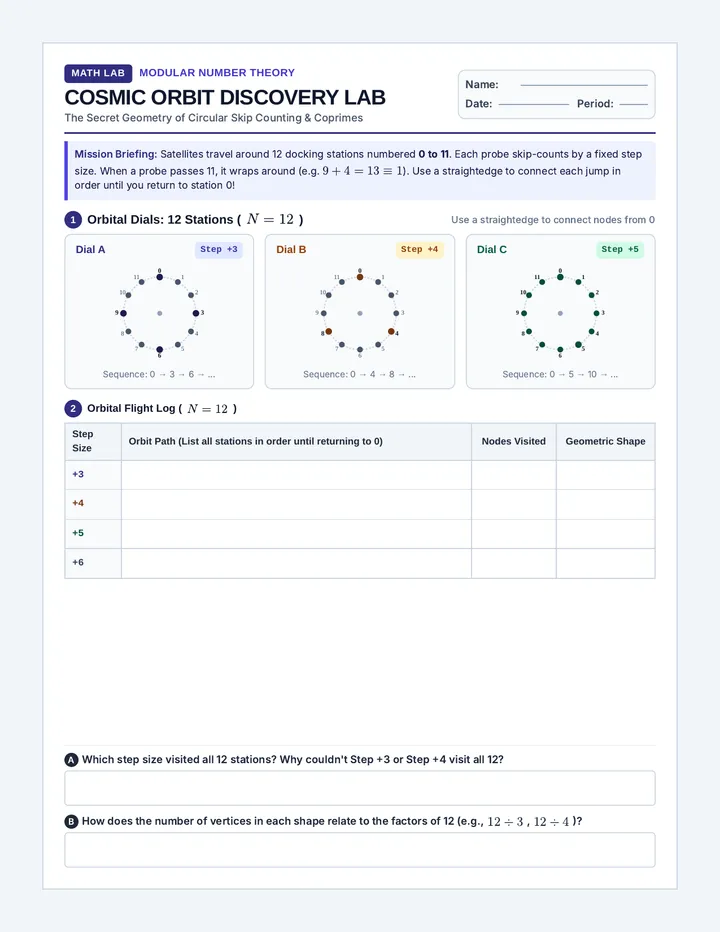
COSMIC ORBIT DISCOVERY LAB
The Secret Geometry of Circular Skip Counting & Coprimes
Name:
Date: Period:
Mission Briefing: Satellites travel around 12 docking stations numbered 0 to 11. Each probe skip-counts by a fixed step size. When a probe passes 11, it wraps around (e.g. \(9 + 4 = 13 \equiv 1\)). Use a straightedge to connect each jump in order until you return to station 0!
1 Orbital Dials: 12 Stations (\(N = 12\))
Use a straightedge to connect nodes from 0
Dial A Step +3
0 1 2 3 4 5 6 7 8 9 10 11 Sequence: 0 → 3 → 6 → ...
Dial B Step +4
0 1 2 3 4 5 6 7 8 9 10 11 Sequence: 0 → 4 → 8 → ...
Dial C Step +5
0 1 2 3 4 5 6 7 8 9 10 11 Sequence: 0 → 5 → 10 → ...
2 Orbital Flight Log (\(N = 12\))
| Step Size | Orbit Path (List all stations in order until returning to 0) | Nodes Visited | Geometric Shape |
|---|
| +3 | | | |
| +4 | | | |
| +5 | | | |
| +6 | | | |
A Which step size visited all 12 stations? Why couldn't Step +3 or Step +4 visit all 12?
B How does the number of vertices in each shape relate to the factors of 12 (e.g., \(12 \div 3\), \(12 \div 4\))?
Part II: Decimal Orbits & Deep Space Decoding
The Universal Coprime Law
LAB PAGE 2 OF 2
3 The 10-Node Dial Experiment (\(N = 10\), Nodes 0 to 9)
Dial D: Step +2
Start at 0, jump by 2.
Nodes:
Shape:
Total visited:
0 1 2 3 4 5 6 7 8 9
Dial E: Step +3
Start at 0, jump by 3.
Nodes:
Shape:
Total visited:
0 1 2 3 4 5 6 7 8 9
4 Formulate the Universal Orbit Law
1. The Star Condition: A skip step \(S\) visits every single station on a ring of size \(N\) if and only if: \(\gcd(N, S) =\) (Meaning \(N\) and \(S\) share no common factors other than 1).
2. Key Terminology: Two whole numbers whose greatest common factor is 1 are called:
3. The Sub-Loop Formula: If \(\gcd(N, S) > 1\), the probe gets trapped in a polygon with exactly \(\frac{N}{\gcd(N, S)}\) vertices.
Cosmic Orbit Teacher Guide
Teacher Guide Instructional Protocol
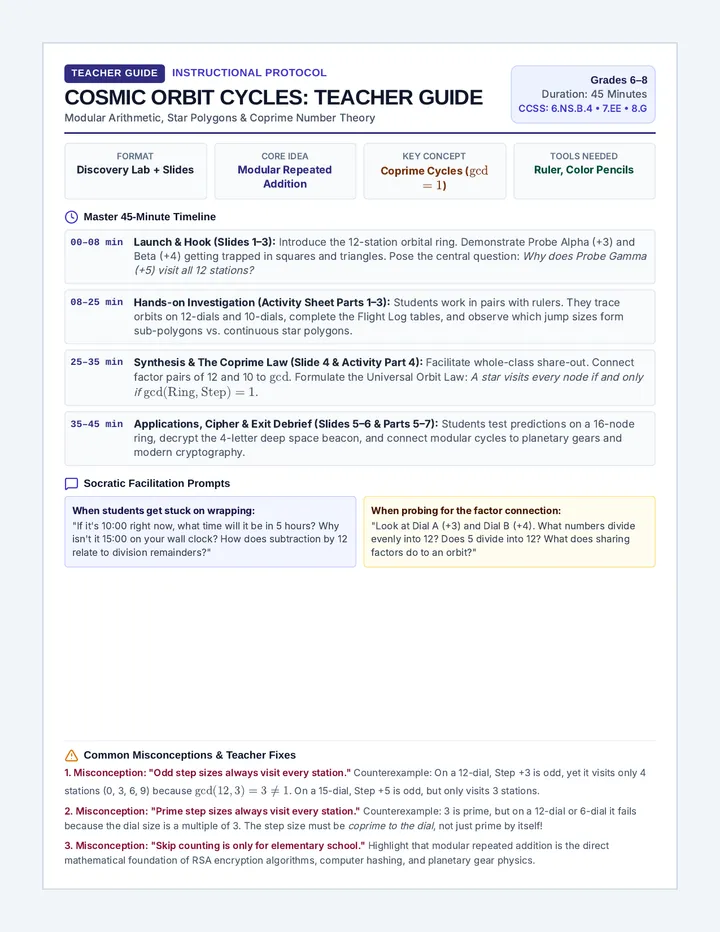
COSMIC ORBIT CYCLES: TEACHER GUIDE
Modular Arithmetic, Star Polygons & Coprime Number Theory
Grades 6–8
Duration: 45 Minutes
CCSS: 6.NS.B.4 • 7.EE • 8.G
Format Discovery Lab + Slides
Core Idea Modular Repeated Addition
Key Concept Coprime Cycles (\(\gcd = 1\))
Tools Needed Ruler, Color Pencils
Master 45-Minute Timeline
00–08 min
Launch & Hook (Slides 1–3): Introduce the 12-station orbital ring. Demonstrate Probe Alpha (+3) and Beta (+4) getting trapped in squares and triangles. Pose the central question: Why does Probe Gamma (+5) visit all 12 stations?
08–25 min
Hands-on Investigation (Activity Sheet Parts 1–3): Students work in pairs with rulers. They trace orbits on 12-dials and 10-dials, complete the Flight Log tables, and observe which jump sizes form sub-polygons vs. continuous star polygons.
25–35 min
Synthesis & The Coprime Law (Slide 4 & Activity Part 4): Facilitate whole-class share-out. Connect factor pairs of 12 and 10 to \(\gcd\). Formulate the Universal Orbit Law: A star visits every node if and only if \(\gcd(\text{Ring}, \text{Step}) = 1\).
35–45 min
Applications, Cipher & Exit Debrief (Slides 5–6 & Parts 5–7): Students test predictions on a 16-node ring, decrypt the 4-letter deep space beacon, and connect modular cycles to planetary gears and modern cryptography.
Socratic Facilitation Prompts
When students get stuck on wrapping:
"If it's 10:00 right now, what time will it be in 5 hours? Why isn't it 15:00 on your wall clock? How does subtraction by 12 relate to division remainders?"
When probing for the factor connection:
"Look at Dial A (+3) and Dial B (+4). What numbers divide evenly into 12? Does 5 divide into 12? What does sharing factors do to an orbit?"
Common Misconceptions & Teacher Fixes
1. Misconception: "Odd step sizes always visit every station." Counterexample: On a 12-dial, Step +3 is odd, yet it visits only 4 stations (0, 3, 6, 9) because \(\gcd(12, 3) = 3 \neq 1\). On a 15-dial, Step +5 is odd, but only visits 3 stations.
2. Misconception: "Prime step sizes always visit every station." Counterexample: 3 is prime, but on a 12-dial or 6-dial it fails because the dial size is a multiple of 3. The step size must be coprime to the dial, not just prime by itself!
3. Misconception: "Skip counting is only for elementary school." Highlight that modular repeated addition is the direct mathematical foundation of RSA encryption algorithms, computer hashing, and planetary gear physics.