Roller Coaster Curves Handout
Roller Coaster Curves
Increasing, Decreasing & Constant Intervals
Name:
Date:
1 Reading the Ride (Left to Right)

Think like a rider: Always read a graph from left to right. Notice how the train climbs up to the peak, then drops down!
Increasing Interval (I)
As \(x\) increases (left to right), \(y\) goes up. The coaster is climbing uphill.
Decreasing Interval (D)
As \(x\) increases (left to right), \(y\) goes down. The coaster is dropping downhill.
Constant Interval (C)
As \(x\) increases (left to right), \(y\) stays the same. The track is flat.
Cut Strategy: Always cut the graph with vertical lines at every peak, valley, and flat turn—then label each section I, D, or C and write its \(x\)-values \((a, b)\).
2Roller Coaster Track: Cut & Write Interval Notation
This rollercoaster ride is cut at its peaks, valley, and flat turn, with each interval labeled I, D, or C. Write each interval using the \(x\)-values of the cuts.
I D C I D x y -8 -6 -4 -2 2 4 6 8 5 3 1 -2 -3 x = -8 x = -5 x = -1 x = 2 x = 5 x = 8

Worked Example (Using the Cuts)
• I (start to 1st peak, \(x = -8\) to \(-5\)): \((-8, -5)\)
• D (1st peak to valley, \(x = -5\) to \(-1\)): \((-5, -1)\)
Now finish the remaining cuts:
Constant (C):
Increasing (I):
Decreasing (D):
3 Cut at Peaks & Valleys to Spot Intervals
Vertical dashed cut lines are drawn at \(x = -4\), \(x = 1\), \(x = 4\), and \(x = 7\), with each interval labeled I, D, or C. Write the \(x\)-interval for each section from left to right.
 D I D I C
| Section |
Interval & Type |
| 1st Car |
|
| 2nd Car |
|
| 3rd Car |
|
| 4th Car |
|
| Flat End |
|
Quick Check: Why do we cut the graph at the peaks and valleys before labeling I, D, or C?
4 Design Your Own Coaster Track
Draw vertical dashed cut lines at \(x = -2\) and \(x = 1\) first, label each section I, C, or D, and sketch a continuous rollercoaster function from \(x = -6\) to \(x = 6\):
x y -6 -4 -2 2 4 6 4 2 -2 -4
Track Requirements:
1. Increasing (I) on \((-6, -2)\)
2. Constant (C) on \((-2, 1)\)
3. Decreasing (D) on \((1, 6)\)
At what \(x\)-values did you place your turning points (cuts), and what is your coaster's highest \(y\)-value?
Roller Coaster Splish Splash Handout
Coaster Splash
Positive & Negative Output Intervals
Name:
Date:
1 Above the Water vs. Underwater

Imagine a water coaster: The \(x\)-axis (\(y = 0\)) is the water surface. Track above the water has positive \(y\)-values; track below is underwater!
Positive Interval (+) — Above Water
Where the graph is above the \(x\)-axis (\(y > 0\)). Outputs are positive numbers.
Negative Interval (−) — Underwater
Where the graph is below the \(x\)-axis (\(y < 0\)). Outputs are negative numbers.
Cut at the Waterline: Draw vertical dashed lines wherever the track crosses the \(x\)-axis (\(x\)-intercepts)—then label each section + or − and write its \(x\)-values \((a, b)\).
2 Splash Track: Cut at \(x\)-Intercepts
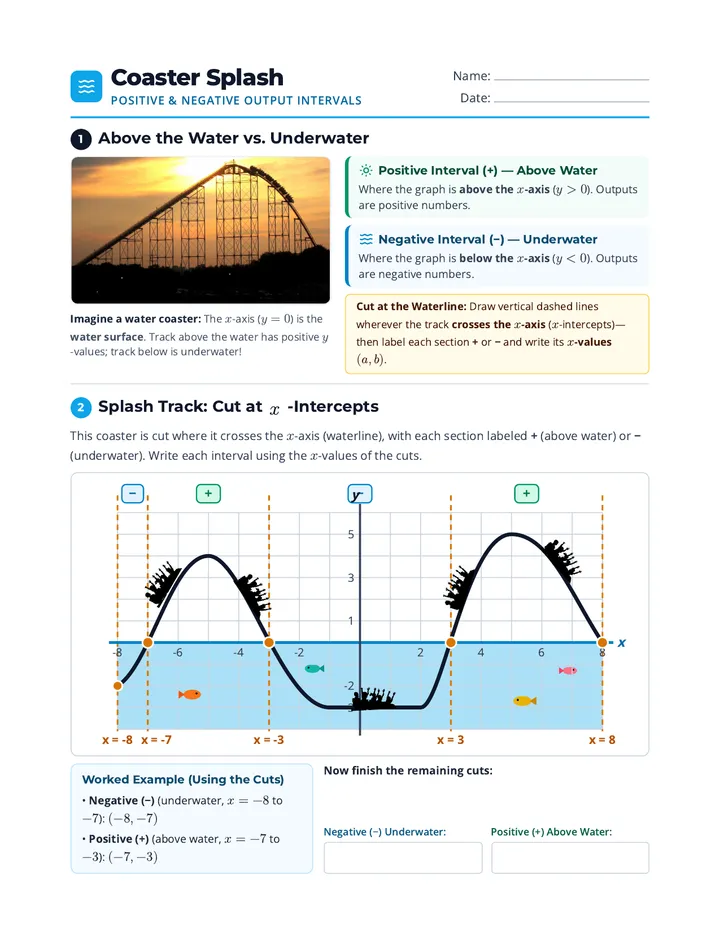
This coaster is cut where it crosses the \(x\)-axis (waterline), with each section labeled + (above water) or − (underwater). Write each interval using the \(x\)-values of the cuts.
− + − + x y -8 -6 -4 -2 2 4 6 8 5 3 1 -2 -3 x = -8 x = -7 x = -3 x = 3 x = 8

Worked Example (Using the Cuts)
• Negative (−) (underwater, \(x = -8\) to \(-7\)): \((-8, -7)\)
• Positive (+) (above water, \(x = -7\) to \(-3\)): \((-7, -3)\)
Now finish the remaining cuts:
Negative (−) Underwater:
Positive (+) Above Water:
3 Cut at the Waterline to Spot + and − Intervals
Blue water fills the area below the \(x\)-axis, and vertical dashed cut lines mark where the track crosses \(y = 0\). Write the \(x\)-interval and type (+ or −) for each section from left to right.
 + − + − +
1st Span (+ / −):
2nd Span (+ / −):
3rd Span (+ / −):
4th Span (+ / −):
5th Span (+ / −):
Quick Check: Why do we cut at the \(x\)-intercepts (waterline) for + and − intervals?
4 Design Your Own Splash Coaster
Draw vertical dashed cut lines at \(x = -2\) and \(x = 2\) first, label each section + or −, and sketch a continuous coaster track from \(x = -6\) to \(x = 6\):
x y -6 -4 -2 2 4 6 4 2 -2 -4
Splash Track Requirements:
1. Positive (+) on \((-6, -2)\)
2. Negative (−) on \((-2, 2)\)
3. Positive (+) on \((2, 6)\)
Where does your coaster cross the waterline (\(x\)-intercepts), and what is its deepest \(y\)-value?