Vector Breakdown Worksheet Vector Breakdown
Lesson 1: Vector Resolution Using Trigonometry
STUDENT WORKSHEET
Name:
Date:
The Sled Dilemma
Imagine you are pulling a sled across the snow. You pull on the rope with a force of \(100 \, \text{N}\) at an angle of \(30^\circ\) above the horizontal. Why does this feel different than pulling the sled straight forward? What part of your pull is actually moving the sled forward, and what part is lifting it up?
The Resolution Formula
Given a vector \(\mathbf{v}\) with magnitude \(|\mathbf{v}|\) and direction \(\theta\) (measured from the positive x-axis):
Horizontal Component
\(v_x = |\mathbf{v}| \cos \theta\)
Vertical Component
\(v_y = |\mathbf{v}| \sin \theta\)
Component Calculations
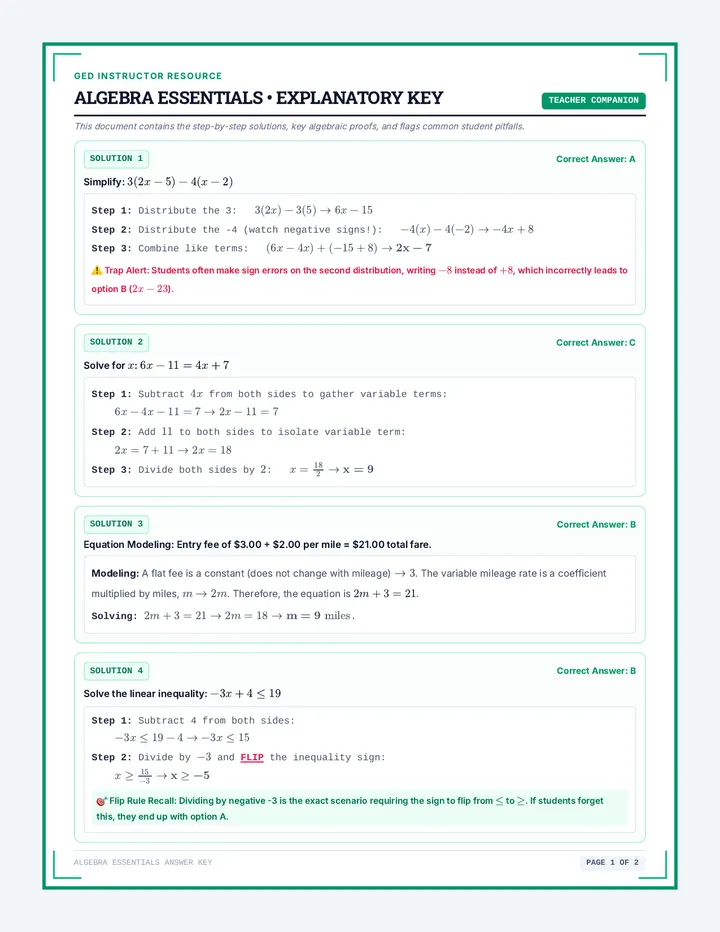
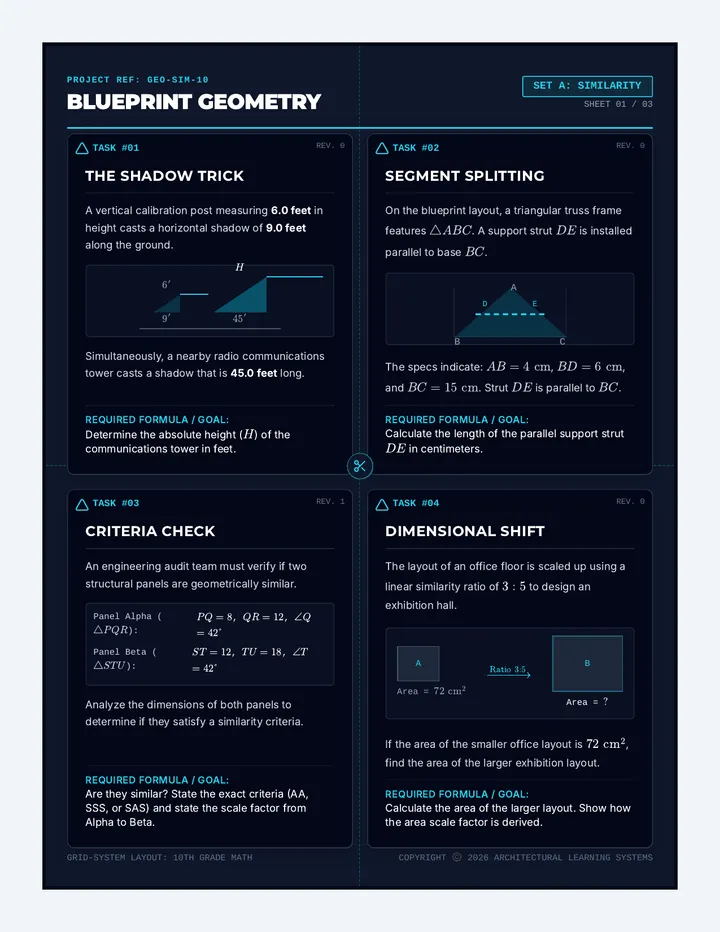
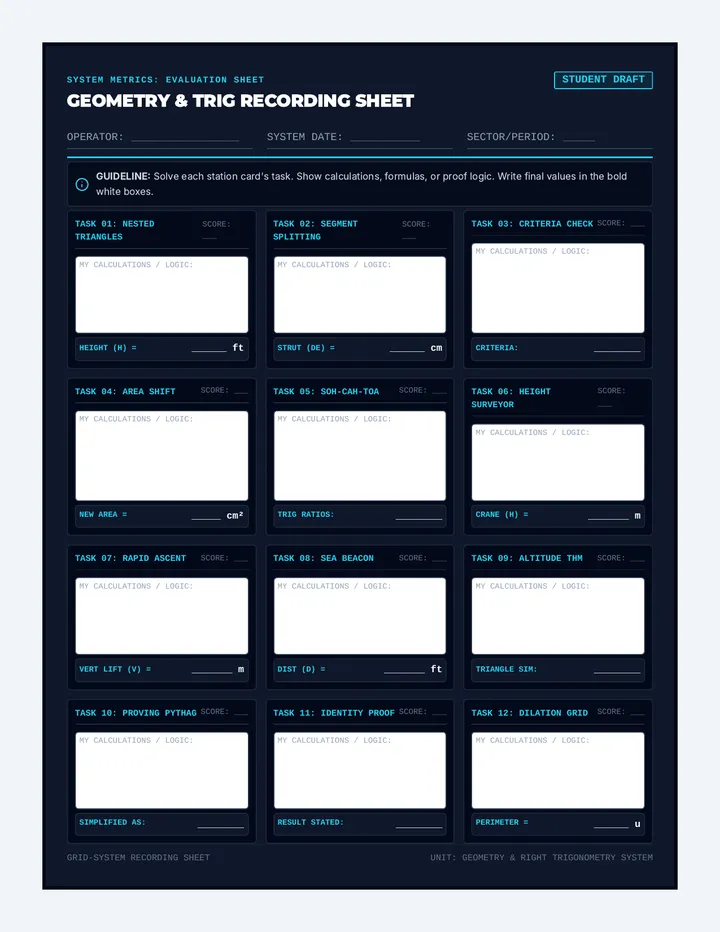
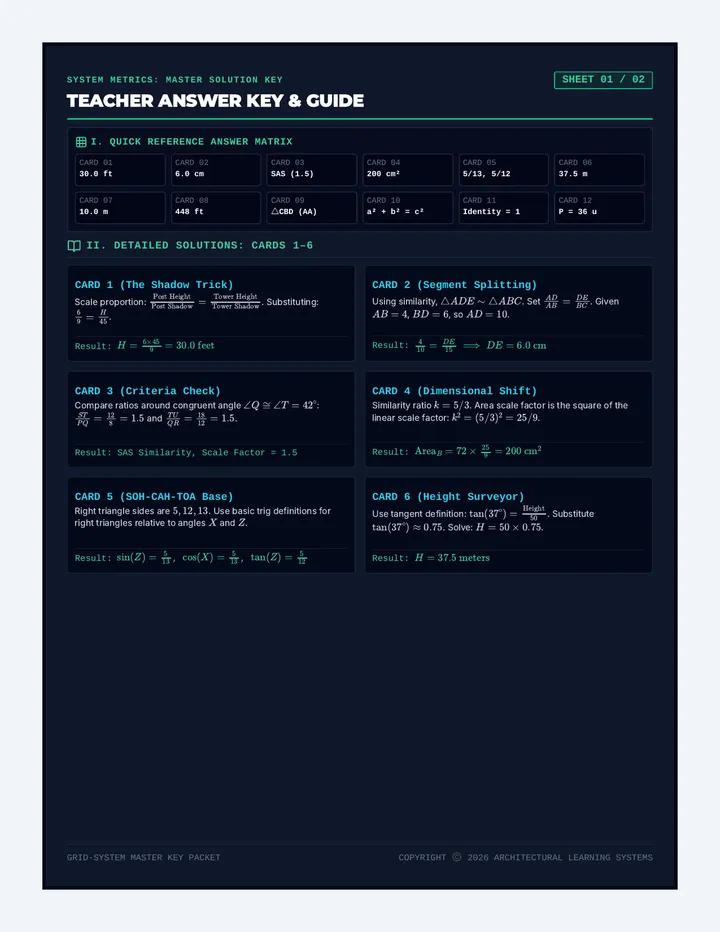
1. The Sled Force
Mag: 100 N | Angle: 30°
Resolve the pull force from the hook into its horizontal (\(F_x\)) and vertical (\(F_y\)) components.
Show Work for \(F_x\)
Show Work for \(F_y\)
2. Launch Velocity
Mag: 45 m/s | Angle: 120°
A projectile is launched with a velocity of \(45 \, \text{m/s}\) at an angle of \(120^\circ\) relative to the positive x-axis. Find the rectangular coordinates \((v_x, v_y)\).
Show Calculations
\(v_x =\)
\(v_y =\)
3. The Gust of Wind
Mag: 12 mph | Direction: SE (315°)
A wind vector has a magnitude of \(12 \, \text{mph}\) blowing Southeast (\(315^\circ\)). Write the vector in component form.
Show Calculations
Component Form \(\langle x, y \rangle =\)
Critical Thinking
If you double the angle of a vector (e.g., from \(30^\circ\) to \(60^\circ\)) but keep the magnitude the same, do the components also double? Explain why or why not using your understanding of trigonometric functions.
Vector Breakdown Slides Mathematics of Motion
Vector
Breakdown
Resolving Forces and Motion using Trigonometry
The Sled Dilemma
You pull a sled with a force of 100 N at an angle of 30°.
How much effort moves it forward?
How much effort lifts it up?
Total Force &neq; Forward Force
[DIAGRAM: SLED PULL AT 30°]
What is Resolution?
Resolution is the process of breaking a single diagonal vector into two perpendicular components.
Standard Framework
We use the x (horizontal) and y (vertical) axes as our reference.
Horizontal Component (\(v_x\))
\(v_x = |\mathbf{v}| \cos \theta\)
Vertical Component (\(v_y\))
\(v_y = |\mathbf{v}| \sin \theta\)
The Trig Connection
Cosine (\(\cos\))
Measures horizontal displacement.
Sine (\(\sin\))
Measures vertical displacement.
Unit Circle Visualization
At radius \(R\), point is \((R\cos\theta, R\sin\theta)\)
Live Walkthrough
Work It Out
Resolve a vector with magnitude 50 and angle 210°.
1. Horizontal
\(50 \cos(210^\circ) = -43.3\)
2. Vertical
\(50 \sin(210^\circ) = -25.0\)
"Since 210° is in Quadrant III, both components should be negative."
Vector Breakdown Teacher Guide Resolution Guide
Teacher Resource: Vector Breakdown
TEACHER KEY
Lesson Objectives
Resolve polar vectors into rectangular (x, y) components.
Connect trigonometric functions to directionality.
Predict quadrant signs based on direction angles.
Pacing
60 MIN
10m Hook / 20m Slides / 30m Practice
Worksheet Answer Key
1. The Sled Force
Mag: 100 N | Angle: 30°
Horizontal (\(F_x\))
\(100 \cdot \cos(30^\circ)\)
\(100 \cdot 0.866 = 86.6 \, \text{N}\)
Vertical (\(F_y\))
\(100 \cdot \sin(30^\circ)\)
\(100 \cdot 0.5 = 50 \, \text{N}\)
Interpretation: 86.6N moves the sled forward, 50N lifts it up (reducing friction).
2. Launch Velocity
Mag: 45 m/s | Angle: 120°
\(v_x = 45 \cdot \cos(120^\circ) = -22.5 \, \text{m/s}\)
\(v_y = 45 \cdot \sin(120^\circ) = 38.97 \, \text{m/s}\)
Note: The negative x-component indicates the projectile is moving left (Quadrant II).
3. The Gust of Wind
Mag: 12 mph | Direction: 315°
\(\langle 12 \cos(315^\circ), 12 \sin(315^\circ) \rangle = \langle 8.49, -8.49 \rangle\)
Common Misconception
Students often assume \(x\) is always \(\sin\) and \(y\) is always \(\cos\). Remind them that \(\cos\) is the "horizontal shadow" on the x-axis and \(\sin\) is the "vertical shadow" on the y-axis in the standard position.
Grid Command Worksheet Grid Command
Lesson 2: Algebraic Operations and Linear Combinations
CODE-BREAKER ACTIVITY
Agent Name:
Date:
Mission Briefing: Grid Command
A high-value target is moving across a coordinate grid. Their movement is controlled by specific unit vectors: \(\mathbf{i}\) (1 unit East) and \(\mathbf{j}\) (1 unit North). To find the final extraction point, you must compute the linear combination of their movements algebraically.
Component Form
\(\mathbf{v} = \langle x, y \rangle\)
Unit Vector Form
\(\mathbf{v} = x\mathbf{i} + y\mathbf{j}\)
Part 1: Movement Arithmetic
Given: \(\mathbf{u} = 3\mathbf{i} - 2\mathbf{j}\) and \(\mathbf{v} = -5\mathbf{i} + 8\mathbf{j}\)
A) Compute \(\mathbf{u} + \mathbf{v}\)
RESULT:
B) Compute \(2\mathbf{u} - \mathbf{v}\)
RESULT:
Part 2: The Extraction Point
The target starts at position \((10, 10)\). They follow three consecutive displacement vectors:
\(\mathbf{d}_1 = \langle -4, 2 \rangle\)
\(\mathbf{d}_2 = 7\mathbf{i} - 5\mathbf{j}\)
\(\mathbf{d}_3 = 2\mathbf{d}_1 + 3\mathbf{i}\)
1. Simplify \(\mathbf{d}_3\) into component form:
2. Find the Resultant Displacement \(\mathbf{R} = \mathbf{d}_1 + \mathbf{d}_2 + \mathbf{d}_3\):
3. Final Coordinates:
Starting position \((10, 10) + \mathbf{R} =\)
(
,
)
Optional Scratch Grid
Algebraic Precision Slides Vector Operations
Algebraic
Precision
Moving beyond drawings to master the math of unit vectors and linear combinations.
The Building Blocks
Every vector in a 2D plane can be built using two Standard Unit Vectors:
\(\mathbf{i}\)
Unit Horizontal Vector
\(\langle 1, 0 \rangle\)
\(\mathbf{j}\)
Unit Vertical Vector
\(\langle 0, 1 \rangle\)
Component Conversion
\(\langle 4, -3 \rangle\)
\(4\mathbf{i} - 3\mathbf{j}\)
Algebraic Addition
To add or subtract vectors algebraically, simply combine like terms (the components).
Addition Rule
\(\mathbf{u} = \langle a, b \rangle\)
\(\mathbf{v} = \langle c, d \rangle\)
\(\mathbf{u} + \mathbf{v} = \langle a+c, b+d \rangle\)
Scalar Rule
\(k\mathbf{u} = k\langle a, b \rangle\)
\(k\mathbf{u} = \langle ka, kb \rangle\)
Linear Combinations
A fancy name for combining addition and scalar multiplication.
If \(\mathbf{w} = 3\mathbf{u} - 2\mathbf{v}\)...
1. Scale \(\mathbf{u}\)
Multiply all coords by 3
2. Scale \(\mathbf{v}\)
Multiply all coords by -2
Sum the Results
Rapid Response
Let \(\mathbf{u} = \langle 2, -1 \rangle\) and \(\mathbf{v} = 4\mathbf{i} + 3\mathbf{j}\).
\(\mathbf{u} + \mathbf{v}\)
\(3\mathbf{u}\)
\(2\mathbf{u} - \mathbf{v}\)
Flight Path Challenge Worksheet Flight Path Challenge
Lesson 3: Navigation and Velocity Applications
FLIGHT SIMULATION DATA
Navigator:
Flight ID:
Navigation Terms
Airspeed / Water Speed: Speed relative to the medium.
Ground Speed: Speed relative to the earth.
Heading: The direction the nose is pointed.
Bearing: The actual direction of travel.
"Resultant Velocity =
Object Velocity + Medium Velocity"
Mission 1: Crosswind Correction
A small plane has an airspeed of 150 mph and is maintaining a heading of Due North (90°) . A steady crosswind is blowing at 40 mph from the West (moving toward the East, or 0° ).
1. Write both vectors in components:
Plane \(\mathbf{p} =\)
Wind \(\mathbf{w} =\)
2. Calculate Resultant Velocity (\(\mathbf{R}\)):
Show addition here
Find Ground Speed:
(Magnitude of Resultant)
Find True Bearing:
(Angle \(\theta = \arctan(y/x)\))
Mission 2: River Crossing
A boat pilot wants to travel directly across a river (Due East). The river flows South at 5 knots . The boat's motor produces 12 knots of speed.
Challenge: At what heading must the pilot aim to travel directly East?
Sketch your vector triangle and solve for the unknown angle.
Calculated Heading Angle:
Balance Point Worksheet Balance Point
Lesson 4: Force Vectors and Static Equilibrium
ENGINEERING LAB
Engineer:
Lab Group:
\(\sum \mathbf{F} = 0\)
Static Equilibrium
An object is in static equilibrium if the sum of all forces acting upon it equals the zero vector. This means: \(\sum F_x = 0\) and \(\sum F_y = 0\).
Task 1: The Three-Way Tug
A metal ring is being pulled by three separate ropes. Your goal is to find the resultant force (\(F_R\)) and then determine what fourth force (\(F_4\)) would bring the ring into perfect equilibrium.
Force A
10N @ 0°
Force B
15N @ 120°
Force C
20N @ 225°
Step 1: Resolve all forces into component form \(\langle F_x, F_y \rangle\).
\(A_x =\)
\(A_y =\)
\(B_x =\)
\(B_y =\)
\(C_x =\)
\(C_y =\)
Step 2: Sum the components to find \(F_R\).
\(\langle \dots , \dots \rangle\)
Final Solution: The Equilibrium Force
To achieve equilibrium, \(F_4\) must be the direct opposite of the resultant. Find the magnitude and direction of \(F_4\).
Magnitude
Direction
Systems Check
If a crate is hanging from two ropes at different angles, which rope is under more tension: the one with the steeper angle or the one with the shallower angle? Why?
Unit Direction Slides Advanced Vector Analysis
Unit
Direction
Normalization and the Geometry of Pure Direction
The "Look" Vector
In video games, characters need to "face" a direction without moving.
The Problem:
If magnitude represents speed, how do we represent direction with zero speed ?
Solution: Magnitude must equal 1.
|u| = 1
Unit Vector
Normalization
To create a unit vector \(\mathbf{u}\) in the same direction as \(\mathbf{v}\):
\(\mathbf{u} = \frac{\mathbf{v}}{|\mathbf{v}|}\)
1
Find the magnitude of the original vector.
2
Divide each component by that magnitude.
Worked Example
Normalize \(\mathbf{v} = \langle 3, 4 \rangle\)
1
\(|\mathbf{v}| = \sqrt{3^2 + 4^2} = 5\)
2
\(\mathbf{u} = \frac{\langle 3, 4 \rangle}{5} = \langle 0.6, 0.8 \rangle\)
Check: \(0.6^2 + 0.8^2 = 0.36 + 0.64 = 1\)
Why does it matter?
Lighting
Game engines use unit vectors to calculate how light bounces off surfaces.
Physics
Defining the direction of gravity or magnetic fields independently of force strength.
Optimization
Using magnitude of 1 simplifies complex matrix multiplications in graphics cards.
Direction Designer Worksheet Direction Designer
Lesson 5: Unit Vector Normalization and Direction
TECHNICAL SPECS
Developer:
Asset ID:
Standard Normalization Formula
\(\mathbf{u} = \frac{1}{|\mathbf{v}|} \mathbf{v}\)
Requirement:
\(|\mathbf{u}| = 1\)
Part 1: Basic Normalization
A) Vector \(\mathbf{a} = \langle 5, -12 \rangle\)
Show Work
UNIT VECTOR:
B) Vector \(\mathbf{b} = 8\mathbf{i} + 15\mathbf{j}\)
Show Work
UNIT VECTOR:
Part 2: Asset Directional Modeling
A character in a 3D game engine is located at \((10, 2)\). They are aiming their weapon toward a target at \((16, 10)\).
Step 1: Find the Displacement Vector (\(\mathbf{D}\)) from character to target.
\(\mathbf{D} = \langle x_2 - x_1, y_2 - y_1 \rangle =\)
Step 2: Normalize \(\mathbf{D}\) to find the "Look Vector" \(\mathbf{L}\).
(This tells the game engine which way the weapon points, regardless of distance.)
Critical Design Discussion
If a vector has a magnitude less than 1 (e.g., \(|\mathbf{v}| = 0.5\)), does normalizing it make the components larger or smaller? Explain the logic.
Vector Master Key Guide Vector Master Key
Teacher Resource: Lessons 2-5 Answer Compendium
TEACHER GUIDE
Lesson 2: Grid Command Key
Part 1: \(\mathbf{u} = \langle 3, -2 \rangle\), \(\mathbf{v} = \langle -5, 8 \rangle\)
\(\mathbf{u} + \mathbf{v} = \langle 3-5, -2+8 \rangle = \langle -2, 6 \rangle\)
\(2\mathbf{u} - \mathbf{v} = \langle 6, -4 \rangle - \langle -5, 8 \rangle = \langle 11, -12 \rangle\)
Part 2: \(\mathbf{d}_1 = \langle -4, 2 \rangle\), \(\mathbf{d}_2 = \langle 7, -5 \rangle\), \(\mathbf{d}_3 = 2\langle -4, 2 \rangle + \langle 3, 0 \rangle = \langle -5, 4 \rangle\)
Resultant \(\mathbf{R} = \langle -4+7-5, 2-5+4 \rangle = \langle -2, 1 \rangle\)
Final Coord: \((10-2, 10+1) = (8, 11)\)
Lesson 3: Flight Path Key
Mission 1: Plane \(\mathbf{p} = \langle 0, 150 \rangle\), Wind \(\mathbf{w} = \langle 40, 0 \rangle\)
Resultant \(\mathbf{R} = \langle 40, 150 \rangle\)
Ground Speed: \(\sqrt{40^2 + 150^2} \approx 155.2 \, \text{mph}\)
True Bearing: \(\arctan(150/40) \approx 75.1^\circ\) (or \(14.9^\circ\) East of North)
Mission 2: River flows \(\langle 0, -5 \rangle\). Need resultant \(\langle x, 0 \rangle\). Boat speed 12.
We need boat's \(y\)-component to cancel the river's \(-5\). So \(12\sin\theta = 5 \Rightarrow \sin\theta = 5/12 \Rightarrow \theta \approx 24.6^\circ\) North of East.
Lesson 4: Balance Point Key
Step 1 (Resolving):
\(A = \langle 10, 0 \rangle\)
\(B = \langle -7.5, 13 \rangle\)
\(C = \langle -14.1, -14.1 \rangle\)
Step 2 (Resultant): \(\sum F_x = 10 - 7.5 - 14.1 = -11.6\); \(\sum F_y = 0 + 13 - 14.1 = -1.1\)
Final \(F_4\): To balance, we need \(\langle 11.6, 1.1 \rangle\). Mag: 11.65N, Angle: 5.4°.
Lesson 5: Direction Designer Key
Part 1:
\(\mathbf{a} = \langle 5, -12 \rangle, |\mathbf{a}| = 13 \Rightarrow \mathbf{u}_a = \langle 5/13, -12/13 \rangle\)
\(\mathbf{b} = \langle 8, 15 \rangle, |\mathbf{b}| = 17 \Rightarrow \mathbf{u}_b = \langle 8/17, 15/17 \rangle\)
Part 2: Displacement \(\mathbf{D} = \langle 16-10, 10-2 \rangle = \langle 6, 8 \rangle\)
Look Vector \(\mathbf{L} = \langle 6, 8 \rangle / 10 = \langle 0.6, 0.8 \rangle\).