Vector Arithmetic Slides Unit: Vector Analysis
Vector Arithmetic &
Component Form
Mastering 2D Operations for Navigation and Physics
Lesson 01 // 2D Systems
The Pilot's Problem
"You are piloting a Cessna 172 on final approach. Your airspeed is 100 knots due North, but a crosswind is blowing from the West at 25 knots."
Critical Questions:
Which direction is the plane actually moving?
What is your actual speed over the ground?
What 'heading' must you hold to stay on the runway?
25 kt West Wind
100 kt Airspeed
Ground Track Analysis Required
The Dual Nature of Vectors
MODE 01
Geometric Form
Defined by Magnitude (\(r\)) and Direction (\(\theta\)).
\( \vec{v} = (10, 45^\circ) \)
Best for: Visualizing force and motion in the real world.
MODE 02
Component Form
Defined by horizontal (\(v_x\)) and vertical (\(v_y\)) parts.
\( \vec{v} = \langle v_x, v_y \rangle \)
or
\( \vec{v} = v_x \hat{i} + v_y \hat{j} \)
Best for: Calculation and multi-vector addition.
The Translation Key
Decomposition
\[ v_x = |\vec{v}| \cos \theta \]
\[ v_y = |\vec{v}| \sin \theta \]
Composition
\[ |\vec{v}| = \sqrt{v_x^2 + v_y^2} \]
\[ \theta = \tan^{-1}\left(\frac{v_y}{v_x}\right) \]
|\vec{v}|
v_x
v_y
\theta
Always verify your quadrant after using \(\tan^{-1}\)!
Vector Addition: Two Perspectives
The Visual
"Head-to-Tail" Method: Move the second vector so its start touches the end of the first.
Resultant: \(\vec{A} + \vec{B}\)
The Algebra
Simply add corresponding components. No drawing required!
\( \vec{u} = \langle 3, -4 \rangle \)
\( \vec{v} = \langle 1, 9 \rangle \)
\( \vec{u} + \vec{v} = \langle 3+1, -4+9 \rangle \)
\( \vec{R} = \langle 4, 5 \rangle \)
Navigational Vector Worksheet Navigational Vector Analysis
2D Component Form & Arithmetic
Student Name:
Date/Section:
Mission Objectives: Decompose vectors into \(x\) and \(y\) components; Perform scalar multiplication and addition; Solve relative velocity challenges.
1
The Decomposition Phase
Convert the following magnitude-direction vectors into component form \( \langle v_x, v_y \rangle \). Round to two decimal places.
Vector A Mag: 12, Dir: 30°
vx =
vy =
< ___, ___ >
Vector B Mag: 25, Dir: 215°
vx =
vy =
< ___, ___ >
2
The Arithmetic Phase
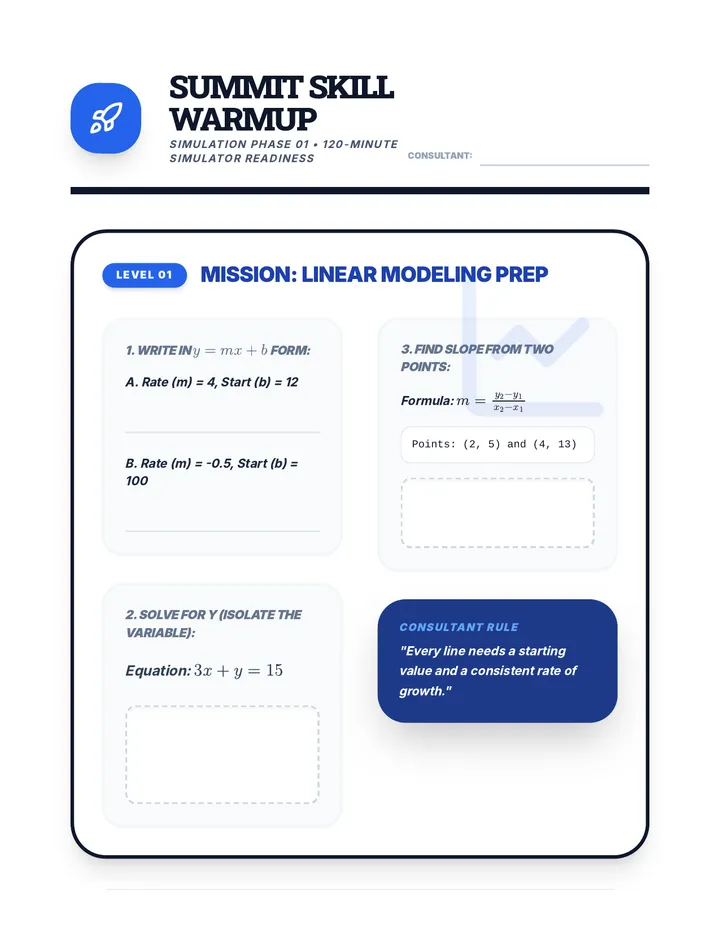
Given the vectors: u = < -4, 3 > and v = < 5, -1 >. Calculate the following resultants.
a) 2u + v
b) 3v - u
c) | u + v |
Find the magnitude of the sum.
3
Navigational Mission
Scenario: Cross-Channel Transit
A ferry captain is crossing a 40-mile wide channel. The ferry's motors propel it at 18 knots (mph) due North. However, a tidal current is flowing at 6 knots at a bearing of 120° (measured clockwise from North).
Q1: Write the ferry's velocity (\(v_f\)) and the current's velocity (\(v_c\)) in component form.
Q2: Find the resultant ground velocity vector of the ferry (\(v_g = v_f + v_c\)).
Q3: What is the ferry's actual ground speed and its actual bearing? If it needs to land exactly North of its starting point, in what direction should the captain point the ferry?
Navigational Vector Key Teacher Solution Guide
Navigational Vector Analysis (Lesson 01)
Internal Use Only
Part 1: Decomposition
Vector A (Mag: 12, Dir: 30°)
\( v_x = 12 \cos(30^\circ) \approx 10.39 \)
\( v_y = 12 \sin(30^\circ) = 6.00 \)
Result: < 10.39, 6.00 >
Vector B (Mag: 25, Dir: 215°)
\( v_x = 25 \cos(215^\circ) \approx -20.48 \)
\( v_y = 25 \sin(215^\circ) \approx -14.34 \)
Result: < -20.48, -14.34 >
Part 2: Arithmetic
Given: u = < -4, 3 >, v = < 5, -1 >
a) 2u + v
2<-4, 3> + <5, -1> = <-8, 6> + <5, -1> = <-3, 5>
b) 3v - u
3<5, -1> - <-4, 3> = <15, -3> + <4, -3> = <19, -6>
c) | u + v |
u + v = <1, 2>
Mag = \(\sqrt{1^2 + 2^2} = \sqrt{5} \approx \)2.24
Part 3: Navigational Mission
Q1: Component Forms
\(v_f\) (18 kt North) = < 0, 18 >
// Note: 120° Bearing from North is 30° below the positive x-axis (or 330° standard angle)
\(v_c\) (6 kt @ 120° Bearing) = \(v_c = \langle 6 \sin(120^\circ), 6 \cos(120^\circ) \rangle \text{ or } \langle 6 \cos(-30^\circ), 6 \sin(-30^\circ) \rangle\)
Using standard math angles (North = 90°): 120° bearing = 90 - 120 = -30°
\(v_c = \langle 6 \cos(-30^\circ), 6 \sin(-30^\circ) \rangle = \langle 5.20, -3.00 \rangle\)
Q2: Resultant Velocity
\(v_g = \langle 0 + 5.20, 18 - 3.00 \rangle = \langle 5.20, 15.00 \rangle\)
Q3: Final Metrics
Ground Speed = \(\sqrt{5.2^2 + 15^2} \approx 15.88 \text{ knots}\)
Actual Course = \(\tan^{-1}(15/5.2) \approx 70.8^\circ \text{ standard angle (approx 19.2° Bearing)}\)
To land due North: The ferry must counteract the east-component (5.20) of the current. Ferry x-component must be -5.20.
\(v_{fx} = -5.20\), \(v_{fy} = \sqrt{18^2 - (-5.2)^2} \approx 17.23\).
Bearing = \(\tan^{-1}(-5.2/17.23) \approx -16.8^\circ\). Captain should point 16.8° West of North.
Instructional Tips
Bearing vs. Standard Angle: High school students often confuse navigational bearings (starts North, clockwise) with mathematical angles (starts East, counter-clockwise). Explicitly clarify which is being used.
Quadrant Logic: Remind students to check the signs of components to ensure their angle calculation is in the correct quadrant.
Estimation: Encourage students to "sketch first" to see if their calculated resultant makes visual sense.
3D Dimension Slides Lesson 02 // Spatial Logic
The Z-Axis Shift
Extending Magnitude & Direction into 3D Space
3D Coordinates & Unit Vectors
The Drone Challenge
"Imagine a drone takeoff from the exact corner of this classroom. It needs to reach a sensor mounted 15 feet along the side wall, 10 feet out from that wall, and 8 feet up in the air."
01
Plot the Target
Assign \(x\), \(y\), and \(z\) values to this location.
02
Find the Distance
How far did the drone travel in a straight line?
Z (Alt) Y X
P(10, 15, 8)
Magnitude in Higher Dimensions
The Formula
\[ |\vec{v}| = \sqrt{x^2 + y^2 + z^2} \]
Just as in 2D, the 3D magnitude is an extension of the Pythagorean Theorem . It calculates the "norm" or the direct length from the origin to point \((x, y, z)\).
Sample Calculation
Vector: \(\langle 2, 4, 4 \rangle\)
\(|\vec{v}| = \sqrt{2^2 + 4^2 + 4^2}\)
\(|\vec{v}| = \sqrt{4 + 16 + 16}\)
\(|\vec{v}| = \sqrt{36}\)
Magnitude = 6
Unit Vectors: The Standard Scale
What is a Unit Vector?
A vector with a magnitude of exactly 1 . It describes direction without affecting magnitude .
How to Normalize (\(\hat{u}\)):
\[ \hat{u} = \frac{\vec{v}}{|\vec{v}|} \]
Divide every component by the magnitude.
i
X-Axis Unit Vector
\(\langle 1, 0, 0 \rangle\)
j
Y-Axis Unit Vector
\(\langle 0, 1, 0 \rangle\)
k
Z-Axis Unit Vector
\(\langle 0, 0, 1 \rangle\)
3D Magnitude Worksheet Spatial Intelligence Brief
3D Coordinate Mapping & Vector Norms
Operator Name
01
3D Point Plotting
The following table lists three targets in a 3D workspace. Sketch the approximate location of Target A on the grid provided and calculate the displacement vector from the origin \((0,0,0)\).
Target ID X (Width) Y (Depth) Z (Height) Alpha (A) 4 3 12 Beta (B) -5 2 6 Gamma (G) 0 -8 -3
Vector Formulation (Alpha):
Z Y X
Plot Alpha: (4, 3, 12)
02
Magnitude & Normalization
Input: \(\vec{v} = \langle 6, 2, 3 \rangle\)
Mission: Calculate magnitude and the unit vector.
Magnitude \(|\vec{v}|\)
Unit Vector \(\hat{v}\)
Input: \(\vec{w} = \langle -4, 4, 2 \rangle\)
Mission: Calculate magnitude and the unit vector.
Magnitude \(|\vec{w}|\)
Unit Vector \(\hat{w}\)
03
Point-to-Point Displacement
Problem Statement: The Crane Analysis
A construction crane's hook moves from point \(P_1(10, 5, 20)\) to point \(P_2(30, 25, 45)\). (Units in meters)
A) Determine the displacement vector \(\vec{d}\) representing the hook's motion.
B) Calculate the total distance the hook moved (Magnitude of \(\vec{d}\)). Round to two decimal places.
3D Magnitude Key Instructor Key
Lesson 02: Spatial Mapping Solutions
Confidential Data
Ver 1.0 // JAN 2026
Part 1: 3D Mapping
Alpha Vector Calculation:
Point A = (4, 3, 12)
Origin = (0, 0, 0)
Vector \(\vec{a} = \langle 4-0, 3-0, 12-0 \rangle = \mathbf{\langle 4, 3, 12 \rangle}\)
Grading Note:
Ensure students correctly identify that the displacement from origin is simply the point coordinates. For plotting, students should show point 4 units along X, 3 units along Y, then "lift" it 12 units vertically.
Part 2: Magnitude & Normalization
Input: < 6, 2, 3 >
MAGNITUDE
\(\sqrt{6^2+2^2+3^2}\)
\(\sqrt{36+4+9} = \sqrt{49}\)
= 7
UNIT VECTOR
\(\langle 6/7, 2/7, 3/7 \rangle\)
≈ <0.86, 0.29, 0.43>
Input: < -4, 4, 2 >
MAGNITUDE
\(\sqrt{(-4)^2+4^2+2^2}\)
\(\sqrt{16+16+4} = \sqrt{36}\)
= 6
UNIT VECTOR
\(\langle -4/6, 4/6, 2/6 \rangle\)
= <-2/3, 2/3, 1/3>
Part 3: The Crane Analysis
A) Displacement Vector \(\vec{d}\)
\(\vec{d} = P_2 - P_1\)
\(\vec{d} = \langle 30-10, 25-5, 45-20 \rangle\)
\(\vec{d} = \langle 20, 20, 25 \rangle\)
B) Total Distance (Magnitude)
\(|\vec{d}| = \sqrt{20^2 + 20^2 + 25^2}\)
\(|\vec{d}| = \sqrt{400 + 400 + 625}\)
\(|\vec{d}| = \sqrt{1425}\)
Distance ≈ 37.75 meters
Teaching Insight
Students often miscalculate magnitude when negative components are present (e.g., squaring \(-4\) as \(-16\)). Remind them that squared terms in the magnitude formula are always positive .
Dot Product Logic Slides Lesson 03 // Vector Interaction
The Dot Product
Algebraic Power Meets Geometric Meaning
Angles, Orthogonality, & Projections
The Efficiency Problem
"Suppose you are pushing a heavy crate across a floor. If you push straight ahead (horizontally), 100% of your effort moves the crate. If you push at a 45° angle downward, your effort is split."
Why does direction matter?
Some force moves the crate forward.
Some force just squishes it into the floor.
The **Dot Product** calculates that "useful" alignment.
Force \(\vec{F}\) Displacement \(\vec{d}\)
Work = \(\vec{F} \cdot \vec{d}\)
The Dual Definition
Algebraic Method
Component Sum
\[ \vec{a} \cdot \vec{b} = a_x b_x + a_y b_y + a_z b_z \]
Fast and easy for raw data.
Geometric Method
Angular Relationship
\[ \vec{a} \cdot \vec{b} = |\vec{a}| |\vec{b}| \cos \theta \]
Reveals the angle between vectors.
Key Applications
Orthogonality Test
If two vectors are perpendicular (90°) , their dot product is zero .
\(\vec{a} \cdot \vec{b} = 0\)
Pro Tip
Use the dot product to find the angle (\(\theta\)) between any two 3D vectors:
\(\theta = \cos^{-1}\left(\frac{\vec{a} \cdot \vec{b}}{|\vec{a}||\vec{b}|}\right)\)
Vector Projections
Calculates the "shadow" of vector \(\vec{a}\) onto vector \(\vec{b}\).
SCALAR PROJECTION (Length) \( comp_{\vec{b}}\vec{a} = \frac{\vec{a} \cdot \vec{b}}{|\vec{b}|} \)
VECTOR PROJECTION (Shadow) \( proj_{\vec{b}}\vec{a} = \left(\frac{\vec{a} \cdot \vec{b}}{|\vec{b}|^2}\right)\vec{b} \)
Dot Product Worksheet Force Alignment Analytics
Dot Products, Angles, & Scalar Projections
Field Agent ID
01
The Algebra of Alignment
SET ALPHA: \(\vec{u}=\langle 4, -1, 3 \rangle\), \(\vec{v}=\langle 2, 5, -2 \rangle\)
1. Calculate Dot Product (\(\vec{u} \cdot \vec{v}\))
2. Determine Orthogonality
Orthogonal Not Orthogonal
SET BETA: \(\vec{a}=\langle 3, 0, 4 \rangle\), \(\vec{b}=\langle -4, 2, 3 \rangle\)
1. Calculate Dot Product (\(\vec{a} \cdot \vec{b}\))
2. Find the Angle \(\theta\) (to nearest degree)
02
Work & Energetic Efficiency
The Mission
A dockworker pulls a heavy pallet across a warehouse floor. The pallet moves from origin to position \(\vec{d} = \langle 12, 0, 0 \rangle\) meters. The dockworker applies a constant force vector \(\vec{F} = \langle 40, 0, 30 \rangle\) Newtons using a strap.
A) Component Analysis
Calculate the Work done using the formula \(W = \vec{F} \cdot \vec{d}\). (Result in Joules)
B) Geometric Analysis
Calculate the magnitudes \(|\vec{F}|\) and \(|\vec{d}|\), and use the cosine formula to verify your result for Work.
C) Efficiency Assessment
The "Useful Force" is the scalar projection of \(\vec{F}\) onto the direction of motion \(\vec{d}\). Find \(comp_{\vec{d}}\vec{F}\).
Technical Reflection
What percentage of the total applied force (\(|\vec{F}|\)) is actually doing Work in the direction of motion? Show your calculation.
03
Advanced Vector Shadows
Find the vector projection of \(\vec{u} = \langle 2, 4, -5 \rangle\) onto \(\vec{v} = \langle 1, 2, 2 \rangle\).
Step 1: Calculate \(\vec{u} \cdot \vec{v}\) and \(|\vec{v}|^2\)
Step 2: Assemble the Vector Projection \(proj_{\vec{v}}\vec{u}\)
Verification: If your answer is correct, the difference vector (\(\vec{u} - proj_{\vec{v}}\vec{u}\)) should be orthogonal to \(\vec{v}\). (Mental check!)
Dot Product Key Instructor Key
Lesson 03: Force Alignment Solutions
Calculated Data
Ver 1.0 // JAN 2026
Part 1: Algebraic Sets
SET ALPHA SOLUTION
\(\vec{u} \cdot \vec{v} = (4)(2) + (-1)(5) + (3)(-2)\)
\(\vec{u} \cdot \vec{v} = 8 - 5 - 6 = \mathbf{-3}\)
Result: Not Orthogonal
SET BETA SOLUTION
\(\vec{a} \cdot \vec{b} = (3)(-4) + (0)(2) + (4)(3)\)
\(\vec{a} \cdot \vec{b} = -12 + 0 + 12 = \mathbf{0}\)
Result: Orthogonal (90°)
Part 2: Dockworker Scenario
A) WORK (W)
\( \langle 40, 0, 30 \rangle \cdot \langle 12, 0, 0 \rangle \)
\( 480 + 0 + 0 = \)
480 Joules
B) MAGNITUDES & COSINE
\(|\vec{F}| = \sqrt{40^2+30^2} = 50N\)
\(|\vec{d}| = 12m\)
\(\theta = \cos^{-1}(480 / (50 \times 12)) = \cos^{-1}(0.8) \approx 36.87^\circ\)
C) Efficiency Metrics
Useful Force (\(comp_{\vec{d}}\vec{F}\)) = \(480 / 12 = \mathbf{40N}\)
Efficiency Percentage = \((40N / 50N) \times 100 = \mathbf{80\%}\)
Part 3: Projection Analysis
Calculating \(proj_{\vec{v}}\vec{u}\) for \(\vec{u}=\langle 2,4,-5 \rangle\), \(\vec{v}=\langle 1,2,2 \rangle\)
1. \(\vec{u} \cdot \vec{v} = 2 + 8 - 10 = \mathbf{0}\)
2. \(|\vec{v}|^2 = 1 + 4 + 4 = \mathbf{9}\)
Projection = \((0 / 9) \langle 1, 2, 2 \rangle\)
Result: \(\langle 0, 0, 0 \rangle\)
Since vectors are orthogonal, the "shadow" of one onto the other is zero.
Cross Product Slides Lesson 04 // Rotational Logic
The Cross Product
Determinants, Right-Hand Rules, & Torque
Normal Vectors & Force Systems
The Torque Dilemma
"A mechanic is trying to loosen a rusted bolt. They apply a force (\(\vec{F}\)) at the end of a long wrench (\(\vec{r}\))."
Key Variables:
Wrench Length (\(\vec{r}\))
Applied Force (\(\vec{F}\))
Torque (\(\tau\))
r (Radius)
Force (\(\vec{F}\))
Torque = \(\vec{r} \times \vec{F}\)
Calculating the Cross Product
Unlike the dot product, the cross product result is another vector . We use a 3x3 determinant to find it.
\[ \vec{a} \times \vec{b} = \begin{vmatrix} \mathbf{i} & \mathbf{j} & \mathbf{k} \\ a_x & a_y & a_z \\ b_x & b_y & b_z \end{vmatrix} \]
Expansion Rule
\( \mathbf{i}(a_y b_z - a_z b_y) \)
\( - \mathbf{j}(a_x b_z - a_z b_x) \)
\( + \mathbf{k}(a_x b_y - a_y b_x) \)
"The middle term (j) is always subtracted!"
Geometric Significance
1. Mutually Orthogonal
The resulting vector \(\vec{a} \times \vec{b}\) is perpendicular to both \(\vec{a}\) and \(\vec{b}\). It defines the normal vector to their shared plane.
2. Area Relation
The magnitude \(|\vec{a} \times \vec{b}|\) is exactly equal to the area of the parallelogram formed by \(\vec{a}\) and \(\vec{b}\).
Area = \(|\vec{a}| |\vec{b}| \sin \theta\)
Right Hand Rule:
Thumb = \(\vec{a} \times \vec{b}\)
Torque Calculation Worksheet Rotational Torque Analysis
Cross Products & Vector Orthogonality
Engineering Specialist
01
The Determinant Protocol
Input Vectors
\(\vec{a} = \langle 1, 3, -2 \rangle\)
\(\vec{b} = \langle 2, -1, 0 \rangle\)
Find \(\vec{a} \times \vec{b}\)
Determinant Setup Matrix
Calculation Steps
Result Vector: < ____, ____, ____ >
02
Torque Engineering
Case Study: Industrial Bolt
A mechanic uses a 0.5-meter wrench, represented by position vector \(\vec{r} = \langle 0.5, 0, 0 \rangle\). They apply a force vector \(\vec{F} = \langle 0, 20, 50 \rangle\) Newtons at the end of the wrench handle.
A) Torque Vector (\(\vec{\tau}\))
Calculate \(\vec{\tau} = \vec{r} \times \vec{F}\). Show the full determinant expansion.
B) Torque Magnitude
Find \(|\vec{\tau}|\). This represents the total rotational "oomph" (in Newton-meters).
Physics Insight
Which direction is the bolt actually turning? (Analyze the sign of the torque components and use the Right Hand Rule).
03
Spatial Areas
A triangle is defined in 3D space by its vertices:
\(A(0,0,0)\), \(B(2,1,0)\), \(C(0,3,4)\).
"The area of a triangle formed by vectors \(\vec{u}\) and \(\vec{v}\) is exactly \(\frac{1}{2}|\vec{u} \times \vec{v}|\)."
Step 1: Identify vectors \(\vec{AB}\) and \(\vec{AC}\).
Step 2: Calculate \(\vec{AB} \times \vec{AC}\) and find the area.
Torque Calculation Key Instructor Key
Lesson 04: Rotational Mechanics Solutions
Confidential Data
Ver 1.0 // JAN 2026
Part 1: Determinant Operations
Cross Product Solution
\[ \begin{vmatrix} \mathbf{i} & \mathbf{j} & \mathbf{k} \\ 1 & 3 & -2 \\ 2 & -1 & 0 \end{vmatrix} \]
\( \mathbf{i}(0 - 2) - \mathbf{j}(0 - (-4)) + \mathbf{k}(-1 - 6) \)
\( -2\mathbf{i} - 4\mathbf{j} - 7\mathbf{k} \)
Result: < -2, -4, -7 >
Part 2: Industrial Torque
A) Torque Vector (\(\vec{\tau}\))
\[ \begin{vmatrix} \mathbf{i} & \mathbf{j} & \mathbf{k} \\ 0.5 & 0 & 0 \\ 0 & 20 & 50 \end{vmatrix} \]
\( \mathbf{i}(0) - \mathbf{j}(25) + \mathbf{k}(10) \)
= < 0, -25, 10 >
B) Magnitude & Direction
\(|\vec{\tau}| = \sqrt{0^2 + (-25)^2 + 10^2} = \sqrt{625 + 100} = \sqrt{725} \approx \mathbf{26.93 \text{ Nm}}\)
Sign Analysis: Negative j means the torque vector points in the -y direction. Positive k means +z. Using RHR, the rotational direction is clockwise in the yz-plane.
Part 3: Spatial Areas
Triangle ABC Solution
\(\vec{u} = \vec{AB} = \langle 2, 1, 0 \rangle\)
\(\vec{v} = \vec{AC} = \langle 0, 3, 4 \rangle\)
\(\vec{u} \times \vec{v} = \mathbf{i}(4) - \mathbf{j}(8) + \mathbf{k}(6) = \langle 4, -8, 6 \rangle\)
\(|\vec{u} \times \vec{v}| = \sqrt{16+64+36} = \sqrt{116} \approx 10.77\)
Triangle Area = \(\frac{1}{2}(10.77) \approx 5.39 \text{ sq units}\)
Teaching Point
Remind students that the order of the cross product matters. \(\vec{a} \times \vec{b} = -(\vec{b} \times \vec{a})\). In torque problems, reversing the order mathematically suggests the bolt is being tightened instead of loosened!
Equilibrium Slides Lesson 05 // Mastery Synthesis
The Equilibrium Challenge
Analyzing 3D Force Systems and Structural Integrity
Vector Sum \(\sum \vec{F} = 0\)
Torque Sum \(\sum \vec{\tau} = 0\)
The Static Problem
"A 500 kg traffic light assembly is suspended at a major intersection by three separate steel cables. If any one cable exceeds its breaking strength, the system fails."
Mission Constraints:
Resolve tension into 3D components.
Apply Dot Products for angles.
Calculate total resultant forces.
500 kg
State: STATIC EQUILIBRIUM
The Mastery Synthesis
01
Geometry
Identify coordinate points for all attachments and the central hub.
02
Unit Vectors
Calculate unit vectors (\(\hat{u}\)) for each cable to establish directions.
03
System Setup
Model each force as \(T \cdot \hat{u}\) and sum them to match the weight.
04
Integrity Check
Solve the system and check magnitudes against breaking limits.
Tension System Challenge Activity Structural Integrity Audit
3D Static Equilibrium Project
Lead Engineer Signature
The Project Scenario
You are tasked with verifying the safety of a 6000 N (approx 612 kg) chandelier in a hotel lobby. It is held by three cables attached to the ceiling at points A, B, and C . The central hub is at the origin O(0, 0, 0) . The weight acts in the negative Z direction.
Attachment Grid
Cable A: (3, 4, 12)
Cable B: (-3, 4, 12)
Cable C: (0, -6, 8)
01
Phase 1: Unit Vector Resolution
Determine the unit vectors (\(\hat{u}_A, \hat{u}_B, \hat{u}_C\)) for each cable from the origin to the attachment points. Show all magnitude calculations.
Cable A Unit Vector
Cable B Unit Vector
Cable C Unit Vector
02
Phase 2: System of Equations
Static Requirement
\[ \sum \vec{F}_x = 0 \] \[ \sum \vec{F}_y = 0 \] \[ \sum \vec{F}_z = 6000 \]
Due to the symmetry of Cables A and B across the yz-plane, their tensions \(T_A\) and \(T_B\) must be equal. Use this fact to simplify your system.
Write out the simplified equations for the Y and Z directions:
03
Phase 3: Stress Test
A) Calculated Tensions
Solve for \(T_A, T_B,\) and \(T_C\). Round results to the nearest Newton.
B) Safety Evaluation
The breaking strength of each steel cable is 4500 N . Does this installation meet safety standards? Explain your conclusion.
Tension System Solution Guide Engineering Master Key
Lesson 05: Structural Equilibrium Solution Guide
Final Assessment Data
Ver 1.0 // JAN 2026
Phase 1: Unit Vector Analysis
CABLE A
Dist = \(\sqrt{3^2+4^2+12^2} = 13\)
\(\hat{u}_A = \langle 3/13, 4/13, 12/13 \rangle\)
CABLE B
Dist = \(\sqrt{(-3)^2+4^2+12^2} = 13\)
\(\hat{u}_B = \langle -3/13, 4/13, 12/13 \rangle\)
CABLE C
Dist = \(\sqrt{0^2+(-6)^2+8^2} = 10\)
\(\hat{u}_C = \langle 0, -0.6, 0.8 \rangle\)
Phase 2: System Equations
Setup: Symmetry implies \(T_A = T_B\)
Sum of Y Forces
\(2(T_A \cdot \frac{4}{13}) - T_C(0.6) = 0\)
\(0.615 T_A - 0.6 T_C = 0\)
Therefore, \(T_C \approx 1.025 T_A\)
Sum of Z Forces
\(2(T_A \cdot \frac{12}{13}) + T_C(0.8) = 6000\)
\(1.846 T_A + 0.8 T_C = 6000\)
Phase 3: Final Safety Audit
Final Tension Solve
Substitute \(T_C\):
\(1.846 T_A + 0.8(1.025 T_A) = 6000\)
\(1.846 T_A + 0.82 T_A = 6000\)
\(2.666 T_A = 6000\)
\(T_A = T_B \approx 2251 \text{ N}\)
\(T_C \approx 2307 \text{ N}\)
Safety Status: PASS
All calculated tensions (\(\sim 2251\)N and \(\sim 2307\)N) are significantly below the breaking strength of 4500 N .
Factor of Safety \(\approx 1.95\)
Evaluation Tips
Students should be awarded full credit if they correctly identified the unit vectors and correctly set up the sum of forces. Minor rounding differences in the final Newton values are acceptable (\(\pm 5\)N).