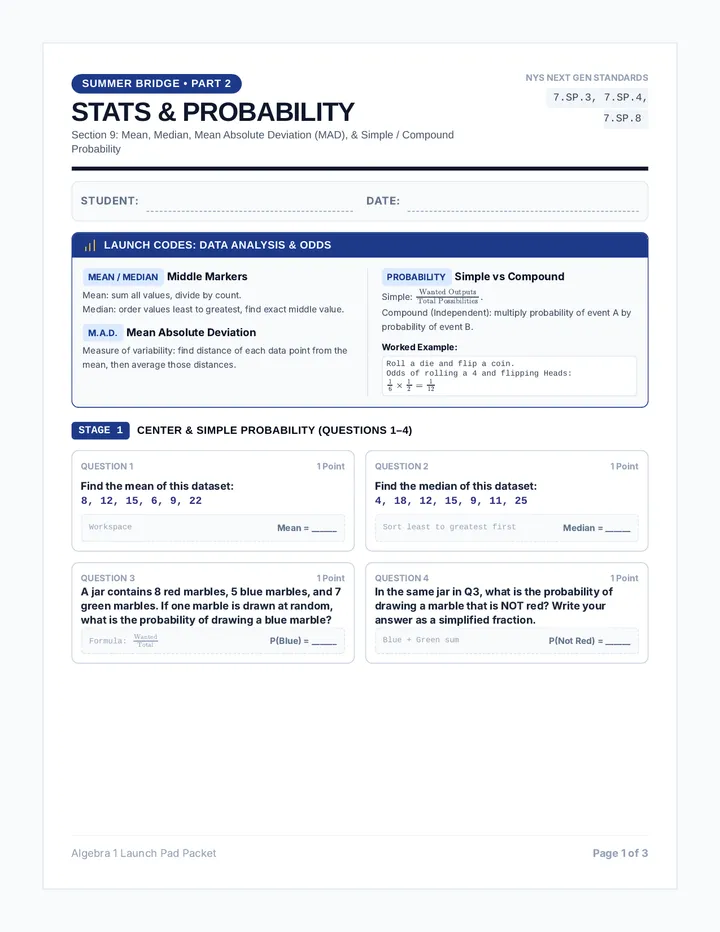
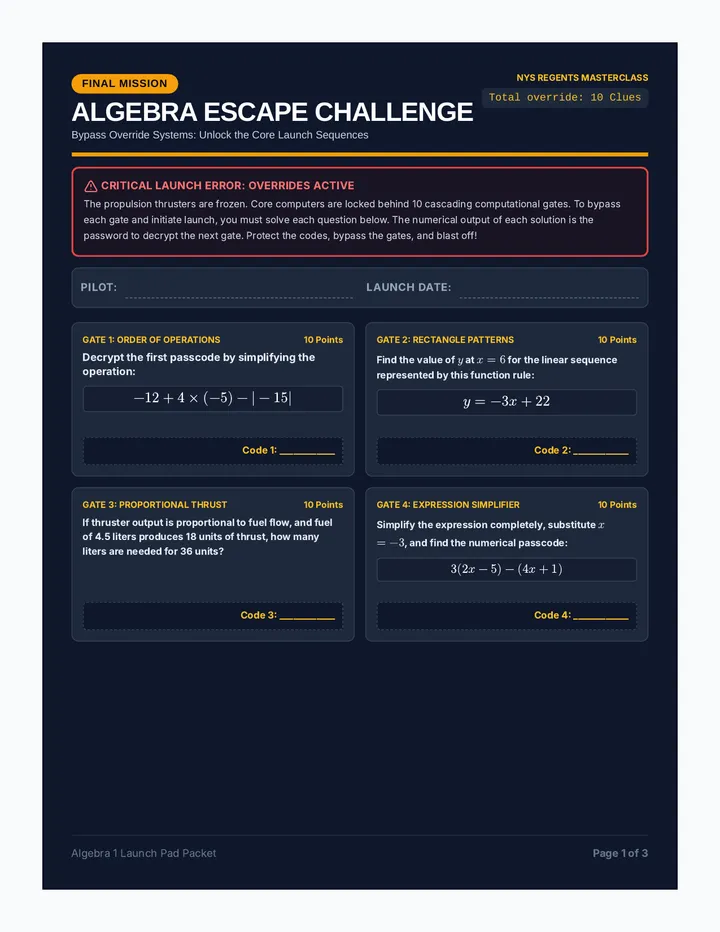
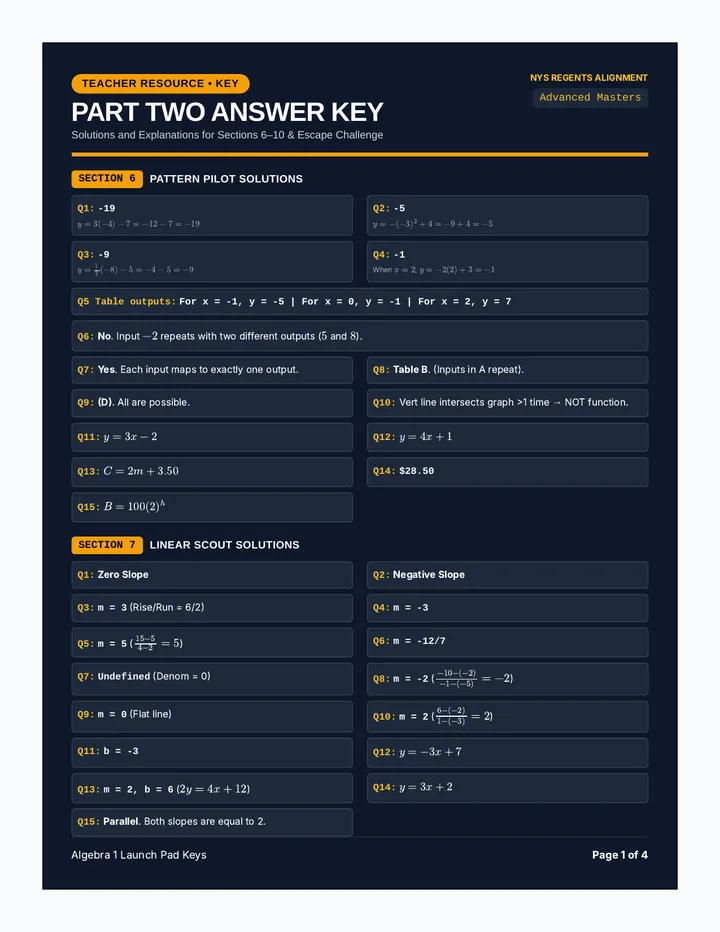
Area Model Slides Unit: Theorem Architects
Area Model Foundations
Deriving the why before the how.
Right Triangles
Area Models
?
The Square Puzzle
Imagine you have three squares. One is 3x3, one is 4x4, and one is 5x5.
Challenge:
Can you rearrange the area of the two smaller squares to perfectly fill the larger one?
9 units²
Square A
16 units²
Square B
25 units²
Square C
Right Triangle Anatomy
Leg (a) Leg (b) Hypotenuse (c)
L
Legs
The two shorter sides that form the 90° right angle.
H
Hypotenuse
The longest side opposite the right angle.
The Proof in Pictures
Area Relationship
If we build squares on each side of the triangle, the areas of the "Leg Squares" added together equals the area of the "Hypotenuse Square".
\[a^2 + b^2 = c^2\]
a²
b²
c²
Blueprint Check
"I use this theorem every day to ensure my wall frames are perfectly square. If the diagonals aren't equal, the building isn't stable."
Architect Perspective
Square Proofs Worksheet Square Proofs Investigation
Lesson 1: Area Model Foundations
Student Name: _________________________
Date: _________________________________
Part 1: The Right Triangle Blueprint
Label the parts of the right triangle below using the terms: Leg (a) , Leg (b) , and Hypotenuse (c) . Then, circle the 90-degree angle.
Part 2: Area Relationships
For each triangle side below, calculate the area of the square that would be built on it. Record your findings in the table.
4 units 3 units 5 units
Side Length Square Area (units²) Leg (a) 3 Leg (b) 4 Hypotenuse (c) 5
Observation Point:
What is the mathematical relationship between the area of the two smaller squares (Leg a + Leg b) and the area of the large square (Hypotenuse c)? Write it as an equation below.
Part 3: The Rearrangement Proof
Look at the two large squares below. Both large squares have the same side length: (a + b) .
a²
b²
Triangles
Triangles
Configuration A
c²
4 Identical Triangles
Configuration B
Reflect:
If we remove the 4 identical triangles from both Configuration A and Configuration B, what is left over in each?
Config A:
Config B:
Summary Conclusion
Based on your observations, complete the following statements:
1. In a right triangle, the square of the longest side (the _______________) is equal to the __________ of the squares of the other two sides.
2. This means that if the legs are a and b and the hypotenuse is c , the formula is:
________________________________
Quick Check
If a right triangle has legs of 6 cm and 8 cm, what is the area of the square that would be formed on the hypotenuse? (Hint: add the areas of the leg squares).
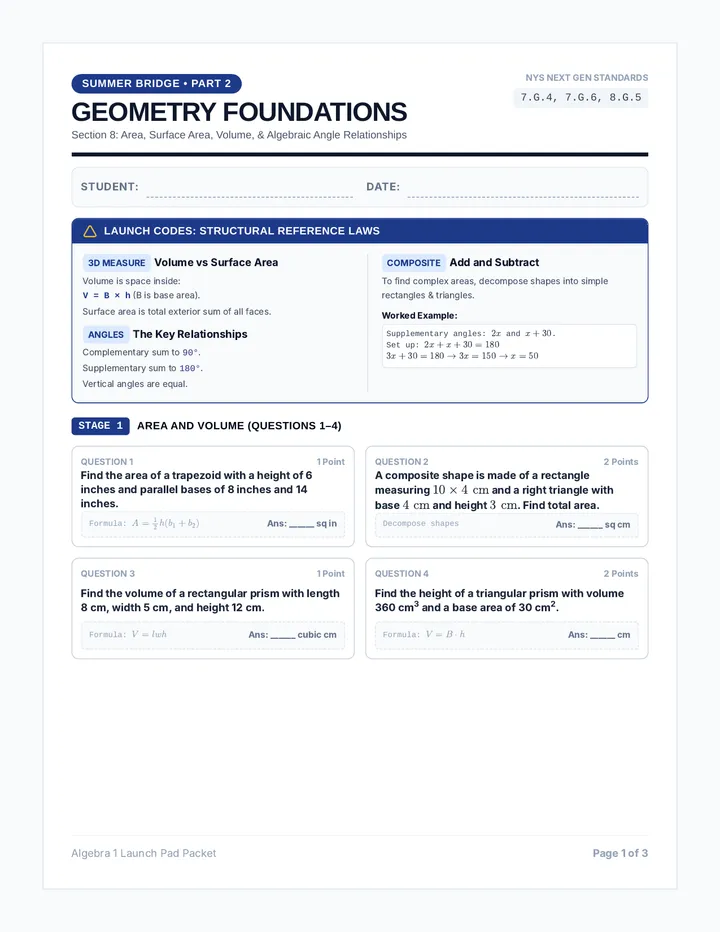
Proofs Teacher Guide Teacher Guide: Area Model Foundations
Lesson 1: Geometric Proof & Logic
Duration
60 Minutes
Target Grade
9th Grade Geometry
Essential Skill
Visual proof derivation
Learning Objectives
Identify the legs and hypotenuse of a right triangle.
Demonstrate that \(a^2 + b^2 = c^2\) represents the area of squares built on triangle sides.
Explain the geometric logic behind the Pythagorean Theorem using rearrangement proofs.
Common Misconceptions
Side vs. Area: Students often confuse the side length (\(a\)) with the square of the side length (\(a^2\)). Emphasize that the "+" in the theorem refers to combining areas , not just lengths.
Non-Right Triangles: Students may try to apply the theorem to all triangles. Constantly reinforce that this relationship only exists if a 90° angle is present.
Lesson Flow
Time Activity Teacher Notes 0-10m Hook: The Square Puzzle Use Slide 2. Ask students if they can visually see how two small squares fit into one large one. 10-25m Anatomy & Area Check Students complete Part 1 & 2 of the worksheet. Ensure they circle the right angle correctly. 25-45m Rearrangement Proof Walk through Slide 4 together. Discuss why removing 4 triangles from both squares proves area equality. 45-60m Synthesis & Exit Ticket Summarize the formula \(a^2 + b^2 = c^2\). Use the "Quick Check" on the worksheet as a formative assessment.
Discussion Prompts
Conceptual
"If we changed the angle from 90° to 100°, would the two smaller squares still fill the larger one? Why not?"
Architectural
"How might an architect use this to ensure a house has perfectly straight corners?"
Side Length Slides Lesson 2: Algebraic Application
Side Length Mastery
From area models to architectural measurements.
The Algebraic Toolkit
Now that we know the why , we can use the formula to find any missing side of a right triangle.
\[a^2 + b^2 = c^2\]
a, b = lengths of the legs
c = length of the hypotenuse
b = 12 a = 5 c = ?
1
Case 1: Finding the Hypotenuse
The "Ladder" Method
STEP 1: Plug in a and b .
STEP 2: Square both numbers.
STEP 3: Add the areas together.
STEP 4: Take the square root!
\(5^2 + 12^2 = c^2\)
\(25 + 144 = c^2\)
\(169 = c^2\)
\(\sqrt{169} = 13\)
2
Case 2: Finding a Leg
When you already know the hypotenuse, you must subtract to find the missing leg.
\(a^2 + 8^2 = 10^2\)
\(a^2 + 64 = 100\)
\(a^2 = 100 - 64\)
\(a^2 = 36\)
\(a = 6\)
b = 8 a = ? c = 10
Safety Inspection
"A 10-foot ladder is placed 6 feet from the base of a house. For safety, it must reach the window 8 feet up. Will it reach?"
Challenge Task:
Draw the triangle and solve with your partner.
Sketch Area
Side Finder Worksheet Side Finder Workshop
Lesson 2: Side Length Mastery
Blueprint Drafted By: ___________________
Date: _________________________________
Objective: Calculate the missing side lengths for each right triangle below. Show your algebraic steps clearly.
Note: If an answer is not a perfect square, round to the nearest tenth.
1
Find the missing Hypotenuse (c)
8 cm 6 cm c = ?
Calculations
Answer: _________
2
Find the missing Leg (a)
12 in 15 in a = ?
Calculations
Answer: _________
3
Architectural Problem
"A support beam is needed for a 9-foot tall wall. The base of the beam must be 12 feet away from the wall to satisfy safety codes. How long should the beam be?"
Sketch your diagram here
Calculations
Answer: _________
Advanced Blueprint Challenges
Challenge 4: Precision Measurement
The hypotenuse of a right triangle is 10 meters and one leg is 5 meters. Calculate the other leg. Express your answer in simplest radical form and then as a decimal.
Radical Form:
Decimal Form:
Final Project Check
Challenge 5: The Park Shortcut
A rectangular park measures 200 meters by 150 meters. If you walk diagonally across the park instead of walking along the perimeter, how many meters do you save?
Diagonal Distance: _________
Total Distance Saved: _________
Architect Self-Review
I can solve for the hypotenuse.
I can solve for a missing leg.
I can simplify radical answers.
Calculation Answer Key Answer Key: Side Finder Workshop
Teacher Resource
Problem 1: Hypotenuse
6² + 8² = c² → 36 + 64 = 100 → √100 = 10
Correct Answer: 10 cm
Problem 2: Missing Leg
a² + 12² = 15² → a² + 144 = 225 → a² = 81 → √81 = 9
Correct Answer: 9 in
Problem 3: Architectural Beam
9² + 12² = c² → 81 + 144 = 225 → √225 = 15
Correct Answer: 15 feet
Challenge 4: Precision Measurement
5² + b² = 10² → 25 + b² = 100 → b² = 75
√75 = √(25 * 3) = 5√3
Radical: 5√3
Decimal: ≈ 8.7 m
Challenge 5: The Park Shortcut
Diagonal = √(200² + 150²) = √(40000 + 22500) = √62500 = 250 m
Perimeter walk = 200 + 150 = 350 m
Savings: 350 - 250 = 100 meters
Triangle Tester Slides Lesson 3: The Converse Theorem
Corner Classification
Testing the triangle before you build the wall.
The Egyptian Rope Stretchers
Ancient Egyptian architects didn't have laser levels. They used a rope with 12 knots spaced at equal intervals.
The 3-4-5 Trick:
By pinning the knots to create a triangle with sides 3, 4, and 5, they formed a perfect 90° corner every time.
But why does that work? And what if the sides don't follow the formula?
4 units 3 units 5 units
The Converse of the Theorem
If the side lengths of a triangle satisfy \(a^2 + b^2 = c^2\), then the triangle must be a right triangle.
Input
Side lengths a, b, c
Output
Right Triangle?
Classifying "Not Right" Triangles
ACUTE
\[c^2 < a^2 + b^2\]
The longest side is "too short" to make a right angle.
OBTUSE
\[c^2 > a^2 + b^2\]
The longest side is "too long" and pushes the corner out.
Acute
Obtuse
Lab Testing
A triangle has side lengths of 7, 9, and 12 . What type of triangle is it?
7² = 49
9² = 81
12² = 144
144 ___ 49 + 81
Corner Classifier Worksheet Corner Classifier Activity
Lesson 3: The Converse & Inequalities
Inspector: ___________________________
Date: _________________________________
Right
c² = a² + b²
Acute
c² < a² + b²
Obtuse
c² > a² + b²
Part 1: Basic Classification
Determine if the following side lengths form an Acute , Right , or Obtuse triangle. Show your work.
A) 5, 12, 13
Show Work:
Type: ________________
B) 6, 8, 11
Show Work:
Type: ________________
C) 9, 10, 12
Show Work:
Type: ________________
D) 4, 4, 7
Show Work:
Type: ________________
Part 2: The Rope Stretcher's Dilemma
An Egyptian apprentice is trying to make a right-angled corner for a new tomb. He uses a rope to create a triangle with side lengths of 8, 15, and 17 knots.
Question: Did he succeed in making a perfect right angle?
Proof:
State the Converse Theorem as part of your answer.
Architectural Analysis
Model 402-B
Case Study: The Roof Truss
A builder is constructing a roof truss with side lengths of 10 ft, 10 ft, and 16 ft. He wants to know if the peak of the roof forms an obtuse angle so that rain will slide off easily.
Work Space
Calculation: ____________
Verdict: ______________
The Logic Gate
If \(c^2 = a^2 + b^2\) for a triangle, is it possible for one of the other angles in the triangle to be obtuse? Explain your reasoning using what you know about the sum of angles in a triangle.
Safety Protocol
Before you test for triangle type, remember the Triangle Inequality Theorem : The sum of any two sides must be greater than the third side. If it's not, you don't even have a triangle to classify!
Rope Stretchers Guide Teacher Resource: Rope Stretchers
Lesson 3: Historical Inquiry Extension
Historical Context
The harpedonaptai (literally "rope stretchers") were specialists in Ancient Egypt and Greece who used knotted ropes to establish right angles for foundations of temples and pyramids. While they may not have known the algebraic formula \(a^2 + b^2 = c^2\), they possessed the practical knowledge that specific ratios of lengths create perfect corners.
Classroom Demonstration
To recreate this in class, you will need 12-foot ropes or strings with marks/knots at 1-foot intervals.
Divide students into groups of three.
Each student holds a specific knot: Knot 0, Knot 3, and Knot 7 .
They must pull the rope taut until they form a triangle.
The sides will be 3 units, 4 units, and 5 units (since 12 knots create 12 segments).
Discussion Check
"Why 12 segments? Why not 13? (Answer: 3 + 4 + 5 = 12. It's the perimeter of the smallest Pythagorean Triple.)"
Pythagorean Triples List
Common integer ratios that students should recognize as "perfect right corners":
3, 4, 5
5, 12, 13
8, 15, 17
7, 24, 25
Analysis of Part 2 (Worksheet)
When grading the Egyptian Challenge on the student worksheet, look for the following logic:
1. Calculation:
8² + 15² = 64 + 225 = 289
17² = 289
2. Conclusion:
Since the sum of the squares of the legs (289) equals the square of the hypotenuse (289), the triangle is right-angled .
3. Proof:
"According to the Converse of the Pythagorean Theorem, if a triangle satisfies the equation, then it is a right triangle."
Distance Drafting Slides Lesson 4: Coordinate Geometry
Distance Drafting
Mapping reality to the coordinate plane.
Programming Measurement
In a video game, the player is at (2, 2) and an enemy is at (10, 8) .
The Developer's Question:
How does the game engine calculate the exact distance for a projectile to travel?
P
E
Finding Delta (Change)
We can find the distance between any two points by drawing a right triangle and calculating the change in \(x\) and \(y\).
Δx
"Run" (Horizontal distance)
Δy
"Rise" (Vertical distance)
Δx = |x₂ - x₁| Δy = |y₂ - y₁| Distance (d)
The Distance Formula
\[d = \sqrt{(x_2 - x_1)^2 + (y_2 - y_1)^2}\]
It's just \(a^2 + b^2 = c^2\) in disguise!
We square the differences, add them, and take the square root.
Calculation Workflow
Points: (1, 2) and (4, 6)
Δx = 4 - 1 = 3
Δy = 6 - 2 = 4
d² = 3² + 4²
d = √25 = 5
PRO TIP
The order doesn't matter when you subtract (e.g., \(x_2 - x_1\) or \(x_1 - x_2\)) because squaring a negative number always makes it positive!
Coordinate Connection Worksheet Coordinate Connection
Lesson 4: Mapping Distances
Designer: _____________________________
Date: _________________________________
Part 1: The Grid Triangle
Plot the two points on the grid below. Then, draw a right triangle and calculate the distance between them.
Points: A(2, 3) and B(8, 11)
Draft Grid
1. Find Horizontal Change (Δx)
Δx = 8 - 2 = _________
2. Find Vertical Change (Δy)
Δy = 11 - 3 = _________
3. Apply Theorem
d² = (Δx)² + (Δy)²
Distance AB = _________
Part 2: Algebraic Distance
Use the Distance Formula to find the distance between the following point pairs. Round to the nearest tenth if necessary.
(4, 1) and (7, 5)
Workspace
(-2, 4) and (3, 9)
Workspace
(0, 0) and (-6, 8)
Workspace
Mission: Game Pathing
You are coding a top-down adventure game. Use your coordinate drafting skills to solve the following logic problems.
Task 1: The Fast Travel
The player is at Point A (10, 20) . The nearest quest marker is at Point B (40, 60) . The "Fast Travel" ability only works if the straight-line distance is 60 units or less.
Is the player within range for Fast Travel?
Calculations
YES, it's in range.
NO, too far.
Task 2: Enemy Detection
A security turret is located at (5, 5) . It has a detection radius of 10 units . A player sneaks by at position (12, 12) .
Question: Does the turret detect the player?
Calculate the distance and compare it to the radius.
Turret Status: ___________________________
Code Review
Explain why the distance formula is technically the same thing as the Pythagorean Theorem. What part of the formula represents the "legs" of the triangle?
Distance Mastery Answer Key Answer Key: Coordinate Connection
Teacher Guide
Part 1: The Grid Triangle
Points: A(2, 3) and B(8, 11)
Δx = 8 - 2 = 6
Δy = 11 - 3 = 8
d² = 6² + 8² → 36 + 64 = 100
Distance AB = 10 units
Part 2: Algebraic Distance
(4, 1) and (7, 5)
Δx=3, Δy=4 → √(3²+4²) = √25 = 5
(-2, 4) and (3, 9)
Δx=5, Δy=5 → √(5²+5²) = √50 ≈ 7.1
(0, 0) and (-6, 8)
Δx=6, Δy=8 → √(6²+8²) = √100 = 10
Mission: Game Pathing
Task 1: Fast Travel
Δx = 30, Δy = 40 → √(30²+40²) = √2500 = 50 units
Verdict: YES, in range (50 ≤ 60)
Task 2: Enemy Detection
Δx = 7, Δy = 7 → √(7²+7²) = √98 ≈ 9.9 units
Verdict: DETECTED (9.9 < 10)
Code Review Answer
"The distance formula is the same as the Pythagorean Theorem because the subtraction of coordinates \((x_2 - x_1)\) and \((y_2 - y_1)\) finds the horizontal and vertical lengths of a right triangle's legs. The square root of the sum of their squares then finds the hypotenuse, which is the straight-line distance."
Spatial Scaffolding Slides Lesson 5: 3D Geometry
Spatial Diagonals
Hidden triangles in a three-dimensional world.
The Longest Object
"Can you fit a 15-inch umbrella inside a box that is 10 inches long, 8 inches wide, and 6 inches tall?"
Spatial Reasoning
The longest path isn't along the floor or a wall—it's from one bottom corner to the opposite top corner .
The 3D Workflow
STEP 1: The Floor
Calculate the diagonal of the base using the length and width.
\(L^2 + W^2 = d_{base}^2\)
STEP 2: The Height
Use that base diagonal and the height to find the space diagonal.
\(d_{base}^2 + H^2 = d_{space}^2\)
Shortcut Formula
\[\sqrt{L^2 + W^2 + H^2}\]
You can do it all in one algebraic move!
Structural Integrity
In construction, "squaring" a room requires measuring the diagonals of the rectangular footprint.
If the diagonals of the box are equal, the corners are 90 degrees.
"I measure the 3D diagonal of the room's frame. If it matches my calculation, I know the walls are vertical AND the corners are square."
— Lead Carpenter
Blueprint Final Exam
A box has dimensions 3ft x 4ft x 12ft.
What is the space diagonal?
1. Base Diagonal: 3² + 4² = ?
2. Space Diagonal: ?² + 12² = ?
Box Diagonal Challenge Box Diagonal Challenge
Lesson 5: 3D Spatial reasoning
Architect: _____________________________
Date: _________________________________
Project Scope: In this final challenge, you will calculate the distance between opposite corners of 3D prisms. This requires finding a 2D diagonal first, or using the 3D distance formula: d = √(L² + W² + H²)
Guided Draft
1. The Storage Crate
A crate has dimensions 30 cm (length), 40 cm (width), and 120 cm (height). Find the space diagonal.
Step A: Base Diagonal
Find diagonal of 30 x 40 base.
Step B: Space Diagonal
Use base diagonal and 120 height.
Total Distance:
_______ cm
2. The Umbrella Paradox
An umbrella is 38 inches long. Can it fit in a shipping box that is 30 in x 20 in x 15 in ?
Calculate the maximum internal distance to prove your answer.
Show Workspace:
Space Diagonal: _________
FITS
NO FIT
Structural Engineering: Room Squaring
"A framing crew is checking a room that is 12 feet wide and 16 feet long. They want to make sure the walls are perfectly vertical at 8 feet tall. They measure the distance from the bottom-left-front corner to the top-right-back corner."
What should the 3D diagonal measure if the room is perfectly 'square'?
Target Distance: _________
If they measure 22 feet, is the room square? Why or why not?
Answer: _________________
Synthesis Reflection
Imagine a cube with side length S . Write an expression in terms of S for the length of its space diagonal. (Hint: apply the formula \(\sqrt{L^2 + W^2 + H^2}\)).
________________________________
Unit Complete: Theorem Architects
You have mastered 2D and 3D applications of the Pythagorean Theorem.
Spatial Diagonal Answer Key Answer Key: Spatial Diagonals
Teacher Guide
1. The Storage Crate
Dimensions: 30 x 40 x 120 cm
Step A (Base): √(30² + 40²) = √2500 = 50 cm
Step B (Space): √(50² + 120²) = √(2500 + 14400) = √16900 = 130 cm
Correct Answer: 130 cm
2. The Umbrella Paradox
Umbrella length: 38 in. Box: 30 x 20 x 15 in.
Space Diagonal = √(30² + 20² + 15²) = √(900 + 400 + 225) = √1525 ≈ 39.1 in
Verdict: FITS (39.1 > 38)
Room Squaring Logic
Target 3D Diagonal Calculation:
√(12² + 16² + 8²) = √(144 + 256 + 64) = √464 ≈ 21.5 ft
Target Distance: ≈ 21.5 feet
Observation Check (22 ft measurement):
Answer: NO, it is not square. Since the measurement (22) is larger than the mathematical ideal (21.5), the walls are likely leaning or the floor corners are obtuse.
Synthesis Solution (Cube Diagonal)
For a cube with side S , the space diagonal is:
d = √(S² + S² + S²) = √(3S²) = S√3
Teaching Tip for 3D
The most common error is students using the 2D base diagonal as the final answer. Encourage them to physically draw the internal triangle inside a physical cardboard box to see why a second calculation is needed.