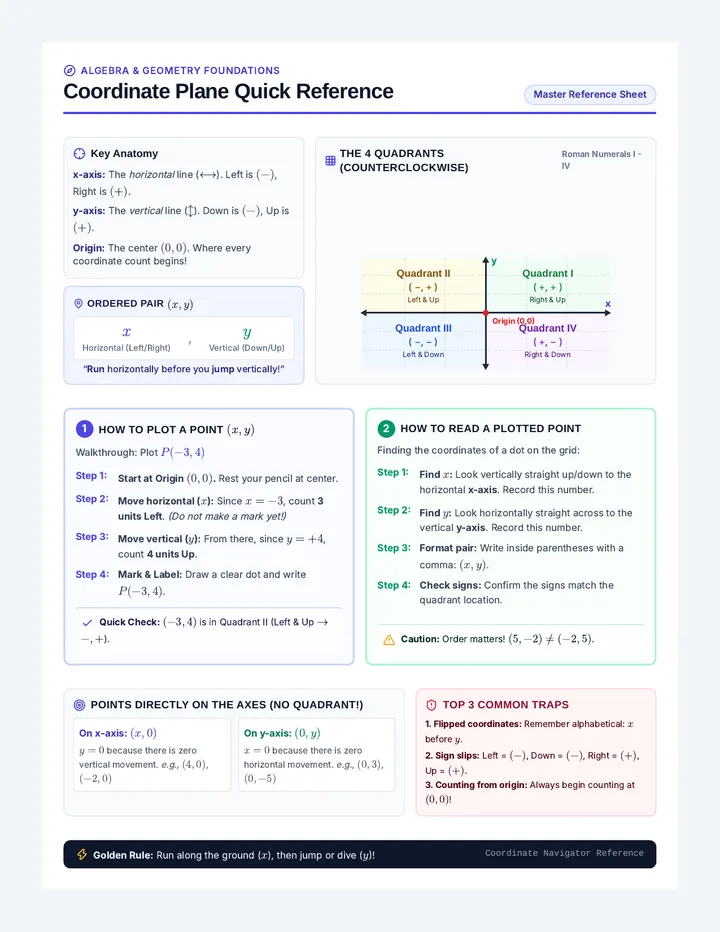
Math Mastery Blueprint ChecklistMath Mastery Blueprint RIT Score Range: 221–230 Student Skills Guide Step by Step Success Welcome to the 221–230 RIT Range! Use this checklist to track progress. Check the box when the skill is mastered and record the date. Ratios & Algebra Solve Unit Rate Problems Ex: 5 lbs of apples for $10 = $2 per lb. Date Write and Use Expressions Ex: "Three times a number plus five" is written as 3n + 5. Date Solve One-Step Equations Ex: Find x in x + 12 = 30 or 4x = 24. Date Calculate Percent Problems Ex: Finding a 15% tip on a $40 bill. Date The Number System Divide Fractions by Fractions Ex: How many 1/2-cup servings are in 3/4 cup of rice? Date Negative Numbers & Absolute Value Ex: Knowing -10 is less than -5, and |-10| = 10. Date Coordinate Plotting Ex: Finding the location of (-3, 4) on a coordinate map. Date NWEA MAP Math Checklist: 221–230 Page 1 of 2 Geometry Area of Polygons Ex: Finding the area of triangles and parallelograms. Date Volume with Fractional Edges Ex: Volume of a box measuring 2 1/2 by 3 by 1 1/4 inches. Date Surface Area Nets Ex: Unfolding a box into a flat pattern to find total area. Date Data & Statistics Calculate Center and Spread Ex: Finding Mean, Median, and Range of a set of data. Date Data Displays Ex: Creating and reading Box Plots or Histograms. Date Quick Home Tips Grocery Math: Find the "unit price" of items to find the best deal. Recipe Scaling: Adjust a recipe for more people using multiplication. Weather Watch: Use cold temperatures to talk about negative numbers. Package Volume: Measure boxes to find how much they can hold. Parent-Student Skills Guide Page 2 of 2
Power Up Activities WorksheetPower Up Activities At-Home Practice • RIT 221–230 Focus Real World Math Strengthen math skills with these simple weekly activities. The Better Buy Unit Rates: Compare two sizes of the same product at the store. Divide price by weight to find the cost per ounce. Recipe Remix Proportions: Find a recipe for 4 people and calculate the ingredients needed for 6 people using fractions. Coordinate Hunt Geometry: Hide a snack. Give coordinates like (-3, 2) on a paper grid to direct your student to the location. Household Stats Statistics: Track daily screen time or water intake for a week. Calculate the Mean, Median, and Mode. Weekly Goal Setting My Math Goal for this Week: How I'll know I've mastered it: "Pure mathematics is, in its way, the poetry of logical ideas." — Albert Einstein
Instructional Impact ChecklistInstructional Impact RIT Target Tracker: 221–230 Class: __________ Term: __________ Operations & Algebraic Thinking 6.RP, 6.EE Learning ObjectiveIPMSolve multi-step unit rate problems (pricing, speed). | | | Evaluate numerical expressions with whole-number exponents. | | | | | Identify equivalent expressions using properties (Distributive, etc.). | | | | | Solve one-variable equations and inequalities in context. | | | | The Number System 6.NS Learning ObjectiveIPMCompute quotients of fractions (fraction by fraction). | | | Order and apply absolute value of rational numbers. | | | | | Graph points in all four quadrants to solve problems. | | | | Teacher Resource • NWEA MAP 221–230 Page 1 of 2 Geometry 6.G Learning ObjectiveIPMFind area of triangles and quadrilaterals via decomposition. | | | Find volume of prisms with fractional edge lengths. | | | | | Represent 3D figures using nets to calculate surface area. | | | | Statistics & Probability 6.SP Learning ObjectiveIPMSummarize data sets in relation to their context.
Numerical Power ChecklistNumerical Power Numerical Representations Focus • RIT 221–230 Student: ____________________________ Date: ________________ Track your mastery of number relationships. Check each box as you master the skill. Classifying & Comparing Classification: Distinguish between whole, integer, and rational numbers. Ordering: Order negative/positive rational numbers on a number line. Absolute Value: Understand |x| as distance from zero (e.g., |-10| = 10). Factors & Exponents Prime Factors 24 = 23 × 3 GCF & LCM Pairs up to 100 FDP Conversions Fluency: Fluent conversions between fractions, decimals, and percents. Quick Mastery Check 1. Find |-42|. 2. 3/5 = ___ (Decimal) 3. Write the prime factorization of 36 using exponents: Focused Mastery Checklist • Numerical Power RIT 221–230
Numerical Power Checklist 211-220Numerical Power Numerical Representations Focus • RIT 211–220 Student: ____________________________ Date: ________________ Check the box as you master each skill in representing and relating numbers. The Place Value System Decimal Place Value: Understand values to the thousandths place (0.001). Powers of 10: Explain patterns in zeros when multiplying by powers of 10. Rounding Decimals: Round decimals to any place value (tenth, hundredth, etc.). Fractional Relationships Equivalent Fractions Identify and create equivalent fractions to simplify or compare. Mixed Numbers & Improper Fractions Convert fluently between mixed numbers and improper fractions. Coordinate & Number Concepts Coordinate Plane: Graph points in the first quadrant of the coordinate plane. Prime & Composite: Identify prime and composite numbers up to 100. Quick Mastery Check 1. Round 4.567 to the hundredths. 2. Is 51 prime or composite? 3. Write 2 1/4 as an improper fraction: Numerical Representations Tracker • RIT 211–220 Math Mastery Series
Milestone Assessment WorksheetMilestone Assessment RIT Range: 211–220 • Grade 5 Proficiency Student Name: ____________________________ Date: ________________ Operations & Algebraic Thinking 1. Evaluate: \( (12 + 8) \div 4 + (7 - 3) \times 2 \) Answer: 2. Write an expression for: "Add 5 and 7, then multiply the sum by 3." Expression: Numerical Representations 3. Round 4.582 to the nearest hundredth: Work area: 4. Solve: \( 84.5 \div 10^2 = \) Work area: 5. Compare using <, >, or =: 0.74 0.704 Number & Operations — Fractions 6. Solve: \( \frac{2}{3} + \frac{1}{4} = \) Show your work here: 7. Solve: \( \frac{3}{5} \times 4 = \) Show your work here: Geometry & Measurement 8. Find the volume of a rectangular prism with: Length: 5 cm Width: 3 cm Height: 10 cm Volume: 9. Plot and label point A at (4, 2): 012345 012345 <table class="w-full h-full border-collapse pointer-events-none opacity-20"><tbody><tr><td class="border border-slate-400"></td><td class="border border-slate-400"></td><td class="border border-slate-400"></td><td class="border border-slate-400"></td><td class="border border-slate-400"></td></tr><tr><td class="border border-slate-400"></td><td class="border border-slate-400"></td><td class="border border-slate-400"></td><td class="border border-slate-400"></td><td class="border border-slate-400"></td></tr><tr><td class="border border-slate-400"></td><td class="border border-slate-400"></td><td class="border border-slate-400"></td><td class="border border-slate-400"></td><td class="border border-slate-400"></td></tr><tr><td class="border border-slate-400"></td><td class="border border-slate-400"></td><td class="border border-slate-400"></td><td class="border border-slate-400"></td><td class="border border-slate-400"></td></tr><tr><td class="border border-slate-400"></td><td class="border border-slate-400"></td><td class="border border-slate-400"></td><td class="border border-slate-400"></td><td class="border border-slate-400"></td></tr></tbody></table> Milestone Assessment • NWEA MAP 211–220 Math Mastery Tracker
Milestone Assessment Answer KeyAnswer Key Milestone Assessment • RIT 211–220 Operations & Algebraic Thinking 1 13 (20/4 + 4*2 = 5 + 8) 2 \( (5 + 7) \times 3 \) Numerical Representations 3 4.58 4 0.845 5 0.74 > 0.704 Fractions 6 \( \frac{11}{12} \) (8/12 + 3/12) 7 \( \frac{12}{5} \) or \( 2\frac{2}{5} \) Geometry & Measurement 8 150 cm³ (5*3*10) 9 Correctly plotted at (4, 2) Scoring Guide Mastery (8–9) Ready for advanced RIT 221+ concepts. Focus on efficiency. Target (6–7) Stable in the 211–220 range. Focus on fraction fluency. Growth (0–5) Core intervention needed. Review place value concepts.