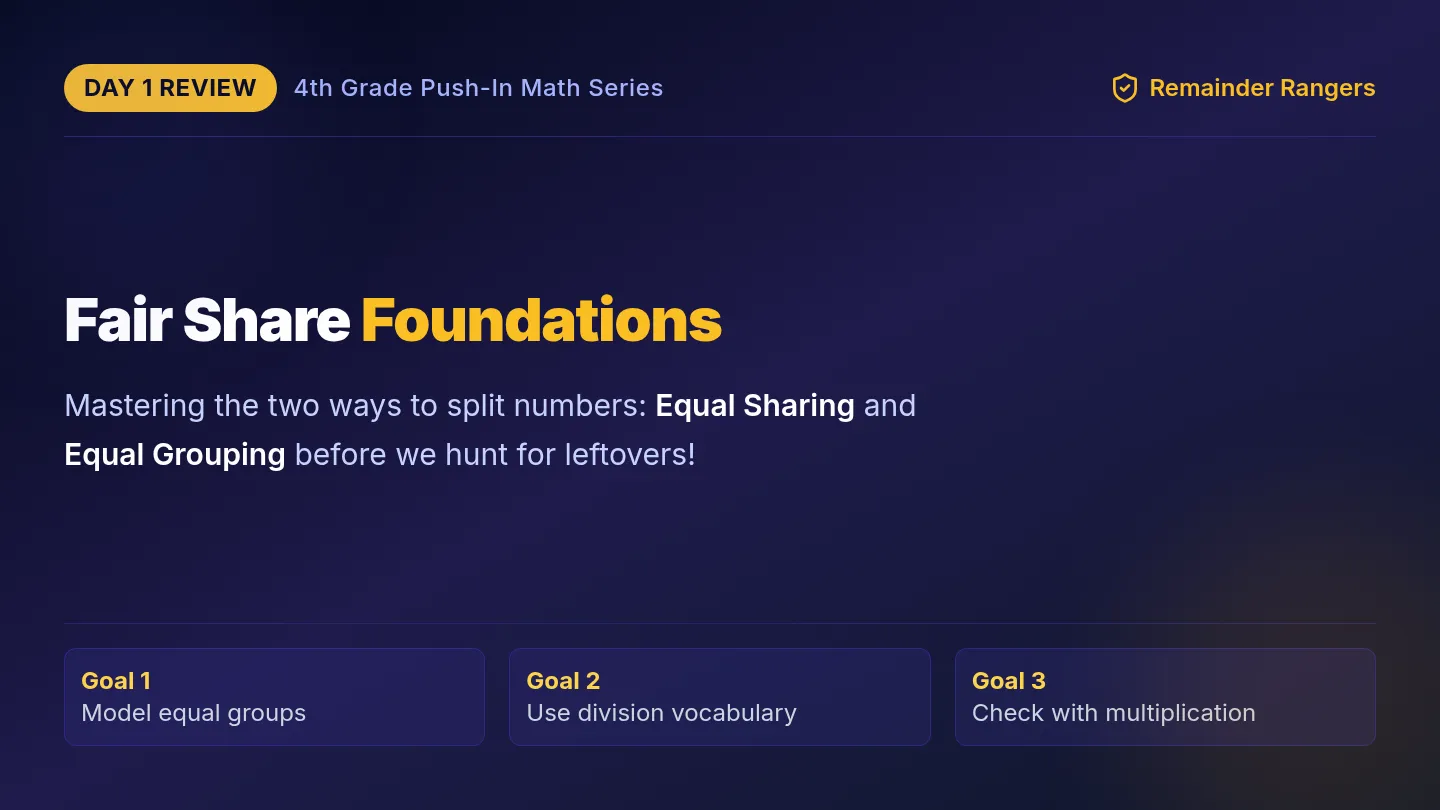
Fair Share Slides Day 1 Review 4th Grade Push-In Math Series
Remainder Rangers
Fair Share Foundations
Mastering the two ways to split numbers: Equal Sharing and Equal Grouping before we hunt for leftovers!
Goal 1
Model equal groups
Goal 2
Use division vocabulary
Goal 3
Check with multiplication
Two Ways We Look at Division
Total = 12
Model 1 Partitive
Equal Sharing
You know the number of groups . How many in each group?
"12 pencils shared among 3 students."
12 ÷ 3 = 4 each 3 groups of 4
Model 2 Quotative
Equal Grouping
You know the size of each group . How many groups can you make?
"12 pencils put into packs of 4."
12 ÷ 4 = 3 packs 3 groups of 4
Both models describe equal amounts. If even one group has less, it is not division!
Anatomy of a Division Problem
Vocabulary Check
Dividend
24
The total amount you start with before splitting.
"The whole pizza"
Divisor
6
The number of groups or the size of each group.
"The number of plates"
Quotient
4
The fair result in each group (the answer!).
"Slices per plate"
24 ÷ 6 = 4 6 ) 24 = 4 24 / 6 = 4
Division's Best Friend: Multiplication
Fact Family
Think in Reverse!
When solving 35 ÷ 5 = ?, ask yourself:
"5 times what number equals 35?"
Because 5 × 7 = 35, we know instantly that 35 ÷ 5 = 7!
Fact Family Triangle
35
5 × 7
5 × 7 = 35
7 × 5 = 35
35 ÷ 5 = 7
35 ÷ 7 = 5
Always check division with multiplication: Quotient × Divisor = Dividend .
Small Group Mission Brief
Day 1 Action Plan
1
Circle & Group
Draw equal shares using counters or drawings to solve basic story problems.
2
Label the Parts
Spot the dividend, divisor, and quotient in various problem layouts.
3
Fact Check
Multiply to confirm that your quotient split the total perfectly evenly!
Tomorrow's mystery: What happens when numbers cannot be shared equally?
Day 2 Preview
Fair Share Practice Worksheet Day 1 Remainder Rangers Push-In
Fair Share Foundations
Name:
Date:
Goal: Use equal sharing and grouping models to divide, label parts, and check using multiplication fact families.
Part 1: Model the Division
1. Sharing Model: Share 18 counters equally among 3 plates.
Draw 3 plate circles and distribute 18 dots equally:
18 ÷ 3 = ______ Dots per plate: ____
2. Grouping Model: Pack 20 stickers into bags of 5.
Loop or draw groups of 5 until you reach 20:
20 ÷ 5 = ______ Bags made: ____
Part 2: Label the Division Anatomy
Match each term to its definition by writing the letter in the blank:
A. Dividend
The total amount you start with.
B. Divisor
The number of equal groups.
C. Quotient
The result or answer in each group.
42 ÷ 7 = 6 In this problem: 42 is the: [ ___ ] 7 is the: [ ___ ] 6 is the: [ ___ ]
Part 3: Fact Family Multiplication Check
Solve: 32 ÷ 4 = _____
Think: 4 × _____ = 32
Fact 1: 4 × _____ = 32
Fact 2: _____ × 4 = 32
Fact 3: 32 ÷ _____ = 4
Solve: 54 ÷ 6 = _____
Think: 6 × _____ = 54
Fact 1: 6 × _____ = 54
Fact 2: _____ × 6 = 54
Fact 3: 54 ÷ _____ = 6
Ranger Exit Check Self-Assessment
Marcus has 28 baseball cards. He puts an equal number into 4 albums. How many cards go in each album? Show your division equation and multiplication check:
Division Equation:
Multiplication Check:
Fair Share Teacher Guide Teacher Guide Day 1 • 45-Minute Push-In
Standards: 4.OA.A.3, 4.NBT.B.6
Fair Share Foundations
Instructional blueprint for supporting push-in 4th grade students reviewing equal grouping, division models, and inverse operations.
45-Minute Lesson Pacing Breakdown
Time
Phase
Push-In Teacher Action
Student Engagement
0 - 8 min
Warm-Up & Hook
Present Slides 1-2. Hand out 12 two-color counters to push-in table.
Physically partition 12 counters into 3 groups, then into bags of 4.
8 - 20 min
Concept Deep Dive
Slides 3-4: Clarify Dividend vs Divisor vs Quotient; highlight fact triangle.
Choral response on vocabulary; connect division equations to multiplication.
20 - 35 min
Guided Small Group
Facilitate Worksheet Parts 1-3. Prompt with sentence stems and manipulatives.
Draw groupings, match terms, solve fact families with partner support.
35 - 45 min
Check & Preview
Collect Exit Check. Ask teaser: "What if Marcus had 29 baseball cards?"
Independent exit check completion; share initial thoughts on leftovers.
Co-Teaching Strategy (Alternative / Station)
While Gen Ed teacher conducts whole-group review, push-in teacher pulls targeted students to the kidney table. Use concrete manipulatives before paper-and-pencil recording.
Key Stem: "Division means fair shares: every single group must have the exact same number."
Common Misconceptions
Confusing Divisor & Dividend: Remind students the dividend is the large starting total.Treating division as subtraction: Emphasize that division measures equal groups , not just taking away random amounts.
Push-In Sentence Stems
"I am dividing [dividend] into [divisor] equal groups."
"To check my answer, I multiply [quotient] by [divisor] to get [dividend] ."
Quick Answer Key (Worksheet)
Part 1: 1. 18 ÷ 3 = 6 (6 dots each). 2. 20 ÷ 5 = 4 (4 bags).
Part 2: 42 = Dividend (A), 7 = Divisor (B), 6 = Quotient (C).
Part 3: 32 ÷ 4 = 8 (4 × 8 = 32). 54 ÷ 6 = 9 (6 × 9 = 54).
Exit Check: 28 ÷ 4 = 7 cards per album. Check: 7 × 4 = 28 cards.
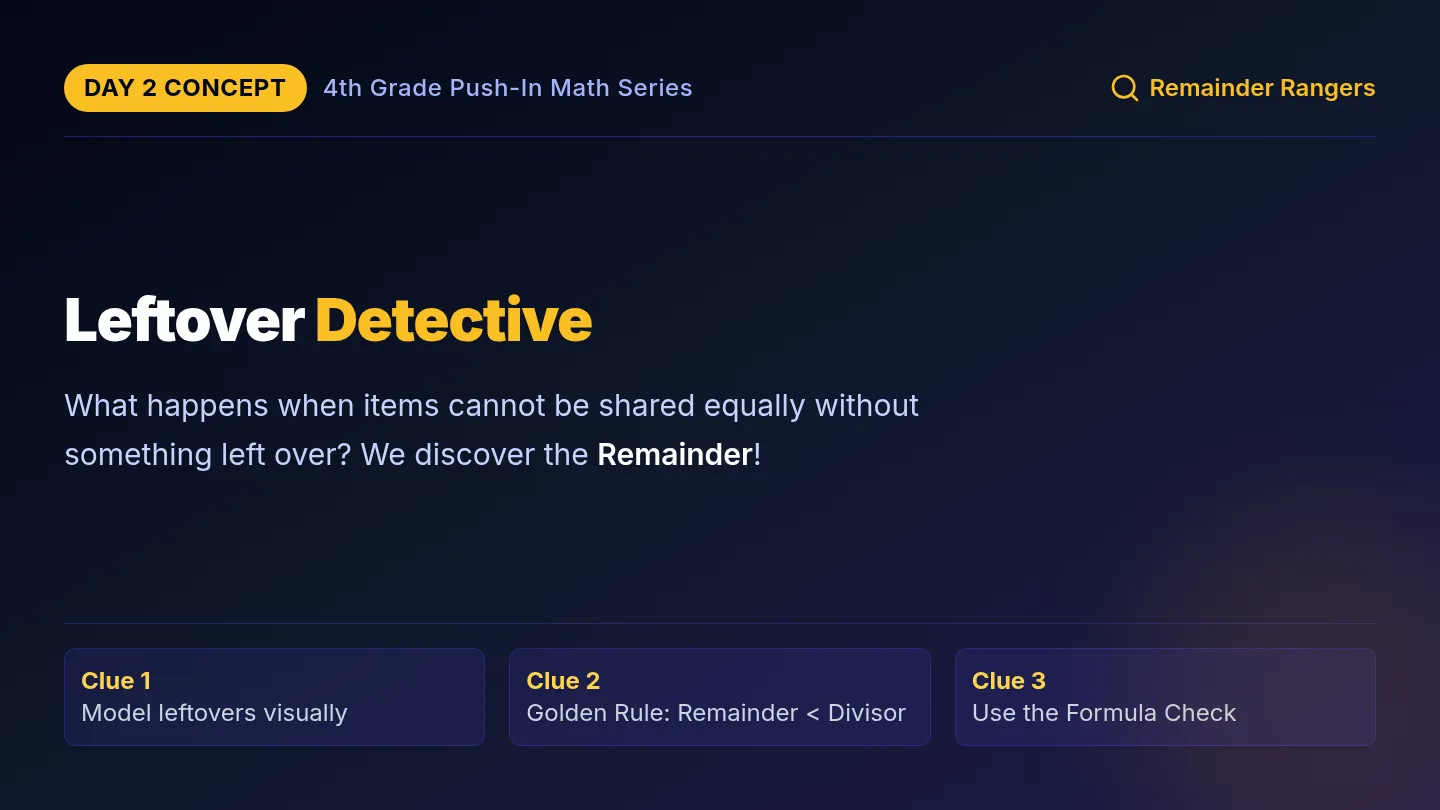
Leftover Detective Slides Day 2 Concept 4th Grade Push-In Math Series
Remainder Rangers
Leftover Detective
What happens when items cannot be shared equally without something left over? We discover the Remainder !
Clue 1
Model leftovers visually
Clue 2
Golden Rule: Remainder < Divisor
Clue 3
Use the Formula Check
The Mystery of the Extra Piece
Investigation Case #17
17 Apples Shared by 3 Friends
Can we give each friend 6 apples?
No! 3 friends × 6 apples = 18 apples (We only have 17!).
Can we give each friend 5 apples?
Yes! 3 friends × 5 apples = 15 apples.
How many apples are still left in the basket? 2 apples!
The Written Solution
17 ÷ 3 = 5 R 2
5 = Quotient
Each friend gets 5 full apples.
R 2 = Remainder
2 extra apples leftover.
A remainder is the amount left over because it is not enough to make another equal group!
The Golden Detective Rule
Non-Negotiable
Detective Law #1
The Remainder MUST be LESS than the Divisor!
Remainder < Divisor
Red Flag Mistake!
Student solves: 19 ÷ 4 = 3 R 7
Why it is broken: Your remainder (7) is bigger than your divisor (4)! You can make another full group of 4!
Correct Detective Work
Corrected: 19 ÷ 4 = 4 R 3
Why it works: Remainder (3) is strictly less than divisor (4). No more full groups can be formed!
If you divide by 5 , the only possible remainders are 0, 1, 2, 3, or 4 !
The Remainder Proof Formula
Double-Check Your Work
How to check any division problem with remainders:
(Quotient × Divisor) + Remainder = Dividend
Step 1: Multiply
5 × 4 = 20
Multiply the whole quotient by the divisor.
Step 2: Add Remainder
20 + 3 = 23
Add the leftover pieces back into the total.
Step 3: Compare
23 = 23 ✓
Matches the starting dividend perfectly!
If your check does not equal the dividend, either the multiplication is wrong or the remainder is wrong!
Today's Case Files
Leftover Detective Practice Worksheet Day 2 Remainder Rangers Push-In
Leftover Detective Practice
Name:
Date:
Rule of the Day: The Remainder must always be less than the Divisor (\(R < D\))!
Part 1: Circle Groups & Count Leftovers
1. Solve: 14 ÷ 4
Draw 14 dots. Circle groups of 4. Keep leftovers outside:
Full groups of 4: _____ Leftover dots: _____
14 ÷ 4 = _____ R _____
2. Solve: 23 ÷ 5
Draw 23 dots. Circle groups of 5. Keep leftovers outside:
Full groups of 5: _____ Leftover dots: _____
23 ÷ 5 = _____ R _____
Part 2: Check with (Quotient × Divisor) + Remainder
3. Check: 19 ÷ 3 = 6 R 1
Formula: (Q × D) + R = Dividend
Step 1 (Multiply): 6 × 3 = _____
Step 2 (Add R): _____ + 1 = _____
Does it equal 19? [ ] Yes [ ] No
4. Check: 26 ÷ 4 = 6 R 2
Formula: (Q × D) + R = Dividend
Step 1 (Multiply): 6 × 4 = _____
Step 2 (Add R): _____ + 2 = _____
Does it equal 26? [ ] Yes [ ] No
Part 3: Red Flag Alert! Find & Fix the Mistake
A student wrote: 15 ÷ 4 = 2 R 7
Why is this answer impossible?
The remainder 7 is bigger than the divisor 4. The student forgot to write an R.
What is the correct answer?
Think: 4 × 3 = 12, then find leftovers.
15 ÷ 4 = _____ R _____
Ranger Exit Check Independent Solve
Solve 22 ÷ 6 . Write the quotient and remainder, then write the check equation below:
Quotient & Remainder:
22 ÷ 6 = _____ R _____
Check Equation: (Q × D) + R
(___ × 6) + ___ = ___
Leftover Detective Teacher Guide Teacher Guide Day 2 • 45-Minute Push-In
Standard: 4.OA.A.3
Leftover Detective Guide
Hands-on push-in intervention plan for conceptualizing remainders, enforcing the \(R < D\) rule, and algebraic verification.
45-Minute Lesson Pacing Breakdown
Time
Phase
Push-In Teacher Action
Student Engagement
0 - 8 min
Hook & Problem
Slides 1-2. Give pairs 17 plastic tiles to share among 3 small cups.
Distribute tiles equally. Notice the 2 remaining tiles cannot be split.
8 - 20 min
The Golden Rule
Slides 3-4. Emphasize \(R < D\). Introduce check formula \((Q \times D) + R\).
Chant: "Remainder must be less than the divisor!" Verify with dry-erase boards.
20 - 35 min
Worksheet Practice
Guide Parts 1-3. Focus on drawing leftover dots clearly outside group loops.
Circle groups, write equations, calculate check steps, critique the red flag error.
35 - 45 min
Exit Check & Debrief
Collect Exit Check. Ask: "Can a remainder be useful in real life?"
Complete independent solve of 22 ÷ 6 and state if 4 leftover apples can make pie.
Concrete Manipulative Protocol
Use small sorting bowls or muffin tins. Have students physically move 1 item at a time into each bowl. If they run out before all bowls receive another item, those pieces must stay on the "Remainder Mat."
Tactile Anchor: If you can give 1 more to everyone, keep going!
Diagnostic Questioning Prompts
"Why can't our remainder be 4 if we are dividing by 4?" (Because 4 is enough to make another full group!)"If the divisor is 7, what is the largest possible remainder?" (6!)"What does the check formula prove?" (That all parts add back up to the starting total.)
Push-In Sentence Stems
"I have [Q] full groups, and [R] leftover because it's less than [D] ."
"I know my remainder is correct because [R] < [D] and \((Q \times D) + R = \text{Dividend}\)."
Quick Answer Key (Worksheet)
Part 1: 1. 14 ÷ 4 = 3 R 2 (3 groups, 2 leftovers). 2. 23 ÷ 5 = 4 R 3 (4 groups, 3 leftovers).
Part 2: 3. (6 × 3) + 1 = 18 + 1 = 19 (Yes). 4. (6 × 4) + 2 = 24 + 2 = 26 (Yes).
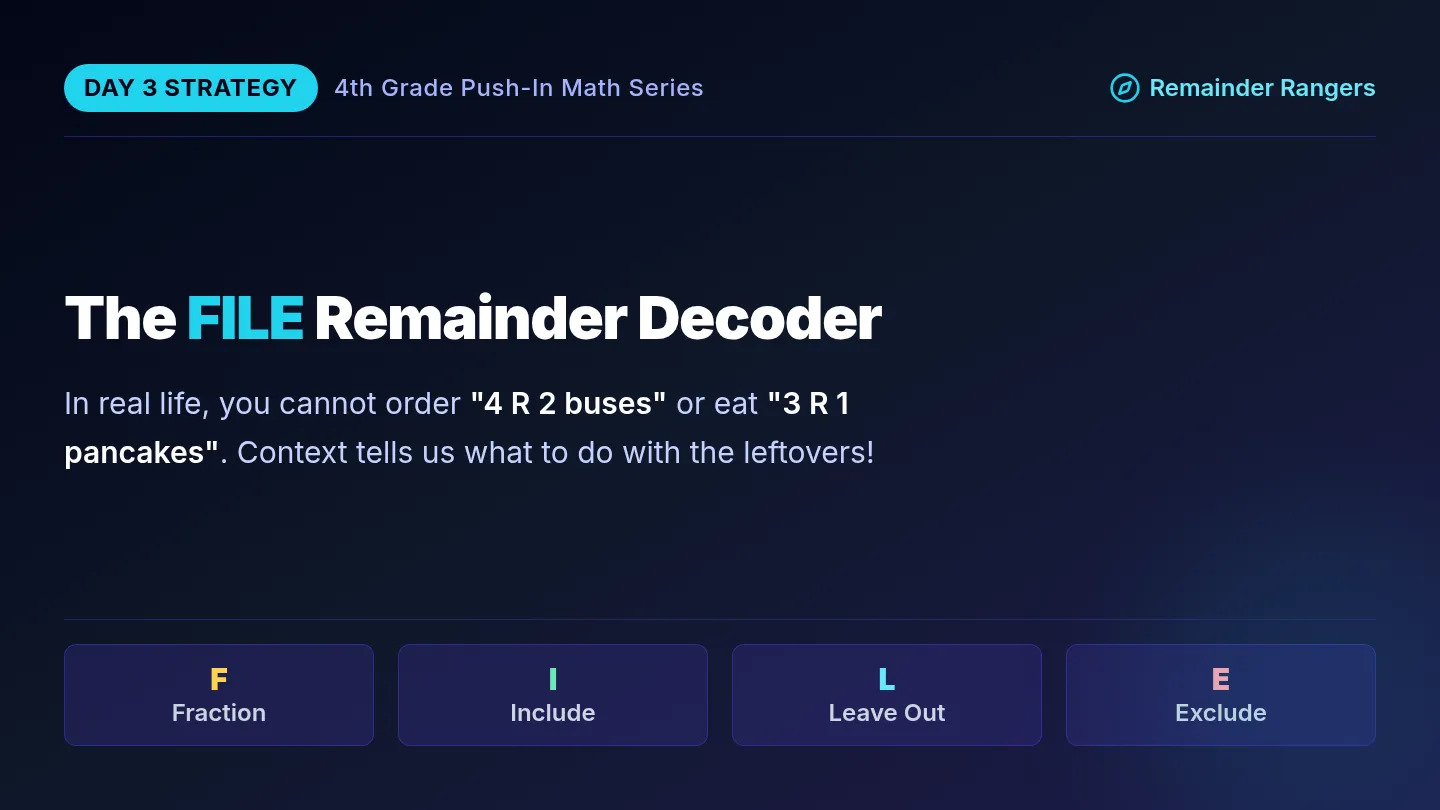
FILE Strategy Slides Day 3 Strategy 4th Grade Push-In Math Series
Remainder Rangers
The FILE Remainder Decoder
In real life, you cannot order "4 R 2 buses" or eat "3 R 1 pancakes" . Context tells us what to do with the leftovers!
F
Fraction
I
Include
L
Leave Out
E
Exclude
The 4 Paths for Any Remainder
Decision Code
F
Fraction
Turn the remainder into a fraction (\(R / D\)).
Example: Sharing pizzas, cookies, or string.
I
Include
Include remainder and add 1 more group (\(Q + 1\)).
Example: Vans, tents, tables, packing crates.
L
Leave Out
The remainder IS the direct answer to the question!
Example: "How many are left over?"
E
Exclude
Drop remainder! Only complete whole groups count.
Example: Making full gift bags or items you can buy.
Read the question carefully: What is it specifically asking for?
F Fraction: Sharing Fair Portions
Cut & Split
The Story Problem
"4 friends share 9 brownies equally. How many brownies does each friend receive?"
1. Divide total: 9 ÷ 4 = 2 R 1
2. Each person gets 2 whole brownies .
3. There is 1 brownie left over for 4 friends.
4. Cut the last brownie into 4 equal slices: 1/4 each!
Fraction Rule Formula
Answer: 2 1/4
• Whole number = Quotient (2)
• Numerator = Remainder (1)
• Denominator = Divisor (4)
Used whenever things can be sliced, poured, or cut!
Keywords: equal shares, food, pizza, ribbons, juice, miles
I Include: Round Up for Everyone!
Add 1 More
The Story Problem
"26 students are going to the zoo. Each van holds 6 students. How many vans are needed?"
1. Divide total: 26 ÷ 6 = 4 R 2
2. 4 vans hold 24 students (4 × 6).
3. 2 students are left behind at school!
4. We must INCLUDE them by ordering 1 more van!
Include Rule Formula
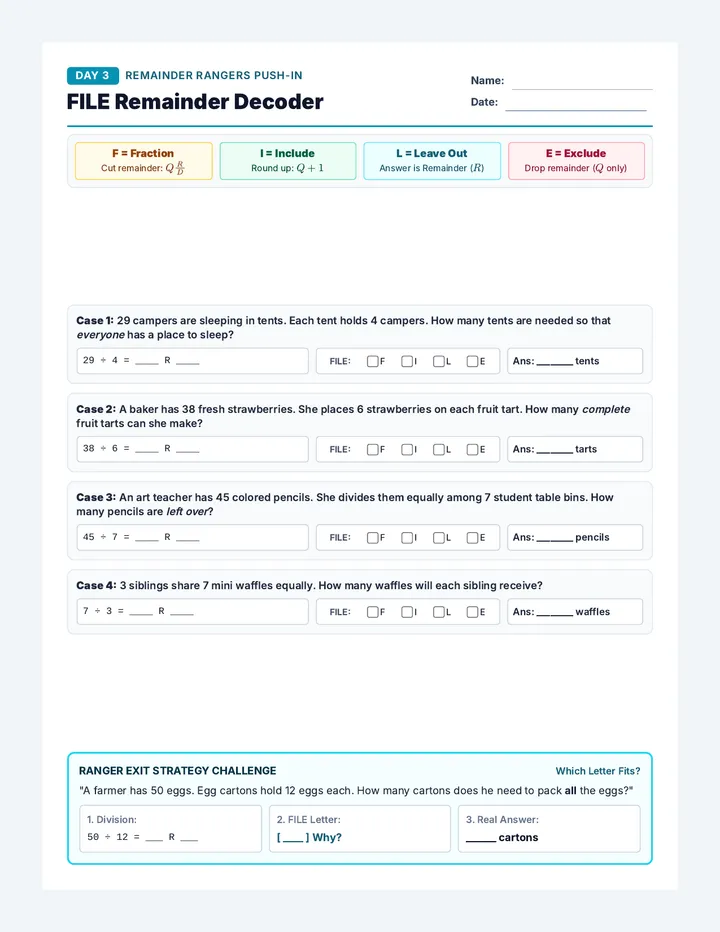
FILE Decoder Practice Worksheet Day 3 Remainder Rangers Push-In
FILE Remainder Decoder
Name:
Date:
F = Fraction
Cut remainder: \(Q \frac{R}{D}\)
I = Include
Round up: \(Q + 1\)
L = Leave Out
Answer is Remainder (\(R\))
E = Exclude
Drop remainder (\(Q\) only)
Case 1: 29 campers are sleeping in tents. Each tent holds 4 campers. How many tents are needed so that everyone has a place to sleep?
29 ÷ 4 = ____ R ____
FILE: F I L E
Ans: ________ tents
Case 2: A baker has 38 fresh strawberries. She places 6 strawberries on each fruit tart. How many complete fruit tarts can she make?
38 ÷ 6 = ____ R ____
FILE: F I L E
Ans: ________ tarts
Case 3: An art teacher has 45 colored pencils. She divides them equally among 7 student table bins. How many pencils are left over ?
45 ÷ 7 = ____ R ____
FILE: F I L E
Ans: ________ pencils
Case 4: 3 siblings share 7 mini waffles equally. How many waffles will each sibling receive?
7 ÷ 3 = ____ R ____
FILE: F I L E
Ans: ________ waffles
Ranger Exit Strategy Challenge Which Letter Fits?
"A farmer has 50 eggs. Egg cartons hold 12 eggs each. How many cartons does he need to pack all the eggs?"
1. Division:
50 ÷ 12 = ___ R ___
2. FILE Letter:
[ ____ ] Why?
3. Real Answer:
______ cartons
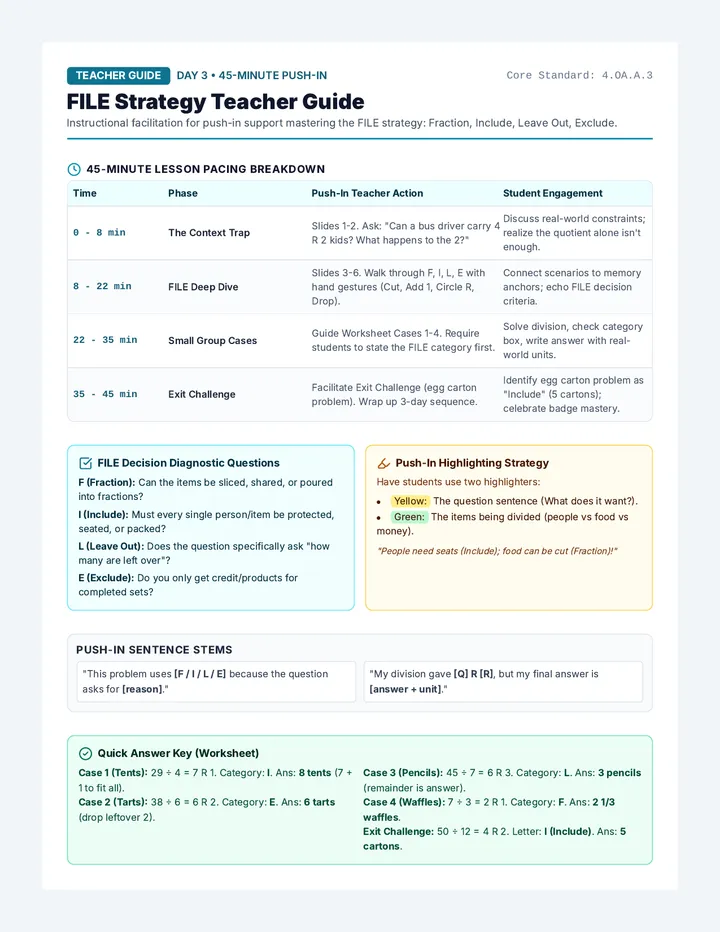
FILE Strategy Teacher Guide Teacher Guide Day 3 • 45-Minute Push-In
Core Standard: 4.OA.A.3
FILE Strategy Teacher Guide
Instructional facilitation for push-in support mastering the FILE strategy: Fraction, Include, Leave Out, Exclude.
45-Minute Lesson Pacing Breakdown
Time
Phase
Push-In Teacher Action
Student Engagement
0 - 8 min
The Context Trap
Slides 1-2. Ask: "Can a bus driver carry 4 R 2 kids? What happens to the 2?"
Discuss real-world constraints; realize the quotient alone isn't enough.
8 - 22 min
FILE Deep Dive
Slides 3-6. Walk through F, I, L, E with hand gestures (Cut, Add 1, Circle R, Drop).
Connect scenarios to memory anchors; echo FILE decision criteria.
22 - 35 min
Small Group Cases
Guide Worksheet Cases 1-4. Require students to state the FILE category first.
Solve division, check category box, write answer with real-world units.
35 - 45 min
Exit Challenge
Facilitate Exit Challenge (egg carton problem). Wrap up 3-day sequence.
Identify egg carton problem as "Include" (5 cartons); celebrate badge mastery.
FILE Decision Diagnostic Questions
F (Fraction): Can the items be sliced, shared, or poured into fractions?I (Include): Must every single person/item be protected, seated, or packed?L (Leave Out): Does the question specifically ask "how many are left over"?E (Exclude): Do you only get credit/products for completed sets?
Push-In Highlighting Strategy
Have students use two highlighters:
Yellow: The question sentence (What does it want?).
Green: The items being divided (people vs food vs money).
"People need seats (Include); food can be cut (Fraction)!"
Push-In Sentence Stems
"This problem uses [F / I / L / E] because the question asks for [reason] ."
"My division gave [Q] R [R] , but my final answer is [answer + unit] ."
Quick Answer Key (Worksheet)
Case 1 (Tents): 29 ÷ 4 = 7 R 1. Category: I . Ans: 8 tents (7 + 1 to fit all).
Case 2 (Tarts): 38 ÷ 6 = 6 R 2. Category:
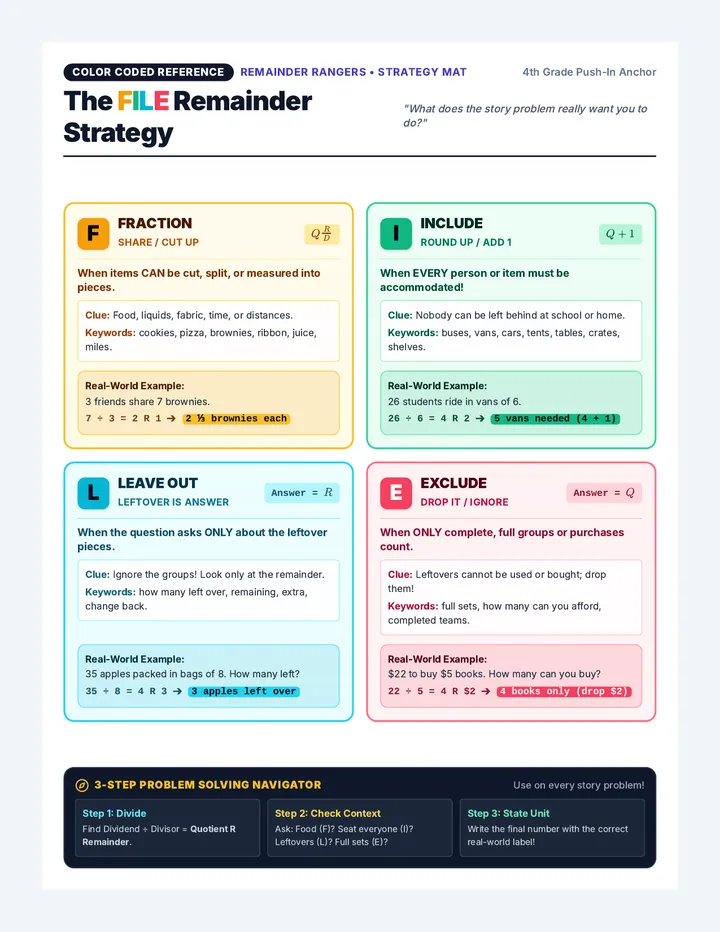
FILE Decoder Anchor Chart Color Coded Reference Remainder Rangers • Strategy Mat
4th Grade Push-In Anchor
The FILE Remainder Strategy
"What does the story problem really want you to do?"
F
FRACTION
Share / Cut Up
\(Q \frac{R}{D}\)
When items CAN be cut, split, or measured into pieces.
Clue: Food, liquids, fabric, time, or distances.
Keywords: cookies, pizza, brownies, ribbon, juice, miles.
Real-World Example:
3 friends share 7 brownies.
7 ÷ 3 = 2 R 1 ➔ 2 ⅓ brownies each
I
INCLUDE
Round Up / Add 1
\(Q + 1\)
When EVERY person or item must be accommodated!
Clue: Nobody can be left behind at school or home.
Keywords: buses, vans, cars, tents, tables, crates, shelves.
Real-World Example:
26 students ride in vans of 6.
26 ÷ 6 = 4 R 2 ➔ 5 vans needed (4 + 1)
L
LEAVE OUT
Leftover is Answer
Answer = \(R\)
When the question asks ONLY about the leftover pieces.
Clue: Ignore the groups! Look only at the remainder.
Keywords: how many left over, remaining, extra, change back.
Real-World Example:
35 apples packed in bags of 8. How many left?
35 ÷ 8 = 4 R 3 ➔ 3 apples left over
E
EXCLUDE
Drop It / Ignore
Answer = \(Q\)
When ONLY complete, full groups or purchases count.
Clue: Leftovers cannot be used or bought; drop them!
Keywords: full sets, how many can you afford, completed teams.
Real-World Example:
$22 to buy $5 books. How many can you buy?
22 ÷ 5 = 4 R $2 ➔ 4 books only (drop $2)
3-Step Problem Solving Navigator Use on every story problem!
Step 1: Divide
Find Dividend ÷ Divisor = Quotient R Remainder .
Step 2: Check Context
Ask: Food (F)? Seat everyone (I)? Leftovers (L)? Full sets (E)?
Step 3: State Unit
Write the final number with the correct real-world label!