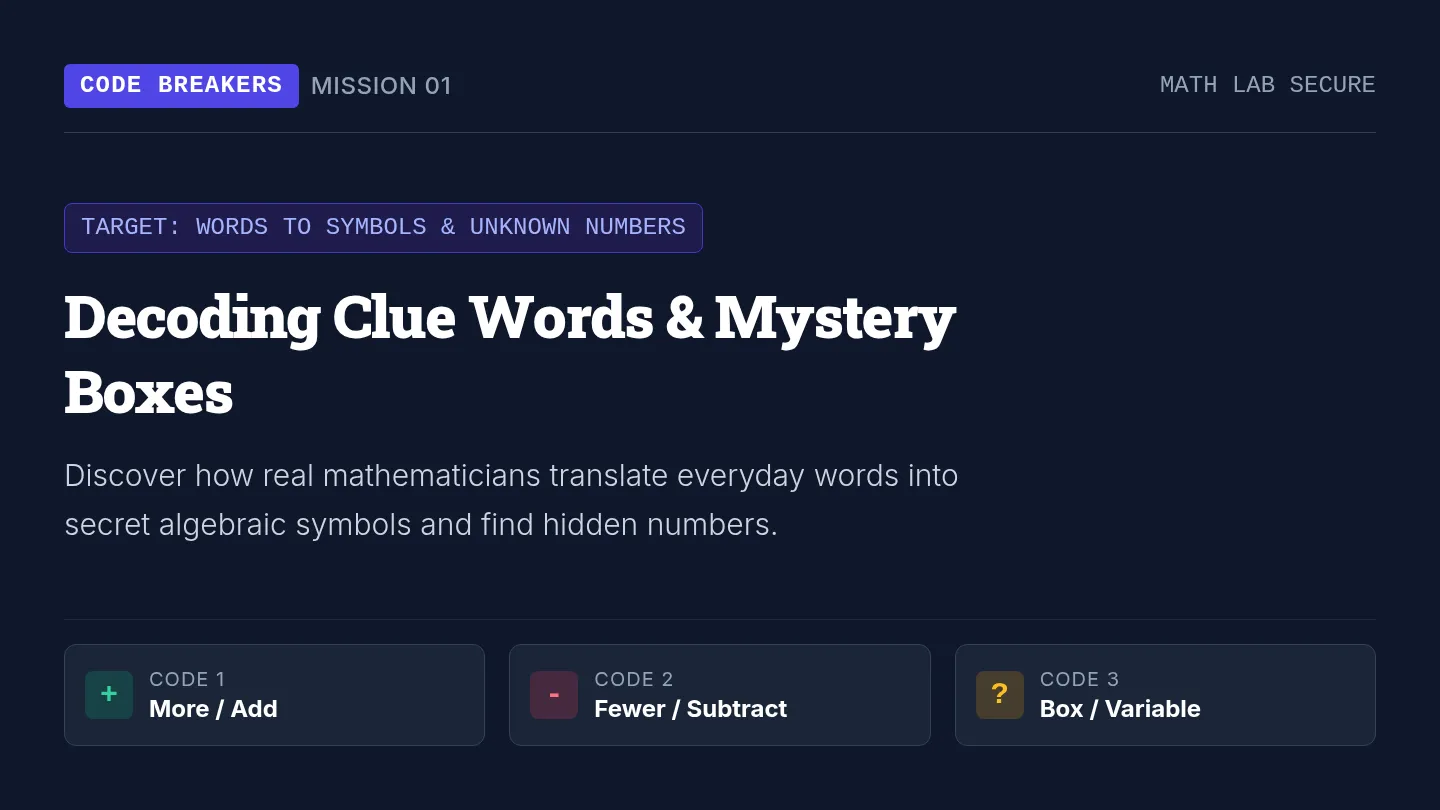
Decimal Decoder Lab Slides Decimal Decoder Lab
System Check: 8.NS.A.1 | Tier 2 Intervention
Mission Objectives
1
Demonstrate that every number has a decimal expansion.
2
Identify Rational Numbers as expansions that repeat or terminate.
3
Master the Fraction Conversion code for repeating decimals.
Can every number be written as a decimal?
"Every real number has a decimal expansion. It's like a unique ID card for the number's place on the number line."
The Rational Team
"Predictable & Patterned"
Type A: Terminators
They come to a clean stop. No surprises!
\( \frac{1}{2} = 0.5 \)
Type B: Repeaters
They go on forever, but always follow a pattern.
\( \frac{1}{3} = 0.333... = 0.\bar{3} \)
The Irrational Outsiders
"Infinite & Chaotic"
WARNING: No Patterns Found
These decimals go on forever without ever repeating a single chunk of numbers.
\( \pi \)
3.1415926...
\( \sqrt{2} \)
1.4142135...
"If you can't write it as a fraction \( \frac{p}{q} \), it's Irrational!"
The Conversion Algorithm
Goal: Convert \( 0.\bar{7} \) into a fraction.
STEP 1: Set \( x = 0.777... \)
STEP 2: Multiply by 10 → \( 10x = 7.777... \)
STEP 3: Subtract → \( 10x - x = 9x \)
STEP 4: Solve → \( 9x = 7 \), so \( x = \frac{7}{9} \)
Shortcut Reveal!
\( \frac{7}{9} \)
Repeat over 1 digit?
Lab Activity
Grab your Rational Sorting Cards . Work with your team to categorize each decimal expansion.
Time Remaining
10:00
Success Goal
100% Accuracy
Decimal Decoder Teacher Guide Decimal Decoder Lab
Teacher Facilitation Guide
Standard
CO 8.NS.A.1
Pacing
45-60 Minutes
Focus
Tier 2 Intervention
Materials
Slide Deck, Lab Report, Sorting Cards, Whiteboards
Instructional Sequence
Opening (5 min)
The Decimal Hook
"If I give you any fraction, can you turn it into a decimal?"
Review division as a way to find decimal expansions.
Use Slide 3 to discuss how decimals are "identity cards" for numbers.
Guided (15 min)
Classifying expansions
"Notice a pattern? Rational numbers either stop or repeat. That's their secret code."
Compare \( 1/2 \) vs \( 1/3 \) vs \( \pi \).
Key Misconception: Students often think all long decimals are irrational. Emphasize that long doesn't mean infinite/non-repeating.
The Code (15 min)
Converting Repeaters
"To break the code, we use algebra to 'erase' the infinite part."
Model \( 0.\bar{x} \) conversion using Slide 6.
Scaffold with whiteboards: \( 0.\bar{4}, 0.\bar{15} \).
Lab Task (15 min)
Card Sorting & Lab Report
"Sort these number codes into their correct laboratory bins."
Students use Sorting Cards to categorize into Rational (Terminating), Rational (Repeating), and Irrational.
Teacher circulates to check the "Irrational" bin specifically.
Differentiation & Support
Support (Tier 2/3)
Visual Anchor: Keep Slide 4 and 5 visible during the sorting activity.Template Use: Provide a fill-in-the-blank template for the algebraic conversion steps.Calculator Check: Allow calculators to verify fraction-to-decimal divisions.
Extension
Multi-Digit Repeaters: Challenge students to convert \( 0.\overline{123} \).Decimal Search: Find a number between \( \pi \) and \( 3.2 \). Is it rational?
Questioning Framework
Prompt Type Question/Stem Conceptual "How can you tell just by looking at the decimal if it can be written as a fraction?" Procedural "Why do we multiply by 10 (or 100) when converting a repeating decimal?" Error Analysis "A student says 3.14 is irrational because it's like Pi. Why are they wrong?"
Progress Monitoring
Observe student interactions during the sorting task using the following checklist:
Can distinguish between pattern and chaos.
Identifies terminating decimals as rational.
Correctly sets up the \( x = \) equation.
Knows \( \pi \) and \( \sqrt{2} \) are "code names" for irrationals.
Decimal Decoder Lab Report Lab Report: Decimal Decoder
Grade 8 Number Systems Division
Agent:
Date:
Phase 1: Initial Scans
Convert these fractions into decimals using division. Does the expansion stop or repeat?
01 \( \frac{3}{8} \)
Terminating
Repeating
02 \( \frac{5}{11} \)
Terminating
Repeating
Phase 2: Breaking the Code
Use the algebraic method to convert the repeating decimal \( 0.\bar{5} \) back into a fraction.
1
Set x equal to the decimal:
\( x = \) _______________________
2
Multiply by 10 to shift the decimal:
\( 10x = \) _______________________
3
Subtract the first equation from the second:
\( 10x - x = \) _______________________
4
Solve for x (The Fraction):
\( x = \) _______________________
Phase 3: Lab Analysis
Record your findings from the Rational Sorting Cards below. List at least two examples for each bin.
Rational (Terminating)
Example A:
Example B:
Rational (Repeating)
Example A:
Example B:
Irrational
Example A:
Example B:
Phase 4: Laboratory Conclusion
1. Explain in your own words: Why is a decimal like \( 0.333... \) considered rational even though it never ends?
2. True or False: Every real number can be written as a decimal expansion.
TRUE
FALSE
3. Reflection: What is the most "irrational" number you've encountered today? Why does it fit that description?
Rational Sorting Cards Manipulative Rational Sorting Cards
Instructions: Cut along the dashed lines. Sort these "Number Codes" into the correct laboratory bins on your Lab Report or sorting mat.
0.75
Code: Terminating
\( \frac{1}{3} \)
Code: Fraction
\( 0.\bar{6} \)
Code: Repeating
\( \pi \)
Code: Constant
\( \sqrt{2} \)
Code: Radical
0.1212...
Code: Infinite Pattern
-5
Code: Integer
3.14159...
Code: Mystery expansion
\( \frac{22}{7} \)
Code: Fraction
Rational (Terminating)
Rational (Repeating)
Irrational Decimal Decoder Exit Ticket System Logout
Exit Ticket: Decimal Decoder Lab
Agent Name
Score
1 Which of the following describes a rational number? (Circle all that apply)
A decimal that stops (terminates)
A decimal that repeats a pattern forever
A decimal that never ends and has no pattern
Any number that can be written as \( \frac{p}{q} \)
2 Convert \( 0.\bar{8} \) to a rational number (fraction). Show your code!
3 Identify this decimal: 3.14159... Is it rational or irrational? Explain why.
Rational
Irrational
Laboratory status: Mission Complete