Quad Quest Slides Quad Quest
Navigating the Four Quadrants
The Cartesian Map
X-Axis
The horizontal line (left to right). Like the equator on a map.
Y-Axis
The vertical line (up and down). Like the prime meridian.
The Origin
The point (0, 0) where the axes cross. Home base.
x y
I
II
III
IV
The Secret Code
( x , y )
1st Number: X
Run left or right first!
Negative = Left Positive = Right
2nd Number: Y
Jump up or down second!
Negative = Down Positive = Up
The 4 Neighborhoods
Quadrant II
( - , + )
Left and Up
Quadrant I
( + , + )
Right and Up
Quadrant III
( - , - )
Left and Down
Quadrant IV
( + , - )
Right and Down
Human Battleship
Time to navigate! We're turning the floor into a giant coordinate plane. Your body is the point.
Can you find your coordinates before your ship is sunk?
Grid Navigator Worksheet Grid Navigator
Topic: Identifying & Plotting Rational Coordinates
NAME:
DATE:
Part 1: The Four Neighborhoods
Identify which quadrant (I, II, III, or IV) or axis the following ordered pairs would be located in without plotting them.
(5, 3) Quadrant: ________
(-4.5, -2) Quadrant: ________
(0, -6) Location: ________
(-10, 7.5) Quadrant: ________
(3, -1/2) Quadrant: ________
(-2, 0) Location: ________
Part 2: Marking the Map
Plot and label the following points on the coordinate plane below. Be precise with rational numbers!
Point A: (4, 2)
"The Lookout Tower"
Point B: (-3, 5)
"Hidden Cove"
Point C: (-5, -4)
"Sunken Ship"
Point D: (2.5, -6)
"Treasure Chest"
Point E: (-1.5, 0)
"Anchor Point"
x y
4
-4
4
-4
0
Navigator's Reflection
Explain the steps you took to plot Point D (2.5, -6). Which direction did you move first, and why?
Human Battleship Guide Human Battleship Guide
Kinesthetic Learning Activity • Lesson 1
DURATION
20–30 Mins
GROUPING
Whole Class
MATERIALS
Masking Tape
The Arena Setup
Use masking tape to create a large coordinate plane on the classroom floor (at least 10x10 units).
Clearly mark the X-axis and Y-axis with bolder tape.
Label the axes with integers (-5 to 5 or -10 to 10 depending on space).
Designate the Origin (0,0) with a bright star or circle.
Divide the class into two teams: Team Submarine and Team Destroyer.
How to Play
Phase 1: Deployment
Team A chooses 3 students to be their "ships." These students secretly stand on three specific points on the grid. They must keep their eyes closed or face away from Team B.
Phase 2: The Attack
Team B calls out an ordered pair (e.g., "Fire at -3, 4!").
A student from Team B must then walk the grid to that point: starting at the origin, walking left/right, then walking up/down.
Phase 3: Hit or Miss?
If a Team A ship is standing on that exact coordinate, they are "sunk" and must leave the grid. If not, it's a miss! Teams swap roles until all ships are sunk.
Pro-Navigator Tips
Movement Rule: Enforce the "Walk before you Jump" rule (X then Y). This solidifies the ordered pair sequence.
Rational Numbers: Challenge students by allowing ships to stand on "halves" (e.g., 2.5, -4) to increase difficulty.
Quadrant Checks: Before a student walks to their target, ask them: "In which quadrant do you think your hit will land?"
Shape Shifter Slides Shape Shifters
Plotting Polygons on the Plane
Points to Polygons
The Vertex Rule
In coordinate geometry, each corner of a shape is an ordered pair called a vertex .
The Path Rule
We create the shape by connecting the vertices in the order they are given and closing the loop.
(-3, 3) (3, 3) (3, -3) (-3, -3)
Example: A Square on the Grid
Decoding the Map
Today, you are decoding Celestial Constellations .
Each set of coordinates reveals a star cluster. If you plot them wrong, the "star" will be out of place!
1
Plot
Mark each vertex precisely.
2
Connect
Draw straight lines in order.
3
Close
Back to the first point!
Why do we do this?
Architecture
Blueprints are just polygons on a coordinate plane.
Game Design
3D characters are made of thousands of tiny polygons.
GPS & Mapping
Defining boundaries of cities or properties.
Mystery Constellation Worksheet Celestial Mapping
Mystery Constellation Workshop
NAME:
DATE:
Stellar Instructions
Plot the following sets of vertices on the star map. Connect the points in order as you go. For each set, connect the last point back to the first point to close the polygon.
Constellation Alpha 4 VERTICES
1. (2, 8)
2. (8, 8)
3. (8, 2)
4. (2, 2)
Identity: ________________
Constellation Beta 3 VERTICES
1. (-7, 4)
2. (-3, 9)
3. (-3, 4)
Identity: ________________
Constellation Gamma 5 VERTICES
1. (-2, -2)
2. (-2, -8)
3. (-5, -9)
4. (-8, -8)
5. (-8, -2)
Identity: ________________
Constellation Delta 4 VERTICES
1. (3, -3)
2. (6, -1)
3. (9, -3)
4. (6, -5)
Identity: ________________
10
-10
-10
10
0
Challenge: Shape Shift
Look at Constellation Beta. If you added 5 to every X-coordinate and subtracted 3 from every Y-coordinate, in which quadrant would the new shape be located?
Shape Shifter Answer Key Answer Key
Mystery Constellation Worksheet • Lesson 2
Constellation Identities
Constellation Alpha
Shape: Square
Coordinates: (2,8), (8,8), (8,2), (2,2)
Constellation Beta
Shape: Right Triangle
Coordinates: (-7,4), (-3,9), (-3,4)
Constellation Gamma
Shape: Pentagon (Irregular)
Coordinates: (-2,-2), (-2,-8), (-5,-9), (-8,-8), (-8,-2)
Constellation Delta
Shape: Rhombus / Diamond
Coordinates: (3,-3), (6,-1), (9,-3), (6,-5)
Challenge Solutions
The "Shape Shift" Challenge
Question: Look at Constellation Beta. If you added 5 to every X-coordinate and subtracted 3 from every Y-coordinate, in which quadrant would the new shape be located?
Answer: Quadrant I
Reasoning: Original vertices were in Quad II. Adding 5 to X makes them -2 and +2. Subtracting 3 from Y makes them 1 and 6. Specifically: (-2, 1), (2, 6), (2, 1). Two vertices are in Quad I, and one is in Quad II, so the shape straddles the Y-axis but is primarily in/moving toward Quadrant I. (Accept Quadrant I/II boundary).
Quick Visual Check
Simplified visualization of key
Taxi Tracker Slides Taxi Tracker
Distance on the Coordinate Plane
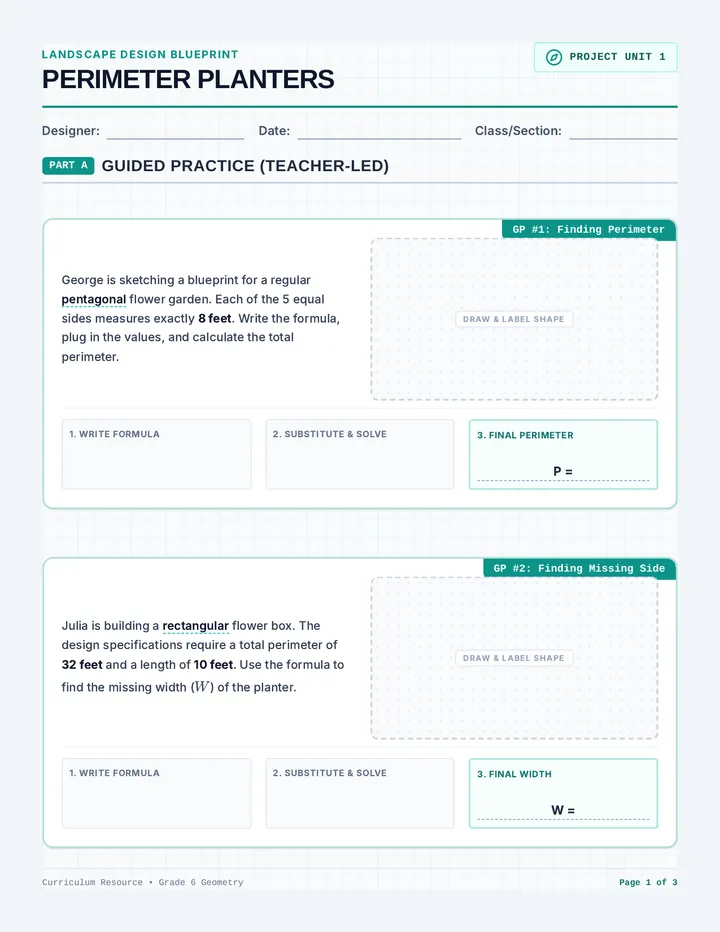
01 How far between points?
The Ground Rule
We only calculate horizontal (left-right) and vertical (up-down) distances for now. No diagonals!
The Secret Math
Distance is always positive . We use Absolute Value to find it.
| \(x_1 - x_2\) | or | \(y_1 - y_2\) |
Two Ways to Travel
Same Quadrant
Points share the same sign (+ or -). Just subtract the different coordinates.
Point A: (2, 5)
Point B: (2, 2)
Distance: | 5 - 2 | = 3 units
Crossing Axes
Points have different signs. Add their absolute values to find total distance.
Point C: (-3, 4)
Point D: (5, 4)
Distance: | -3 | + | 5 | = 8 units
Taxi Challenge
LEVEL: NOVICE
"Pickup at (-4, -6). Dropoff at (-4, 8). How many blocks long is this trip?"
Identify:
Same X-coordinate? Yes (-4)
Vertical distance? Yes
Crossing axes? Yes!
| -6 | + | 8 | = ?
14 BLOCKS
Distance Dispatch Worksheet Distance Dispatch
City Grid Taxi Service • Log Sheet
DRIVER ID:
SHIFT DATE:
Active Dispatch Logs
Calculate the shortest horizontal or vertical distance (in blocks) for each trip. Show your absolute value work!
01
Route
(-4, 2) → (5, 2)
Calculation Space
Total Blocks
________ blocks
02
Route
(-3, -7) → (-3, -1)
Calculation Space
Total Blocks
________ blocks
03
Route
(2.5, 4) → (2.5, -3.5)
Calculation Space
Total Blocks
________ blocks
The "Express Square" Perimeter
A taxi must drive around the perimeter of a rectangle to patrol a neighborhood. The corners (vertices) are:
A: (2, 2)
B: (6, 2)
C: (6, 5)
D: (2, 5)
1. Length of AB: _________
2. Length of BC: _________
3. Total Perimeter: _________
Route Sketch (Optional)
The Shift Manager's Challenge
Driver! You are at point (10, 5). You need to get to (-10, 5). You want to take your lunch break at the origin (0,0). Explain why taking a "detour" to the origin doesn't change the total distance you travel.
Taxi Tracker Answer Key Answer Key
Distance Dispatch • Lesson 3
Active Dispatch Logs
TRIP 01: (-4, 2) → (5, 2)
| -4 | + | 5 | = 9 blocks
TRIP 02: (-3, -7) → (-3, -1)
| -7 - (-1) | = | -6 | = 6 blocks
TRIP 03: (2.5, 4) → (2.5, -3.5)
| 4 | + | -3.5 | = 7.5 blocks
The Express Square
Length of AB
4 units
| 6 - 2 |
Length of BC
3 units
| 5 - 2 |
Total Perimeter
14 units
2(4) + 2(3)
Manager's Challenge Reasoning
"Because (10, 5), (0, 5), and (-10, 5) all lie on the same horizontal line (y = 5). Traveling from 10 to 0 is 10 units. Traveling from 0 to -10 is another 10 units. Total = 20 units. This is the same as the absolute difference | 10 - (-10) | = 20. The origin (or any point on the segment) is just a stop along the straight path."
Land Surveyor Slides Land Surveyor
Area & Perimeter on the Plane
From Length to Area
The Blueprint
We use our Distance Skills to find the length of each side (Base and Height).
The Calculation
Rectangle Area = \(b \times h\)
Triangle Area = \(\frac{1}{2}b \times h\)
Base = 6 units Height = 6 units
Area = \(\frac{1}{2}(6 \times 6) = 18\) units²
Complex Plots (Decomposition)
Not every plot of land is a perfect rectangle! When we have a complex polygon , we slice it into simpler shapes.
Slice into rectangles and triangles.
Calculate the area of each piece.
Sum them up for the total area.
Rect A + Rect B = Total Plot
The Surveyor's Brief
"Attention Surveyors! We have a new park boundary defined by vertices at:
(-5, 0), (5, 0), and (0, 10).
What is the total acreage (area) of this triangular park? And how much fencing (perimeter) do we need for the base?"
Base: 10 units
Height: 10 units
Area: 50 units²
Property Plotter Worksheet Property Plotter
Official Survey Report
SURVEYOR NAME:
DATE:
"Instructions: For each plot of land, determine the dimensions (Base and Height), calculate the Perimeter (where possible), and determine the Total Area. Show all your work for full certification."
01 The Apple Orchard (Rectangle)
Vertices: (-5, 4), (3, 4), (3, -2), (-5, -2)
Base Length: ________________ units
Height: ________________ units
Perimeter: ________________ units
Total Area: ________________ sq units
Sketch Area
02 The Fishing Pond (Right Triangle)
Vertices: (2, 2), (10, 2), (2, 8)
Base Length: ________________ units
Height: ________________ units
Total Area: ________________ sq units
Formula used: ________________________________
Sketch Area
The Estate Challenge (Complex Polygon)
A large plot is defined by the following vertices. Hint: Decompose it into two rectangles!
A: (-2, -2) | B: (6, -2) | C: (6, -5) | D: (2, -5) | E: (2, -8) | F: (-2, -8)
Step 1: Areas of pieces
Piece 1 Area: __________
Piece 2 Area: __________
Grand Total Area
__________
sq units
Property Plotter Answer Key Answer Key
Property Plotter • Lesson 4
01. The Apple Orchard
Base (x-diff): | 3 - (-5) | = 8 units
Height (y-diff): | 4 - (-2) | = 6 units
Perimeter: 2(8) + 2(6) = 28 units
Total Area
48 units²
02. The Fishing Pond
Base (x-diff): | 10 - 2 | = 8 units
Height (y-diff): | 8 - 2 | = 6 units
Formula: 1/2 (b × h)
Total Area
24 units²
The Estate Challenge
Decomposition Strategy 1
"Slice vertically at x = 2"
Rectangle 1: (-2, -2) to (2, -8) → Area = 4 × 6 = 24
Rectangle 2: (2, -2) to (6, -5) → Area = 4 × 3 = 12
Decomposition Strategy 2
"Slice horizontally at y = -5"
Rectangle Top: (-2, -2) to (6, -5) → Area = 8 × 3 = 24
Rectangle Bottom: (-2, -5) to (2, -8) → Area = 4 × 3 = 12
Total Estate Area
36
sq units
Tycoon Blueprint Slides Park Tycoon
The Culminating Project
Project Brief
You have been hired to design the newest Coordinate Kingdom theme park.
Your map must fit within a specific boundary and include 5 mandatory attractions. Each attraction has specific Area and Distance requirements.
"Precise math is the difference between a record-breaking roller coaster and a safety hazard!"
Boundary
-10 to +10
Requirement
5 Polygons
Technical Specifications
Attractions
• Roller Coaster (Rect)
• Water Slide (Tri)
• Ferris Wheel (Square)
• Food Court (Rect)
• Entry Gate (Segment)
The Math
• List all vertices
• Calculate side lengths
• Calculate total area
• Prove fit in quadrants
The Bonus
• Design a logo
• Use all 4 quadrants
• Add a "Secret Route"
• Non-overlapping plots
Tycoon Success Checklist
Accuracy First
Are your vertices plotted exactly where you said they were?
Area Evidence
Did you show the absolute value math for your distances and area?
Visual Polish
Is your map clear, labeled, and color-coded for the visitors?
Park Planner Project Guide Park Planner
THEME PARK TYCOON PROJECT GUIDE
ARCHITECT:
PROJECT ID: CP-6.G.3
Phase 1: The Design Objective
Design a theme park map on a coordinate plane ranging from -10 to +10 on both axes. You must plot and label at least 5 attractions, ensuring they do not overlap.
Phase 2: Attraction Specs
1. Roller Coaster Rectangle
Requirement: Must have an area of at least 20 sq units.
V1: (___, ___)
V2: (___, ___)
V3: (___, ___)
V4: (___, ___)
2. Water Slide Triangle
Requirement: Must be located entirely in Quadrant III.
V1: (___, ___)
V2: (___, ___)
V3: (___, ___)
3. Ferris Wheel Square
Requirement: One vertex must be at the Origin (0, 0).
V1: (0, 0)
V2: (___, ___)
V3: (___, ___)
V4: (___, ___)
4. Food Court Any Polygon
Requirement: Must have at least 5 vertices (irregular shape).
V1: (___, ___)
V2: (___, ___)
V3: (___, ___)
V4: (___, ___)
V5: (___, ___)
Phase 3: Engineering Log
Attraction Base (b) Height (h) Area Calculation Roller Coaster _____ _____ Area = _______ units² Water Slide _____ _____ Area = _______ units² Food Court Decomposition required? Area = _______ units²
Coordinate Kingdom Map MAP SCALE: 1 UNIT = 10 METERS
x y
10
-10
-10
10
Tycoon Grading Rubric Tycoon Grading Rubric
Coordinate Kingdom Mapping Project • Assessment Guide
Total Possible
100 PTS
Criteria Expert (20-25) Proficient (15-19) Novice (0-14)
Plotting Accuracy
Vertices on the map match the coordinate log exactly.
| All 5+ attractions are plotted with 100% precision. Lines are straight and shapes are closed. | All attractions are plotted; 1-2 minor errors in vertex placement or line closure. | Multiple plotting errors. Shapes are unrecognizable or don't match log coordinates. |
|
Mathematical Proofs
Absolute value used to find distance and area.
| Step-by-step absolute value work shown for all shapes. All area calculations are correct. | Work shown for most shapes; calculations are correct but missing logic or absolute value signs. | Missing calculations or significant errors in area formulas. Work is not shown. |
|
Spec Fulfillment
Met all specific attraction requirements (Area, Origin, Quadrant).
| All 5 specs met (Area > 20, Q3 Water Slide, Origin Ferris Wheel, 5-sided Food Court). | 4 out of 5 specs met correctly. One attraction misses a specific constraint. | 2 or fewer specs met. Requirements for specific attractions were ignored. |
|
Cartographic Design
Visual clarity, labeling, and creative theme park elements.
| Professional quality map. Labeled attractions, color-coded, and creative theme throughout. | Map is clear and easy to read. Labels are present. Neat but lacks extra creative detail. | Map is messy or difficult to interpret. Missing labels or key design elements. |
Final Certification Notes
Final Grade
/ 100