Balance and Beyond Slides BALANCE & BEYOND
The Logic of the Equals Sign
Lesson 1.1 Algebraic Foundations
The Mystery Bag Challenge
A scale is perfectly balanced. On the left are 3 mystery bags and 2 gold coins. On the right are 14 gold coins.
How much does each bag weigh?
?
?
?
The Golden Rule
"Whatever you do to one side of an equation,
you must do to the other."
Failure to do so breaks the balance, making the equation false.
Maintain Equality • Preserve the Balance
Inverse Operations
To isolate a variable, we must undo what has been done to it.
The "Un-doing" Pairs:
Addition (+) Subtraction (–)
Multiplication (×) Division (÷)
EXAMPLE
\(x + 5 = 12\)
What is "happening" to \(x\)?
It is being added by 5.
How do we "undo" it?
Subtract 5 from both sides.
Mobile Logic
In a balanced mobile:
The total weight on each side is equal.
Removing the same thing from both sides keeps it balanced.
10
What is the weight of one diamond?
Balance Puzzles Worksheet Mobile Balance Puzzles
Lesson 1.1 Activity
Logic of the Equals Sign
Name: ___________________________________
Date: ___________________
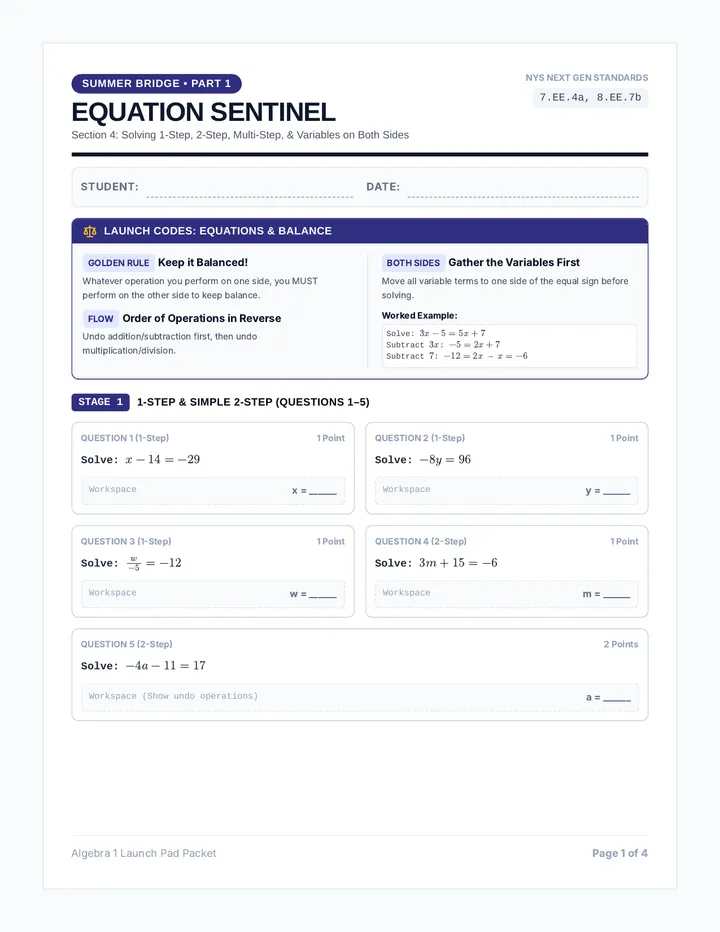
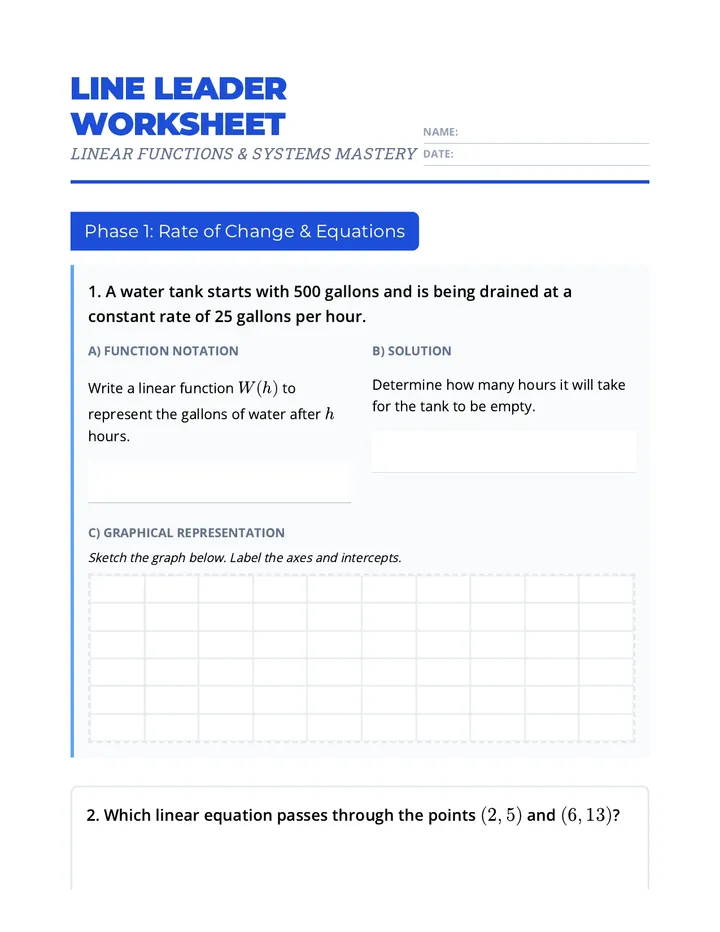
PART 1: THE VISUAL BALANCE
Each mobile below is perfectly balanced. The number at the top represents the total weight of the mobile. Each branch of a mobile must hold exactly half of the weight above it.
PUZZLE A
24
12
?
?
What is the value of one square?
PUZZLE B
40
One Circle =
One Diamond =
PART 2: THE ALGEBRAIC BRIDGE
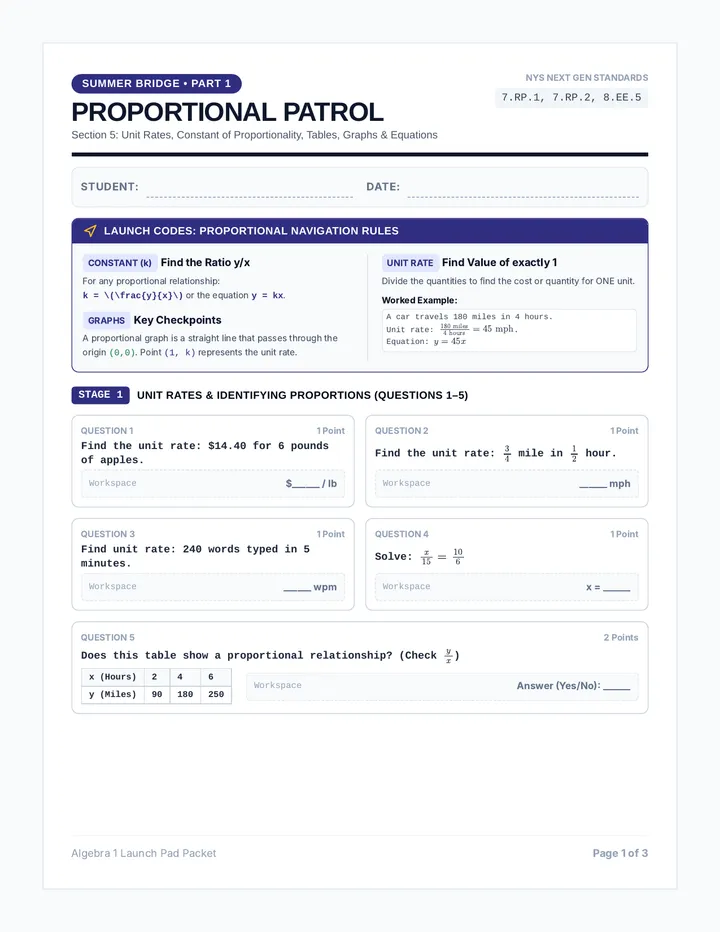
Translate these balance problems into algebraic equations using \(x\) for the unknown value. Then, solve using inverse operations.
\(x + x + x\)
\(15\)
Equation
Solve (Show Work)
"Four boxes and five coins balance with twenty-five coins."
Equation
Solve (Show Work)
PART 3: MAINTAINING THE BALANCE
For each equation, identify the operation currently happening to \(x\), the inverse operation needed to undo it, and solve.
Equation What is happening? Inverse Move Solution Path \(x - 14 = 22\) \(5x = 45\) \(\frac{x}{7} = 4\) \(2x + 8 = 20\)
THE LOGIC CHECK
Why is it essential to perform the inverse operation on both sides of the equals sign? Use the concept of the balance scale in your explanation.
Facilitating Balance Teacher Guide Facilitating Balance
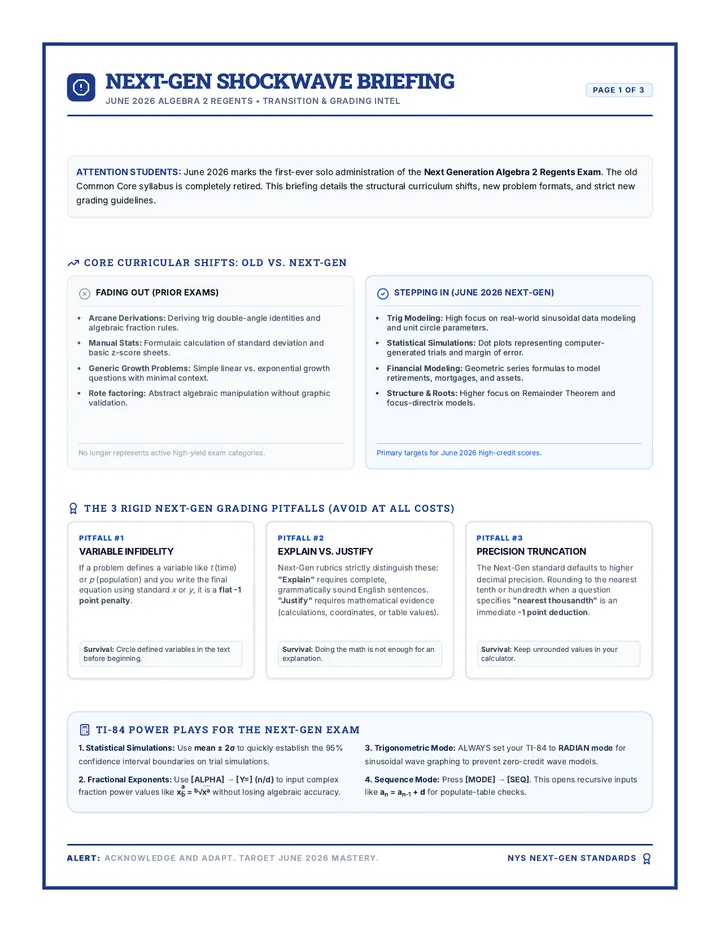
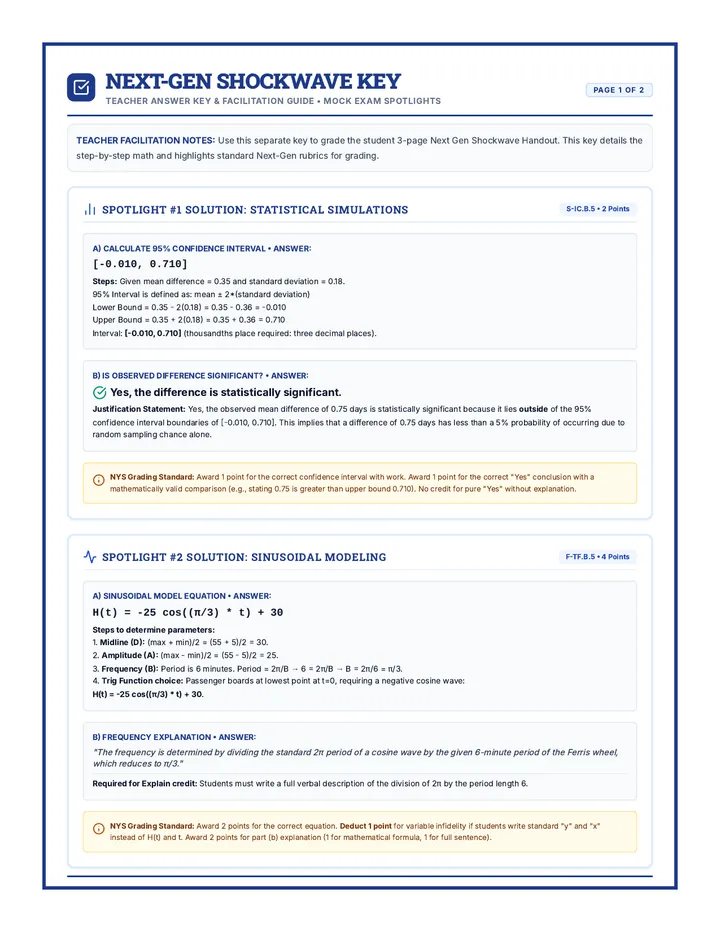
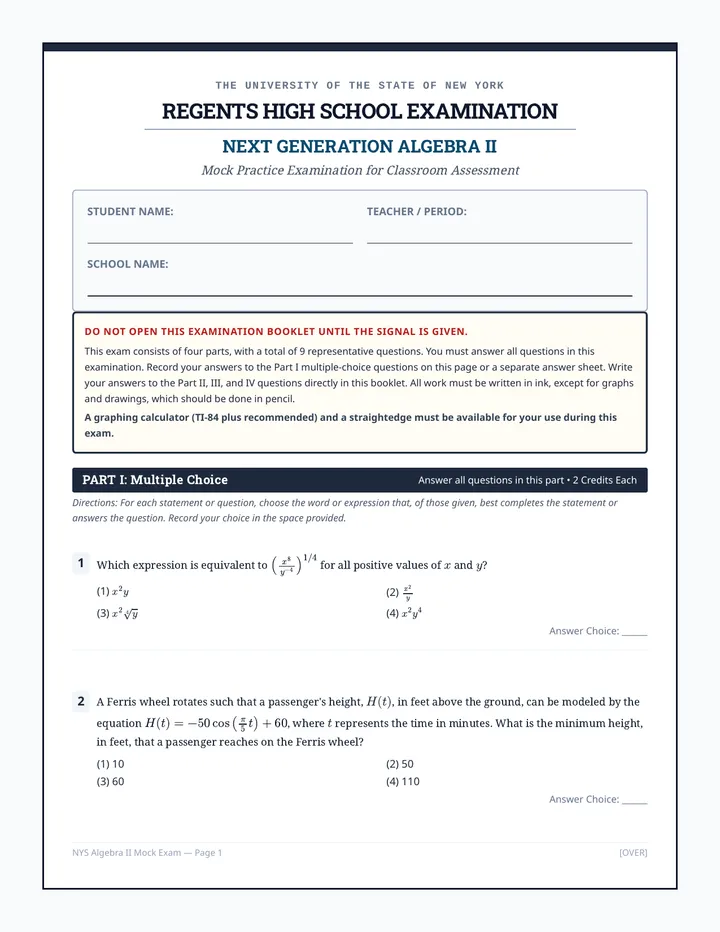
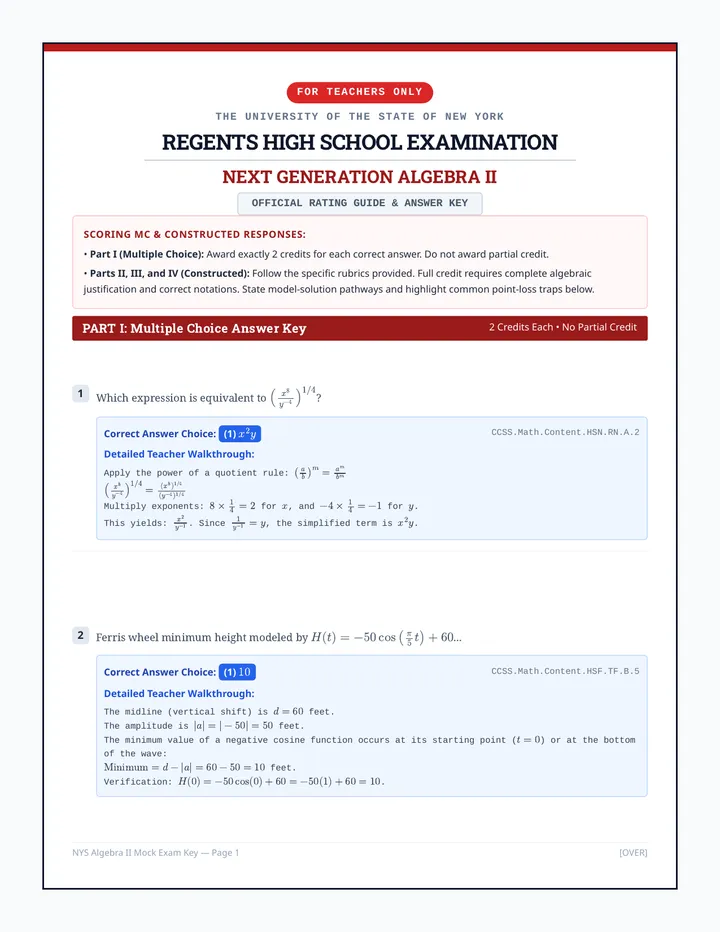
Teacher Facilitation Guide • Lesson 1.1
Duration
50-60 Minutes
Objective
Visualize equality using balance models.
Key Terms
Inverse, Equality, Isolate
The Hook: Mystery Bag Challenge
Students often view the equals sign as an "operator" (calculate the answer) rather than a "relational" symbol (the two sides are the same). This activity pivots that mindset.
Setup:
Bring a physical balance scale (if possible) or use the slide visual.
Place 3 identical opaque bags (labeled 'x') and 2 small weights on the left.
Place 14 identical small weights on the right.
The Script:
"We need to find the weight of one bag without opening it. We can only move things if we keep the scale level. What is our first move?"
Expected Response: "Take 2 weights off both sides."
Teacher: "Why both sides? What happens if I only take from the left?"
Pacing & Facilitation
00-10 min
The Mystery Bag Hook
Use the physical or digital scale. Focus on the word "Equivalent." If students say "subtract 2," ask them to prove why it works for the scale.
10-25 min
The Mobile Logic (Direct Instruction)
Introduce the concept of "splitting weight." If the top is 24, each branch is 12. This naturally introduces division as an inverse of having multiple identical objects.
25-50 min
Independent/Partner Practice
Students work through the Balance Puzzles Worksheet. Circulate and check for "The Golden Rule" application in Part 3.
Common Pitfalls
X The "One-Sided" Move: Students subtract from the left but forget the right. Remind them the scale will tip.
X Inverse Confusion: Seeing \(+5\) and adding 5 more. Use the "undo" metaphor: "If I put on shoes, I have to take them off."
Discussion Prompts
"If we add a 10lb weight to one side, what must we do to the other to keep it balanced? Why?"
"Can we solve an equation without inverse operations? How? Why might it be harder?"
Properties of the Law Slides PROPERTIES OF THE LAW
Equation Solving as a Legal Argument
Lesson 2.1 The Formal Statutes of Algebra
Legal Standing
In math, you can't just "do" something because it feels right. Every move must be backed by a Mathematical Property.
"Solving an equation is like a lawyer presenting a case. You must cite the law for every piece of evidence you present."
The Golden Statute
"If you perform the same operation to both sides, the Equality is maintained."
The Four Pillars of Equality
Addition
(A.P.O.E.)
If \(a = b\), then \(a + c = b + c\)
Add to both sides
Subtraction
(S.P.O.E.)
If \(a = b\), then \(a - c = b - c\)
Subtract from both
Multiplication
(M.P.O.E.)
If \(a = b\), then \(ac = bc\)
Multiply both sides
Division
(D.P.O.E.)
If \(a = b\), then \(\frac{a}{c} = \frac{b}{c}\)
Divide both sides
Supporting Statutes
Distributive Property
\(a(b + c) = ab + ac\)
Multiply a single term by two or more terms inside a set of parentheses.

Substitution Property
If \(a = b\), then \(a\) can be replaced by \(b\) in any expression or equation.
Used often for simplifying: \(2x + 3x\) becomes \(5x\).
Illegal Moves
"Any move that breaks the balance is a violation of the Law of Equality."
Violation #1
Adding to the left side but NOT to the right side.
Violation #2
Dividing only one term instead of the entire side.
Property Police Worksheet The Property Police
Citing Statutes for Algebraic Moves
Officer Name: ________________________
Date: ___________________
Part 1: Citing the Statute
Identify which Property of Equality justifies each transformation. Use abbreviations if needed: APOE, SPOE, MPOE, DPOE, Distributive, Substitution.
\(x - 7 = 12\)
\(x = 19\)
\(4x = 24\)
\(x = 6\)
\(3(x + 2) = 15\)
\(3x + 6 = 15\)
\(x + 5 + 2x = 20\)
\(3x + 5 = 20\)
Part 2: The Deposition
Fill in the missing steps or reasons for the following investigation.
Algebraic Step (Evidence) Property Used (Statute) \(2(x - 4) + 5 = 11\) Given Equation \(2x - 8 + 5 = 11\) \(2x - 3 = 11\) Addition Property of Equality \(x = 7\)
Part 3: Illegal Search & Seizure
Below is a solution that has been flagged for a violation. Circle the step where the illegal move occurred and explain the "violation of the law."
The Crime Scene CASE #402
Step 1: \(4x + 10 = 30\)
Step 2: \(4x = 40\)
Step 3: \(x = 10\)
Identify the Violation:
Explain why Step 2 is illegal...
Officer's Recommendation
"To fix this, the suspect should have used the _______________________ Property of Equality."
Math Autopsy Slides MATH AUTOPSY
Investigating the Death of Logic
Lesson 3.1 Precision & Error Analysis
Viral Logic Fail
Viral Post:
\(20 + 20 \times 0 + 1 = ?\)
A) 1
B) 21
"99% of people get this wrong! Share if you're a genius."
Why does the internet argue?
Most people make an Order of Operations mistake or a Conceptual mistake. Today, we investigate how and why logic breaks.
Today's Mission:
Identify, Classify, and Correct algebraic errors.
Diagnosis: Classifying the Fail
Arithmetic Error
The logic was sound, but the "mathing" was wrong.
Example: \(3 \times 7 = 24\) or \(12 - (-5) = 7\)
Conceptual Error
A "Rule of the Law" was broken. A property was misused or ignored.
Example: Subtracting from only one side or incorrect distribution.
Case Study: "The Half-Divider"
Evidence
\(2x + 8 = 20\)
\(x + 8 = 10\)
\(x = 2\)
What went wrong?
The student attempted the Division Property of Equality, but they only divided two of the three terms.
"If you divide a side, you must divide the entire side."
The Autopsy Report
When you find an error, you must:
1
Locate
Circle the exact spot it died.
2
Diagnose
Arithmetic or Conceptual?
3
Resuscitate
Solve it correctly.
Math Autopsy Worksheet The Autopsy Report
Investigating Algebraic Logic Breakdown
Lead Investigator: ____________________
Date: ___________________
Part 1: The Morgue
"Examine each case file below. Circle exactly where the logic failed, diagnose the error type, and explain the cause of death."
Case #001
\(3(x - 5) = 24\)
\(3x - 5 = 24\)
\(3x = 29\)
\(x = \frac{29}{3}\)
Diagnosis
Arithmetic
Conceptual
Cause of Death (Explanation)
Case #002
\(4x + 10 = 2\)
\(4x = -8\)
\(x = -4\)
Diagnosis
Arithmetic
Conceptual
Cause of Death (Explanation)
Part 2: Resuscitation
Choose ONE of the cases from Part 1 and provide the Correct Treatment (Step-by-step solution).
CASE BEING RESUSCITATED: #_______ Show all Properties of Equality used
List the Properties used in each step...
PART 3: THE VIRAL TRAP
Design your own "Viral Fail" equation. It should look correct at first glance but contain one sneaky conceptual error. Trade with a partner to see if they can identify it.
Your "Fake" Work
Partner's Diagnosis
The Algebraic Trial Slides THE ALGEBRAIC TRIAL
The Art of the Two-Column Proof
Lesson 4.1 Rigorous Mathematical Communication
Beyond the Answer
"In high-level math, getting the right answer is only 20% of the job. Proving it is the other 80%."
A Proof Must Be:
Step-by-Step
Uninterrupted Logic
Citing the Statutes
The Anatomy
L
Left Column
The Mathematical Move (Evidence)
R
Right Column
The Justification (Statute)
Model Case: \(3x - 10 = 20\)
Statement
Reason
1. \(3x - 10 = 20\)
1. Given Equation
2. \(3x = 30\)
2. Addition Prop. of Equality
3. \(x = 10\)
3. Division Prop. of Equality
The Silent Debate
You will work with a partner. You cannot speak. You only communicate through the paper.
Rules of the Game:
Partner A writes the first Step.
Partner B writes the Reason for that Step.
Partner B writes the next Step.
Partner A writes the Reason for that Step.
Collaboration through logic,
not volume.
The Closing Argument
"Your goal today is not to 'finish' the problem. It is to make your reasoning so clear that anyone can follow your trail of breadcrumbs."
Clarity
Precision
Authority
Algebraic Trial Worksheet Algebraic Trial Evidence
Formal Justification Workshop
Counsel Name: _____________________
Date: ___________________
PART 1: FILLING THE RECORD
Complete the missing Statements or Reasons in the proofs below.
Equation A: \(5(x + 2) = 40\)
Statement Reason \(5(x + 2) = 40\) Given Equation \(5x + 10 = 40\) 1. ____________________________ \(5x = 30\) 2. ____________________________ Division Property of Equality
PART 2: THE FULL DEFENSE
Construct a formal two-column proof for the equation below. Every algebraic move must have a corresponding statute cited.
Solve & Prove: \(\frac{x}{3} - 7 = 5\)
Statements
Reasons
Part 3: The Silent Debate
"Communication is strictly through the pen. If you talk, you lose the case!"
Challenge: \(2(x + 5) - 4 = 14\)
Statements
Reasons
Partner B starts here...
Counsel A Signature: ________________ Counsel B Signature: ________________
Broken Bridges Slides BROKEN BRIDGES
Identities & Special Cases
Lesson 5.1 The Final Verdict
The Truth Check
How do we know if our solution is actually correct? We use the Substitution Property.
"Plug it back into the original equation. If the left side equals the right side, you've maintained the bridge of equality."
Verification Example
\(4x + 2 = 18 \quad (x = 4)\)
\(4(4) + 2 = 18\)
\(16 + 2 = 18\)
\(18 = 18 \quad \checkmark\)
Broken Bridges
Sometimes, the math tells you that balance is impossible.
The "Nonsense" Statement:
\(5 = 7\)
If you solve and the variable disappears, leaving a false statement, there is...
NO SOLUTION
What it looks like:
\(x + 5 = x + 7\)
Subtract x from both sides...
\(5 = 7\) ???
Eternal Bridges
An Identity is an equation that is always true, no matter what value you pick for \(x\).
The "Mirror" Statement:
\(10 = 10\)
If you solve and the variable disappears, leaving a true statement, there are...
INFINITE SOLUTIONS
What it looks like:
\(2(x + 5) = 2x + 10\)
Distribute...
\(2x + 10 = 2x + 10\)
\(10 = 10\) \(\checkmark\)
The Summary Verdict
Conditional
\(x = 5\)
Only ONE number works.
Contradiction
\(0 = 4\)
No number will ever work.
Identity
\(x = x\)
Every number works.
Broken Bridges Worksheet Broken Bridges
Substitution & Special Solution Sets
Student Name: _____________________
Date: ___________________
Part 1: The Final Verification
Use the Substitution Property to determine if the given solution maintains the bridge of equality.
Equation: \(3(x - 4) = 15\)
Check for \(x = 9\):
Show substitution here...
Valid
Invalid
Equation: \(2x + 10 = 5x - 2\)
Check for \(x = 4\):
Show substitution here...
Valid
Invalid
Part 2: Sorting the Verdicts
Solve each equation. Determine if it has One Solution, No Solution, or Infinite Solutions.
\(3x + 5 = 3x + 10\)
Work...
Verdict
ONE NONE INF
\(5(x + 2) = 5x + 10\)
Work...
Verdict
ONE NONE INF
\(2(x - 3) = 10\)
Work...
Verdict
ONE NONE INF
PART 3: THE ARCHITECT
Design an equation that results in an Identity (Infinite Solutions). It must include distribution on at least one side.
Design an equation that results in a Contradiction (No Solution). It must include combining like terms.
Unit Reflection
How has your understanding of the "Equals Sign" changed throughout this unit? Is it a command to find an answer, or a relationship between two sides? Explain.