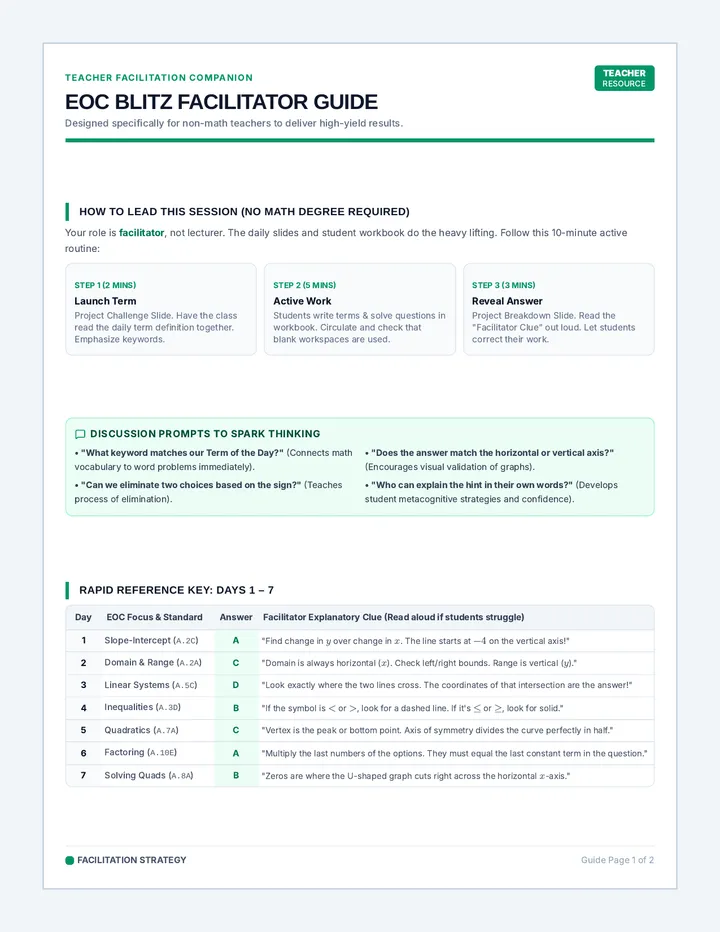
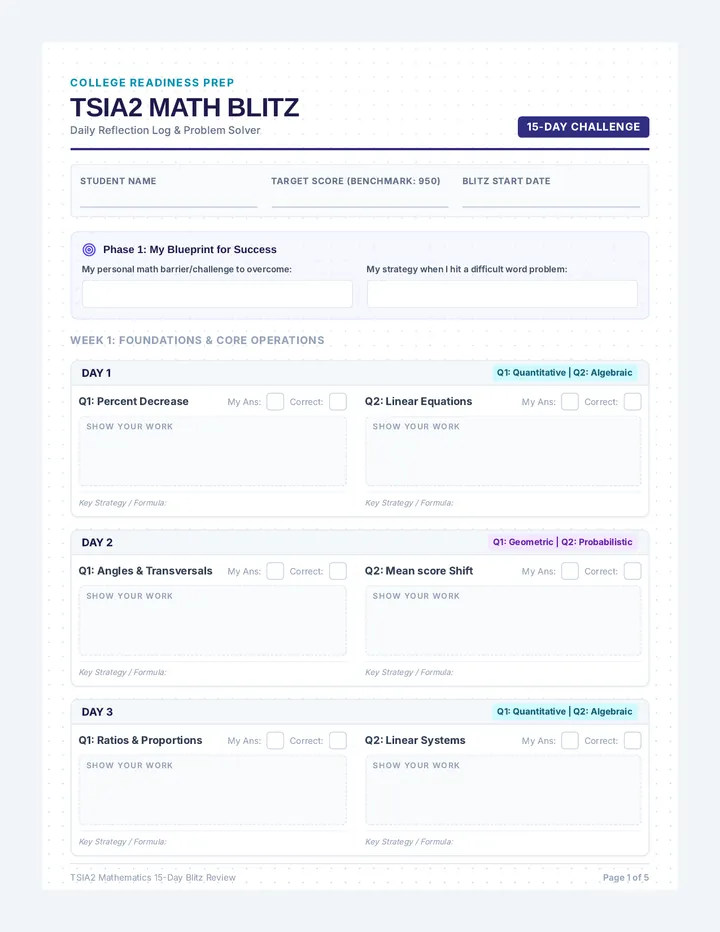
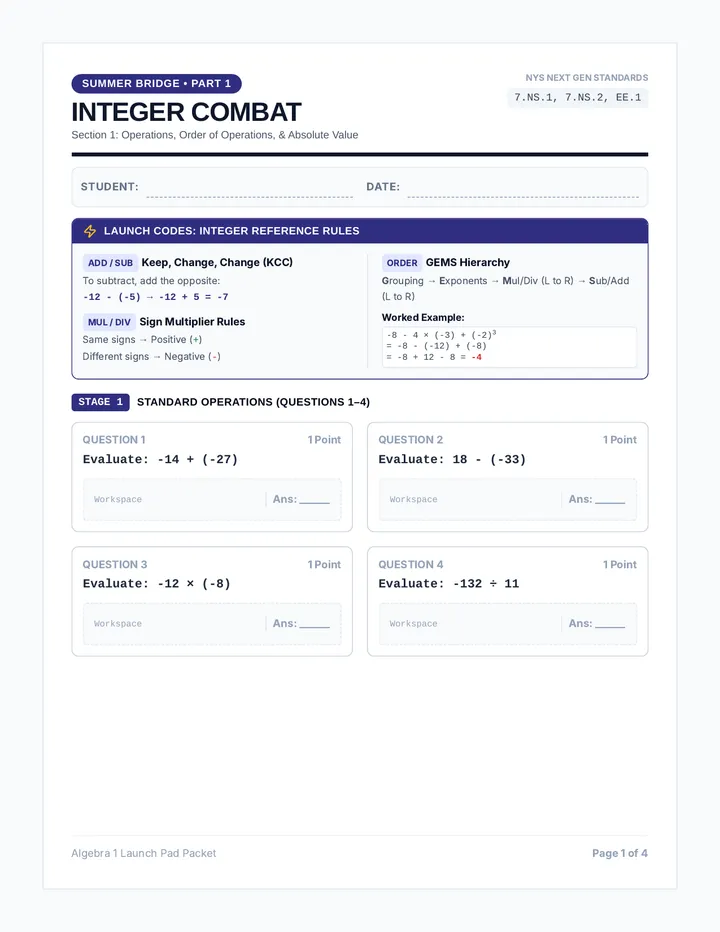
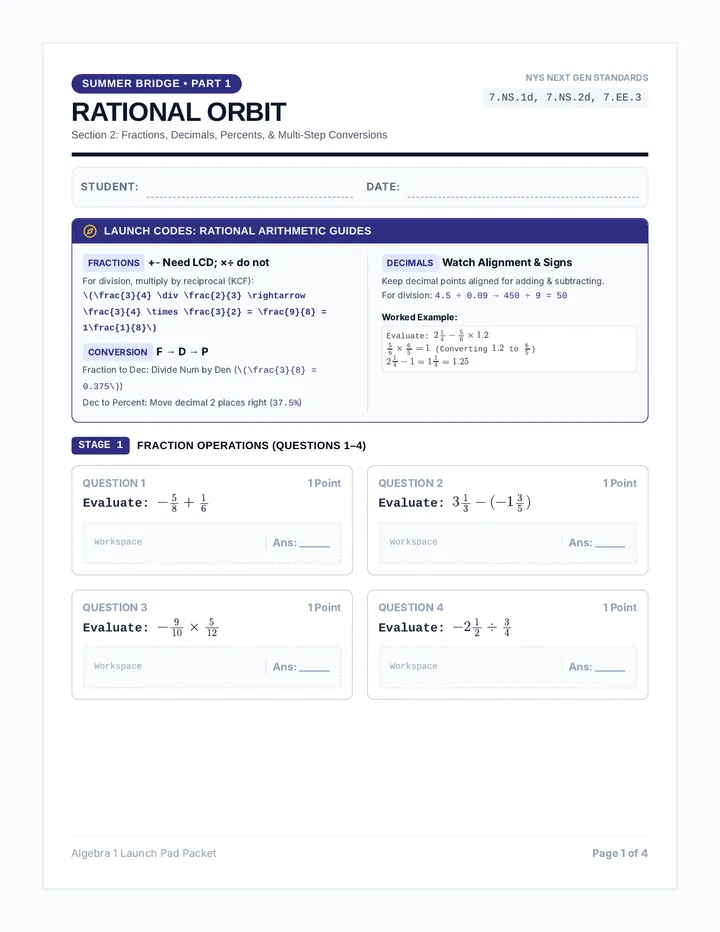
Parameter Navigator Guide Parameter Navigator Guide
Teacher Instructional Resource
Tier 2 Intervention
Learning Objective
Students will interpret the parameters in linear (\(f(x) = mx + b\)) and exponential (\(f(x) = a \cdot b^x\)) functions in terms of a real-world context, specifically identifying initial values, constant rates of change, and growth/decay factors.
Standard
Colorado HS.F-LE.B.5
Intervention Arc (30-45 mins)
1
Direct Instruction: The Blueprint (10 mins)
Use the Function Flight Slides to explicitly define linear vs. exponential parameters. Focus on "Starting Point" vs. "Change."
2
Guided Practice: Matching Blueprint (15 mins)
Facilitate the matching activity. Ask: "Does this value tell us where we started or how we move?" Scaffold by circling units (e.g., "$ per hour").
3
Progress Monitoring: Mission Decoder (10-15 mins)
Independent writing task. Use sentence frames for students struggling with articulation. Collect for data tracking.
Instructional Look-Fors
The Linear Logic
\[f(x) = mx + b\]
b (Initial Value): The "one-time" cost, flat fee, or starting amount. (Y-intercept)
m (Rate of Change): The "repeated" amount, look for words like "per," "each," or "every." (Slope)
The Exponential Engine
\[f(x) = a \cdot b^x\]
a (Initial Value): The starting amount at time zero.
b (Growth Factor): The multiplier. "Doubling" (2), "tripling" (3), or percentage (1.05).
Common Pitfalls
The Misconception The Intervention Response Confusing \(b\) (y-intercept) with \(b\) (growth factor). Use structural highlighting. Label linear as "Add/Subtract" and exponential as "Multiply." Interpreting a growth factor of 1.05 as 105% growth. Ask: "If we multiply by 1, do we change?" Explain that the '1' keeps the original, and '.05' is the extra 5%. Switching \(m\) and \(b\) in linear word problems. Identify units. The rate (\(m\)) always has combined units (e.g., miles per hour). The initial value (\(b\)) has single units (e.g., miles).
Scaffolding Prompts
"Which of these numbers happens only once?"
"If 'x' increases by 1, how does the output change?"
"Is this growing by adding the same amount, or by multiplying?"
"In this story, what is our 'Day 0' or 'Hour 0'?"
Function Flight Slides Function Flight
Parameter Decoding Mission
Flight Plan
The Mission
Learn to decode the hidden meanings of numbers in linear and exponential equations.
Identify "Starting Points"
Calculate "Rate of Change"
Interpret "Growth Factors"
Two Flight Paths
Linear
\(y = mx + b\)
Changes by ADDING
The same amount is added or subtracted every single time step.
Exponential
\(y = a \cdot b^x\)
Changes by MULTIPLYING
The output is multiplied by a factor every single time step.
Decoding: Linear
The "Steady Climb" Equation
y =
m
Rate
x +
b
Start
Initial Value (b)
• The starting amount
• One-time fee / Flat cost
• Value when \(x = 0\)
Rate of Change (m)
• The constant change
• Key words: "per," "each"
• Slope of the line
Signal Received
"A space shuttle mission costs $500 million to launch, plus $2 million for every day it orbits Earth."
\(C(d) = 2d + 500\)
2
Rate of Change
The daily cost added to the bill.
500
Initial Value
The launch cost (one-time fee).
Decoding: Exponential
The "Turbo Boost" Equation
y =
a
Start
·
bx
Factor
Initial Value (a)
• Amount at "Day 0"
• Original quantity
• The starting point
Growth Factor (b)
• The multiplier
• Doubles (2), Half (0.5)
• 1 + rate (e.g. 1.05)
Mission Alert
"A biological sample starts with 200 cells and doubles every hour."
\(P(t) = 200 \cdot (2)^t\)
200
Initial Value
The starting number of cells.
2
Growth Factor
The rate of "doubling" (multiplier).
Parameter Match Activity Mission: Parameter Match
Pilot Name
Date
Mission Objective: Identify the starting value and the rate of change/growth factor for each flight scenario. Connect the math symbol to its real-world meaning.
MISSION 1
The Cargo Transport
"A shipping plane starts with 5,000 lbs of cargo. Every hour of flight, it burns fuel, which reduces the total weight by 400 lbs ."
\(W(h) = -400h + 5,000\)
Match the Parameter to its Meaning
-400
5,000
The weight of the plane before it starts flying.
The amount of weight lost for every hour in the air.
MISSION 2
Satellite Signal Growth
"A satellite transmission starts with 10 data packets. Because of a booster, the number of packets triples every second."
\(P(s) = 10 \cdot (3)^s\)
Match the Parameter to its Meaning
10
3
The multiplier showing that the data is tripling.
The initial number of packets at the start of the mission.
Mission Decoder Task Mission Decoder Task
Pilot Name
Date
Progress Monitoring: Interpret parameters in linear and exponential functions.
HS.F-LE.B.5
1
The Landing Approach
An airplane is at an altitude of 30,000 feet . The pilot begins to descend at a constant rate of 1,200 feet per minute .
\(A(m) = 30,000 - 1,200m\)
Identify the Initial Value (b)
What does this number represent in the story of the landing?
Identify the Rate of Change (m)
What does this number represent in the story of the landing?
2
The Flight Network Effect
A new safety video is shared on the flight network. It starts with 100 views and the total views increase by 50% every day.
\(V(d) = 100 \cdot (1.50)^d\)
Identify the Initial Value (a)
What does this number represent in the story of the video?
Identify the Growth Factor (b)
Explain what the 1.50 tells us about how the views are changing.
Decoder Tools (Sentence Frames)
• The number ________ is the starting amount of ________ because...
• Every time ________ increases by 1, the ________ changes by ________.
• The multiplier of ________ means the amount is growing by ________ %.
• In this equation, ________ represents the constant rate of ________.
Parameter Match Key Answer Key: Parameter Match
Teacher Resource
Use this key to quickly verify student matching. Look for students who may be confusing the units (e.g., total weight vs. rate of loss).
MISSION 1
The Cargo Transport (Linear)
\(W(h) = -400h + 5,000\)
-400
Rate (m)
The amount of weight lost for every hour in the air.
Note: The negative sign indicates weight is being lost/subtracted.
5,000
Initial (b)
The weight of the plane before it starts flying.
Note: This is the starting value at h = 0.
MISSION 2
Satellite Signal Growth (Exponential)
\(P(s) = 10 \cdot (3)^s\)
10
Initial (a)
The initial number of packets at the start of the mission.
Note: This is the quantity at s = 0.
3
Factor (b)
The multiplier showing that the data is tripling.
Note: The base of the exponent determines the multiplication factor.