Dough Dividers Teacher Guide Dough Dividers
Teacher Lesson Guide • NC.5.NF.3
Topic Fractions as Division
Lesson Objective
Students will interpret a fraction as division of the numerator by the denominator. They will solve word problems involving division of whole numbers leading to answers in the form of fractions or mixed numbers, using visual fraction models or equations.
Materials Needed
Dough Dividers Slides
Sharing Sheet Worksheet
Paper Circles (Pizzas)
Order Up Exit Ticket
Instructional Sequence
1
The Hook: The Pizza Dilemma (10 mins)
Present a scenario: 3 pizzas need to be shared equally among 4 chefs. Ask students: "Can each chef have a whole pizza?" Use physical paper circles to demonstrate the 'division' process. Lead students to see that 3 ÷ 4 = 3/4.
2
Direct Instruction (15 mins)
Introduce the concept: Numerator ÷ Denominator = Fraction . Practice with several examples: 2 loaves for 5 people (2/5), 7 pizzas for 3 people (7/3 or 2 1/3). Emphasize that the "thing being shared" is the numerator.
3
Guided Practice: Kitchen Orders (15 mins)
Using the slides, solve sharing problems together. Focus on drawing models (rectangles for loaves, circles for pizzas) and writing the corresponding division equations and fractions.
4
Independent Practice (15 mins)
Students complete the "Sharing Sheet" worksheet. Monitor for students who confuse the numerator and denominator (sharing people between pizzas instead of pizzas between people!).
Differentiation
Support
Provide pre-drawn shapes. Use fraction tiles for tactile learners.
Extension
Ask students to write their own word problems resulting in mixed numbers > 5.
Chef's Vocabulary
Numerator: The item being cut or shared.
Denominator: The number of groups or people sharing.
Quotient: The final result, written as a fraction.
Dough Dividers Slides Fraction Kitchen
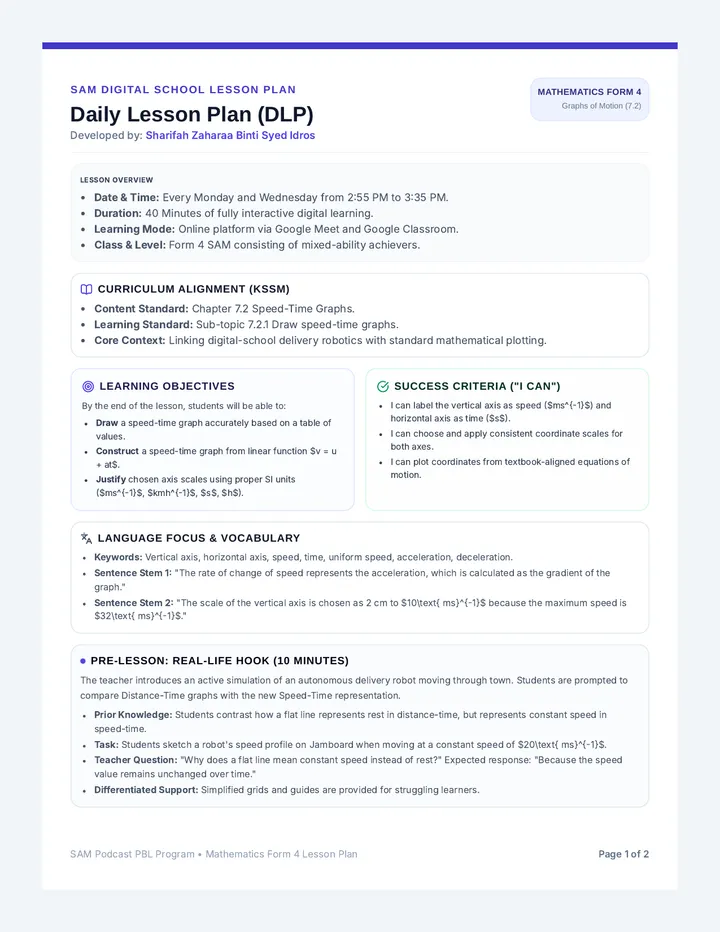
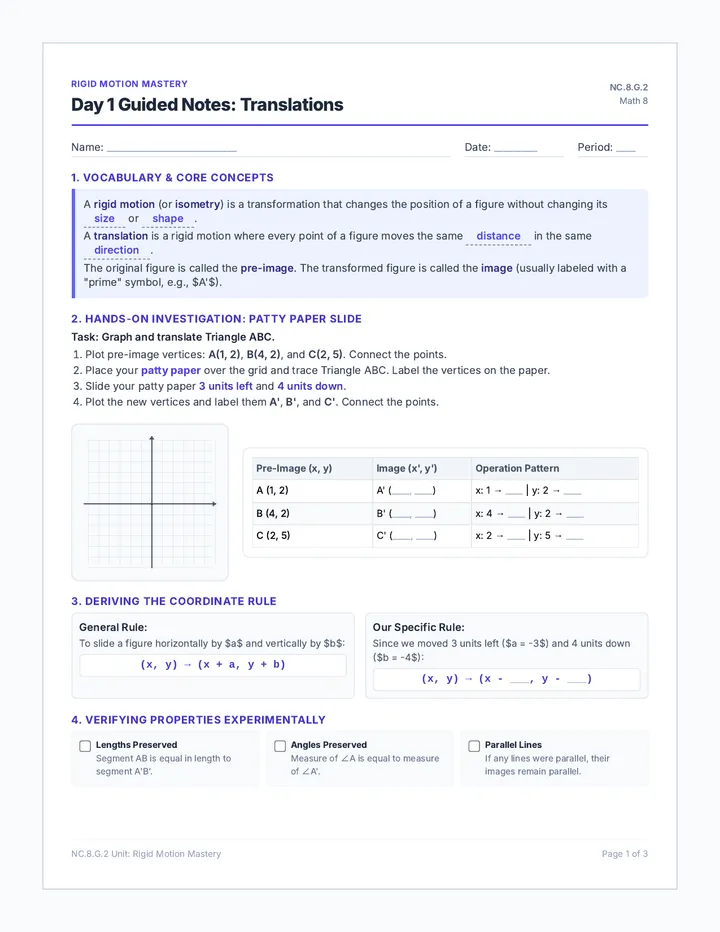
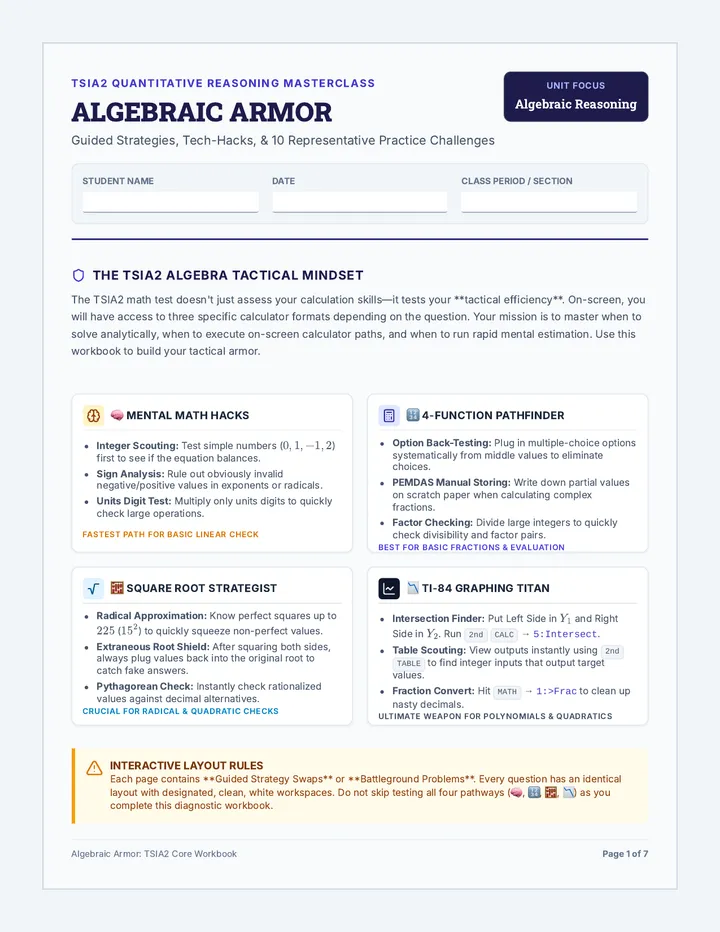
DOUGH
DIVIDERS
Understanding Fractions as Division
THE KITCHEN DILEMMA
We have 3 pizzas.
We have 4 chefs.
How much pizza does each chef get if they share equally?
P
P
P
The Secret Sauce
Numerator
What we share
÷
Denominator
The Groups
3 ÷ 4 = 3/4
Bakery Batch
"A baker makes 5 loaves of cinnamon bread. She wants to divide them equally between 2 customers."
Equation
5 ÷ 2 = ?
Fraction Result
5/2 = 2 1/2
THINK LIKE A CHEF
"If you share 8 cupcakes between 3 friends, how many cupcakes does each friend get?"
A) 3/8
B) 8/5
C) 2 2/3
Discuss with your partner
Sharing Sheet Worksheet Sharing Sheet
Fraction Kitchen Bakery
Chef Name:
Service Date:
Kitchen Instructions:
For each order below, write the division equation and the fraction that shows how much food each person receives. Draw a visual model to show your work.
1
Order #402: 2 pizzas shared equally by 3 friends.
Division Equation
Final Portion (Fraction)
Visual Model
2
Order #403: 5 giant cookies shared equally by 4 customers.
Division Equation
Final Portion (Mixed Number)
Visual Model
3
Order #404: 7 loaves of rosemary bread shared between 2 soup kitchens.
Division Equation
Final Portion (Mixed Number)
Visual Model
4
Chef Challenge: Create your own order!
Write a word problem where 9 items are shared between 5 people . Show the equation and the answer as a mixed number.
Equation
Answer
Order Up Exit Ticket Order Up Exit Ticket
End of Service Check • NC.5.NF.3
Chef Name:
1. Write 7 ÷ 3 as a fraction and a mixed number.
Fraction
Mixed Number
2. Solve the Problem:
"The head chef needs to split 4 trays of lasagna equally between 5 large parties. How much lasagna does each party get?"
Show Model & Equation
Chef Confidence Level
Trainee
Cook
Chef
Kitchen Rules Anchor Charts NC.5.NF.3
Dough Dividers
Fractions ARE Division!
Numerator
The Stuff Shared
÷
Denominator
The Groups Sharing
The Pizza Rule
"3 pizzas shared by 4 friends."
3 ÷ 4 = 3/4
Each person gets 3/4 of a pizza.
P
P
P
Pro Chef Tip
"Always ask: What is being cut? That's your numerator!"
NC.5.NF.7
Slice Servers
Dividing with Unit Fractions
Whole ÷ Unit
"How many 1/4 slices are in 3 whole cakes?"
3 ÷ 1/4 = 12
More pieces!
Unit ÷ Whole
"Split 1/2 tray of brownies into 3 pieces."
1/6
1/6
1/6
1/2 ÷ 3 = 1/6
Smaller pieces!
The Serving Secret
"Look at your visual model first. Does your answer show how many fit or how big a piece is?"
Order Up Task Cards Card 1 NC.5.NF.3
"The baker has 4 loaves of bread. He wants to share them equally with 5 neighbors."
How much bread does each neighbor get?
Order Up!
Card 2 NC.5.NF.4
"A brownie recipe calls for 3/4 cup of cocoa powder. If Chef Sofia makes 2 batches, how much powder does she need?"
Write your answer as a mixed number.
Order Up!
Card 3 NC.5.NF.7
"There is 1/2 of a tray of focaccia left. The server divides it equally into 4 small bags."
What fraction of the whole tray is in each bag?
Order Up!
Card 4 NC.5.NF.4
Kitchen Space Check
"What is the area of a cooling rack that is 2/3 yard long and 1/2 yard wide?"
Draw Model
Order Up!
Topping Totals Teacher Guide Topping Totals
Teacher Lesson Guide • NC.5.NF.4
Topic Multiplying Fractions
Lesson Objective
Students will apply multiplication to fractions by finding portions of ingredients and calculating the area of rectangular baking sheets with fractional side lengths using visual area models.
Materials Needed
Topping Totals Slides
Baking Math Worksheet
Graph Paper
Recipe Check Exit Ticket
Instructional Sequence
1
The Hook: Recipe Scaling (10 mins)
Model "1/2 of 1/2" using a measuring cup or paper circle. Explain that in math, "of" often signals multiplication when dealing with parts of a whole.
2
Direct Instruction: Visual Area Models (20 mins)
Demonstrate tiling a rectangle. Draw a "pan," partition it into columns for the first fraction, then rows for the second. Shade the overlap to find the product.
3
Guided Practice: Pan Sizes (10 mins)
Practice Area = L × W with 2/3 × 3/4. Help students see that the denominator of the product is the total number of small squares in the model.
4
Independent Work (15 mins)
Students complete the "Baking Math" worksheet. Encourage them to draw "transparent" overlaps (shading vertical one way, horizontal another).
Troubleshooting
Common Error: Students may add the numerators or find common denominators. Fix: Reiterate that we are finding a "part of a part."
Misconception: Thinking multiplication always makes a number larger. Fix: Compare products to factors using area models.
Topping Totals Slides Fraction Kitchen
Topping
Totals
Multiplying Fractions & Finding Area
Recipe Scaling
The Ingredients:
1 batch needs 3/4 cup of chocolate chips.
How much do we need for 2 batches?
The Calculation
2 × 3/4
6/4 = 1 1/2 cups
Area Model Shading
Visualizing 2/3 × 3/4
2/3 yard
3/4 yard
Overlap Area
6/12 sq yd
Simplified
1/2 sq yard
Chef Challenge
"Which model correctly shows 1/2 × 1/3?"
Model A
Model B
Model C
Discuss with your partner
Baking Math Worksheet Baking Math
Fraction Kitchen Production • NC.5.NF.4
Chef: ________________________________
Part 1: Scaling the Recipes
1. A cake recipe uses 2/3 cup of sugar. Chef Mario wants to make 4 cakes.
How much sugar is needed in total?
Equation & Calculation Space
Final Answer: ________________________________
2. A cookie recipe uses 3/4 lb of butter. The baker only wants to make 1/2 of a batch.
How much butter is needed?
Equation & Calculation Space
Final Answer: ________________________________
Part 2: The Bakery Pan Area
3. Find the area of a baking sheet that is 3/4 foot long and 2/5 foot wide.
Draw Visual Area Model
Numerical Equation
Final Area Result
4. A rectangular tart has side lengths of 2/3 inch and 4/5 inch.
Draw Visual Area Model
Numerical Equation
Final Area Result
Chef Bonus Challenge
A baker needs to frost a rectangular counter that is 5/6 yard long and 2/3 yard wide. What is the total area to be frosted?
Model
Equation & Answer
Recipe Check Exit Ticket Recipe Check
Quality Control Exit Ticket • NC.5.NF.4
Baker Name:
1. Solve: 3/5 × 2/3 = ___________
Show Your Work
2. Visual Challenge:
"A kitchen mat has a length of 1/2 meter and a width of 4/5 meter. What is the area?"
Model Multiplication
Area Result
"When you multiply two fractions between 0 and 1, is the product larger or smaller than the original factors? Explain why."
Explanation Station
Slice Servers Teacher Guide Slice Servers
Teacher Lesson Guide • NC.5.NF.7
Topic Dividing Fractions
Lesson Objective
Students will divide unit fractions by whole numbers and whole numbers by unit fractions. They will use visual models to represent division and solve real-world problems.
Materials Needed
Slice Servers Slides
Portion Patrol Worksheet
Fraction Strips
Final Slicing Exit Ticket
Instructional Sequence
1
The Hook: Slicing the Slice (10 mins)
Present Scenario A: "We have 3 whole cakes. Each serving is 1/4 of a cake. How many servings can we make?" Present Scenario B: "We have 1/2 of a pizza. 3 friends share it equally."
2
Direct Instruction: Visual Division (20 mins)
Model Whole ÷ Fraction using tape diagrams. Model Fraction ÷ Whole by partitioning a shaded region. Emphasize that we are counting "how many fit" or "how big one piece is."
3
Guided Practice: Kitchen Portions (10 mins)
Practice translating word problems into division expressions. Focus on identifying the Dividend (what is being cut) vs. the Divisor (how it's being cut).
4
Independent Work (15 mins)
Students complete the "Portion Patrol" worksheet. Have them explain their models to a partner using "of" or "groups" language.
Pacing Tip
Allow students time to draw. Visualizing why the answer becomes larger or smaller is more important than memorizing "Keep Change Flip" at this stage.
Slice Servers Slides Fraction Kitchen
Slice
Servers
Dividing with Unit Fractions
Two Ways to Slice
1
Whole ÷ Fraction
"We have 4 loaves. Each slice is 1/3 loaf. How many slices total?"
4 ÷ 1/3 = 12
2
Fraction ÷ Whole
"We have 1/2 pizza. 4 friends share it. How much does each get?"
1/2 ÷ 4 = 1/8
Model: 3 ÷ 1/2
"How many halves are in 3 wholes?"
12
34
56
The Answer is 6
Model: 1/4 ÷ 2
"Split a quarter in half. What part of the whole is it?"
1/8
1/8
Result: 1/8
Portion Patrol Worksheet Portion Patrol
Fraction Kitchen Serving Station • NC.5.NF.7
Chef: ____________________ Date: ________
Challenge 1: Whole Number ÷ Unit Fraction
1. A baker has 4 lbs of dough. Each pizza crust needs 1/2 lb of dough.
How many pizzas can the baker make?
Equation
Visual Model
2. 6 packs of sprinkles are poured into containers that hold 1/3 pack each.
How many containers are filled?
Equation
Visual Model
Challenge 2: Unit Fraction ÷ Whole Number
3. 1/3 of a cake is left. 4 staff members want to share it equally.
What fraction of a whole cake does each get?
Equation
Visual Model
4. A chef has 1/4 gallon of oil to split between 5 dressings.
How much oil goes into each dressing?
Equation
Visual Model
Kitchen Rule of Thumb
When you divide a whole number by a unit fraction , the answer is than the original number.
When you divide a unit fraction by a whole number , the answer is than the original fraction.
Final Slicing Exit Ticket Final Slicing
Kitchen Checkout Exit Ticket • NC.5.NF.7
Server Name:
1. Solve and Model: 2 ÷ 1/3
Model Space
Final Answer
2. Solve and Model: 1/5 ÷ 2
Model Space
Final Answer
"Which problem would result in a larger answer: 5 ÷ 1/2 or 1/2 ÷ 5? Explain why."
Chef's Reasoning