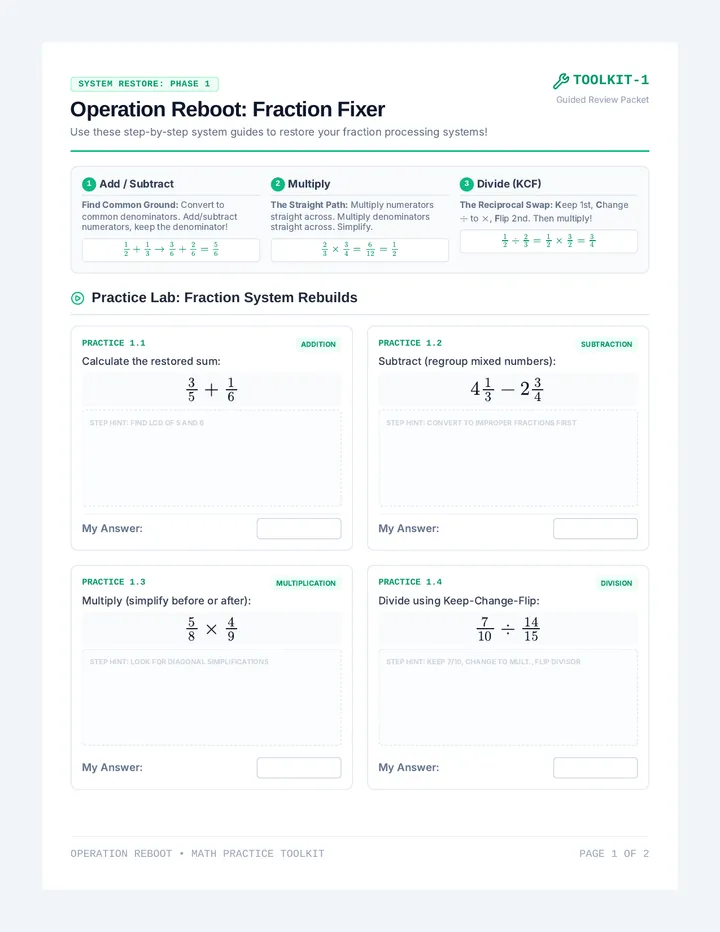
Fraction Tower SlidesFRACTION TOWER TAKEDOWN Conquering complex fractions with structural strength and denominator-clearing speed. 7th Grade Math Mastery Level Today's Mission Master the Clearing Method to simplify complex fractions faster than traditional Keep-Change-Flip. Key Terms Complex Fraction Denominator Clearing Reciprocal Strategy We will analyze a "Monster Tower" and learn to attack it from the bottom up! WARM-UP SHOWDOWN Which method do you find more intuitive for this problem? Method A: Keep-Change-Flip \[ \frac{\frac{1}{2}}{\frac{3}{4}} = \frac{1}{2} \times \frac{4}{3} = \frac{4}{6} = \frac{2}{3} \] Traditional Division by Reciprocal Method B: Clearing \[ \frac{\frac{1}{2} \cdot \color{pink}{4}}{\frac{3}{4} \cdot \color{pink}{4}} = \frac{2}{3} \] Multiply Top/Bottom by LCD The Monster Tower Witness the simplification of a super complex fraction. Watching Strategy: 1. Look for patterns in the "Repeated Addition" 2. Watch the "Bottom-Up" movement 3. Pay attention to how the narrator "Clears" the fractions Embedded media Pause at 2:25 Simplifying a Super Complex Fraction! Watch for the "Clearing" technique. Pause Point #1 Repeated Addition (0:25) Think-Pair-Share The narrator sees a tower of additions: 3+3+3+3+3+3+3+3 Challenge Question Why is multiplication the first step in solving a "complex fraction" like this? "Multiplication is just fast addition." Pause Point #2 Bottom-Up Attack (1:37) "In order to simplify this super complex fraction, we need to work our way from the bottom all the way to the top." Step 1 Find the smallest sub-fraction Step 2 Clear the denominator Step 3 Climb the tower level by level The Secret Weapon (2:25) Instead of Keep-Change-Flip, the narrator does this: \[ \frac{12}{\frac{9}{2}} \cdot \frac{\color{pink}{2}}{\color{pink}{2}} \] The Logic Multiplying by \( \frac{2}{2} \) is the same as multiplying by 1. It doesn't change the value! The Result The denominator fraction disappears instantly. No more "flipped" confusion. Pro Tip: Simplify First! At 4:20, the narrator shows \( \frac{18 \times 8}{45} \). Instead of doing \( 18 \times 8 = 144 \), he simplifies by dividing 18 and 45 by 9. \( \frac{18 \cdot 8}{45} \rightarrow \frac{2 \cdot 8}{5} = \frac{16}{5} \) Never handle a big number you don't have to! Method Match-Up 1 You will solve 3 problems on your worksheet. 2 Solve once using Keep-Change-Flip. 3 Solve again using Denominator Clearing. Which method is faster? Which method has fewer places to make a mistake? Stump the Teacher Create your own "Monster Tower" fraction. If it takes me more than 60 seconds to solve, you win! Requirements: At least 4 levels high Must be solvable (no zeros!) Use numbers between 1 and 20
Fraction Takedown WorksheetFraction Takedown Method Match-Up Worksheet Agent Name: Mission Date: Phase 1: Warm-Up Showdown Solve the problem below using two different strategies. Which one felt more efficient? Method A: Keep-Change-Flip \( \frac{1/2}{3/4} \) Method B: Denominator Clearing \( \frac{1/2}{3/4} \) Phase 2: Method Match-Up Solve each complex fraction using both methods. Circle the method you found faster for each problem. Target 01 \[ \frac{5}{\frac{5}{2}} \] Keep-Change-Flip Area Denominator Clearing Area Target 02 \[ \frac{\frac{2}{3}}{\frac{4}{9}} \] Keep-Change-Flip Area Denominator Clearing Area Target 03 \[ \frac{12}{\frac{15}{4}} \] Keep-Change-Flip Area Denominator Clearing Area Phase 3: Mission Reflection 1. Overall, which method did you prefer for solving "Monster Tower" style fractions? Why? 2. The narrator mentioned a "bottom-up" strategy. Why is it impossible to solve these towers from the top down? Extension: Stump the Teacher Construct your own "Monster Tower" below. Can you make it complex enough to take more than 60 seconds to solve? Design Your Tower Here
Fraction Tower Discussion CardsFraction Tower Discussion Cards Small Group / Whole Class Prompt Set Video Timestamp: 0:25 The narrator sees eight 3s being added together. Is there a faster way to write this expression? Why is this "shortcut" helpful when dealing with massive complex fractions? Fraction Tower Takedown Video Timestamp: 1:37 Predict the first step. Why must we start at the absolute bottom of the tower? What happens if you try to solve from the top down? Try to explain the logic. Fraction Tower Takedown The Secret Weapon The narrator multiplies the top and bottom by the same number (e.g., \( \times 2/2 \)). Why does this work? Does this change the value of the fraction? Why or why not? Fraction Tower Takedown Video Timestamp: 4:20 "Simplify before you multiply." Why did the narrator simplify 18 and 45 by 9 first? Compare solving \( (18 \cdot 8) / 45 \) with and without simplifying first. Which is safer? Fraction Tower Takedown Method Showdown When is Keep-Change-Flip better? When is Denominator Clearing better? Think of a specific problem where one method would be much easier than the other. Fraction Tower Takedown Deep Logic The narrator calls this a "Monster Problem." What makes a math problem a "Monster"? Is it the size of the numbers, the number of steps, or something else? Fraction Tower Takedown Teacher Note: Cut along the dashed lines. Use these cards for "Turn and Talk" moments during the video viewing or as exit ticket prompts. For a movement-based activity, tape them around the room and have students rotate in small groups to discuss and record one "key takeaway" for each card.
Fraction Takedown Answer KeyFraction Takedown Answer Key & Teacher Guide Official Key Phase 1: Warm-Up Showdown Keep-Change-Flip \( \frac{1}{2} \div \frac{3}{4} = \frac{1}{2} \cdot \frac{4}{3} = \frac{4}{6} = \mathbf{\frac{2}{3}} \) Denominator Clearing \( \frac{\frac{1}{2} \cdot 4}{\frac{3}{4} \cdot 4} = \frac{2}{3} \) (LCD of 2 and 4 is 4) Phase 2: Method Match-Up Target 01 \( 5 / (5/2) \) KCF: \( 5 \cdot \frac{2}{5} = \frac{10}{5} = 2 \) Clearing: \( \frac{5 \cdot 2}{(5/2) \cdot 2} = \frac{10}{5} = 2 \) Target 02 \( (2/3) / (4/9) \) KCF: \( \frac{2}{3} \cdot \frac{9}{4} = \frac{18}{12} = \frac{3}{2} \) Clearing: \( \frac{(2/3) \cdot 9}{(4/9) \cdot 9} = \frac{6}{4} = \frac{3}{2} \) Target 03 \( 12 / (15/4) \) KCF: \( 12 \cdot \frac{4}{15} = \frac{48}{15} = \frac{16}{5} \) Clearing: \( \frac{12 \cdot 4}{(15/4) \cdot 4} = \frac{48}{15} = \frac{16}{5} \) Phase 3: Reflection Key Q2: Why is it impossible to solve towers from the top down? "Top-down" fails because the divisor at the top is itself an unsolved complex fraction. Division requires a single number or a simple fraction. By starting at the bottom, we resolve the 'deepest' layers first, turning them into simple values that can then be used as denominators for the layer above. Instructional Tips • Emphasize that "Clearing" is just multiplying by a form of 1 (e.g., 2/2 or 4/4). • Students struggling with KCF usually forget to flip. "Clearing" avoids this by removing the fraction entirely. • For the extension, encourage students to use numbers that have common factors to make the "Monster" look scarier but actually be easier to simplify (like the narrator's 18 and 45).