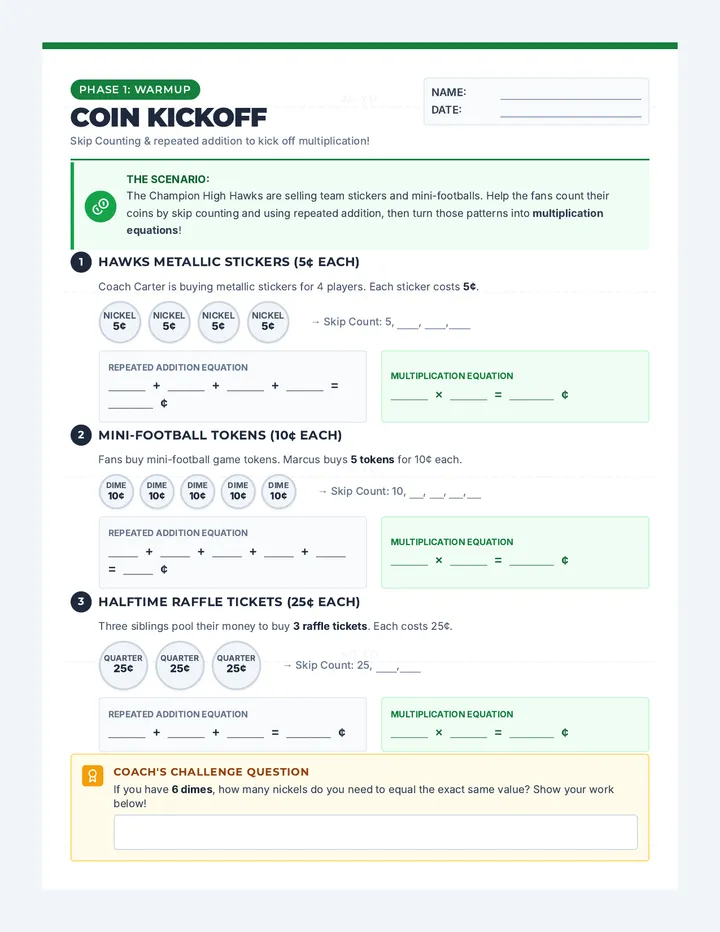
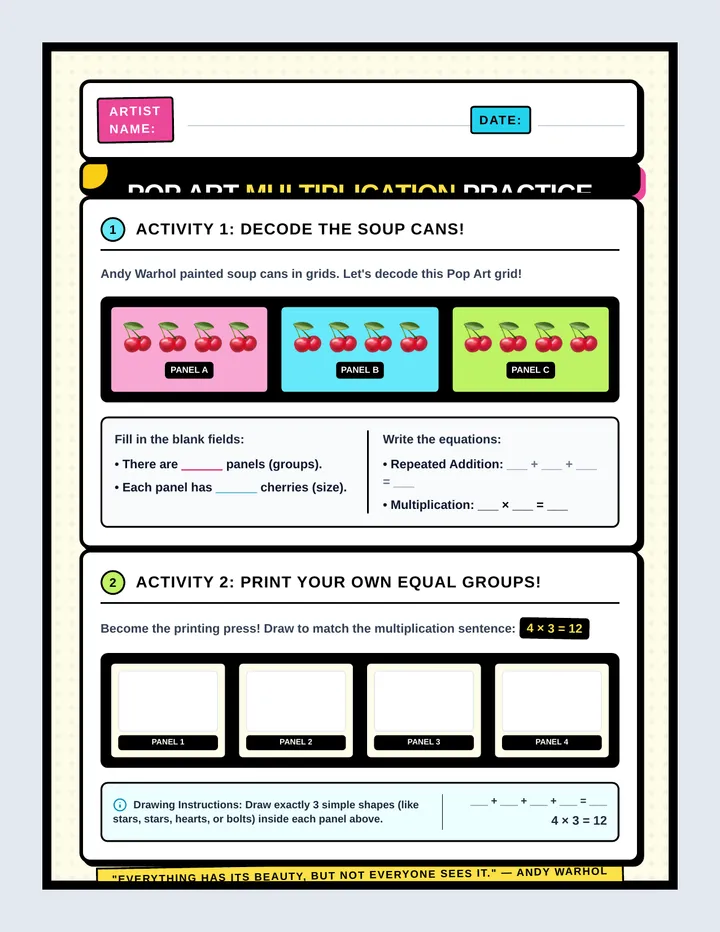
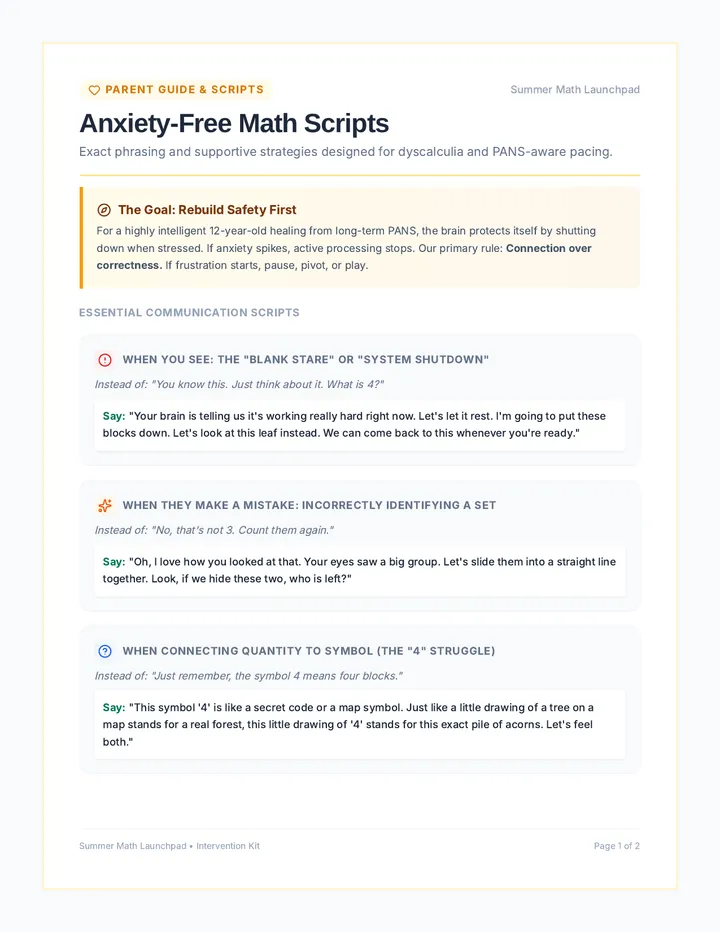
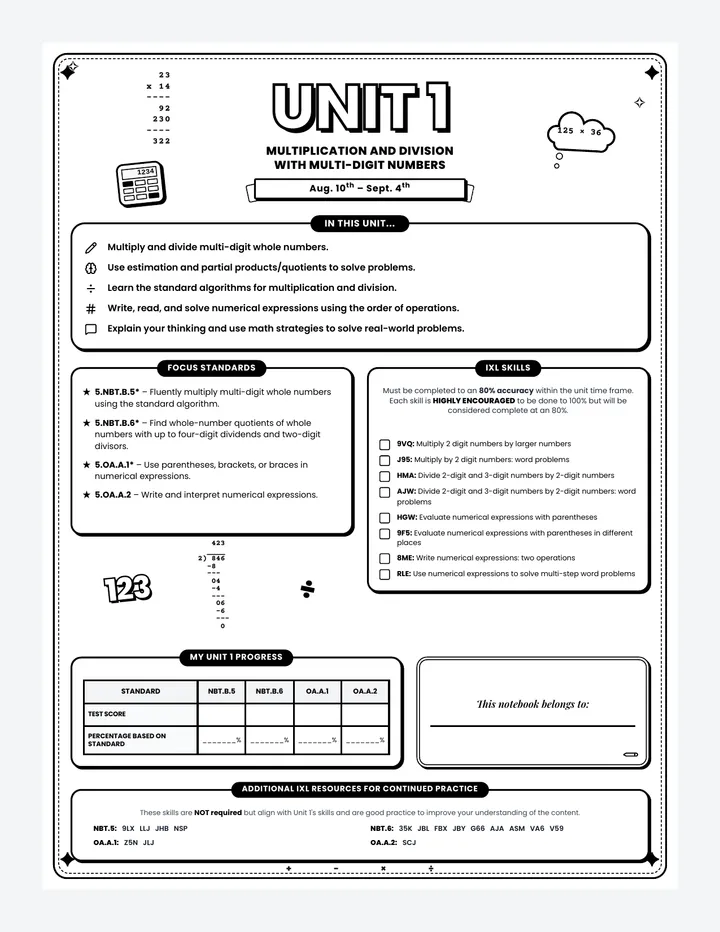
Fraction Feast Slides Slice & Share
Equal Parts • Partes Iguais
1 Whole / Todo
1
Fair Share / Partes Iguais
Not Fair / Desigual
Which is Fair? / Qual é igual?
A
B
Split it! / Divida! Fair Share Finder Worksheet Fair Share Finder
Partes Iguais ou Desiguais
Nome:
Data:
Igual
Desigual
Circle the face for each picture.
Circule o rosto para cada figura.
Slice and Share Teacher Guide Facilitation Guide: Fraction Foundations
Designed for SIFE support with minimal literacy (Portuguese/English)
Learning Goal
To establish the conceptual prerequisite for Eureka Math Grade 3 Module 5: Fractions are made of equal parts. This guide focuses on identifying "Fair Shares" (equal) vs. "Unfair Shares" (unequal) using high-visual, low-text strategies.
Visual & Verbal Anchors
Concept: Equal (Fair)
English: "Equal" / "Fair"
Portuguese: "Igual" (ee-gwahl) / "Justo" (zhoos-toh)
Gesture: Hold hands out flat, level with each other.
Visual: Smile icon
Concept: Unequal (Not Fair)
English: "Not Equal" / "Not Fair"
Portuguese: "Desigual" (day-zee-gwahl) / "Não justo" (now zhoos-toh)
Gesture: Hold hands at different heights (one high, one low).
Visual: Frown icon
Instructional Sequence (Slides)
Slide 2
Defining "Whole" (Todo):
Point to the circle and square. Use a circular motion with your hand to show the entire shape. Say: "1 Whole. Todo."
Slide 3
The Fair Share (Igual):
Point to the smiles. Explain: "The same! Everyone is happy." Use the level-hands gesture. Emphasize that the space on both sides is the same size.
Slide 4
The Unfair Share (Desigual):
Point to the frown and the small slice. Explain: "No! Not fair. One is big, one is small." Show the difference in size with your hands.
Assessment Administration
Model First: Sit with the student. Point to the first problem (Equal Circle). Point to the smile, then the frown. Dramatically circle the smile and say "Igual! Fair!"
Check for "Circle" vs. "Mark": Ensure the student knows to circle one and leave the other. Some students with limited formal schooling may try to mark both or color them in.
Observation: As the student works, watch for hesitation on Item 6 (Triangle). This is the most complex visual. If they struggle, use paper-folding to show how the parts don't overlap perfectly.
Non-Verbal Check: If the student finishes, point to a "Desigual" shape and ask "Igual?" with a questioning tone. See if they can shake their head "No."
Next Steps (Eureka Connection)
Once the student consistently identifies equal vs. unequal parts, move to **halves** and **fourths**. Continue using the Portuguese words for "Two parts" (Duas partes) and "Four parts" (Quatro partes) before introducing written fractions like 1/2 or 1/4.
Counting Parts Slides Count the Parts
Contando Partes
2
3
4
2
2 Partes / Equal Parts
1 2
1 2
3
3 Partes / Equal Parts
1 2 3
1 2 3
4
4 Partes / Equal Parts
1 2 3 4
1 2 3 4
How many? / Quantas?
1 2 3
2 3 4
Part Counter Worksheet Count the Parts
Contando Partes
Nome:
1
2
3
Circle the number.
Circule o número.
1 2 3
2 3 4
3 4 5
1 2 3
2 3 4
3 4 5
Counting Parts Teacher Guide Facilitation Guide: Counting Parts
Lesson 2: Quantifying equal parts (SIFE Support)
Learning Goal
Once the student understands equal parts , they must learn to count them. This lesson bridges the gap between seeing parts and naming them as halves, thirds, and fourths through numeric symbols.
Numerical Anchors
2
Duas Partes
(Two parts)
3
Três Partes
(Three parts)
4
Quatro Partes
(Four parts)
Steps for Success
1
Touch and Count:
Use the slides. Physically touch each part on the screen and count out loud: "Um... dois!" (1... 2!). Encourage the student to mirror your counting and touch the parts.
2
The "Whole" Check:
Regularly point to the entire shape and say "1 Todo" (1 Whole) before counting the parts. This reinforces that the parts live inside a single whole.
3
Symbol Matching:
On the worksheet, show the student how the number of fingers you hold up matches the number of parts and the number they circle.
Common SIFE Misconceptions
Counting Lines instead of Spaces: The student might count the partition lines (1 line for halves) instead of the areas. Point to the middle of the space, not the lines.
Ignoring Equality: The student might try to count 3 parts in an unequal shape. Always refer back to Lesson 1: "Is it fair? If not fair, we don't count for fractions."
Number Orientation: Since the student is non-literate, ensure they recognize 2, 3, and 4. Use dot patterns next to the numbers if they struggle with the symbols.
This lesson supports Eureka Math M5 Topic A, Lessons 1-2. It prepares the student to identify unit fractions by first mastering the count of the denominator.
One Piece Slides One Piece Only
Apenas Uma Parte
1
2
1 out of 2 / Uma de duas
1
3
1 out of 3 / Uma de três
1
4
1 out of 4 / Uma de quatro
Is it 1 part? / É uma parte? Unit Fraction Worksheet One Piece Picker
Apenas Uma Parte
Nome:
Circle the shape with 1 part shaded.
Circule a figura com 1 parte pintada.
Shade only 1 part.
Pinte apenas 1 parte.
1 / 3
1 / 2
1 / 4
1 / 3
Unit Fraction Teacher Guide Facilitation Guide: Unit Fractions
Lesson 3: The concept of "One Part" (SIFE Support)
Learning Goal
To introduce the **unit fraction** (1 part out of a whole). This is the foundation for Eureka Math's unit fraction notation. The goal is for the student to identify exactly one shaded part and relate it to the total number of parts counted in Lesson 2.
Verbal Anchors
The Phrase
"1 out of [X]"
"Uma de [Número]"
The Gesture
Point to the shaded part with **one** finger. Then spread your hand to show the **whole** shape.
Instructional Flow
1
See the Part:
Show Slide 2 (1/2). Point to the purple side. Say "One. Uma." Point to the empty side. "Total? One, two." Model the phrase: "1 out of 2."
2
Symbol Introduction:
Show the fraction symbol on the slide (1 over 2). Point to the 1. "1 part." Point to the 2. "Total parts." Keep it verbal and visual; do not expect the student to write the numbers yet.
3
Active Shading:
On the worksheet, watch the student shade. They might want to color the whole thing. Redirect by saying "Only one! Apenas uma!" and pointing to a single segment.
Support Strategies
Color Coding: Always use the same color (like Purple) for the shaded part to build consistency.
Physical Manipulatives: Use blocks or paper cut-outs. Hand the student **one** piece and ask them to place it back into the "puzzle" (the whole).
Reading Symbols: If the student recognizes digits, point to the denominator on the worksheet (e.g., the 3 in 1/3) and ask them to count the segments to verify.
This lesson bridges to Eureka Grade 3 Module 5 Lesson 3 & 4. It establishes the "unit" as the building block for all fractions.
Non-Unit Fraction Slides More Than One
Mais de Uma Parte
2
3
2 out of 3 / Duas de três
1 2
1 2
3
4
3 out of 4 / Três de quatro
1 2 3
1 2 3
How many shaded? / Quantas pintadas?
1 2
3 4
More Parts Worksheet More Parts Picker
Mais de Uma Parte
Nome:
2
How many parts are shaded?
Quantas partes estão pintadas?
1 2 3
2 3 4
Shade the number.
Pinte o número.
2
4
3
3
2
2
3
4
Non-Unit Fraction Teacher Guide Facilitation Guide: Non-Unit Fractions
Lesson 4: Counting multiple shaded parts (SIFE Support)
Learning Goal
To move from "one part" to "multiple parts." The student will identify that the numerator (the top number) tells us **how many** parts to consider/shade. This connects directly to Eureka Math Module 5's work with non-unit fractions.
Numerical Fluency
The Phrase
"[Number] out of [Total]"
"[Número] de [Total]"
The Gesture
Touch each shaded part one by one while counting. Then circle the whole group with your hand.
Step-by-Step Instruction
1
Review Unit Fractions:
Start by showing a 1/4 model. Ask "Quantas?" (How many?). Then show a 3/4 model. Count the parts together: "Um, dois, três!"
2
Fraction Notation:
On Slide 3 (3 out of 4), point to the top '3'. Explain: "3 shaded." Point to the bottom '4'. "4 total." Even if the student cannot write the numbers, encourage them to trace the digits with their finger.
3
The Shading Challenge:
On the worksheet (Section 2), look at the top number. Have the student hold up that many fingers before they start shading. Say "Pinte [Número]!"
Watch For...
Counting Unshaded Parts: The student might count the empty spaces instead of the shaded ones. Use a high-contrast color (like Red) to make the shaded parts obvious.
Shading randomly: If they shade non-adjacent parts, that is okay for now as long as the count is correct. However, for number line preparation later, try to encourage shading left-to-right.
Full Shading: If a student shades the whole shape when asked for 2/4, remind them of Lesson 1 "Fair Share" — ask if everyone gets the same.
This lesson completes the visual foundation for Eureka Grade 3 Module 5 Lesson 5-7. The student is now ready to begin looking at these same concepts on a number line with heavy support.
Fraction Visual Poster Fraction Visuals
Visualização de Frações
1 Todo
1/2 1 de 2
1/3 1 de 3
2/3 2 de 3
1/4 1 de 4
2/4 2 de 4
3/4 3 de 4
1/5 1 de 5
2/5 2 de 5
3/5 3 de 5
4/5 4 de 5