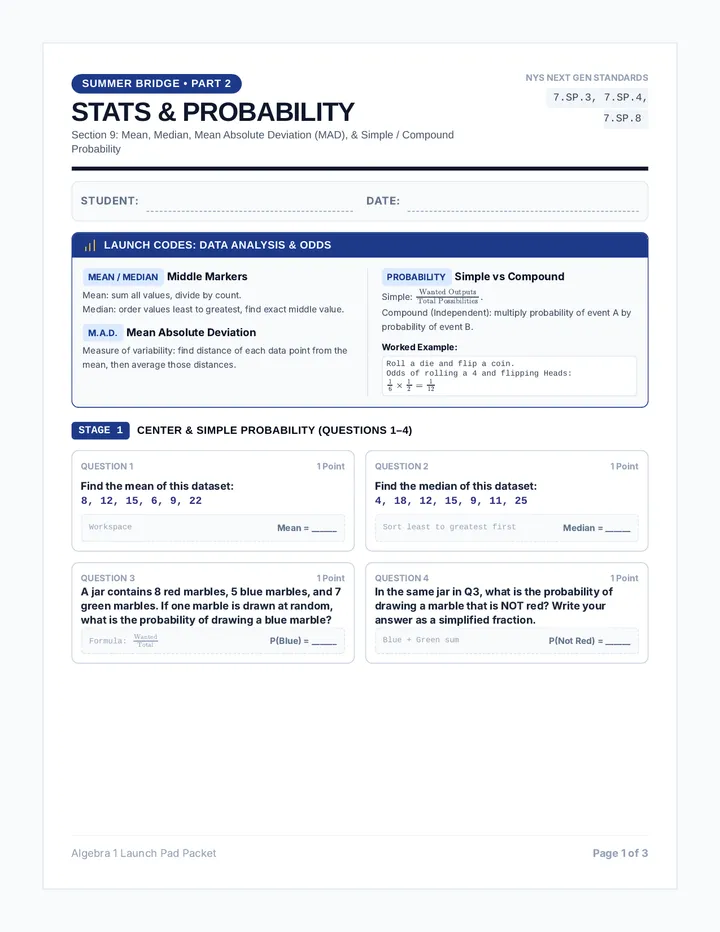
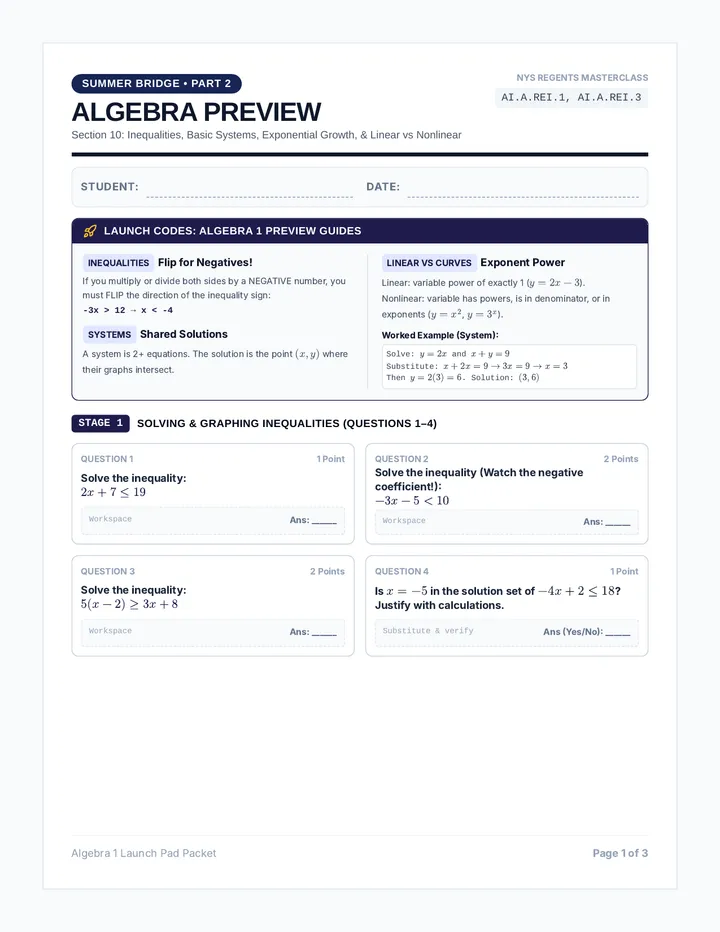
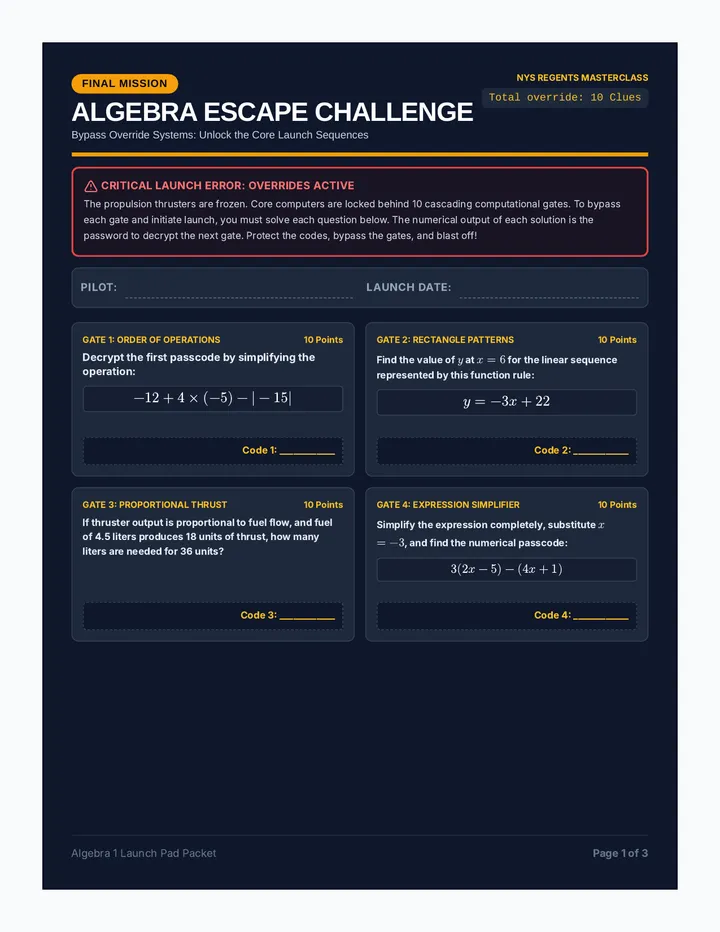
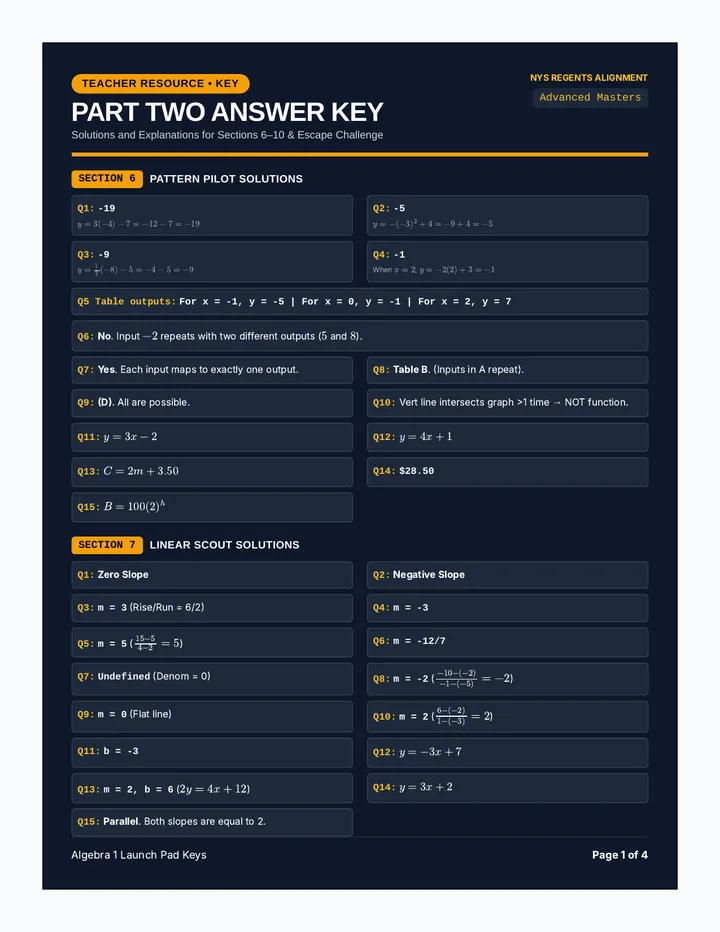
Division Semantics Slides Division Semantics
Blueprinting the Logic of Division
Unit 1.1
Fraction Division Series
The Quarter Challenge
Consider this real-world scenario:
You have $20.00 in your pocket. You need to exchange it for quarters ($0.25).
How many quarters do you have?
20 ÷ 0.25
20 ÷ 1/4
Why is the answer larger than the original number?
The Dual Logic of Division
Type A
Partitive
"Fair Sharing"
Sharing a total into a known number of equal-sized groups.
"If I have 10 cookies and 2 bags, how many cookies per bag?"
Type B
Quotative
"Measurement"
Finding how many groups of a certain size fit into the total.
"If I have 10 cookies and each bag holds 2, how many bags?"
Why Quotative Matters
When dividing by a fraction, we ask:
"How many groups of this size fit into this total?"
Easier to visualize
Works for all numbers
The Number Line Blueprint
Let's model 2 ÷ 1/2
0 1 2
1
Divide each unit into pieces of size 1/2.
2
Count how many jumps it takes to reach 2.
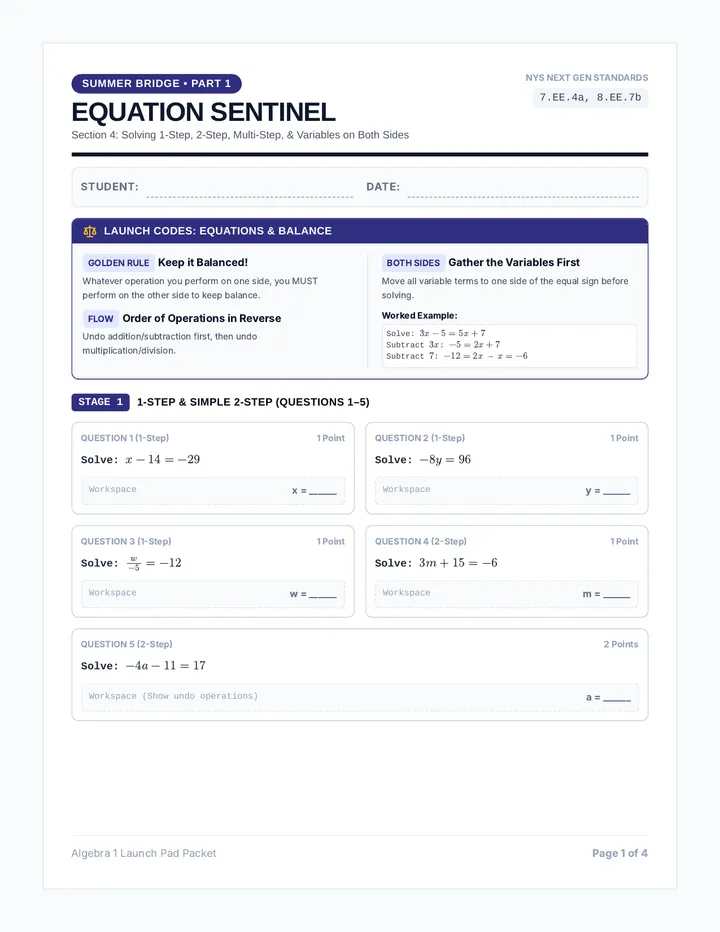
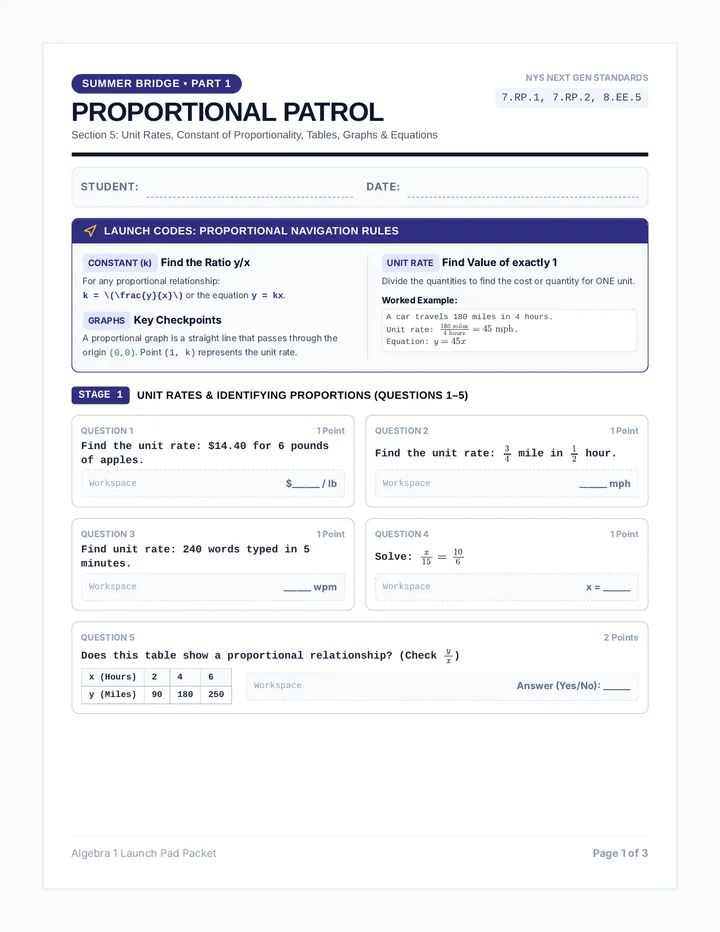
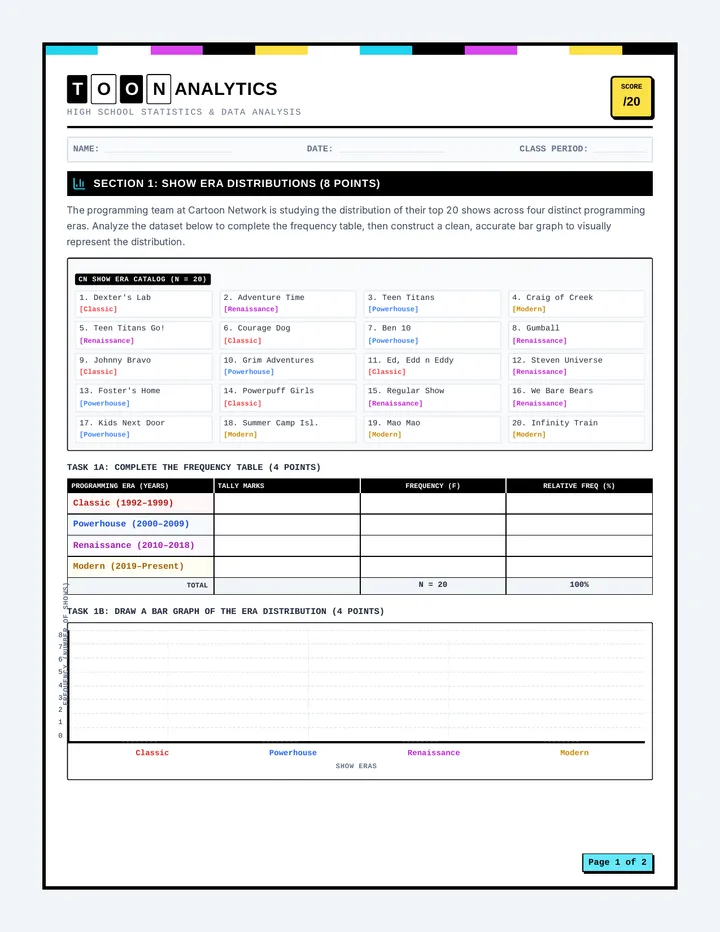
Modeling Division Worksheet Modeling Fraction Division
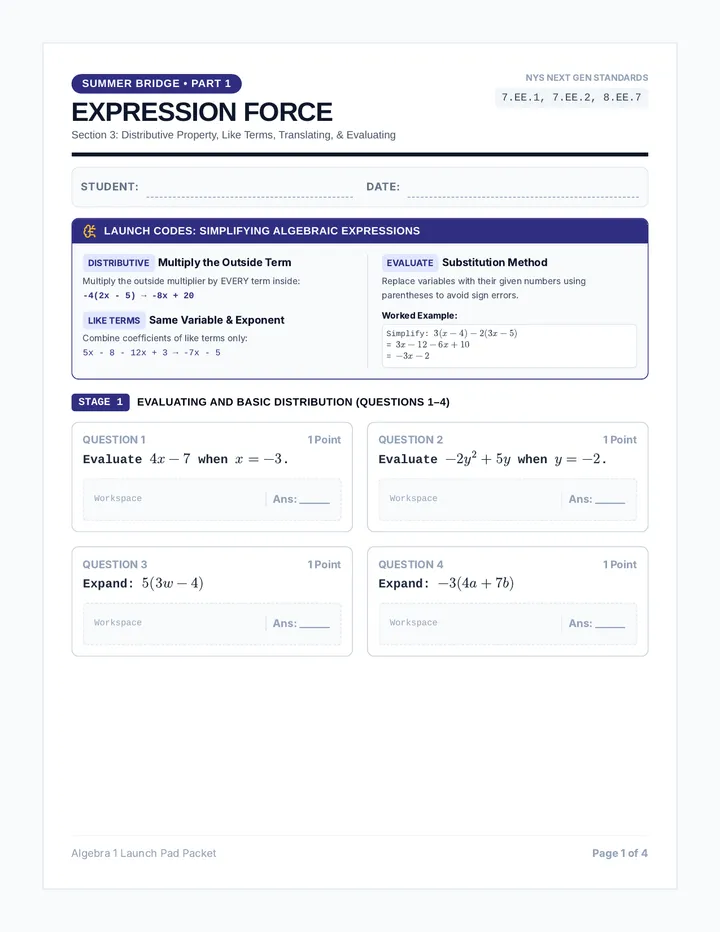
Lesson 1.1: The Quotative Perspective
Name:
Date:
Key Concept: Quotative Division
Instead of sharing, think of division as measuring. The expression \( A \div B \) asks: "How many groups of size \( B \) are inside \( A \)?"
01
The Whole Number Bridge
Model the expression \( 6 \div 2 \) on the number line below. Use "jumps" of size 2.
0
6
Number of jumps:
Explanation in words:
02
Unit Fraction Division
Model \( 3 \div \frac{1}{2} \). First, divide each whole unit into halves, then count the jumps.
0
1
2
3
How many "halves" are in 3 wholes? Explain why the result is larger than 3.
03
Non-Unit Fraction Challenge
Model \( 2 \div \frac{2}{3} \). Mark thirds on the number line, then jump by two-thirds at a time.
0
1
2
Does the size of the jump (\(\frac{2}{3}\)) change how many jumps you can make compared to jumping by \(\frac{1}{3}\)?
Spec: 9.MATH.DIV.01
Construction in progress...
Division Semantics Teacher Guide Instructional Blueprint
Lesson 1: Division Semantics
Core Objective
Students will shift from "sharing" division to "measurement" (quotative) division to build a conceptual bridge to fractions.
Essential Question
"How many groups of size B fit into total A?"
Materials List
Semantics Slide Deck
Modeling Worksheet
20 Quarters (Optional physical hook)
0-10 MIN
The Hook: The Quarter Exchange
"Students often think division always makes things 'smaller'. The quarter hook breaks this immediately."
Prompt: "If I have $20, why does dividing it by $0.25 give me 80 coins? Is it still 'division' if the number goes up?"
Misconception: Students might try to multiply. Guide them back to the definition: We are asking how many 0.25s are in 20.
10-30 MIN
Guided Exploration: Number Lines
Work through the first problem on the worksheet together. Transition from Whole Numbers (6 ÷ 2) to Unit Fractions (3 ÷ 1/2).
Look For
Students correctly dividing the 'whole' spaces into the fraction's denominator (e.g., cutting a space into 3 parts for thirds).
Ask This
"If we jump by 2/3 instead of 1/3, will we take more or fewer jumps? Why?"
30-45 MIN
Closure: The Language of Division
"Before they leave, every student should be able to translate \( 4 \div \frac{2}{5} \) into the sentence: 'How many groups of two-fifths are in four?'"
Common Denominator Slides The Common Denominator
Simplifying the Blueprint
Same Size, Same Logic
You have 8 pieces of pizza. Each serving is 2 pieces.
How many servings?
8 ÷ 2 = 4
You have 8/10 of a pizza. Each serving is 2/10.
How many servings?
8/10 ÷ 2/10 = ?
Architect's Discovery
If the denominators match, you just divide the numerators.
\[ \frac{a}{c} \div \frac{b}{c} = a \div b \]
"When pieces are the same size, we only care how many pieces we have."
What if they don't match?
01
The Problem
\( \frac{1}{2} \div \frac{1}{4} \)
The denominators (2 and 4) are different sizes.
02
Re-Draft
\( \frac{2}{4} \div \frac{1}{4} \)
Convert to common denominators. Now the "pieces" are the same size.
03
Solve
\( 2 \div 1 = 2 \)
Just divide the top numbers!
Mental Blueprint Check
A) \( \frac{9}{12} \div \frac{3}{12} \)
?
B) \( \frac{2}{3} \div \frac{1}{6} \)
Hint: Match them!
C) \( \frac{3}{4} \div \frac{1}{8} \)
?
Common Denominator Worksheet Common Denominator Strategy
Fraction Construction: Protocol 1.2
Station / Name
The Rule
"When piece sizes match, divide the numerators."
\( \frac{a}{c} \div \frac{b}{c} = \frac{a \div b}{1} \)
EXAMPLE
\( \frac{4}{5} \div \frac{2}{5} \) \( 4 \div 2 = 2 \)
Set 1: Matching Denominators
\( \frac{10}{11} \div \frac{2}{11} = \)
\( \frac{12}{15} \div \frac{4}{15} = \)
Set 2: Re-Drafting (Converting)
Show your work as you convert to a common denominator first.
\( \frac{1}{2} \div \frac{1}{8} \)
÷
SOLVE
\( \frac{2}{3} \div \frac{4}{9} \)
÷
The "Common Sense" Check
Why does this strategy work? In your own words, explain why we can ignore the denominator once the denominators are the same.
Common Denominator Answer Key Answer Key
Common Denominator Strategy
Faculty Reference Guide // Lesson 1.2
Set 1: Matching Denominators
\( \frac{10}{11} \div \frac{2}{11} \)
5
Logic: 10 pieces ÷ 2 pieces = 5 groups
\( \frac{12}{15} \div \frac{4}{15} \)
3
Set 2: Re-Drafting (Converting)
\( \frac{1}{2} \div \frac{1}{8} \)
\( \frac{4}{8} \div \frac{1}{8} \rightarrow 4 \div 1 \)
4
\( \frac{2}{3} \div \frac{4}{9} \)
\( \frac{6}{9} \div \frac{4}{9} \rightarrow 6 \div 4 \)
1.5
Teacher Discussion Points
Q:
Wait, \( 6 \div 4 \) is \( 1.5 \). Is it okay to have a decimal answer in fraction division?
A:
Yes! It means one full group of size \( \frac{4}{9} \) fits into \( \frac{6}{9} \), with half a group left over. This transition is vital for understanding mixed numbers later.
Reciprocal Slides The Visual Reciprocal
Reversing the Blueprint
Dividing by Unit Fractions
How many 1/3 pieces fit into 1 whole?
1 ÷ 1/3 = 3
Wait... isn't that just 1 × 3?
1/3
1/3
1/3
The "Two-Step" of 2/3
What happens when we divide by 2/3?
1
Triple the Wholes
First, we find out how many thirds we have in total. (Multiply by 3)
2
Group the Thirds
Then, we see how many groups of 2 we can make from those thirds. (Divide by 2)
The Logic
÷ 2/3
is the same as
× 3 / 2
Area Model Blueprint
Instead of a number line, we can use a rectangle. Vertical lines show the pieces. Horizontal lines show the groups.
Vertical
The Pieces
Horizontal
The Groups
Area Model Activity The Area Model Blueprint
Lesson 1.3: Visualizing the Reciprocal
Lab Sheet
How to build it
1. Draw the Whole
Start with a large rectangle representing the value of 1.
2. Draw the Pieces
Divide vertically to show the fraction size (e.g., divide into 3 for thirds).
3. Circle the Groups
Loop together the pieces to form the groups you are dividing by.
1
Model \( 1 \div \frac{2}{3} \)
Sketch Area
Analysis Questions
Predict the Reciprocal
If dividing by \( \frac{2}{3} \) is the same as finding \( \frac{3}{2} \) of a group... what do you think dividing by \( \frac{3}{4} \) is the same as? Use the area model below to test your theory.
\( 1 \div \frac{3}{4} \) ?
Explain the "Flip" logic:
FIG_MODEL_REF_L3
Precision through visualization
Folding Guide Folding Challenge Guide
Teacher-Facing Procedural Spec // Lesson 1.3
Time Allotment
15-20 MIN
The Objective
Students use physical paper folding to experience how many "parts" fit into a whole. This concretely demonstrates why dividing by a fraction (cutting into parts) results in more pieces (multiplying).
Phase 1: The Base Whole
Give each student a long strip of paper (approx. 12 inches). This strip represents 1 whole unit.
Ask them to fold it into fourths. Unfold and look at the creases.
Facilitation: "How many 1/4 size pieces are in this strip? (4). So, 1 ÷ 1/4 = 4. Note how we started with 1 and ended with 4."
Phase 2: The Non-Unit Group
Now, tell them a "group" is defined as 3/4 of a strip. Ask them to mark off 3 of their folded sections.
Ask: "How many full groups of 3/4 can you fit in this whole strip?"
Expected Answer:
"1 full group plus 1/3 of another group. Total 4/3."
Connecting to the Reciprocal
Guide students to see the math:
1. Folded into 4 = × 4
2. Counted groups of 3 = ÷ 3
3. Result = 4/3
Formal Proof
\( 1 \div \frac{3}{4} = \frac{4}{3} \)
"The denominator becomes the multiplier, the numerator becomes the divisor."
PROPERTY OF MATHEMATICS DEPT
REV: 2026.01 // UNIT: RECIPROCAL_VIS
Algorithm Transition Slides The Standard Protocol
Moving from Sketch to Structure
What have we proven?
Finding the Pieces
Dividing by a fraction's denominator is the same as multiplying to find all the pieces.
Grouping the Pieces
Dividing by the numerator is how we bundle those pieces into the groups we need.
The Standard Algorithm Protocol
Keep
\( \frac{3}{4} \)
The total amount stays the same.
Change
×
Multiplication is the reverse operation.
Flip
\( \frac{3}{2} \)
Use the reciprocal (the visual reversal).
Truth, Not Magic.
"Keep-Change-Flip" is just a shortcut for everything we've built. It works because multiplying by the denominator and dividing by the numerator is mathematically identical to multiplying by the reciprocal.
\( \frac{2}{5} \div \frac{2}{3} = \frac{2}{5} \times \frac{3}{2} = \frac{6}{10} = \frac{3}{5} \)
Algorithm Transition Worksheet Standard Algorithm Protocol
Formal Construction Spec: Lesson 1.4
Log ID
DIV-ALG-04
Operator Name
Date of Entry
The Procedure
"Multiplying by the reciprocal is the procedural shortcut for model division."
\( \frac{a}{b} \div \frac{c}{d} = \frac{a}{b} \times \frac{d}{c} \)
Set A: Pure Procedure
\( \frac{2}{3} \div \frac{5}{6} \)
×
Result:
\( \frac{3}{10} \div \frac{1}{4} \)
×
Set B: Whole Number Bridge
Remember: Whole numbers can be written as fractions over 1.
\( 5 \div \frac{1}{2} \)
\( \frac{5}{1} \times \) flip it
\( \frac{8}{9} \div 4 \)
The Blueprint Verification
Pick one problem from above. Draw a quick number line or area model to prove your answer is correct. Does your procedural result match your visual model?
Algorithm Transition Answer Key Protocol Key
Verified Answers
Set A: Pure Procedure
\( \frac{2}{3} \div \frac{5}{6} \)
\( \frac{2}{3} \times \frac{6}{5} = \frac{12}{15} \) \( \frac{4}{5} \)
\( \frac{3}{10} \div \frac{1}{4} \)
\( \frac{3}{10} \times \frac{4}{1} = \frac{12}{10} \) \( \frac{6}{5} \) or \( 1.2 \)
Set B: Whole Number Bridge
\( 5 \div \frac{1}{2} \)
\( \frac{5}{1} \times \frac{2}{1} = \frac{10}{1} \) \( 10 \)
\( \frac{8}{9} \div 4 \)
\( \frac{8}{9} \times \frac{1}{4} = \frac{8}{36} \) \( \frac{2}{9} \)
Pedagogical Note
"Pay close attention to Set B. Students often forget that a whole number has a denominator of 1. If they flip 4 into '4' again, they haven't grasped the reciprocal relationship yet."
Verification Success
The verification drawing should show understanding. For problem 3, a student should draw 5 wholes, cut them in half, and count 10 total halves.
Conceptual Mastery Assessment Final Inspection
Conceptual Mastery Assessment
Fraction Division Blueprints // Unit 1 Conclusion
Lead Engineer
Commission Date
1
Translation Protocol
Translate the following mathematical expression into a quotative question (a question about "groups of size...").
\( \frac{2}{3} \div \frac{1}{6} \)
2
The Blueprint Proof
Show all your thinking. Solve the problem below using either a number line or an area model. You may not use the standard algorithm (Keep-Change-Flip) for this section.
"How many groups of 3/4 fit into 2 wholes?"
Technical Sketch
Final Calculation & Justification
Explain how you handled the "remainder" or fractional part of the group.
3
The Impossible Challenge
Concept over Calculation
"Explain why dividing a number by \( \frac{1}{3} \) results in a larger value, whereas multiplying by \( \frac{1}{3} \) results in a smaller value."
Rules: Do not use numbers in your explanation. Use words like 'pieces', 'wholes', 'sharing', or 'measuring'.
4
The Algorithm Defense
Solve proceduraly: \( \frac{5}{8} \div \frac{2}{3} \).
Why did the "3" move to the top during the flip?
Master Architect Certification
FIG_DIV_ASSESS_FINAL_9.X
Conceptual Mastery Answer Key Mastery Grading Rubric
Unit 1 Assessment Answer Key
Pass Criteria
Conceptual Depth
1. Translation Protocol
Ideal Response
"How many groups of size one-sixth can fit into a total of two-thirds?"
2. The Blueprint Proof (\( 2 \div 3/4 \))
Model Look-Fors
• Number line or Area Model shows 2 wholes.
• Wholes are divided into fourths.
• Groups of 3 fourths are clearly circled/marked.
Correct Result
2 ⅔ groups
Students must note that the 2 "extra" fourths at the end represent 2 out of the 3 needed for a full group.
3. The Impossible Challenge (No Numbers)
Conceptual Rubric
3 pts:
Explains that dividing by 1/3 means "measuring" how many tiny pieces fit in a whole (which is many), while multiplying means "taking a small slice" of a whole.
1 pt:
Explains using procedural terms only (e.g., "you flip it and it gets bigger"). This is a procedural answer, not conceptual.
4. The Algorithm Defense
15/16
"The 3 moves to the top because it represents dividing into pieces of size 3. We multiply by 3 to find out how many total thirds we have."