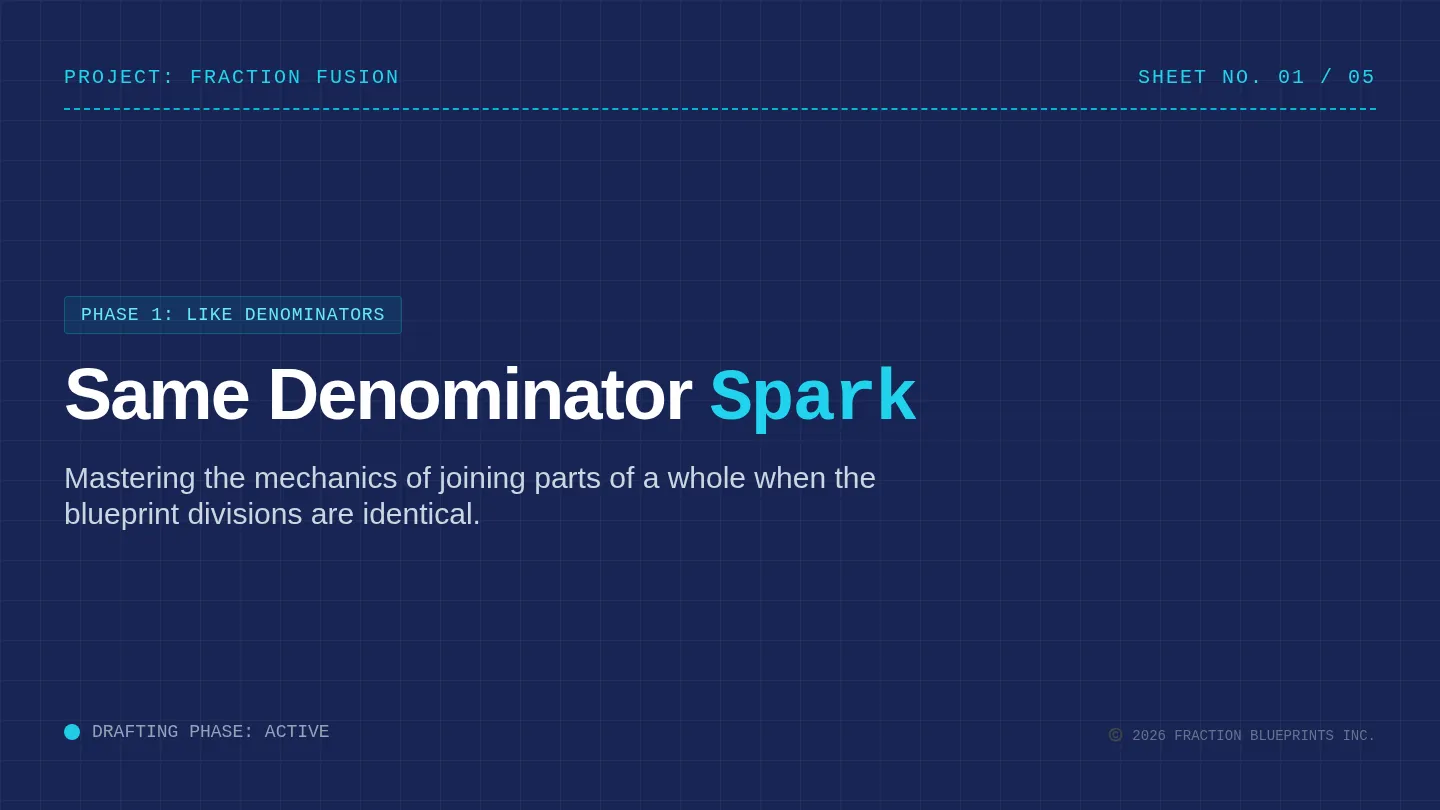
Equal Parts Lesson Plan Lesson Plan: Equal Parts Extravaganza
Unit 5: Fraction Blueprint Builders Duration: 30 Minutes
Lesson Overview
In this foundational lesson, students define the term partition as splitting a shape into parts. The focus is on distinguishing between equal and unequal parts and naming halves, thirds, and fourths based on area models.
Learning Objectives
Define "partitioning" as splitting a shape.
Identify equal parts in rectangles and circles.
Orally name halves, thirds, and fourths.
Materials Needed
Equal Parts Slides
Blueprint Practice Page
Exit Ticket: Rectangle Partition
Paper rectangles for folding
Instructional Sequence
5 Min
Warm-up: Which 3 Go Together?
Display the slide showing four partitioned shapes (A, B, C, D). Ask students to identify three shapes that share a common feature (e.g., "A, B, and C all have equal parts").
Look for students noticing equal vs. unequal sizes.
Introduce the word "partition" during synthesis.
15 Min
Directed Lesson: The Blueprint of Equality
Demonstrate partitioning a paper rectangle into two parts. Purposefully make them unequal. Ask: "Can we call these halves?" Elicit that parts must be the same size.
Key Point: To name parts (halves, thirds, fourths), we must partition the whole into parts of equal area.
Guided Fold: Have students fold one rectangle into 2 equal parts (halves) and another into 4 equal parts (fourths). Discuss the strategy of folding a half in half again to get fourths.
5 Min
Independent Practice
Students complete the "Blueprint Practice Page." They must identify which shapes show equal partitions and draw their own thirds using vertical lines.
5 Min
Cool-down (Exit Ticket)
Students partition a blank rectangle into fourths and write the word "fourths" below it.
Differentiated Support
Provide pre-dotted lines on paper for students struggling with spatial reasoning during folding.
Key Vocabulary
Partition • Equal • Half • Third • Fourth
Equal Parts Slides Equal Parts Extravaganza
Fraction Blueprint Builders: Lesson 1
Precision
Structure
WARM-UP Which 3 Go Together?
Shape A
Shape B
Shape C
Shape D
"I pick shapes __, __, and __ because..."
Vocabulary Check
PARTITION
To partition a shape means to divide or split it into pieces.
The Golden Rule of Fractions
Equal Parts
Same size.
We can name them Halves!
Unequal Parts
Different sizes.
These are NOT halves.
The Fraction Blueprint
2 Equal Parts
HALVES
3 Equal Parts
THIRDS
4 Equal Parts
FOURTHS
Equal Parts Practice Page Blueprint Practice: Equal Parts
Blueprint ID: L1-Practice
Name:
Date:
Mission: Check the architectural blueprints below. Builders only name parts if they are perfectly equal.
1. Inspect the Blueprints
Circle ALL shapes that have been partitioned into equal parts.
A
B
C
D
E
F
2. Be the Architect
Partition this rectangle into thirds. Use vertical lines.
Partition this rectangle into fourths. Use any lines you want!
3. Site Analysis
Why can we NOT say a shape is split into "halves" if the pieces are different sizes?
Equal Parts Exit Ticket Exit Ticket
Lesson 1: Blueprint Check
Name:
Date:
1. Partition this blueprint into fourths. Make sure the parts are equal!
2. What are the names of these parts?
(Example: halves, thirds...)
End of Site Inspection
Partition Card Sort Printable Printable Material: Card Sort Partitions
Lesson 01 • Fraction Blueprint Builders
Cut out these blueprint cards. Sort them into two categories: Equal Parts and Unequal Parts.
CARD A
CARD B
CARD C
CARD D
CARD E
Check spacing!
Blueprint Builders Card Kit • Project 01-SORT
Sixths Eighths Lesson Plan Lesson Plan: Sixths and Eighths Showcase
Lesson 2 • Fraction Blueprint Builders 30 Minutes
Overview
Building on Lesson 1, students expand their partitioning repertoire to include sixths and eighths. The instructional focus is on the halving strategy: subdividing existing thirds into sixths and fourths into eighths.
Learning Objectives
Partition rectangles into 6 equal parts.
Partition rectangles into 8 equal parts.
Explain the relationship between thirds/sixths and fourths/eighths.
Key Materials
Showcase Slides
Sixths & Eighths Practice Page
Exit Ticket: The Octagon Office
Instructional Steps
Start 5'
Warm-up: The Doubling Detective
Display a square partitioned into 4 fourths. Ask: "If I draw one more line through the middle of every part, how many parts will I have?" (8). Elicit that smaller parts result when we subdivide existing ones.
Teach 15'
Direct Instruction: The Sub-Contractor Method
Model partitioning a long rectangle (a "hallway") on the board.
Strategy 1: Sixths
Partition into 3 equal thirds. Then, draw a horizontal line through the middle. Point out the 6 equal "cubicles."
Strategy 2: Eighths
Partition into halves, then fourths. Halve the fourths. Focus on counting the total parts carefully.
Apply 5'
Blueprint Drafting
Students use the "Sixths & Eighths Practice Page." They must choose the doubling strategy to create 8 parts in a rectangle and identify errors in unequal sixths.
Exit 5'
Site Closure
Students partition a final shape into 8 equal parts and circle the word "eighths."
Teacher Note: Watch for students who draw 6 or 8 lines instead of creating 6 or 8 spaces. Emphasize that the space is the part, not the line.
Sixths Eighths Slides Sixths &
Eighths
Refining the Blueprint: Lesson 2
Warm-up
The Sub-Division Mystery
4 Parts
?? Parts
"If we cut every part in half, how many parts do we have now?"
Strategy: Creating Sixths
1
Start with 3 Equal Parts (Thirds).
2
Draw a line through the middle of every part.
3
Count them: 1, 2, 3, 4, 5, 6! These are Sixths.
Strategy: Creating Eighths
1/4
1/4
1/4
1/4
EIGHTHS
"Double the parts, half the size!"
Blueprint Quality Control
Unequal Sixths
Equal Sixths
Sixths Eighths Practice Page Blueprint Drafting: 6s & 8s
Project Phase: Sub-Division
Architect:
Date:
Pro Tip: To make Eighths, start by halving the whole, then halve those halves to get fourths. Finally, halve every fourth!
1. Drafting Sixths
A. Vertical Strategy
Partition into 3 equal thirds, then draw one horizontal line.
B. Grid Strategy
Partition into 6 equal vertical columns.
2. Drafting Eighths
Use the halving strategy for this long rectangle blueprint.
Halves → Fourths → Eighths
3. Quality Control Check
Look at the blueprint below. The architect says these are sixths. Why would you reject this drawing?
Sixths Eighths Exit Ticket Site Closure
Eighths Inspection
Name:
Date:
1 Partition this square into eight equal parts.
(Hint: Halve the halves, then halve again!)
2 What is the name of each equal part?
Halves
Fourths
Sixths
Eighths
Inspection Report Complete • Blueprint Builders Inc.
Unit Fraction Lesson Plan Lesson Plan: Unit Fraction Names
Lesson 3 • The Notation Blueprint 30 Minutes
Instructional Blueprint
This lesson introduces the formal fraction notation \( \frac{1}{b} \). Students connect the words (halves, thirds, etc.) to the symbolic form, learning that the denominator represents the total number of equal parts in the whole.
Objectives
Write unit fractions using \( \frac{1}{b} \) notation.
Explain that the bottom number tells the total parts.
Label every part of a partitioned whole with its unit fraction.
Target Vocabulary
Unit Fraction Notation Denominator
Timeline
05'
Min
Warm-up: The Naming Ceremony
Review Lesson 2 by showing shapes partitioned into 2, 3, 4, 6, and 8. Ask students to shout out the name (e.g., "Eighths!"). Introduce the idea that these names also have a "number form."
15'
Min
Directed: Writing the Blueprint
Introduce the fraction bar. Draw a rectangle partitioned into 4 fourths. Point to one part.
One part of four total
1 / 4
"One-Fourth"
Explain that the "1" means we are looking at one specific part, and the "4" means there are four equal parts in the whole. Repeat for 1/3, 1/6, and 1/8.
05'
Min
Practice: Labeling the Site
Students complete the "Unit Notation practice page." They must write the fraction \( \frac{1}{b} \) inside every part of a shape to show that each part represents the unit fraction.
05'
Min
Exit Ticket
Students look at a shape with 6 equal parts and write the fraction \( \frac{1}{6} \) to name one part.
Concept Check: The parts MUST be equal before we use fraction notation!
Unit Fraction Slides Unit Fraction
Names
Lesson 03 • Blueprint Builders
Warm-up: The Naming Ceremony
05 Minutes
Builders, identify the name of these parts! Shout it out!
Halves
Thirds
Fourths
??
Formal Notation
1
4
The Top Number
One Part we are counting.
The Bottom Number
Total equal parts in the whole.
We call this "One-Fourth"
Labeling the Site
1/3
1/3
1/3
Architect Rule #1:
Every part of the blueprint must be labeled with its unit fraction name.
Total Parts: 3
Notation: 1/3
Site Challenge!
If a rectangle is partitioned into 8 equal parts, what is the notation for one part?
1/??
Unit Fraction Practice Page Notation Practice
Section 1.3 • Unit Fractions
Architect
Site Date
01 Label the Parts
For each blueprint below, write the unit fraction notation inside every single part.
Site Analysis:
"This whole is partitioned into ________ equal parts."
Site Analysis:
"Each part is named 1 / ____"
Architect's Note:
Fill in every cubicle with the unit fraction name.
02 Final Inspection
Partition this blueprint into eighths. Then label ONE part with its unit fraction name.
Total Parts: ________
Unit Fraction Notation: ________
Unit Fraction Exit Ticket Exit Ticket
The Site Final Inspection
Unit 05
ARCHITECT NAME:
1. This blueprint is partitioned into sixths. Label every part with its unit fraction.
2. In the fraction \( \frac{1}{6} \), what does the number 6 tell you about the shape?
Report Verified • Blueprint Builders
Fraction Match Card Sort Printable Fraction Match Cards
Lesson 03 • Notation & Modeling • Card Kit
Mission: Match the symbolic fraction card to the area blueprint card.
1 / 2
1 / 3
1 / 4
Verification Req • Blueprint Builders Inc.
Whole Reconstruction Lesson Plan Lesson Plan: Whole Reconstruction Project
Lesson 4 • Building from the Part 30 Minutes
Instructional Blueprint
This lesson uses a conceptual reversal. Instead of starting with a whole and partitioning it, students start with a single unit fraction part and must use their knowledge of the denominator to reconstruct the complete whole shape.
Objectives
Identify the denominator as the number of parts needed to make 1 whole.
Reconstruct a whole shape given a single unit fraction part.
Explain reasoning using the total count of parts.
Materials
Reconstruction Slides, Broken Blueprints Practice, Exit Ticket, Index cards or cut paper squares.
Instructional Sequence
05'
Min
Warm-up: The Missing Contractor
Show a single rectangular block labeled "1/4 of the building." Ask: "The builders took a break! How many more blocks like this one do we need to finish the building?" (3 more, or 4 total). Emphasize that the denominator tells us the goal.
15'
Min
Directed: Reconstruction Site
Demonstrate with large paper squares on the board.
Step 1: Inspect the Label. Look at the unit fraction (e.g., 1/3). The denominator is 3.
Step 2: Collect the Parts. If the denominator is 3, we need 3 identical pieces to make the whole site.
Step 3: Build the whole. Tape 3 squares together. "Now we have 3/3, which is 1 whole building."
Practice again with 1/2 and 1/6. Emphasize that the shapes must be the same size as the original part.
05'
Min
Broken Blueprints Practice
Students receive a page with single pieces of "blueprints." They must draw the missing pieces to complete the rectangle or square whole.
05'
Min
Final Site Inspection
Students are given 1/4 of a shape and must draw the complete whole by adding 3 more identical parts.
Blueprint Builders Support • Conceptual Reversal • L04-LP
Reconstruction Project Slides Whole
Reconstruction
Lesson 04 • The Reverse Build
Warm-up
The Missing Pieces
1/4
This is ONE part of the plan.
How many total parts make the whole?
How many MORE parts do we need?
Strategy: The Architect's Secret
1/3
The Denominator tells you the TOTAL number of parts needed to make 1 Whole.
1/3
1/3
1/3
Let's Build It!
1
Look at the unit fraction part.
2
Read the Denominator.
3
Draw identical parts until you reach that goal!
Site ID: 1/2
1/2
??
Site Challenge!
If I have ONE block labeled 1/6...
How many blocks total make the building?
Calculating...
Broken Blueprints Practice Page Broken Blueprints
Site Restoration Phase
Lead Architect
Build Date
Mission Briefing
Builders, the site was damaged! We only have one piece of each blueprint. Use the unit fraction label to reconstruct the whole building.
1/3
Starting Block
Draw the full blueprint here
1/2
Starting Block
Draw the full blueprint here
1/6
Starting Block
Draw the full blueprint here
Building Verification Required • Blueprint Builders Inc.
Final Reconstruction Exit Ticket Site Closure
Phase 04 • Final Reconstruction
Lead Architect:
Date:
1. This block represents 1/4 of the building whole.
1/4
Draw the COMPLETED building whole below.
Verified By: Blueprint Builders Inc. Site ID: L04-EXIT
Blueprint Number Lines Lesson Plan Lesson Plan: Blueprint Number Lines
Lesson 5 • Surveying the Path 30 Minutes
Overview
Students transition from area models (shapes) to linear models (number lines). The lesson compares number lines showing whole numbers (0-10) with those showing the interval between 0 and 1. Students learn that fractions represent distances from zero.
Objectives
Identify the "1" whole on a number line.
Compare a 0-10 whole number line to a 0-1 fraction line.
Locate the halfway point (1/2) as a distance from 0.
Preparation
Surveyor Slides, Measurement Practice, Exit Ticket. Large number line for the board (0-10 and 0-1).
Instructional Steps
05'
Warm-up: The Long Walk
Display two number lines. Line A: 0 to 10. Line B: 0 to 1. Both have a tick mark exactly in the middle. Ask: "What number is in the middle of Line A? What number might be in the middle of Line B?" Elicit that 5 is halfway to 10, and 1/2 is halfway to 1.
15'
Directed: The Surveyor's Path
Explain that a number line represents a distance. "If we are building a road from 0 to 1, we can stop at points along the way."
Concept: The Interval
In Lesson 1-4, we partitioned a whole rectangle. Now we are partitioning the space between 0 and 1.
Model partitioning the distance between 0 and 1 into two equal lengths. Mark the end of the first length as 1/2. "This point is 1/2 of the distance from 0 to 1."
05'
Independent Surveying
Students complete the practice page. They identify which number line is partitioned into halves vs fourths by looking at the intervals between 0 and 1.
05'
Site Survey (Exit Ticket)
Students label the "1" on a number line that shows 0 and the halfway mark 1/2.
Blueprint Builders Curriculum • L05-LP • Survey Phase
Blueprint Number Lines Slides Blueprint
Number Lines
Lesson 05 • Surveying the Whole
Warm-up
Double Vision
0 Wait... what's here? 10
0 And here? 1
The Surveyor's Secret
FRACTIONS ARE NUMBERS
THAT LIVE ON THE
NUMBER LINE.
"They describe the distance we've traveled from ZERO."
Area vs. Length
Area Blueprint
1/2
Linear Blueprint
1/2
0
1
"The whole is the distance from 0 to 1!"
Surveyor's Challenge
If this mark is 1/2...
0
Where does the "1" go?
Precision Challenge
If this mark is 1/4...
0
Where does the "1" go?
Blueprint Number Lines Practice Page Site Survey: 0 to 1
Phase 2.1 • Linear Foundations
Architect
Survey Date
01 Identify the Scale
Look at the survey lines below. One shows Whole Numbers. The other shows Fractions. Circle the fraction line.
0
??
??
??
10
Survey A
0
1
1/3
Survey B
02 Site Restoration
Draw the "1" Whole marker on this survey path. Use the distance to 1/3 to help you.
0
1/3
"Triple the distance from 0 to 1/3 to find the whole!"
Blueprint Number Lines Exit Ticket Survey Unit: Linear 05
Project: BP Builders
Site Survey
Lesson 05 • Exit Ticket
ARCHITECT:
DATE:
Where is the "1" Whole mark?
Label the 1 on the number line below. Use the distance to 1/2 to survey the site.
0
1/2
Site Analysis: How did you know where to put the 1?
Final Survey Authorization • Blueprint Builders
Number Line Card Sort Printable Number Line Card Sort
Lesson 05 • Sorting Scales • Card Kit
Mission: Cut out the number line cards below. Sort them into two groups: Whole Number Lines (only whole numbers 0, 1, 2...) and Fraction Number Lines (lines with marks between the wholes).
0
10
LINE A
0
1
LINE B
0
5
LINE C
0
1
2
LINE D
End of Survey Kit • Project 05-SORT
Unit Fraction Survey Lesson Plan Lesson Plan: Unit Fraction Survey
Lesson 6 • Precision Partitioning 30 Minutes
Overview
Students master the art of partitioning the unit interval (0 to 1) on a number line. The focus is on equal spacing and recognizing that the label \( \frac{1}{b} \) refers to the first tick mark after zero.
Objectives
Partition a 0-1 interval into equal parts.
Locate and label unit fractions (\( \frac{1}{b} \)) on a line.
Explain that 1 whole is located at the final partition.
Key Logic
The number of intervals (spaces) must match the denominator. The unit fraction is the point at the end of the first interval.
Timeline
05'
Warm-up: Interval Inspection
Display a number line from 0 to 1. It is partitioned into 4 equal spaces. Ask: "How many spaces do you see between 0 and 1?" (4). "What should we name the first mark?" (1/4).
15'
Directed: Surveying the Unit
Model partitioning a large horizontal line from 0 to 1 into thirds. Demonstrate the "Trial and Error" method—marking marks lightly until the spaces look equal.
The Surveyor's Rule:
1. Count the SPACES, not the tick marks.
2. To make 3 parts, you only need TWO marks between 0 and 1.
3. Label the first mark as 1/3.
Ask: "Where is the 2/3 mark? Where is 3/3?" Introduce the idea that 3/3 is exactly at the "1".
05'
Independent Survey
Students work on the "Unit Survey" page. They must partition lines into 2, 4, and 8 parts and label the unit fraction at the correct point.
05'
Final Stake (Exit Ticket)
Students partition a fresh line into 6 equal parts and label the location of 1/6.
Blueprint Builders Curriculum • L06-LP Target: 3.NF.A.2
Unit Fraction Survey Slides Unit Fraction
Survey
Lesson 06 • Linear Precision
Warm-up
Inspect the Line
05 MINUTES
Look at this survey path. How many equal spaces are between 0 and 1?
0
1
"What is the name of the first mark?"
Surveyor's Secret Rule #1
Count the
SPACES,
Not the tick marks!
!
If the denominator is 4, you need 4 EQUAL SPACES between 0 and 1.
"Tick marks are just the fences between the spaces."
The Thirds Technique
0
1
1/3
Target: 3 Spaces
Only 2 Marks Needed!
CHALLENGE
To show EIGHTHS on a survey line...
How many spaces do we create?
[ Analyzing Blueprints ]
Unit Fraction Survey Practice Page Unit Survey Practice
Linear Precision • Blueprint Builders
Architect
Survey Date
01 Linear Construction
For each survey path, partition the interval into equal parts and label the unit fraction at the first mark.
A. Target: Halves (2 equal spaces)
0
1
B. Target: Fourths (4 equal spaces)
0
1
C. Target: Eighths (8 equal spaces)
0
1
Architect's Reasoning
If you are partitioning a line into thirds, how many tick marks do you need to draw between the 0 and the 1?
Explain your build strategy here...
Unit Fraction Survey Exit Ticket Exit Ticket
Final Site Stake • Lesson 06
ARCHITECT:
1 Partition the survey path below into sixths.
0
1
2 Locate and label the point for 1/6.
"Accuracy is required for architectural safety!"
Blueprint Builders • Survey Authorized • Project BP-L06-FINAL
Expanding Horizons Lesson Plan Lesson Plan: Expanding Horizons Linear
Lesson 7 • Beyond the First Whole 30 Minutes
Instructional Blueprint
Students expand their linear understanding to number lines greater than 1. The key insight is that every whole interval (0-1, 1-2, 2-3) must be partitioned into the same number of equal parts to maintain a consistent scale.
Objectives
Identify whole number markers on a long number line.
Partition multiple whole intervals into the same denominator.
Locate the unit fraction on an extended line.
Materials
Extended Line Slides, Blueprint Practice Page, Exit Ticket. Meter sticks or rulers.
Timeline
05'
Warm-up: The Road to 2
Display a number line from 0 to 2. Tick marks at 0, 1, and 2. Ask: "If we split the first mile (0-1) into halves, what should we do to the second mile (1-2) to keep our blueprint accurate?" Elicit that the "scale" must be the same.
15'
Directed: Consistent Surveying
Model surveying a path from 0 to 3. "We need to mark 1/4 of a mile."
Architect's Checklist:
1. Find every Whole Number marker (0, 1, 2, 3).
2. Partition the space BETWEEN each whole number into 4 equal parts.
3. Each space represents the same distance (1/4).
Ask: "Does the location of 1/4 change if the road gets longer?" Elicit that 1/4 is always the same distance from zero, regardless of how long the line is.
05'
Independent Drafting
Students use the "Extended Survey" practice page. They partition lines from 0-2 and 0-3 and label the unit fraction at the correct point. Watch for students partitioning the *whole* 0-2 line into 4 parts instead of each 1-unit segment.
05'
Inspection (Exit Ticket)
Students label 1/3 on a number line that extends from 0 to 2.
Blueprint Builders Curriculum • L07-LP • Extended Horizons
Expanding Horizons Slides Expanding
Horizons
Lesson 07 • The Long Path
Warm-up
Consistency is Key
If we split the first whole into halves, what must we do to the second whole?
0
1
2
"Same scale for every mile!"
Quality Control: Warning!
The Error:
0
1
2
"I partitioned the WHOLE LINE instead of each WHOLE NUMBER."
The Correction:
Always look for 0 and 1 first.
Partition that space, then repeat the pattern for 1 and 2.
Locating 1/3 on the Long Path
0
1
2
1/3
"It doesn't matter how long the line is. 1/3 is always 1/3 of the distance from 0 to 1."
Architect Challenge
If our survey line goes from 0 to 10...
Is the 1/2 mark still in the same place?
Extended Survey Practice Page Extended Survey Path
Linear Phase 2.2 • Blueprint Builders
Build Authorization
VERIFIED
01 Consistent Partitioning
Architects must partition EVERY whole interval into the target denominator.
A. Target Denominator: 4 (Fourths)
0
1
2
Label the 1/4 mark after surveying!
B. Target Denominator: 3 (Thirds)
0
1
2
Label the 1/3 mark after surveying!
The Architect's Rule
"When a road goes from 0 to 2, why can't we just partition the whole line into 2 equal parts to show halves?"
Explain the survey logic here...
Horizon Scan Exit Ticket STAMP
Exit Ticket
Final Horizon Scan • Lesson 07
CHIEF ARCHITECT:
Locate and label the 1/4 mark on this survey path.
0
1
2
"Surveyor's tip: Partition the correct whole!"
Verification Complete • Blueprint Builders Inc.
Number Line Scoot Game Kit Number Line Scoot
Stage 2 • Halves, Thirds, & Fourths • Game Kit
How to Play
Place your game piece at 0 on a number line.
Roll the number cube. This is your Numerator.
Choose a Denominator (2, 3, or 4).
Move your piece that many jumps along the matching line.
First one to land EXACTLY on the 4 wins the stake!
Navigator's Strategy
"Choose your denominator wisely! Smaller numbers (2) take bigger jumps. Larger numbers (4) take smaller steps!"
Survey Line: Halves
0
2
4
Survey Line: Fourths
0
1
2
3
4
Kit ID: SCOOT-STAGE-2
Non Unit Navigation Lesson Plan Lesson Plan: Non-Unit Navigation
Lesson 8 • Counting the Jumps 30 Minutes
Instructional Blueprint
Students learn to locate non-unit fractions (\( \frac{a}{b} \)) by iterating unit fractions. They use the numerator to count "jumps" of size \( \frac{1}{b} \) starting from zero. This lesson also introduces the formal terms numerator and denominator.
Objectives
Define numerator and denominator.
Locate non-unit fractions by counting intervals from 0.
Identify fractions greater than 1 whole.
Vocabulary
Numerator • Denominator • Interval • Iteration
Timeline
05'
Min
Warm-up: The Jump Counter
Display a line from 0 to 1 split into 4 parts. Model "jumping" from 0 to the first mark (1/4). Ask: "If I make three jumps of this same size, where will I land?" (3/4). Elicit that the name of the spot tells us how many parts we have.
15'
Min
Directed: Blueprint Terminology
Write \( \frac{3}{4} \) on the board in large letters.
Numerator (Top)
The Number of Jumps we take from 0.
Denominator (Bottom)
The Total Parts that make 1 whole mile.
Model locating 5/4. "We take 5 jumps. Since 4 jumps gets us to 1 whole, the 5th jump takes us past the 1."
05'
Min
Navigation Practice
Students work on the "Navigation Maps" page. They count jumps to label points like 2/3, 5/3, 3/8, and 7/8. They must circle points that are greater than 1.
05'
Min
Final Log (Exit Ticket)
Students locate \( \frac{5}{6} \) on a number line by marking their jumps.
Blueprint Builders Curriculum • L08-LP • Navigation Phase
Non Unit Navigation Slides Non-Unit
Navigation
Lesson 08 • Plotting the Path
Coordinates: Linear 8.0
Warm-up
The Jump Counter
If ONE jump is 1/4 of a mile...
0
1
"Where will THREE jumps land?"
Architect's Dictionary
NUMERATOR
3
The number of JUMPS we took.
DENOMINATOR
4
The total EQUAL PARTS in the whole.
Expanding the Path
Locating: 5/4
0
1
5/4
"If the numerator is LARGER than the denominator, we jump past the whole!"
MAP
To locate 7 / 6...
How many jumps of size 1/6 do we take?
Navigation Maps Practice Page Navigation Maps
Phase 3.1 • Plotting Jumps • Blueprint Builders
Architect ID
Linear Status: Active
01 Plotting the Coordinates
Locate and label the following non-unit fractions on each survey line. Mark every jump you take from zero.
A. Plot: 3 / 4
Scale: Fourths
0
1
B. Plot: 5 / 4
Caution: Past 1 Whole
0
1
C. Plot: 2 / 3 and 5 / 3
0
1
2
Navigator's Log
Explain the difference between a unit fraction (like 1/4) and a non-unit fraction (like 3/4).
Logging coordinates...
Non Unit Navigation Exit Ticket Exit Ticket
Final Navigation Log • Lesson 08
COORDINATE OFFICER:
locate and label the fraction 5/6 on the survey line
0
1
"Show your jumps for total precision!"
Auth: Blueprint Builders Ref: BP-L08-EXIT
Locating the Whole Lesson Plan Lesson Plan: Locating the Whole Line
Lesson 9 • Finding the Anchor 30 Minutes
Instructional Blueprint
Students use their understanding of iteration to find the "1" whole on a number line when starting from a non-unit fraction. They apply a two-step survey strategy: partition to find the unit fraction, then iterate to reach the whole.
Objectives
Use the numerator to identify the number of jumps already taken.
Sub-partition a non-unit length to find the unit fraction.
Locate 1 whole by counting out the denominator's worth of parts.
Materials
Anchor Slides • Locate 1 Practice • Exit Ticket • String for measuring distances (optional)
Timeline
05'
Min
Warm-up: The Target Goal
Show a point at \( \frac{2}{3} \). Ask: "If our goal is to reach 1 whole building, how many more spaces like these do we need?" (1 more). Elicit that 3/3 is the goal. "How do we find the size of just one space?"
15'
Min
Directed: The Reverse Survey
Model locating 1 from \( \frac{3}{4} \).
The Two-Step Restoration:
1. SUB-PARTITION: Look at the numerator (3). Split the space from 0 to 3/4 into 3 equal parts. Now you have the size of 1/4!
2. EXTEND: Take that 1/4 jump one more time past the 3/4 mark. That point is 4/4, which is 1 whole!
Discuss fractions > 1. "If we have 5/4, we need to go backward one jump to find 4/4."
05'
Min
Anchor Practice
Students use the practice page. They must find 1 whole given 2/3, 4/8, and 5/4. Focus on checking their work by re-counting the jumps from 0 to their new 1 mark.
05'
Min
Closure (Exit Ticket)
Students are given \( \frac{4}{6} \) on a number line and must locate the "1" whole mark.
Blueprint Builders Curriculum • L09-LP Ref: 3.NF.A.2.A
Locating the Whole Slides Locating the
Whole Line
Lesson 09 • Finding the Anchor
Warm-up
How Far to Finish?
Blueprint Coordinate: 2/3
0
2/3
"If we are at 2 / 3,
where is the 1 WHOLE building?"
Strategy: The Reverse Survey
Step 1: Find 1/b
Look at the Numerator. Split the space from 0 to your point into that many equal parts.
"Now you know the size of ONE jump."
Step 2: Find 1 Whole
Count out jumps until you reach the Denominator total.
"1 whole = 3/3, 4/4, 6/6..."
Restoring the Site: 3/4
0
3/4
"We take the size of one of those 3 segments and add ONE MORE to reach 4/4!"
WHOLE
If our survey point is at 5 / 4...
Do we go FORWARD or BACKWARD to find the "1"?
Anchor Recovery Practice Page Survey Restore: Find 1
Phase 3.2 • Anchor Recovery • Blueprint Builders
Architect ID
Status: Calibration Needed
Mission: Recovery
The "1" whole markers have been lost from the survey maps! Use the provided coordinates to accurately locate and label the 1.
1. Plot point for: 1 WHOLE
Current Marker: 2/3
0
2/3
2. Plot point for: 1 WHOLE
Current Marker: 3/4
0
3/4
3. Plot point for: 1 WHOLE
Current Marker: 5/4
0
5/4
"Be careful! 5/4 is already past the 1 whole mark!"
Anchor Recovery Exit Ticket Exit Ticket
System Calibration • Lesson 09
ARCHITECT:
DATE:
TASK: If the coordinate mark is 4 / 6, find the location of the 1 WHOLE mark.
Survey Coordinate Path
0
4 / 6
Mark 1 here →
Site Data Verification Protocol
Architect's Log:
Explain how you found the whole building.
REF: ANCHOR-9-EXIT
Matching Measures Lesson Plan Lesson Plan: Matching Measures Equivalence
Lesson 10 • Different Names, Same Size 30 Minutes
Instructional Blueprint
In this lesson, students are introduced to the concept of Equivalence through area models. They discover that two fractions can have different numerators and denominators but represent the exact same amount of a whole.
Objectives
Define equivalent fractions as fractions that represent the same size.
Identify equivalent fractions using area diagrams.
Compare 1/2, 1/3, and 1/4 to their multiples (2/4, 2/6, 2/8).
Key Logic
If the total shaded area is the same, the fractions are equivalent, regardless of how many lines are drawn.
Timeline
05'
Min
Warm-up: The Same Size Swap
Display two identical squares. Square A is cut into 2 halves (1 shaded). Square B is cut into 4 fourths (2 shaded). Ask: "If these were cakes, would you get the same amount of cake from A and B?" Elicit that 1/2 is the same size as 2/4.
15'
Min
Directed: The Equivalence Blueprint
Draw a rectangle on the board. Shade 1/3.
Architect's Discovery:
1. Start with 1 / 3 shaded.
2. Draw a horizontal line across the middle of the whole blueprint.
3. Now we have 2 / 6 shaded.
4. Did the shaded area get bigger? NO! It's just named differently.
Introduce the term: Equivalent Fractions. Repeat with 1/4 and 2/8.
05'
Min
Equivalence Matching
Students work on the practice page. They must look at shaded area models and match them to their equivalent partners (e.g., 1/2 matches 3/6, 1/4 matches 2/8).
05'
Min
Final Verification (Exit Ticket)
Students identify which fraction is equivalent to 1/2 from a list and draw a quick area model to prove it.
Blueprint Builders Curriculum • L10-LP • Equivalence Phase Target: 3.NF.A.3
Matching Measures Slides Matching
Measures
Lesson 10 • Equivalence Foundations
Warm-up
The Same Size Swap
Look at these two blueprints. Is the same amount of the building shaded?
1/2
2/4
"Different Names, Same Size!"
Architect's Dictionary
Equivalent
Fractions
Fractions that represent the
EXACT SAME AMOUNT
of the same-size whole.
They are equal partners.
The 1/3 vs 2/6 Challenge
1/3
Base Blueprint
2/6
The Multi-Part Partner
"Same amount of blue, just more lines!"
Partner Challenge
If I have 1 / 4 of a building...
How many EIGHTHS
do I need to match it?
Matching Measures Practice Page Matching Measures
Phase 4.1 • Area Equivalence • Blueprint Builders
Architect ID
Status: Area Analysis
01 Identify Equal Partners
Circle the pair of blueprints below that show EQUIVALENT fractions. (The same total amount is shaded!)
1/3
Survey Blueprint A
1/4
Survey Blueprint B
1/2
Survey Blueprint C
2/4
Survey Blueprint D
Building Assessment Page 01 • Ref: BP-L10-P1
Matching Measures Continued
Phase 4.1 • Area Analysis
02 Match the Measure
Draw a line to match the equivalent blueprints. Inspect the TOTAL area shaded.
Site Plan: 1/3
Site Plan: 1/4
Site Plan: 1/2
Draft: 2/4
Draft: 2/6
Draft: 2/8
Blueprint Builders Curriculum • Page 2 Target: 3.NF.A.3
Matching Measures Exit Ticket Exit Ticket
The Partner Check • Lesson 10
ARCHITECT:
ANALYSIS: Which of these fractions is equivalent to 1 / 2?
1 / 3
2 / 4
3 / 8
Draw a quick blueprint model to PROVE it!
BP-EQUIV-10-FINAL
Building Equivalent Lesson Plan Lesson Plan: Building Equivalent Blueprints
Lesson 11 • Sub-Contracting Spaces 30 Minutes
Instructional Blueprint
Students move from identifying equivalence to generating it. By further partitioning (subdividing) existing area models, students learn that a single amount can have infinite names. The focus is on the mathematical pattern of doubling both the numerator and denominator.
Objectives
Generate equivalent fractions by subdividing area models.
Recognize the pattern in numerators and denominators.
Apply equivalence to fractions greater than 1.
Preparation
Generation Slides • Sub-Division Practice • Exit Ticket • Colored pencils for marking new lines.
Timeline
05'
Min
Warm-up: The Builder's Choice
Display a diagram showing \( \frac{2}{4} \). Ask: "Can you name another fraction that covers this exact same area?" Elicit \( \frac{1}{2} \). Challenge: "What if we draw even more lines? What would it be named then?"
15'
Min
Directed: The Sub-Division Strategy
Model on a large board rectangle.
Sub-Division Protocol:
1. START: Shade 1/2 of the whole.
2. SPLIT: Draw a horizontal line through the center. "We just sub-divided our spaces."
3. COUNT: We used to have 1 shaded part. Now we have 2. We used to have 2 total parts. Now we have 4.
4. RESULT: \( \frac{1}{2} = \frac{2}{4} \). Both numbers DOUBLED.
Practice again with 2/3. Subdivide to get 4/6. Focus on the fact that the total blue amount never changed.
05'
Min
Drafting Equivalence
Students use the practice page. They are given "Base Blueprints" and must draw one horizontal line to generate a new name for the shaded amount.
05'
Min
Site Verification (Exit Ticket)
Students are given a rectangle with 3/4 shaded. They must subdivide it into eighths and write the new fraction name (6/8).
Blueprint Builders Curriculum • L11-LP • Generation Phase Target: 3.NF.A.3.B
Building Equivalent Slides Building
Equivalent
Lesson 11 • Sub-Division Skills
Warm-up
The Builder's Choice
Look at this building plan. We call it 2 / 4.
Can you give it another name?
1 / 2
?? / ??
The Sub-Division Strategy
Draw ONE horizontal line!
1 / 2
2 / 4
"The amount of blue stayed the same. Only the names changed!"
The 2/3 → 4/6 Shift
Base: 2/3
Partner: 4/6
"Double the parts = Double the name!"
Blueprint
Challenge
If I have 3 / 4 of a whole...
What is its EIGHTHS
partner name?
Sub-Division Practice Page Sub-Division Drafting
Phase 4.2 • Generating Partners • Blueprint Builders
Architect ID
Status: Blueprint Refinement
01 Generate the Partner
Draw ONE horizontal line across the middle of each blueprint to find a new name for the shaded amount.
Base Name: 1 / 2
1 / 2 = ?? / ??
"How many parts are shaded now?"
Base Name: 1 / 3
1 / 3 = ?? / ??
Base Name: 2 / 4
2 / 4 = ?? / ??
The Sub-Division Discovery
"When we draw that horizontal line, what happens to the TOTAL number of parts in the whole building?"
Describe the shift...
Building Equivalent Exit Ticket Exit Ticket
Site Verification • Lesson 11
LEAD ARCHITECT:
PHASE 1: Show that 3 / 4 is equivalent to 6 / 8 by subdividing this blueprint.
Current State: 3 / 4
THE DISCOVERY:
When I subdivide the blueprint, the parts become
[ SMALLER / LARGER ] but the total blue area stays the same.
(Circle the correct word)
VERIFICATION CODE: BP-L11-SUBDIV
Same Spot Lesson Plan Lesson Plan: Same Spot Standoff
Lesson 12 • The Linear Equalizer 30 Minutes
Instructional Blueprint
In this culminating lesson, students synthesize their understanding of number lines and equivalence. They learn that Equivalent Fractions occupy the exact same location on a number line, proving they represent the same numerical value.
Objectives
Define linear equivalence as sharing a location.
Identify equivalent fractions on a single number line.
Relate 1 whole to the alignment of \( \frac{b}{b} \) fractions.
Key Metric
The coordinate is the value. If the coordinates are the same, the values are equal.
Timeline
05'
Min
Warm-up: The Point Overlap
Display a number line from 0 to 1. Mark a point at 1/2. Now mark a point at 2/4. Ask: "Did the second point move anywhere else? Or did it land in the exact same spot?"
15'
Min
Directed: The Coordinate Check
Model finding 1/2 and 4/8 on a shared board line.
Architect's Checklist:
1. SURVEY: Partition the road into 2 halves. Mark 1/2.
2. RE-SURVEY: Partition that same road into 8 eighths.
3. COUNT: Take 4 jumps of size 1/8. Land at 4/8.
4. VERIFY: "Are the markers at the same address?" \( \frac{1}{2} = \frac{4}{8} \).
Point out that all equivalent fractions from previous lessons (area models) land at the same spot here.
05'
Min
Standoff Practice
Students use the practice page. They must locate 1/3 and 2/6 on the same line. Then locate 3/4 and 6/8. They circle "Yes" or "No" for equivalence based on the points' locations.
05'
Min
Final Stamp (Exit Ticket)
Students use a provided number line to decide if 2/3 and 4/6 are equivalent.
Blueprint Builders Curriculum • L12-LP • Culmination Phase Target: 3.NF.A.3.A
Same Spot Slides Same Spot
Lesson 12 • Culmination
Warm-up
The Point Overlap
If we mark 1 / 2 and 2 / 4 on this line...
0
1
"Do they live at the same address?"
Architect's Final Rule
Linear Match
If two fractions occupy the SAME LOCATION on a line,
they are equivalent.
The Standoff: 1/3 vs 2/6
0
1
1 / 3
2 / 6
"Different surveys, identical coordinates!"
FINAL
STANDOFF
If two fractions represent the SAME DISTANCE from zero...
Are they equivalent?
Same Spot Practice Page The Final Standoff
Phase 5.0 • Linear Calibration • Blueprint Builders
Architect ID
Status: Final Verification
01 Linear Coordinate Check
Plot both fractions on the same survey path. Circle "YES" if they land on the same spot.
A. Compare: 1 / 2 and 3 / 6
YES
NO
0
1
Coordinate Line Alpha
B. Compare: 3 / 4 and 6 / 8
YES
NO
0
1
Coordinate Line Beta
The Culmination Discovery
"If two different architects build a road from 0 to 1, and they both mark a coordinate at the exact same spot, what must be true about their fractions?"
The survey logic concludes that...
Same Spot Exit Ticket Exit Ticket
LESSON 12 • FINAL
VERIFY: Are 2 / 3 and 4 / 6 equivalent?
CHIEF ARCHITECT:
DATE:
Prove it on the final survey path:
0
1
Final Linear Calibration Protocol
YES
NO
UNIT 05 SURVEY COMPLETE • REF: BP-FINAL-V17
Rolling Equivalence Game Kit Rolling for Equivalence
Lesson 12 • The Final Challenge • Game Kit
Rules of the Roll
Roll 6 number cubes.
Wild Card: 5s are wild! Use them for any number.
Create TWO EQUIVALENT fractions using 4 of your numbers.
Record your equation on the log below.
Draw a quick blueprint or line to PROVE they are equivalent.
Earn 1 point for every verified match!
NUM
DEN
NUM
DEN
Proof of Equivalence (Draw here)
NUM
DEN
NUM
DEN
Proof of Equivalence (Draw here)
NUM
DEN
NUM
DEN
Proof of Equivalence (Draw here)
Kit ID: ROLLING-EQUIV-12