Pattern Architect Slides Pattern Lab: Lesson 1
Pattern
Architects
How can we predict the size of a structure that doesn't exist yet?
The 100-Story Tower
Imagine building a modular tower.
• Each floor takes 4 blocks.
• The roof needs 2 extra blocks for the antenna.
Can you guess how many blocks are in a 100-story tower without building it?
Roof
Floor 3
Floor 2
Floor 1
3-Story Tower Example
Building a Sequence
Step 1: The Table
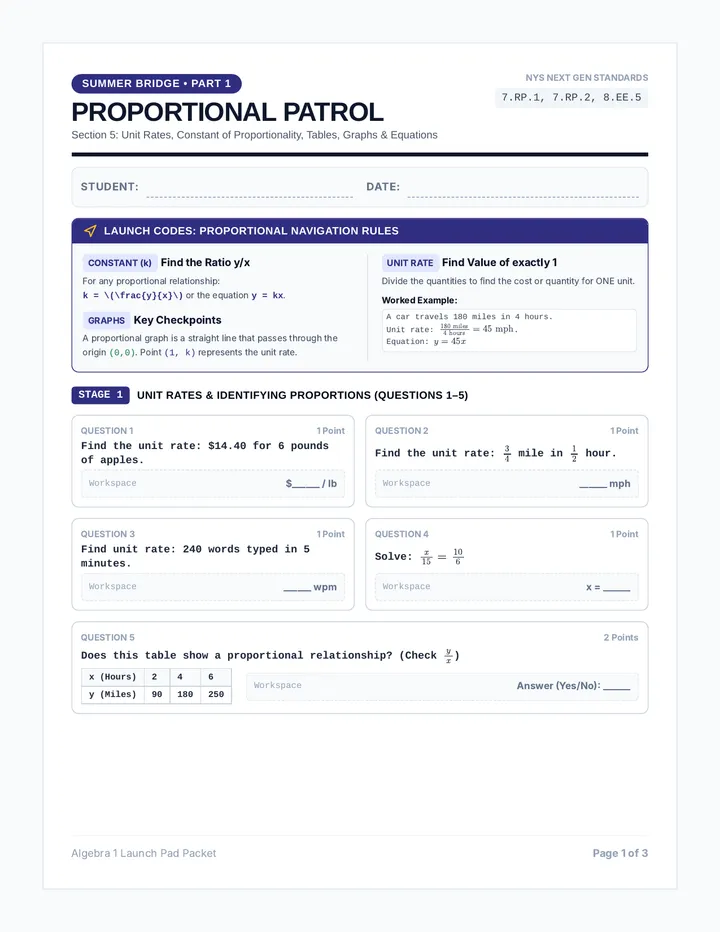
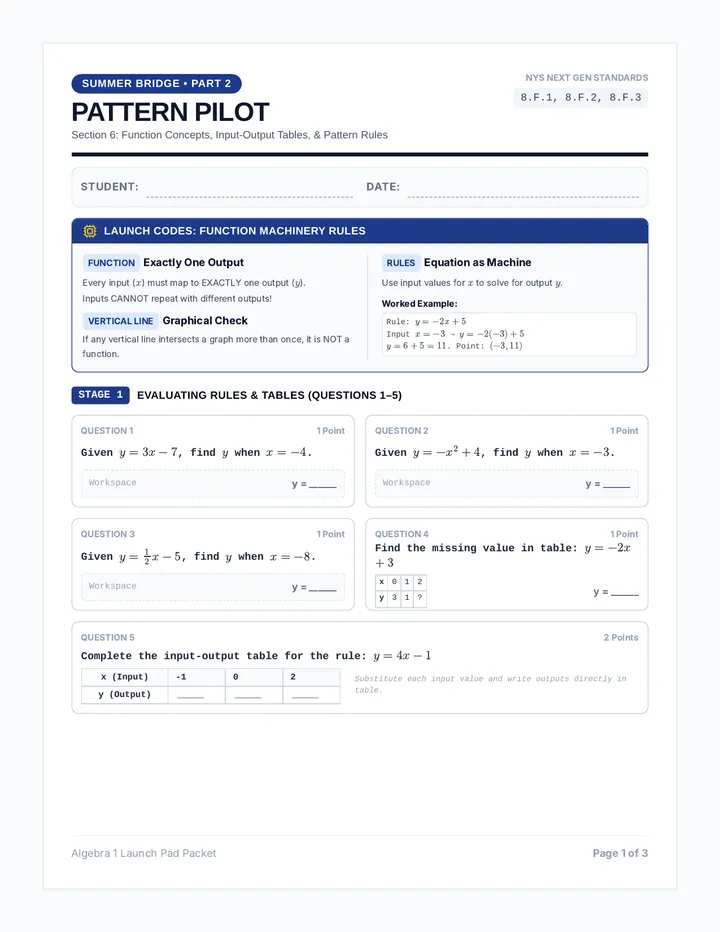
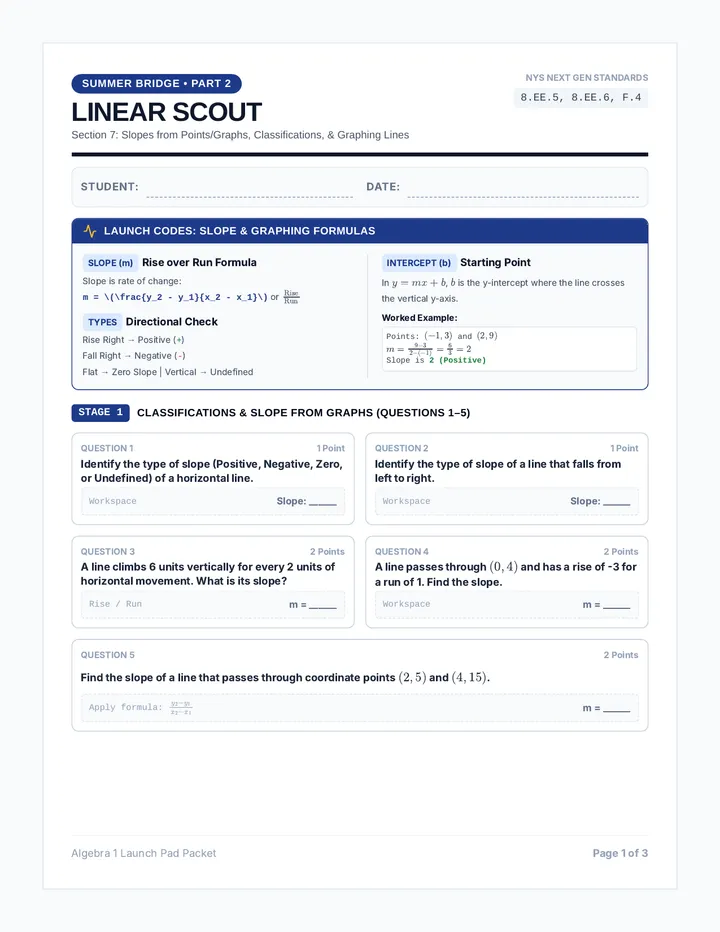
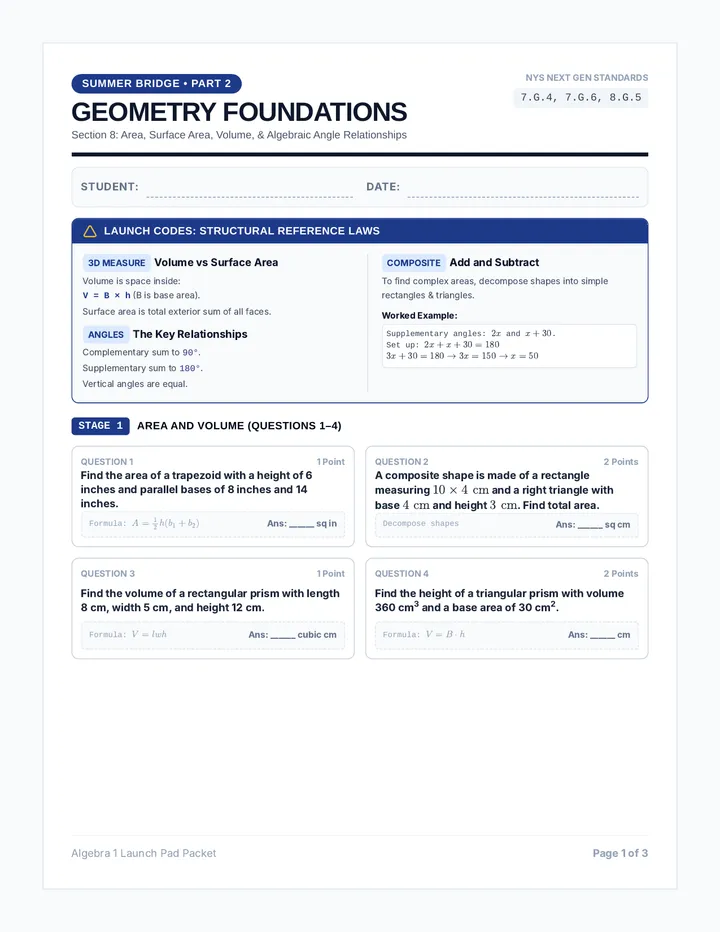
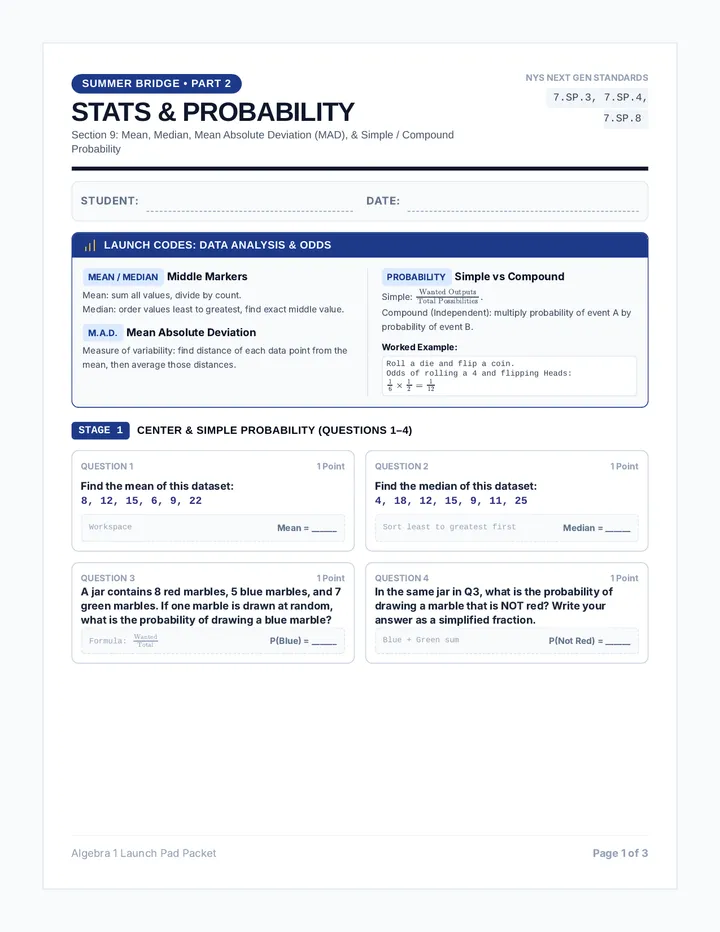
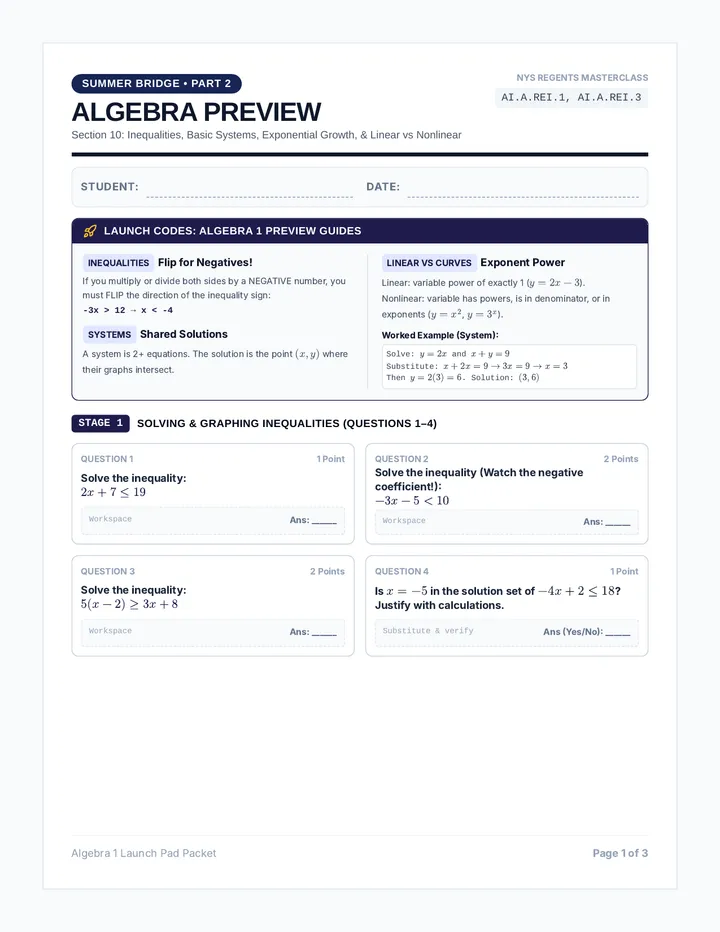
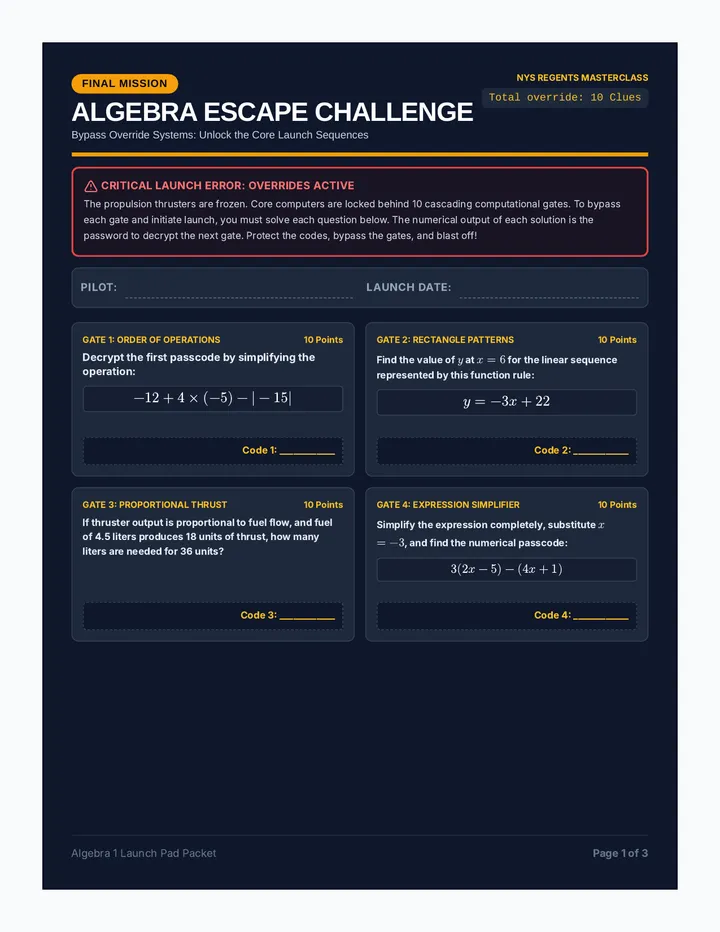
Floors ($n$) Blocks ($B$) 1 6 2 10 3 14 4 ?
1
What is the constant difference between steps?
2
How many blocks are we adding every single time?
3
Where did we start before adding any floors?
The "Blueprints"
Arithmetic Sequence
A sequence of numbers where the difference between consecutive terms is constant.
Example: 6, 10, 14, 18, ...
Common Difference ($d$)
The fixed amount added to each term to get the next one.
In our tower: $d = 4$
Pattern Build Challenge
Grab your building blocks. You're about to design three different sequences and find the math hidden inside them.
Build
Measure
Solve
Tile Tower Worksheet Tile Tower Challenge
Arithmetic Sequences & Pattern Building
Name:
Date:
Mission: Build physical towers using blocks or tiles, record your data, and discover the mathematical rule that governs your creation.
1
The Basic Build
Instructions:
1. Start with a "Base" of 3 blocks.
2. For every "Level" you add, use 2 blocks.
3. Build up to Level 4 and record your counts.
Level ($n$) Total Blocks ($B$) 1 2 3 4
Identify the Rule:
What is the common difference ($d$) in this pattern?
Predict:
How many blocks would a Level 10 tower need? Explain how you found it.
2
Custom Architect
Create your own arithmetic pattern. Decide on a starting number and a common difference.
Starting Amount:
Common Difference:
Term ($n$) Value ($a_n$) 1 2 3 4
Draw your pattern here
(Show terms 1, 2, and 3)
Final Blueprint Analysis
In your own words, what makes a sequence "Arithmetic"?
If a sequence starts at 10 and the common difference is -3, what are the first four terms?
Arithmetic Foundations Teacher Guide Arithmetic Foundations
Teacher Facilitation Guide
Objectives
• Identify constant difference in visual patterns.
• Generate numerical sequences from physical builds.
• Predict future terms based on additive growth.
Materials
• Linking cubes, tiles, or toothpicks.
• "Tile Tower" Worksheet.
• "Pattern Architect" Slides.
Timing
• Hook: 5 mins
• Direct Instruction: 15 mins
• Hands-on Build: 20 mins
• Debrief: 10 mins
Facilitation Steps
01
The Hook (The 100-Story Tower)
Present the tower problem. Encourage students to guess first. Use this to highlight the need for a formula (efficiency). Ask: "Who wants to actually build all 100 levels?"
02
Defining "Arithmetic"
Emphasize the Constant Difference ($d$). In the tower example, $d=4$. Ask students to identify what stays the same (the 4 blocks per floor) vs. what changes (total height). Point out that "Arithmetic" sounds like "Addition."
03
The Pattern Build Activity
Circulate while students build towers. Look for students who realize they don't need to rebuild the whole tower for Level 4, just add to the Level 3 tower. This is the seed for recursive thinking.
Common Misconceptions
Confusing the Base with the Difference
Students might think the sequence starts with the difference. Clarify that the first term ($a_1$) is often Base + 1st addition.
Off-by-one errors
When predicting Level 10, students might add the difference 10 times instead of 9 (if starting from Level 1). Use the visual build to correct this.
Worksheet Key
Experiment 1 (The Basic Build):
Level 1: 5 blocks (3 base + 2) | Level 2: 7 blocks | Level 3: 9 blocks | Level 4: 11 blocks
Common Difference ($d$): 2
Level 10 Prediction: 23 blocks ($5 + 2 \times 9$) or students might reason $3 + 2 \times 10$.
Synthesis:
"Arithmetic sequences add the same number every time."
Example: 10, 7, 4, 1 ($d = -3$)
Growth Explosion Slides Pattern Lab: Lesson 2
Growth
Explosion
Multiplication vs. Addition: Why does one grow so much faster?
The Bacteria Riddle
A bacteria colony doubles in size every hour.
The jar is completely full at 12:00 PM.
At what time was the jar exactly half-full?
JAR
Answer: 11:59 AM
The Power of "Times"
Arithmetic
Repeated Addition.
2, 4, 6, 8, 10, 12...
Geometric
Repeated Multiplication.
2, 4, 8, 16, 32, 64...
The Common Ratio ($r$)
The constant factor we multiply by to get from one term to the next.
10
$\times 3$
30
$\times 3$
90
Here, $r = 3$
Paper Folding Lab
Every fold creates a new world of sections. How quickly can we reach 1,000 sections?
Ready your paper...
Paper Fold Lab Lab Report
The Paper Fold Paradox
Geometric Progressions & Power of 2
Architect:
Date:
The Experiment
Take a single sheet of paper. Fold it exactly in half. Record the number of sections. Then fold it in half again, and again.
Warning: It gets difficult very quickly!
Key Term
Common Ratio ($r$)
The factor we multiply by at each step.
Number of Folds ($n$) Number of Sections ($S$) Calculation / Logic 0 1 Starting point (Flat Paper) 1 2 $1 \times 2$ 2 3 4 5
Identify the Growth
Was the growth Arithmetic (adding the same number) or Geometric (multiplying by the same number)?
The Ratio
What is the common ratio ($r$) for this paper folding sequence?
Prediction Zone
A standard piece of paper can usually only be folded 7 times.
Calculate exactly how many sections would exist if you could fold it 10 times.
The Comparison Test
Sequence A: 5, 10, 15, 20...
Sequence B: 5, 10, 20, 40...
Which is geometric? Explain how you know by looking at the relationship between terms.
Geometric Logic Teacher Guide Geometric Logic
Teacher Facilitation Guide
! Instructional Shift
The core goal of this lesson is to move students away from the "constant addition" mindset. Geometric sequences represent proportional growth. Every step is scaled by the same factor.
"Arithmetic sequences grow like a staircase. Geometric sequences grow like a rocket."
Key Terms
Ratio ($r$) The multiplier between terms.
Exponent The power representing repeated multiplication.
Facilitation Roadmap
1. The Bacteria Riddle (5 mins)
Let students debate. Most will say "11:30" (additive logic). When you reveal "11:59," the "Aha!" moment happens. This illustrates that doubling means the last step is as big as the entire history of the sequence combined.
2. The Paper Fold Lab (25 mins)
Provide standard 8.5x11 paper. Encourage students to keep going until they can no longer physically fold it. Point out that while the physical limit is ~7 folds, the mathematical pattern continues infinitely.
Anticipating Struggles
Identifying the Ratio
Students often struggle when $r < 1$ (decreasing sequences). Remind them that division is just multiplication by a fraction. "Dividing by 2" is the same as "$r = 0.5$".
Calculation Fatigue
Calculating $2^{10}$ by hand can lead to arithmetic errors. Encourage using the "previous answer $\times 2$" method to reinforce recursive logic before we teach explicit formulas.
Lab Key
Data Table: Fold 0 (1), Fold 1 (2), Fold 2 (4), Fold 3 (8), Fold 4 (16), Fold 5 (32).
Common Ratio: $r = 2$
10 Folds: $2^{10} = 1024$ sections.
Comparison: Sequence B is geometric because each term is multiplied by 2 ($r=2$). Sequence A is arithmetic ($d=5$).
Step Logic Slides Pattern Lab: Lesson 3
Step Logic
Coding the "Next Step" using Mathematical Notation
How do you tell a robot what to do?
Imagine a robot that has no memory.
It only knows the Current Step.
"Take what you have right now, and add 5."
IF $n=10$,
THEN $10+5$
The Recursive "Code"
$a_n = a_{n-1} + d$
$a_n$
The Current Term
"What I want to find"
$a_{n-1}$
The Previous Term
"What I had before"
$d$
Common Difference
"The change"
Don't Forget the Ratio!
For multiplication patterns, the code changes slightly...
$a_n = (a_{n-1}) \cdot r$
Example: If a sequence doubles, $r = 2$.
$a_n = a_{n-1} \cdot 2$
Recursive Workshop
It's time to translate our "next step" logic into professional math notation. Open your workbooks to Part 1.
Translate
Symbolize
Solve
Recursive Rules Worksheet Recursive Rules
Translating Step-by-Step Logic
Coder:
Lesson 03 • Pattern Lab
The Blueprint
$a_n = a_{n-1} + d$
"The current term is the previous term plus the difference."
Crucial Step
Always state where you started!
A recursive rule needs a starting term ($a_1$).
01 Arithmetic Translation
A pattern starts at 12 and adds 5 each time.
$a_1 =$
$a_n =$
Sequence: 20, 18, 16, 14...
$a_1 =$
$a_n =$
02 Geometric Translation
A colony of 10 cells triples every hour.
$a_1 =$
$a_n =$
Sequence: 8, 4, 2, 1...
$a_1 =$
$a_n =$
03 Applying the Logic
Given the rule: $a_1 = 5$ and $a_n = a_{n-1} \cdot (-2)$, find the first five terms of the sequence.
$a_1$
5
$a_2$
$a_3$
$a_4$
$a_5$
Recursive Rules Answer Key Recursive Rules
Answer Key • Pattern Lab
Part 1: Arithmetic Solutions
Starts at 12, adds 5:
$a_1 = 12, \quad a_n = a_{n-1} + 5$
Sequence 20, 18, 16, 14:
$a_1 = 20, \quad a_n = a_{n-1} - 2$
Part 2: Geometric Solutions
Starts at 10, triples:
$a_1 = 10, \quad a_n = (a_{n-1}) \cdot 3$
Sequence 8, 4, 2, 1:
$a_1 = 8, \quad a_n = (a_{n-1}) \cdot \frac{1}{2}$ (or 0.5)
Part 3: Pattern Logic Application
$a_1$
5
$a_2$
-10
$a_3$
20
$a_4$
-40
$a_5$
80
Teacher Note: Watch for sign errors. Multiplying by -2 causes the signs to alternate.
Shortcut Science Slides Pattern Lab: Lesson 4
Shortcut
Science
Finding the 1,000th term without doing 999 calculations.
The Problem with "Next Step"
Recursive rules are great for computers...
But what if I ask you for the 1,000th term?
To find $a_{1000}$, you'd first have to find $a_{999}$... then $a_{998}$... all the way back to $a_1$.
Ain't nobody got time for that!
Estimated time: 4 hours
The Arithmetic Shortcut
Every step adds another $d$.
$a_1 = a_1$
$a_2 = a_1 + d$
$a_3 = a_1 + d + d$ ($2$ times)
$a_4 = a_1 + d + d + d$ ($3$ times)
The Logic:
$a_n = a_1 + (n-1)d$
To get to step $n$, you add $d$ exactly $(n-1)$ times.
The Geometric Shortcut
Every step multiplies by another $r$.
$a_1 = a_1$
$a_2 = a_1 \cdot r$
$a_3 = a_1 \cdot r \cdot r$ ($r^2$)
$a_4 = a_1 \cdot r \cdot r \cdot r$ ($r^3$)
The Logic:
$a_n = a_1 \cdot r^{(n-1)}$
To get to step $n$, you multiply by $r$ exactly $(n-1)$ times.
Mastering the Explicit
No more step-by-step counting. We're going straight to the answer. Let's practice building these powerful shortcuts.
Formula Finder Mode: ON
Explicit Mastery Worksheet Mastery Level: Advanced
Explicit Mastery
Finding the Value of Any Step
Architect:
Arithmetic Explicit
$a_n = a_1 + (n-1)d$
Geometric Explicit
$a_n = a_1 \cdot r^{(n-1)}$
01
Arithmetic Shortcuts
Sequence: 7, 10, 13, 16...
Write Explicit Formula:
Find the 50th Term ($a_{50}$):
Sequence: 100, 95, 90, 85...
Write Explicit Formula:
Find the 21st Term ($a_{21}$):
02
Geometric Power
Sequence: 5, 10, 20, 40...
Write Explicit Formula:
Find the 12th Term ($a_{12}$):
Sequence: 100, 50, 25, 12.5...
Write Explicit Formula:
Find the 6th Term ($a_{6}$):
The 100-Story Prediction
Remember our tower from Lesson 1? It started with 5 blocks at Level 1 and added 2 blocks per level.
Write the explicit formula for the tower and use it to find the total blocks for Level 100. Show your setup.
Formula Finder Cheat Sheet Pattern Lab Reference
Formula Finder
The Ultimate Sequence Decoder
Arithmetic
Constant Addition
Recursive Rule
$a_n = a_{n-1} + d$
"Add the common difference to the previous term."
Explicit Formula
$a_n = a_1 + (n-1)d$
"Find any term using the first term and the position."
Variables:
$a_1$: The First Term
$d$: The Common Difference
$n$: The Term Position
Geometric
Constant Multiplication
Recursive Rule
$a_n = (a_{n-1}) \cdot r$
"Multiply the previous term by the common ratio."
Explicit Formula
$a_n = a_1 \cdot r^{(n-1)}$
"Find any term by scaling the first term by powers of $r$."
Variables:
$a_1$: The First Term
$r$: The Common Ratio
$n$: The Term Position
Pro Tip: If you're looking for the next term, use recursive. If you're looking for a far-away term, use explicit.
Code Cracker Challenge Code Cracker
The Final Sequence Challenge
Agent Name:
Mission: Three locks guard the vault. To crack each code, you must identify the sequence type (Arithmetic or Geometric) and write the requested formula.
01
The Number Sequence
15, 22, 29, 36...
Type:
Arithmetic
Geometric
Recursive Rule:
Explicit Shortcut:
02
The Viral Post
"A post has 100 shares. Every hour, the number of shares doubles."
Type:
Arithmetic
Geometric
Common Ratio ($r$):
Explicit Rule:
03
The Final Pattern
Step 1: 2 tiles, Step 2: 4 tiles, Step 3: 6 tiles...
Write the explicit formula AND calculate Step 500:
Pattern Pro Exit Ticket Pattern Pro Exit Ticket
Final Mastery Check
Name:
1. Identify the sequence: $5, 15, 45, 135...$
Arithmetic ($d=10$)
Geometric ($r=3$)
2. Write the explicit formula for a sequence that starts at 10 and has a common difference of 4.
3. Why would you use an explicit formula instead of a recursive formula to find the 500th term?
Cut Here
Pattern Pro Exit Ticket
Final Mastery Check
Name:
1. Identify the sequence: $5, 15, 45, 135...$
Arithmetic ($d=10$)
Geometric ($r=3$)
2. Write the explicit formula for a sequence that starts at 10 and has a common difference of 4.
3. Why would you use an explicit formula instead of a recursive formula to find the 500th term?
Challenge Master Key Challenge Master Key
Teacher Solution Guide • Lesson 05
Lock 01: Numeric Sequence
Sequence
15, 22, 29, 36...
Type: Arithmetic ($d = 7$)
Recursive: $a_1 = 15, \quad a_n = a_{n-1} + 7$
Explicit: $a_n = 15 + (n-1)7$
Lock 02: Viral Post
Scenario
100 shares, doubles every hour.
Type: Geometric ($r = 2$)
Common Ratio: 2
Explicit: $a_n = 100 \cdot 2^{(n-1)}$
Lock 03: Visual Pattern
Pattern
2, 4, 6... tiles
Explicit: $a_n = 2 + (n-1)2$ or $a_n = 2n$
Step 500: $2 \times 500 = 1,000$ tiles.
Exit Ticket Answers
Geometric ($r = 3$)
$a_n = 10 + (n-1)4$
Explicit formulas allow for direct calculation without knowing the 499th term. Recursive would require 499 previous steps, making it inefficient for large $n$.