Dot Talk Slides Daily Number Spark • Pillar 1
Visual Dot Talks for Spatial Reasoning
Focus: Subitizing & Spatial Patterns
See the Pattern in a Flash!
Train your eyes to group dots by shape and structure—no counting by ones!
Goal: Explain how you see parts that combine to make the whole!
Routine 1
Quick Image: Flash for 3 Seconds!
Ready, Set, Look!
What did you see?
How many in all?
Share Your Vision:
"I saw 4 dots in a square on the left, and 3 in a line on the right. 4 + 3 = 7!"
"I saw almost 8 , but one dot was missing from the corner!"
💡 Notice: Everyone sees the groups a little differently!
Routine 2
Same Number, Different Ways!
Both cards have 8 dots!
Pattern A: The Doubles View
"I see two rows of 4. 4 + 4 = 8!"
Pattern B: The Five Anchor
"I see a dice 5 and 3 more. 5 + 3 = 8!"
Turn & Tell: "Which pattern did your eyes recognize faster? Why?"
Dot Blitz
Show With Fingers!
Pop fingers up fast!
Pattern 1
Total = ?
Pattern 2
Total = ?
Pattern 3
Total = ?
Ready? Grab your Dot Talk Sheet for today's 3-minute practice!
Dot Talk Sheet Daily Number Spark
Pillar 1: Visual Dot Talks for Spatial Reasoning
Name:
Date:
My Goal: See groups of dots by shape and pattern without counting by ones! 3-Minute Spark
1
Quick Look: How Many Dots in All?
Look for familiar dice patterns, rows, or clusters.
A
Total:
B
Total:
C
Total:
2
Circle the Two Groups & Write the Addition Sentence
How did your eyes break the dots apart?
= 7
= 9
3
Fast Blitz: Complete the Pattern Facts
3 + 3 =
4 + 4 =
5 + 3 =
5 + 4 =
Dot Detective: Draw 8 Dots Two Different Ways!
Show how to arrange 8 dots so someone can see the total without counting by ones!
Way 1: As a Double (4 + 4)
Way 2: With a 5-Anchor (5 + 3)
Daily Self Check: I counted every dot I saw patterns fast!
Sparks Earned: _____ / 10
Dot Talk Guide Teacher Guide Tier 2 Math Intervention • Pillar 1
Daily Number Spark: Visual Dot Talks
Target Gaps: K.CC.B.5, 1.OA.C.6
Spatial Reasoning & Subitizing
Intervention Objective: Students move from perceptual subitizing (small sets 1–3) to conceptual subitizing (combining structured subsets like 4 and 3 or 5 and 3 to see 7 or 8) through quick visual dot exposures and spatial talk routines.
10-Minute Daily Protocol & Instructional Script
Min 0–2: Quick Image Flash (Slide 2) Flash 3 Sec
Say: "Keep your eyes locked on the screen! I will show a dot card for exactly three seconds, then take it away. Try to capture a photo of it in your mind. 1... 2... 3!" (Cover display). "Show me with your fingers how many dots you saw. How did you see them?" Elicit spatial descriptions: "A square of 4 and a line of 3!"
Min 2–5: Comparative Dot Talk (Slide 3) Turn & Talk
Say: "Look at both cards on Slide 3. They both have 8 dots. Card A is arranged like doubles (4 + 4). Card B is arranged around a dice five (5 + 3). Whisper to your partner: which card was easier for your brain to group? Why?" Validate all student strategies!
Min 5–8: Dot Talk Sheet Practice (Worksheet) Student Work
Distribute the Dot Talk Sheet. Set a 3-minute timer. For Part 2, ensure students actively draw circles around the sub-groups they see before writing the numbers in the blanks. Prevent counting each dot with an index finger.
Min 8–10: Dot Blitz & Self Check (Slide 4) Rapid Fire
Flash Slide 4 patterns: "Pattern 1 total?" (6!), "Pattern 2 total?" (7!), "Pattern 3 total?" (9!). Have students mark their self-check box on the sheet.
Common Misconceptions & In-the-Moment Scaffolds
Misconception: Inability to Decompose Visually
Symptom: Student sees 7 as a chaotic cloud rather than 4 and 3.Intervention: Use two different colored highlighters (e.g. blue and yellow) to outline the separate spatial groups directly on the card.
Misconception: Habitual Finger Pointing
Symptom: Student will not answer until they touch every dot.Intervention: Have student sit on their hands during the 3-second flash to force visual chunking and verbal reasoning.
Dot Talk Sheet Answer Key 10 Total Points
Part 1 (Subitize): A: 6 (double 3)7 (5 + 2)8 (4 + 4)
Counting Collections Slides Daily Number Spark • Pillar 2
Counting Collections & Grouping
Focus: Skip Counting by 2s, 5s & 10s
Group to Count Faster!
When you have a big pile of objects, organize into equal groups so you can skip count with ease!
Pairs of 2
Cups of 5
Tens Frames
Goal: Stop counting 1, 2, 3... Start skip counting 5, 10, 15, 20!
Routine 1
How Did They Count?
Compare the Strategies
Sam's Strategy: Count by Ones
Messy scattered pile of 20 counters... 1, 2, 3... Wait, did I count this one?
Takes a long time & easy to lose track!
Jordan's Strategy: Groups of 5
5
10
15
20
Fast: 5, 10, 15, 20! Easy to double-check!
Turn & Tell: "Why does making groups of 5 protect you from making counting mistakes?"
Routine 2
Count by 2s & Add Leftovers!
Pairs Strategy
Look at this collection of shoes:
👟👟
2
👟👟
4
👟👟
6
👟👟
8
👟👟
10
👟👟
12
👟
+1
Skip count: 2, 4, 6, 8, 10, 12... and 1 more = 13 shoes!
💡 Skip count the full groups, then count on the leftovers!
Collection Blitz
Call Out the Total!
Skip Count Fast!
Collection A
5 cups of 5
5, 10, 15, 20... 25!
Collection B
3 bags of 10
10, 20... 30!
Collection C
6 pairs of 2
2, 4, 6, 8, 10... 12!
Ready? Grab your Counting Collections Sheet for today's 3-minute practice!
Counting Collections Sheet Daily Number Spark
Pillar 2: Counting Collections & Grouping
Name:
Date:
My Goal: Group objects into 2s, 5s, or 10s and skip count to find the total! 3-Minute Spark
1
Skip Count the Groups: Write the Total
Write the running count below each group, then write the total.
A: Cups of 5
5
10
15
20
Total:
B: Pairs of 2
2
4
6
8
10
12
Total:
C: Bags of 10 & Leftovers
10
20
+3
Total:
2
Circle Groups of 5 in the Collection
Circle groups of 5 stars with your pencil. How many groups? How many leftovers?
⭐⭐⭐⭐⭐⭐ ⭐⭐⭐⭐⭐⭐ ⭐⭐⭐⭐⭐
Groups of 5:
Leftovers (ones):
Total Stars:
3
Fill in the Missing Skip Counts
Count by 2s: 2, 4, 6, , 10, 12
Count by 5s: 5, 10, 15, , 25
Count by 10s: 10, 20, 30, , 50
Collection Planner: Organize 14 Counters
Draw circles or tallies to show how you would organize 14 counters into pairs of 2 so a friend can count them quickly!
Draw your groups of 2:
How many pairs?
Daily Self Check: I counted 1 by 1 I skip counted by groups!
Sparks Earned: _____ / 10
Counting Collections Guide Teacher Guide Tier 2 Math Intervention • Pillar 2
Daily Number Spark: Counting Collections
Target Gaps: K.CC.B.4, 2.NBT.A.2
Grouping & Skip Counting
Intervention Objective: Students transition from inefficient one-by-one counting of large sets to creating structured groups (pairs of 2, cups of 5, full tens), skip counting the equal groups, and flexibly switching to counting on by ones for remaining leftovers.
10-Minute Daily Protocol & Instructional Script
Min 0–2: Strategy Compare (Slide 2) Notice & Wonder
Say: "Look at Slide 2. Sam counted 20 counters in a big messy pile one-by-one. Jordan put them into cups of 5. Turn to your partner: which counter will get the right answer faster? Why is it easier to double-check Jordan's work?" Lead students to see that groups of 5 are instantly verifiable.
Min 2–5: Skip Count with Leftovers (Slide 3) Switch Strategies
Say: "Let's count the shoes together by 2s: 2, 4, 6, 8, 10, 12! But wait—there is one extra shoe alone at the end. Can we say 14? No! We must switch our brains from counting by 2s to counting on by 1: 12 plus 1 is 13 shoes!" Practice the vocal shift from 2s rhythm to +1.
Min 5–8: Collections Sheet Practice (Worksheet) Student Work
Distribute the Counting Collections Sheet. For Part 2, monitor students circling 5 stars at a time. Ensure they recount groups of 5 as "5, 10, 15" rather than counting the individual stars inside each circle.
Min 8–10: Collection Blitz & Wrap-Up (Slide 4) Rapid Fire
Point to Slide 4 collections: "5 cups of 5?" (25!), "3 bags of 10?" (30!), "6 pairs of 2?" (12!). Prompt students to complete their self-check meter.
Common Misconceptions & In-the-Moment Scaffolds
Misconception: Continuing the Skip Pattern on Leftovers
Symptom: Counting 5, 10, 15, and saying 20 for a group of 2 leftover items.Intervention: Have student physically tap the desk with a fist for groups of 5, then switch to a single finger tap for ones: "BAM (5), BAM (10), BAM (15), tap (16), tap (17)!"
Misconception: Disorganized Grouping
Symptom: Circles overlap, capturing some items twice or leaving items stranded.Intervention: Teach students to cross out each group as they tally or circle in neat linear rows.
Counting Collections Sheet Answer Key 10 Total Points
Part 1 (Totals): A: 20 (4 × 5)
Strategy Bridge Slides Daily Number Spark • Pillar 3
Mental Math Strategy Bridges
Focus: Fluency Without Finger Counting
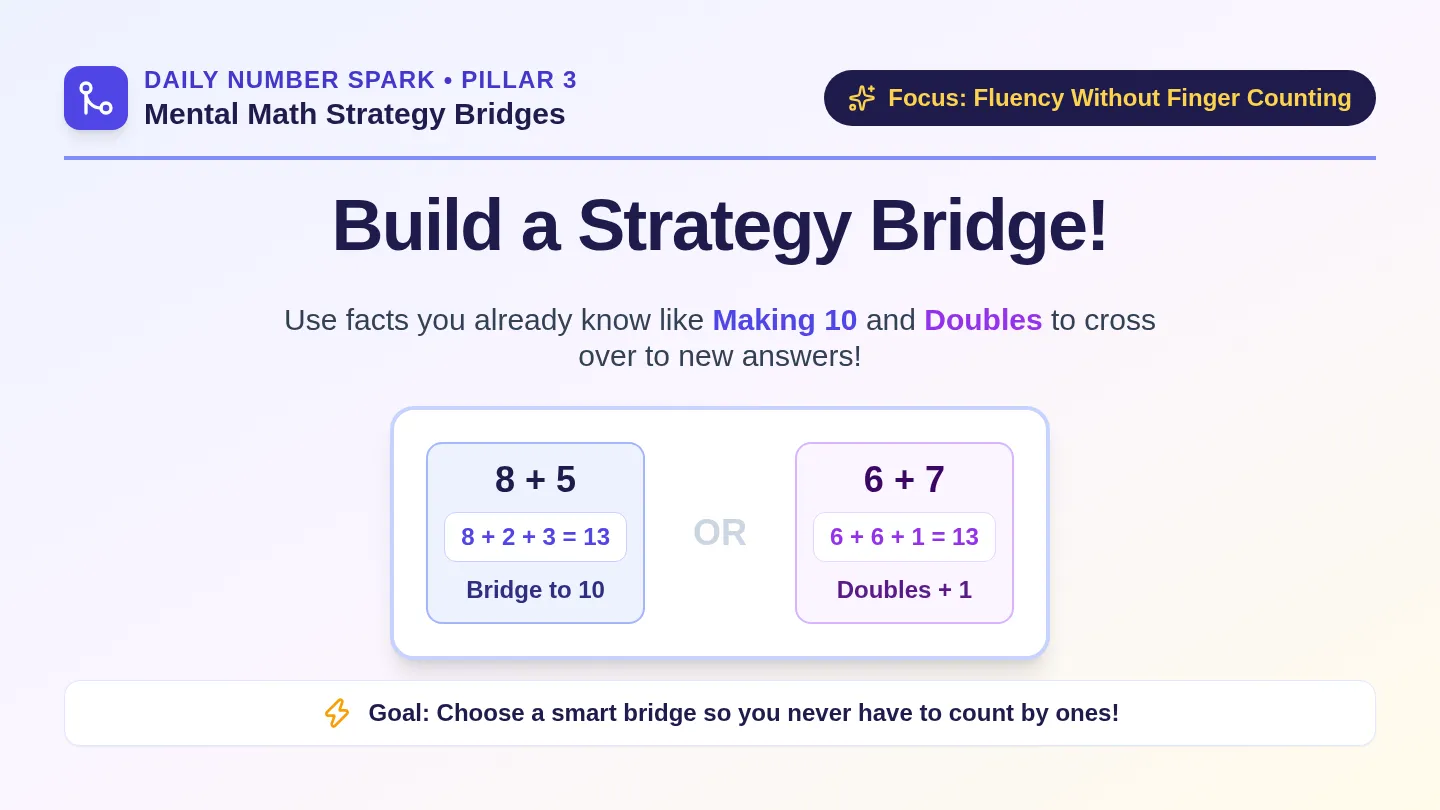
Build a Strategy Bridge!
Use facts you already know like Making 10 and Doubles to cross over to new answers!
8 + 5
8 + 2 + 3 = 13
Bridge to 10
OR
6 + 7
6 + 6 + 1 = 13
Doubles + 1
Goal: Choose a smart bridge so you never have to count by ones!
Bridge 1
The Make-Ten Bridge: 8 + 6
Anchor to 10
How the bridge works:
8
Split 6: 2 + 4
Step 1: 8 + 2 = 10
Step 2: 10 + 4 = 14!
Partner Math Talk
"I know 8 needs 2 to make 10."
"I take 2 from the 6, leaving 4 . So 10 + 4 is 14 !"
💡 No counting on 6 fingers! The 10 makes it fast!
Bridge 2
The Near Doubles Bridge: 6 + 7
Doubles + 1
The Fact You Know:
6 + 6 = 12
You already have your doubles locked in your brain!
The Leap to 6 + 7:
6 + 7 = 13
7 is just one more than 6 . So 12 plus 1 is 13 !
Turn & Tell: "If 7 + 7 is 14, how does that help you solve 7 + 8 instantly?"
Bridge Blitz
Name the Bridge & Solve!
Mental Flash!
Bridge A
9 + 5
9 + 1 + 4 = 14
Bridge B
7 + 8
7 + 7 + 1 = 15
Bridge C
13 − 4
13 − 3 − 1 = 9
Ready? Grab your Strategy Bridge Sheet for today's 3-minute practice!
Strategy Bridge Sheet Daily Number Spark
Pillar 3: Mental Math Strategy Bridges
Name:
Date:
My Goal: Use Make-Ten and Doubles bridges to solve fast without counting by ones! 3-Minute Spark
1
Bridge 1: Make 10 to Add
Split the second number to make a friendly 10, then add the rest.
8 + 5 = ?
8 + 2 + =
Total:
9 + 6 = ?
9 + 1 + =
Total:
7 + 5 = ?
7 + 3 + =
Total:
2
Bridge 2: Near Doubles (Doubles + 1)
Use the double you know to find the answer that is just 1 more.
5 + 5 = 10
So 5 + 6 = 10 + 1 =
7 + 7 = 14
So 7 + 8 = 14 + 1 =
8 + 8 = 16
So 8 + 9 = 16 + 1 =
3
Bridge 3: Hop Backwards Through 10 (Subtraction)
13 − 5 = ?
13 − 3 = 10, then 10 − 2 =
14 − 6 = ?
14 − 4 = 10, then 10 − 2 =
Bridge Master Challenge: Pick Your Strategy!
Elena is solving 8 + 7 . She can use a Make-Ten Bridge (8 + 2 + 5) OR a Near-Doubles Bridge (7 + 7 + 1). Pick which bridge you like best and show the work!
Show your bridge steps:
Total:
Daily Self Check: I counted up by 1s I used a Strategy Bridge!
Sparks Earned: _____ / 10
Strategy Bridge Guide Teacher Guide Tier 2 Math Intervention • Pillar 3
Daily Number Spark: Strategy Bridges
Target Gaps: 1.OA.C.6, 2.OA.B.2
Derived Fact Fluency
Intervention Objective: Students break their dependency on fingers by learning to "derive" unknown facts from known landmark anchors: using 10 as an intermediate station (Make-Ten Bridge) and using known doubles to solve neighbor facts (Near Doubles / Doubles + 1).
10-Minute Daily Protocol & Instructional Script
Min 0–2: Make-Ten Bridge Launch (Slide 2) Bridge 10
Say: "Look at 8 + 6. Instead of counting up 6 fingers, let's build a bridge! What does 8 need to make 10? Exactly, 2! Break 2 off of the 6. What's left of the 6? 4! 8 + 2 is 10, plus 4 is 14! How much faster was that than counting fingers?"
Min 2–5: Near-Doubles Bridge Talk (Slide 3) Doubles + 1
Say: "Everyone shout out: what is 6 + 6? (12!) Now look at 6 + 7. 7 is just 6's next-door neighbor—it's only 1 more! If 6 + 6 is 12, then 6 + 7 must be 12 plus 1, which is 13! You just used a double you know to crack a hard problem!"
Min 5–8: Strategy Bridge Sheet Practice (Worksheet) Student Work
Distribute the Strategy Bridge Sheet. Watch students on Part 1 and 2. Prompt verbalization: "Which double helps you solve 7 + 8? Right, 7 + 7! So 14 plus 1 is 15!" Discourage finger tapping.
Min 8–10: Bridge Blitz & Wrap-Up (Slide 4) Mental Blitz
Call out Slide 4 facts: "9 + 5 bridge?" (14!), "7 + 8 bridge?" (15!), "13 − 4 hop back?" (9!). Celebrate mental agility and mark self-check sparks!
Common Misconceptions & In-the-Moment Scaffolds
Misconception: Reverting to Counting from 1
Symptom: When facing \(8 + 7\), student counts out 8 fingers, then 7 fingers, then starts over from 1.Intervention: Cover student hands with a clipboard. Require them to say: "I know 7 + 7 is 14..." before writing.
Misconception: Forgetting to Subtract Leftovers on 10
Symptom: In \(13 - 5\), student does \(13 - 3 = 10\), but stops at 10 and forgets the remaining 2.Intervention: Draw a 2-step hop arch on paper: Hop 1 to 10, then Hop 2 from 10 to 8.
Strategy Bridge Sheet Answer Key 10 Total Points
Part 1 (Make 10): 8 + 2 + 3 = 13 5 = 15 2 =