Intervention Blueprint Teacher Guide Intervention Blueprint
Tier 2 Small Group: Perimeter & Area on the Coordinate Plane
Standard
HS.G-GPE.B.7
Lesson Objective
Students will apply the distance formula to find the side lengths of polygons in the coordinate plane to calculate perimeter and area, using SSAR (Subtract, Square, Add, Root) templates to organize their thinking.
Targeted Support
Reduced Cognitive Load: Templates handle the organization so students focus on the computation.
The "SSAR" Mnemonic: Subtract, Square, Add, Root.
Visual Anchors: Color-coded coordinate pairs.
Common Pitfalls
Subtracting a negative: \(x_2 - (-x_1) \rightarrow x_2 + x_1\)
Squaring negatives: \((-5)^2\) is positive 25, not -25.
Confusing x and y values when plugging into the formula.
Facilitation Guide
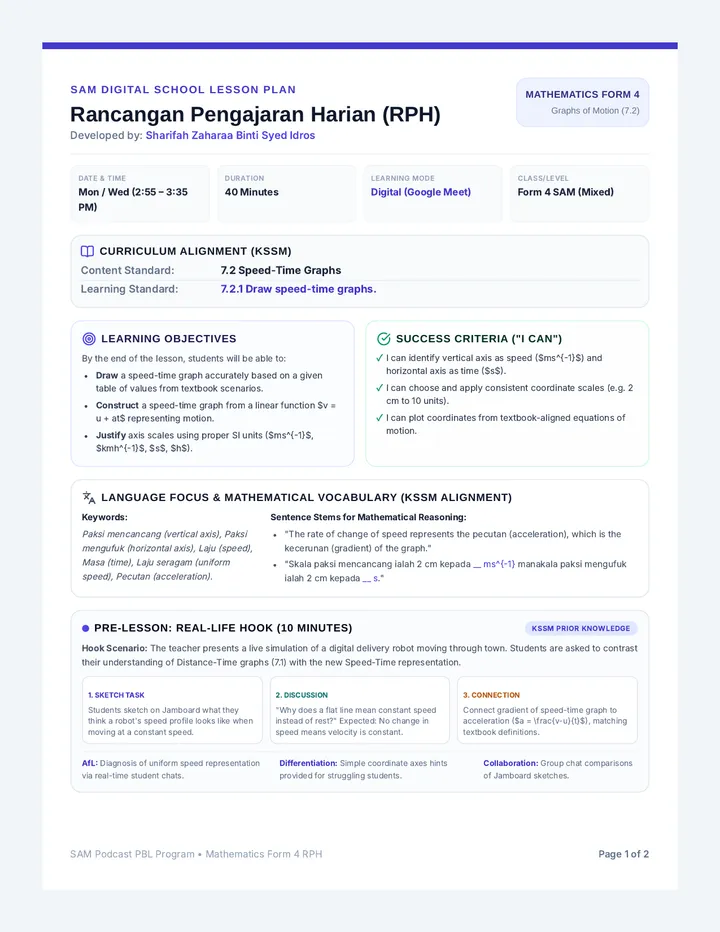
Connect
"We know how to find perimeter of a shape when the lengths are given. But what if the shape is on a map? Today, we use the coordinate blueprint to build our measurements from scratch."
Model
Use the Distance Logic Log . Demonstrate the "Subtract, Square, Add, Root" process. Emphasize that distance is never negative.
Practice
Students work on the Geometry Gridwork Packet . For students struggling with squaring, provide a "Perfect Squares" reference chart.
Check
Use the Coordinate Checkpoint as an exit ticket. Look specifically for consistent squaring of negative numbers.
Scenario Intervention Strategy Struggling with negatives Use a vertical number line and physically count the distance between \(x_1\) and \(x_2\). Mixing Perimeter/Area Use physical string for perimeter and square tiles for area to ground the concept. Calculation Fatigue Focus on one side length at a time. Use a highlighter to "check off" sides once found.
Coordinate Blueprint Slides Geometry Module 4.2
GRIDWORK
BLUEPRINT
Perimeter and Area on the Coordinate Plane
The Distance Formula
d = \(\sqrt{(x_2 - x_1)^2 + (y_2 - y_1)^2}\)
1
Calculates the length of a segment between two points.
2
The length is always a positive number .
The SSAR Method
S
Subtract
Find the difference between x's and y's.
S
Square
Multiply each result by itself.
A
Add
Combine the two squared numbers.
R
Root
Find the square root of the sum.
Finding Perimeter
Total Side Lengths
Step 1: Distance Formula
Find the distance for every side of the polygon.
Step 2: Addition
Add all the side lengths together.
Tip: Round each length to the nearest tenth before adding!
Finding Area
For Triangles
A = \(\frac{1}{2} \cdot \text{base} \cdot \text{height}\)
Pick a horizontal or vertical side for the base to make it easier!
For Rectangles
A = \(\text{base} \cdot \text{height}\)
Find the distance of two adjacent sides (length and width).
Blueprint Checklist
Plot the points carefully.
Identify base and height.
Calculate distances (SSAR).
Plug into the Area Formula.
Distance Logic Logs Distance Logic Logs
Reusable Template for Systematic Distance Calculation
Method
SSAR (Sub-Sq-Add-Root)
LOG #____ : Segment [__________]
\(P_1 (x_1, y_1)\): (____, ____) \(P_2 (x_2, y_2)\): (____, ____)
Step X-Coordinates Y-Coordinates SUBTRACT
\(x_2 - x_1\) and \(y_2 - y_1\)
|
|
|
|
SQUARE
\((\text{result})^2\)
|
|
|
|
ADD
Combine both squares
|
=
|
|
ROOT
\(\sqrt{\text{sum}}\)
|
Length =
|
LOG #____ : Segment [__________]
\(P_1 (x_1, y_1)\): (____, ____) \(P_2 (x_2, y_2)\): (____, ____)
Step X-Coordinates Y-Coordinates SUBTRACT
|
| SQUARE |
|
|
| ADD |
|
| ROOT |
|
Geometry Gridwork Packet Project: Triangle Perimeter
Phase 1: Measure the Boundary
Name: _______________________
Date: ________________________
1. PLOT YOUR POINTS
Point A: (-2, 1)
Point B: (4, 1)
Point C: (1, 5)
1 unit = 1 grid square
THE GOAL
To find the Perimeter of Triangle ABC, you must find the distance of all three sides:
Side 1: Segment AB
Side 2: Segment BC
Side 3: Segment CA
2. CALCULATE SIDE LENGTHS
SIDE AB (-2,1) and (4,1)
Sub: \(4 - (-2) = \text{____}\) and \(1 - 1 = \text{____}\)
Sq: \((\text{____})^2 = \text{____}\) and \((0)^2 = 0\)
Add: \(\text{____} + 0 = \text{____}\)
Root: \(\sqrt{\text{____}} = \text{____}\)
SIDE BC (4,1) and (1,5)
Sub: \(x: \text{____}\) | \(y: \text{____}\)
Sq: \(x: \text{____}\) | \(y: \text{____}\)
Add: \(\text{____}\)
Length: \(\sqrt{\text{____}} \approx \text{____}\)
SIDE CA (1,5) and (-2,1)
Use Logic Log
Length: \(\text{____}\)
Total Perimeter
Sum of all 3 sides
=
Project: Rectangle Area
Phase 2: Calculate the Interior Space
1. PLOT RECTANGLE PQRS
P: (1, 1)
Q: (1, 4)
R: (6, 4)
S: (6, 1)
2. CHOOSE YOUR BASE & HEIGHT
Pick two sides that meet at a corner (perpendicular).
Base (Side RS): (6,1) to (6,4)
Height (Side SP): (6,1) to (1,1)
Tip: If the segments are perfectly horizontal or vertical, you can just subtract the coordinates!
3. CALCULATE MEASUREMENTS
BASE LENGTH
Base = ________
HEIGHT LENGTH
Height = ________
Rectangle Area
Area =
×
=
Coordinate Checkpoint Exit Ticket Coordinate Checkpoint
Progress Monitoring: Distance & Perimeter
Student Name
Date
1
Calculate the length of segment \(JK\).
Point J: (2, 3) | Point K: (6, 6)
Subtract
x:
y:
Square
Length of JK = \(\sqrt{\text{____}}\)
2
If a square has side lengths of 5 units, what is its perimeter?
Self-Reflection Checklist
I can plot points accurately on a grid.
I can use the SSAR method to find distance.
I know the difference between Perimeter and Area.
One thing I still find tricky is: