Impossible Solutions Slides Impossible Solutions
Breaking the Rules of the Number Line
The "Dead End"
Consider the equation: \( x^2 + 1 = 0 \)
What number, when squared, gives \(-1\)?
A positive squared is positive.
A negative squared is positive.
y = x² + 1
No x-intercepts!
"Let there be i..."
We define the imaginary unit as:
\( i = \sqrt{-1} \)
Which implies:
\( i^2 = -1 \)
The missing piece of algebra
Expanding the Toolbox
How do we handle larger negative square roots?
Example 1
\( \sqrt{-16} \)
\( = \sqrt{16} \cdot \sqrt{-1} \)
\( = 4i \)
Example 2
\( \sqrt{-7} \)
\( = i\sqrt{7} \)
The Rule of Thumb
Whenever you see a negative sign inside a square root, "pull it out" as an i and then simplify the positive radical normally.
Quick Fire
Simplify
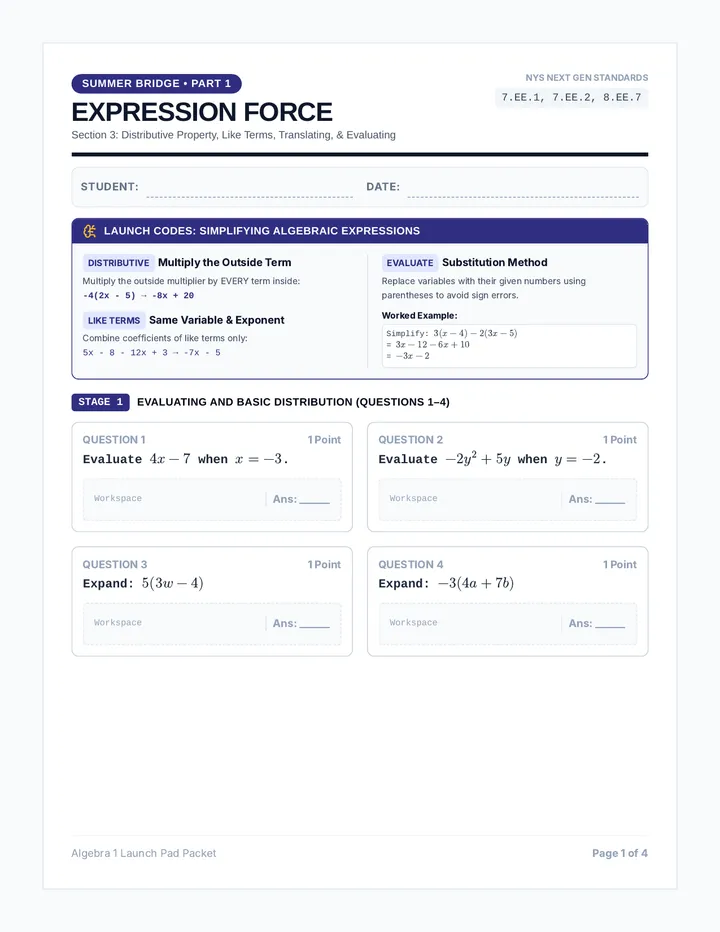
\( \sqrt{-25} \)
Simplify
\( \sqrt{-81} \)
Simplify
\( \sqrt{-2} \)
Ready to rewrite reality?
Radical Rejection Worksheet Radical Rejection
Lesson 1: Defining the Imaginary Unit
Name:
Date:
Engineering Reference
In the real number system, we cannot take the square root of a negative number because no real number times itself results in a negative value. To solve this, we define the imaginary unit \( i \) such that:
\( i = \sqrt{-1} \)
\( i^2 = -1 \)
01 Primary Extractions
Simplify each expression using the imaginary unit \( i \). Show the split step.
\( \sqrt{-49} \)
\( \sqrt{-100} \)
\( \sqrt{-1} \)
\( \sqrt{-144} \)
02 Irrational Remnants
Pull out the imaginary unit and simplify the radical as much as possible.
\( \sqrt{-5} \)
\( \sqrt{-12} \)
\( \sqrt{-18} \)
\( \sqrt{-50} \)
03 Reopening the "Unsolvable"
Solve each quadratic equation. Use \( i \) in your final answers where appropriate.
\( x^2 + 25 = 0 \)
\( 3x^2 + 27 = 0 \)
Critical Thought
You just solved equations that had "No Real Solution" last week. Does this mean the answers aren't "real"? Why do you think mathematicians chose the word "Imaginary"?
Imaginary Inquiry Guide Inquiry Facilitation Guide
Lesson 1: Defining the Imaginary Unit
TEACHER RESOURCE
Learning Objective
Students will conceptualize the need for a new number system by investigating quadratics with no real roots and formalize the definition of \( i = \sqrt{-1} \).
The Hook: Discussion Questions
Question 1:
"If we graph \( y = x^2 + 1 \), why doesn't it touch the x-axis?"
ANTICIPATED: Because x² is always positive, so x² + 1 is always at least 1. It's 'hovering' above the axis.
Question 2:
"Algebraically, we get \( x = \pm\sqrt{-1} \). What would happen if we just... pretended we could do that?"
FOCUS: Moving from 'it's impossible' to 'what if we invented a tool to handle it?'
Misconceptions
"It's not real": Students often think "imaginary" means these numbers aren't useful or don't "exist". Remind them that "Negative" numbers were once considered "false" or "absurd" too.
\( \sqrt{-16} = -4 \): Common error. Squaring \(-4\) gives \(+16\). Emphasize that \( i \) is the only way to get the negative sign.
Lesson Flow
1
The Collision (10 mins):
Present the graph of \( y = x^2 + 1 \). Let students try to find the x-intercepts. Allow them to struggle with the square root of a negative number. This creates "intellectual need."
2
Naming the Ghost (15 mins):
Introduce \( i \). Explain that in mathematics, we often define new objects to solve problems (like defining fractions to solve \( 2x = 1 \)).
3
Procedural Polish (20 mins):
Direct instruction on simplifying \( \sqrt{-n} \). Use the "Product Property" to split the radical: \( \sqrt{-16} = \sqrt{16} \cdot \sqrt{-1} = 4i \).
Differentiation Strategies
Support:
Provide a "Perfect Squares" list (1, 4, 9, 16, 25...). Have students identify which perfect square "hides" inside the negative radical.
Extension:
Introduce the powers of \( i \) (\( i^1, i^2, i^3, i^4 \)). Ask students to find the pattern and predict what \( i^{100} \) would be.
Anatomy of i Slides Anatomy of i
The Structure of Complex Numbers
a + bi
Standard Form
A Complex Number is the sum of two distinct parts:
a Real Part
Any real number: -5, 0, π, 2/3
bi Imaginary Part
A real number \(b\) times the unit \(i\)
The Big Picture
1
If \( b = 0 \)
The number is Real . (e.g., 7 + 0i = 7)
2
If \( a = 0 \)
The number is Pure Imaginary . (e.g., 0 + 3i = 3i)
3
If both exist
It is a standard Complex Number .
COMPLEX NUMBERS
REAL
Identify the Parts
Name the Real (\(a\)) and Imaginary (\(bi\)) components:
\( 4 - 9i \)
a = 4 bi = -9i
\( 12i \)
a = 0 bi = 12i
\( -2 \)
a = -2 bi = 0i
\( 7 + i\sqrt{3} \)
a = 7 bi = i√3
Identity Crisis Worksheet Identity Crisis
Lesson 2: Classifying Complex Numbers
Name:
01 Dissecting Standard Form
Identify the real part (\( a \)) and the imaginary part (\( bi \)) for each number. Write '0' if a part is missing.
Complex Number Real Part (\( a \)) Imaginary Part (\( bi \)) \( 5 + 3i \) \( -2 - 8i \) \( 17i \) \( -4 \) \( \pi + i\sqrt{2} \)
02 Classification Sorting
Categorize the numbers from the word bank into the most specific box possible.
\( 10 \) \( -4i \) \( 1 + 2i \) \( \sqrt{7} \) \( 0 \) \( i\sqrt{5} \) \( -3 + i \) \( 12/5 \)
Real Numbers
Pure Imaginary
Non-Real Complex
Has both a and bi (b ≠ 0)
The Venn Riddle
A classmate says: "Since all real numbers can be written as \( a + 0i \), every single number we have ever learned is actually a complex number."
Is your classmate correct? Explain why or why not.
Complex Classification Key Classification Key
Identity Crisis Worksheet Answer Key
ANSWER KEY
01 | Dissecting Standard Form
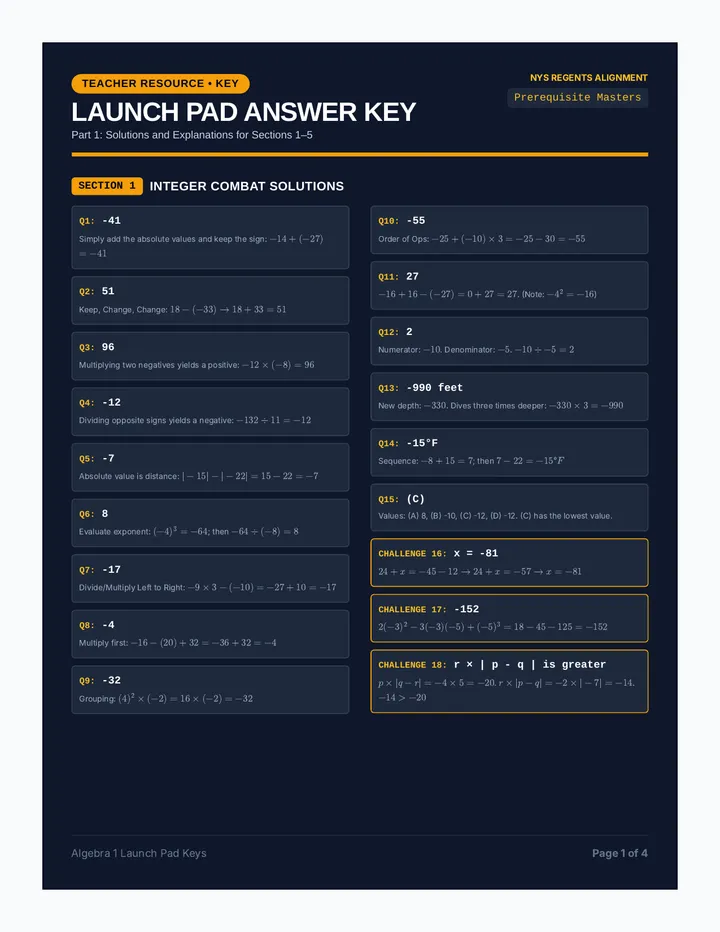
Number Real Part (a) Imaginary Part (bi) \( 5 + 3i \) 5 3i \( -2 - 8i \) -2 -8i \( 17i \) 0 17i \( -4 \) -4 0 \( \pi + i\sqrt{2} \) \(\pi\) \(i\sqrt{2}\)
02 | Classification Sorting
Real Only
Pure Imaginary
Non-Real Complex
The Venn Riddle Answer:
"Yes, the classmate is correct. The set of Real Numbers is a subset of the set of Complex Numbers. Any real number \( r \) can be expressed as \( r + 0i \). This means the number system we know (Real Numbers) is just a 1-dimensional 'slice' of the larger 2-dimensional complex number system."
Flatland Upgrade Slides Flatland Upgrade
The Geometry of the Complex Plane
Out of Room?
The Real Number Line is 1-dimensional. It runs left to right.
"Where do we put the imaginary part?"
Since real and imaginary parts are independent, we need a second axis.
0
The Argand Diagram
Imaginary (i) Real (R)
2 + 2i
Horizontal Axis
The Real Axis (\(a\)). Just like the x-axis.
Vertical Axis
The Imaginary Axis (\(bi\)). Just like the y-axis.
Numbers as Vectors
We often represent complex numbers as vectors —arrows starting from the origin \((0,0)\).
Tip of arrow = \((a, b)\)
Length = Magnitude (coming soon!)
3 + 2i -2 - i
Vector Voyage Worksheet Vector Voyage
Lesson 3: Graphing Complex Numbers
Pilot Name:
01 Target Acquisition
Plot the following complex numbers on the grid to the right. Label each point with its corresponding letter.
A: \( 3 + 4i \)
B: \( -5 + i \)
C: \( -2 - 3i \)
D: \( 4 - 2i \)
E: \( 6i \)
F: \( -4 \)
Imaginary Axis Real Axis
02 Flight Paths (Vectors)
Draw the vector for each complex number. Start your arrow at the origin \((0,0)\) and end it at the point. Use a ruler!
\( Z_1 = -3 + 5i \)
\( Z_2 = 2 - 4i \)
Mapping Connection
How is graphing the complex number \( a + bi \) similar to graphing the coordinate point \( (x, y) \)? How is it different?
Coordinate Comparison Cheat Sheet Cheat Sheet
Comparing Coordinates
Cartesian Plane
Geometry / Algebra I
X
x-axis
Independent Variable
Y
y-axis
Dependent Variable
Notation
(x, y)
Complex Plane
The Argand Diagram
R
Real Axis
Corresponds to 'a'
i
Imaginary Axis
Corresponds to 'bi'
Notation
a + bi
Complex Number As a Point (a, b) Location 3 + 2i (3, 2) Quadrant I -4 + i (-4, 1) Quadrant II -5 - 3i (-5, -3) Quadrant III 7i (0, 7) Positive Imaginary Axis
Tip: Always graph the real part first, then the imaginary!
Magnitude Mission Slides Magnitude Mission
Calculating the Modulus of Complex Numbers
Which is "Larger"?
In real numbers, 5 is larger than 3. But in 2D space, how do we compare:
\( 5 \)
vs
\( 3 + 4i \)
We use distance from the origin \((0,0)\).
The Modulus
The absolute value (or modulus) is the straight-line distance from zero.
The Pythagorean Link
a b |z|
The modulus is the hypotenuse of a right triangle with legs \( a \) and \( b \).
Formula:
\[ |a + bi| = \sqrt{a^2 + b^2} \]
Note: We use "b", not "bi". Distance is a real number!
Action Example
Find the modulus of \( z = -3 + 4i \)
1
Identify parts: a = -3, b = 4
2
Square them: (-3)² + (4)² = 9 + 16
3
Sum: 25
4
Root: |z| = 5
Magnitude Mission Worksheet Magnitude Mission
Lesson 4: Calculating the Modulus
Agent Name:
The Modulus Formula
\( |a + bi| = \sqrt{a^2 + b^2} \)
Distance from (0,0)
Always Non-Negative
01 Primary Calculations
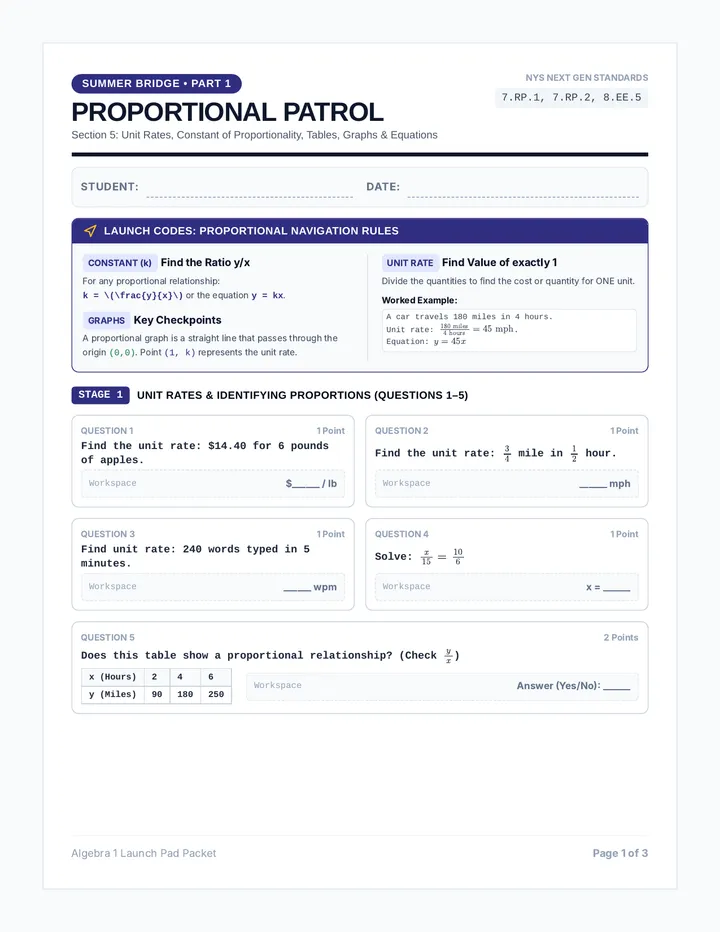
\( |3 + 4i| \)
Show work...
\( |5 - 12i| \)
Show work...
\( |-8 + 6i| \)
Show work...
\( |2 + 2i| \)
Show work...
02 Axis Alignments
Numbers on the axes should be easy. Think about the distance visually!
\( |7i| \)
\( |-10| \)
\( |-3i| \)
03 Magnitude Matchup
Evaluate both numbers and place a >, <, or = in the circle.
\( |1 + 1i| \)
\( |0 + 2i| \)
\( |3 - 4i| \)
\( |5 + 0i| \)
Bonus Challenge
Find a complex number that has a modulus of exactly 13.
Modulus Exit Ticket Modulus Check
Exit Ticket
Name:
1. Calculate the modulus:
\( | -6 + 8i | \)
Identify a and b
Final Magnitude
2. True or False?
"The modulus of \( 0 - 5i \) is \( -5 \)."
True
False
Explain why:
3. Geometric Sketch:
Sketch a vector with a modulus of 2.
Dimension Balance Slides Dimension Balance
Solving Equations with Complex Numbers
The Golden Rule
In a complex number, the Real and Imaginary parts are independent.
They cannot "mix".
Just like X and Y in coordinates, they must be solved separately.
If:
\( a + bi = c + di \)
Then:
\( a = c \)
\( b = d \)
The Split Method
Equation:
\( (2x) + (5y)i = 10 - 20i \)
1
Equate Real: 2x = 10
2
Equate Imaginary: 5y = -20
Solution
Solve for x:
\( x = 5 \)
Solve for y:
\( y = -4 \)
"Don't let the 'i' distract you. It's just a label telling you which numbers belong on the vertical axis."
Summary
Definition
\( i = \sqrt{-1} \)
Plane
x = Real, y = Imaginary
Modulus
Distance = \( \sqrt{a^2+b^2} \)
Ready for the Mastery Quiz?
Equivalence Equation Solver Worksheet Equivalence Solver
Lesson 5: Equating Complex Components
Scientist:
The Balancing Law
Two complex numbers are equal if and only if their real parts are equal and their imaginary parts are equal.
If \( a + bi = c + di \), then a = c and b = d.
01 Simple Balancing
Solve for the variables \( x \) and \( y \).
\( 3x + 4iy = 12 + 16i \)
x =
y =
\( (x - 5) + 3yi = 10 - 9i \)
x =
y =
02 Systems Integration
Isolate the real and imaginary parts first, then solve for the variables.
\( (2x + 1) + (y - 4)i = 9 + 2i \)
Equate Real
Equate Imaginary
\( (x/2) + 10i = 5 + (2y)i \)
Equate Real
Equate Imaginary
Independence Reflection
In the equation \( x + yi = 5 \), what are the values of \( x \) and \( y \)? (Hint: Remember how a real number looks in standard complex form!)
x=
y=
Imaginary Dimensions Quiz Final Evaluation
Imaginary Dimensions
Unit Mastery Quiz: Complex Numbers
Student:
Score:
Section 1: The Unit i
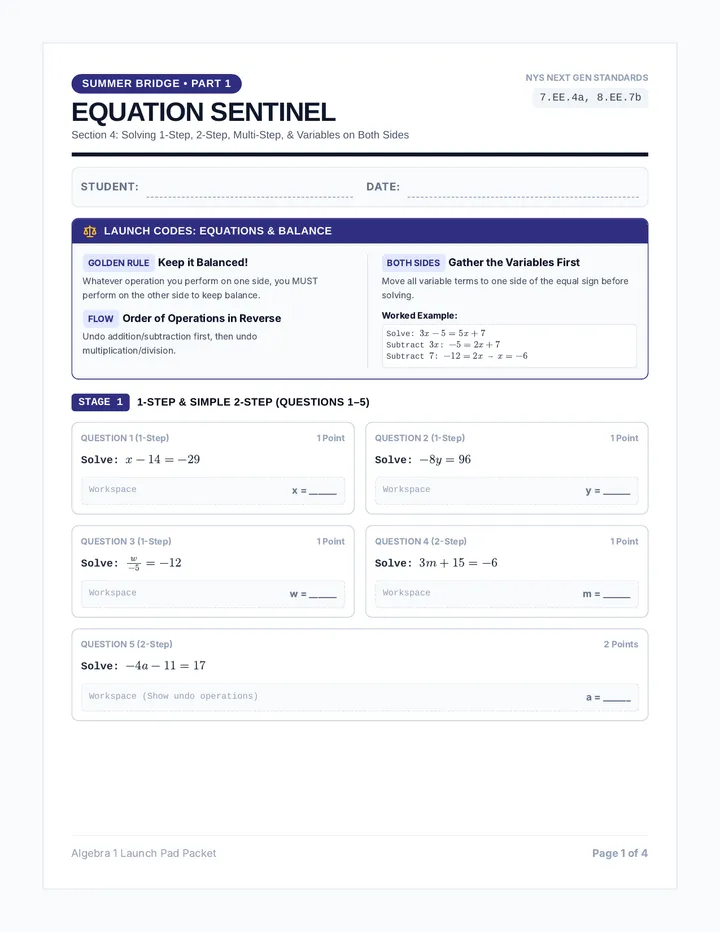
1. Simplify \( \sqrt{-64} \):
2. Simplify \( \sqrt{-20} \):
3. Solve for x: \( x^2 + 4 = 0 \)
4. What is the value of \( i^2 \)?
Section 2: Mapping
5. Plot the following on the grid:
Point P: \( 3 - 2i \)
Vector V: \( -4 + 3i \)
Section 3: Magnitude & Equivalence
6. Find the modulus \( | 5 + 12i | \):
7. Which has a larger modulus, \( 6i \) or \( -7 \)?
8. Solve for \( x \) and \( y \):
\( (x + 3) + (2y)i = 10 - 8i \)
x = ________
y = ________
End of Sequence: Imaginary Dimensions | Grade 10 Algebra