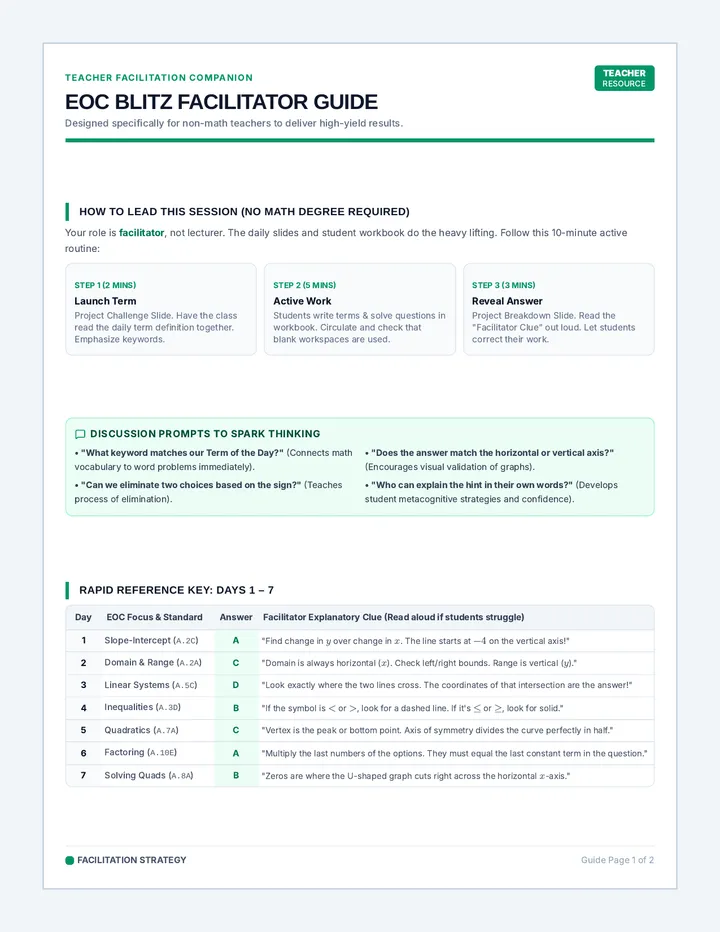
General Form Slides AXIS SHIFT
The General Quadratic Equation
"Why do some conics look 'tilted'?"
The Standard Form
Recall the general second-degree equation:
\[ Ax^2 + Bxy + Cy^2 + Dx + Ey + F = 0 \]
Until now, we have mostly focused on cases where \( B = 0 \).
Aligned: \( B = 0 \)
The "Troublemaker": \( Bxy \)
Rotated: \( B \neq 0 \)
The \( Bxy \) term represents a rotation of the conic's principal axes away from the coordinate axes.
Observation:
When \( B \neq 0 \), the graph is no longer symmetric with respect to lines parallel to the x or y axes.
Why Rotate?
Astronomy
Planetary orbits aren't perfectly aligned with our arbitrary grids.
Engineering
Stress and strain tensors in tilted materials.
Data Science
Principal Component Analysis (PCA) is essentially a rotation of axes.
Our Roadmap
1 Identify coefficients in the general form.
2 Derive formulas to "untilt" the coordinate system.
3 Find the "Invariants" that don't change when we rotate.
4 Graph complex, rotated conics with precision.
Coefficient Detective Worksheet Coefficient Detective
Analyzing the General Second-Degree Equation
Name:
Date:
The Anatomy of the General Form
The general form of a second-degree equation in two variables is:
\[ Ax^2 + Bxy + Cy^2 + Dx + Ey + F = 0 \]
In this worksheet, you will practice identifying the numerical coefficients for various equations. Pay close attention to the Bxy term—its presence suggests that the conic has been rotated.
Part 1: Extraction & Identification
Identify the values of \( A, B, C, D, E, \) and \( F \) for each equation. If a term is missing, the value is 0.
1. \( 3x^2 - 4xy + 3y^2 - 10 = 0 \)
A
B
C
D
E
F
2. \( x^2 + 2xy + y^2 - 4x + 4y = 0 \)
3. \( 5x^2 + 6\sqrt{3}xy - y^2 + 2 = 0 \)
Part 2: Synthesis
Convert the following descriptions into a single general-form equation. Write your final answer in the space provided.
4. A circle centered at the origin with radius 5, but then shifted 3 units right and 2 units down.
5. A conic where \( A = 2, C = -2, B = 5, F = 0, \) and there are no linear terms.
Critical Thinking
Looking at Problem 1 and Problem 3, how does the presence of the \( B \) term change the way you might approach finding the center or vertices compared to standard conic equations like \( \frac{x^2}{a^2} + \frac{y^2}{b^2} = 1 \)?
Anatomy of a Quadratic Guide Anatomy of a Quadratic
Teacher Facilitation Guide • Lesson 1
Topic
General Second-Degree Equation
Learning Objectives
Deconstruct the general form \( Ax^2 + Bxy + Cy^2 + Dx + Ey + F = 0 \).
Differentiate between translational effects (\( D, E \)) and rotational effects (\( B \)).
Predict the geometric orientation based on the presence of the cross-product term.
Quick Prep
Materials:
General Form Slides, Coefficient Detective Worksheet.
Key Concept:
The \( Bxy \) term is the "interaction" between dimensions that pulls the conic off-axis.
Instructional Steps
1
The "What's Missing?" Hook (10 mins)
Display a standard ellipse equation. Ask students: "If we rotate this 45 degrees, what happens to the equation? Do the x and y terms stay separate?" Lead into the concept that rotation requires a mix of coordinates.
"In a standard circle \( x^2 + y^2 = r^2 \), x and y don't 'talk' to each other. In a rotated conic, they are forced to interact through multiplication."
2
Slide Guided Discovery (15 mins)
Use the General Form Slides. Emphasize Slide 3. Visualizing the 'tilt' is critical before diving into the algebra of Lesson 2.
Misconception Alert
Students often think \( D \) and \( E \) cause rotation. Clarify that these only cause translation (shifting the center).
Discussion Prompt
"If \( B = 0 \), but \( A = C \), what shape is it? What if \( A \neq C \)? Why does \( B \) break this simple rule?"
3
Coefficient Detective Workshop (20 mins)
Have students complete the worksheet. Circulate and check Problem 3 specifically, as the radical coefficient \( 6\sqrt{3} \) often intimidates students.
Worksheet Key Highlights
Problem 1:
A=3, B=-4, C=3, D=0, E=0, F=-10
Note: This is an ellipse rotated 45°.
Problem 3:
A=5, B=6√3, C=-1, D=0, E=0, F=2
Note: This is a hyperbola.
Rotation Formula Slides THE TILT
Rotation of Axes Formulas
"If the graph won't move, move the world around it."
The Strategy
To eliminate the \( Bxy \) term, we rotate the \( xy \)-coordinate axes through an angle \( \theta \) to obtain a new \( x'y' \)-coordinate system.
Goal: Rewrite the equation such that the new coefficient \( B' = 0 \).
x y x' y' θ
The Substitution Formulas
Old \( x \) in terms of new \( x', y' \)
\[ x = x' \cos \theta - y' \sin \theta \]
Old \( y \) in terms of new \( x', y' \)
\[ y = x' \sin \theta + y' \cos \theta \]$
To find the new equation, substitute these into the original \( Ax^2 + Bxy + Cy^2 + Dx + Ey + F = 0 \).
Finding \( \theta \)
To make \( B' = 0 \), we need:
\[ \cot(2\theta) = \frac{A - C}{B} \]
Where \( 0 < 2\theta < \pi \)
Two common paths:
If you recognize the angle (e.g., \( \theta = 30^\circ \)), use standard trig values.
If not, use the Half-Angle Formulas to find \( \sin \theta \) and \( \cos \theta \) directly.
The Algebraic Survival Kit
If \( \cot(2\theta) \) is not a common value, use these:
\[ \sin \theta = \sqrt{\frac{1 - \cos(2\theta)}{2}} \]
\[ \cos \theta = \sqrt{\frac{1 + \cos(2\theta)}{2}} \]
Pro-Tip:
Most textbook problems are designed so that \( \cos(2\theta) \) is a simple fraction like \( 3/5 \) or \( 5/13 \). Look for Pythagorean triples!
Angle Hunter Activity Angle Hunter
Mastering the Rotation Transformation
STUDENT:
Skill Builder: Rotation Axes
Essential Formulas
1. To find the angle:
\[ \cot(2\theta) = \frac{A - C}{B} \]
2. Half-Angle Shortcuts:
If \( \cot(2\theta) = \frac{x}{y} \), then \( \cos(2\theta) = \frac{x}{\sqrt{x^2 + y^2}} \)
\( \sin \theta = \sqrt{\frac{1 - \cos 2\theta}{2}} \) | \( \cos \theta = \sqrt{\frac{1 + \cos 2\theta}{2}} \)
A Level 1: Common Angles
1. Given: \( x^2 + xy + y^2 - 1 = 0 \)
Find \( \cot(2\theta) \), \( \theta \), \( \sin \theta \), and \( \cos \theta \).
cot(2θ) =
θ =
sin θ =
cos θ =
2. Given: \( 2x^2 + \sqrt{3}xy + y^2 - 10 = 0 \)
Calculate the transformation values.
B Level 2: The Half-Angle Path
Use this path when \( 2\theta \) is not a multiple of 30° or 45°. Do not find \( \theta \) as a decimal; find exact values for \( \sin \theta \) and \( \cos \theta \).
3. Given: \( 73x^2 + 72xy + 52y^2 + 100 = 0 \)
Step 1: Find cot(2θ)
Step 2: Find cos(2θ)
Step 3: sin θ & cos θ
Your work area:
Self-Check: Did you ensure \( 0 < 2\theta < \pi \)?
Formula Derivation Guide Formula Derivation Guide
Teacher Reference • Lesson 2
Transformation
x, y \to x', y'
Purpose of the Derivation
Deriving the rotation formulas allows students to see that coordinate transformation is not "magic" but a consequence of basic trigonometry. By substituting the rotated coordinates into the general equation, we identify the exact condition needed to make the \( B'x'y' \) coefficient vanish.
Key Challenge
The algebra gets dense. Focus on the coefficient of \( x'y' \) only.
1 Trigonometric Relationships
Begin with the polar representation of a point \( P(x, y) \). If the point is at distance \( r \) from the origin at angle \( \phi \):
\[ x = r \cos \phi, \quad y = r \sin \phi \]
If we rotate the axes by \( \theta \), the new angle is \( \phi - \theta \):
\[ x' = r \cos(\phi - \theta), \quad y' = r \sin(\phi - \theta) \]
2 Angle Sum Identities
Using sum/difference identities to express \( x \) and \( y \) in terms of \( x' \) and \( y' \):
Result for x:
\[ x = x' \cos \theta - y' \sin \theta \]
Result for y:
\[ y = x' \sin \theta + y' \cos \theta \]
3 Eliminating the Cross-Product Term
Substitute these into \( Ax^2 + Bxy + Cy^2 + \dots \). The coefficient of the new \( x'y' \) term, which we call \( B' \), is:
\[ B' = B(\cos^2 \theta - \sin^2 \theta) + 2(C - A)\sin \theta \cos \theta \]
Setting \( B' = 0 \) and using double-angle identities \( \cos 2\theta = \cos^2 \theta - \sin^2 \theta \) and \( \sin 2\theta = 2\sin \theta \cos \theta \):
\[ B \cos 2\theta + (C - A) \sin 2\theta = 0 \] \[ \frac{\cos 2\theta}{\sin 2\theta} = \frac{A - C}{B} \implies \cot 2\theta = \frac{A - C}{B} \]
Facilitation Tips
Encourage students to verify the identities themselves during the derivation.
Highlight that \( D, E, \) and \( F \) do not affect the rotation angle \( \theta \).
Watch for sign errors in the substitution—especially with the \( y' \sin \theta \) term.
Remind students that \( 0 < \theta < 90^\circ \).
Discriminant Power Slides THE UNCHANGING
The Invariant Discriminant
"Some things remain the same, no matter how much you spin."
The Concept of Invariance
An invariant is a property of a mathematical object that remains unchanged under a specific transformation.
Example: The distance between two points is invariant under rotation and translation.
The Quadratic Discriminant
For the general equation \( Ax^2 + Bxy + Cy^2 + Dx + Ey + F = 0 \), the discriminant is defined as:
\[ \Delta = B^2 - 4AC \]
Theorem: The value of \( B^2 - 4AC \) is invariant under rotation.
Classifying Conics
Condition Conic Type Visual \( B^2 - 4AC < 0 \) Ellipse (or Circle) ⬭ \( B^2 - 4AC = 0 \) Parabola ∪ \( B^2 - 4AC > 0 \) Hyperbola )(
The Power of Invariance
Since the discriminant doesn't change when we rotate to "untilt" the conic, we can classify it immediately from the original messy equation.
No substitution needed!
Just identify A, B, and C, and compute \( B^2 - 4AC \).
Example:
\( 2x^2 + 4xy + 5y^2 = 1 \)
\( B^2 - 4AC = 4^2 - 4(2)(5) \)
\( 16 - 40 = -24 \)
RESULT: Ellipse
Quick Classify Quiz Quick Classify
Investigator:
Discriminant Identification Task
Ellipse \( \Delta < 0 \)
Parabola \( \Delta = 0 \)
Hyperbola \( \Delta > 0 \)
Equation Discriminant Calculation (\( B^2 - 4AC \)) Classification 1. \( 2x^2 - 4xy + 8y^2 + 7 = 0 \)
|
| 2. \( x^2 + 2xy + y^2 - 4x = 0 \) |
|
|
| 3. \( 5xy - 12 = 0 \) |
|
|
| 4. \( 3x^2 + \sqrt{2}xy + 3y^2 + x - y = 0 \) |
|
|
| 5. \( x^2 - 6xy + 9y^2 + 2x - 1 = 0 \) |
|
|
The "B=0" Sanity Check
If \( B = 0 \), our discriminant simplifies to \( -4AC \). Explain how the signs of \( A \) and \( C \) in a standard (unrotated) conic relate back to the rules above.
Invariant Proof Notes Invariant Proof Notes
Teacher Technical Reference • Lesson 3
Property
B^2 - 4AC = inv.
The Goal
Students often accept invariance on faith. These notes provide the algebraic pathway to proving that the discriminant of the transformed equation is identical to the original. This is a vital connection for students transitioning into linear algebra and the concept of determinants .
The Transformed Coefficients
Under a rotation \( \theta \), the coefficients of the quadratic form \( Ax^2 + Bxy + Cy^2 \) transform as follows:
\[ A' = A \cos^2 \theta + B \sin \theta \cos \theta + C \sin^2 \theta \]
\[ B' = B(\cos^2 \theta - \sin^2 \theta) + 2(C - A) \sin \theta \cos \theta \]
\[ C' = A \sin^2 \theta - B \sin \theta \cos \theta + C \cos^2 \theta \]
Proof Outline
To prove \( (B')^2 - 4A'C' = B^2 - 4AC \), follow these steps (or present to advanced students):
1
Identify Invariants \( A+C \) and \( B^2-4AC \)
Show that \( A' + C' = (A \cos^2 \theta + C \sin^2 \theta) + (A \sin^2 \theta + C \cos^2 \theta) \). Factoring gives \( A(\cos^2 \theta + \sin^2 \theta) + C(\sin^2 \theta + \cos^2 \theta) = A + C \). This is the first invariant (Trace in matrix terms).
2
Matrix Representation Shortcut
Represent the quadratic form as a symmetric matrix:
\[ M = \begin{pmatrix} A & B/2 \\ B/2 & C \end{pmatrix} \]
The determinant of this matrix is \( \det(M) = AC - B^2/4 \). Notice that \( B^2 - 4AC = -4 \det(M) \).
3
The Rotation Matrix
A rotation is represented by an orthogonal matrix \( R \). The transformed matrix \( M' \) is given by \( M' = R^T M R \). Since \( \det(R) = 1 \):
\[ \det(M') = \det(R^T) \det(M) \det(R) = 1 \cdot \det(M) \cdot 1 = \det(M) \]
Thus, \( B^2 - 4AC \) is preserved!
Connecting to Lesson 5
Use this proof to bridge into Lesson 5 (Matrix Representation). It helps students see why eigenvalues (which relate to these invariants) are the "natural" way to view conics.
Graphing Workshop Slides PRECISION SKETCH
Graphing Rotated Conics
The 5-Step Protocol
1
Classify
Use \( B^2 - 4AC \). Know your target shape.
2
Calculate \( \theta \)
Solve \( \cot 2\theta = (A-C)/B \).
3
Transform
Substitute and simplify to \( A'(x')^2 + C'(y')^2 + \dots \)
4
Find Standard Features
Find center, vertices, and foci in the \( x'y' \)-system.
5
Sketch
Draw the \( x'y' \)-axes first, then the conic.
Drawing the Frame
The most common mistake is trying to draw the conic relative to the original \( xy \)-axes.
Technique:
"Draw the new axes \( x' \) and \( y' \) first at angle \( \theta \). Then, pretend the original grid doesn't exist while you plot your vertices."
Walkthrough
\( x^2 + xy + y^2 = 3 \)
1. \( \Delta = 1^2 - 4(1)(1) = -3 \to \) Ellipse
2. \( \cot 2\theta = (1-1)/1 = 0 \to 2\theta = 90^\circ \to \) \( \theta = 45^\circ \)
3. New equation: \( \frac{3}{2}(x')^2 + \frac{1}{2}(y')^2 = 3 \)
4. Standard form: \( \frac{(x')^2}{2} + \frac{(y')^2}{6} = 1 \)
The Graph Result
This is an ellipse centered at origin, major axis along the \( y' \) line (the line \( y = x \) in the old system), with major radius \( \sqrt{6} \) and minor radius \( \sqrt{2} \).
Watch Your Step!
The B' Check
If your new equation still has an \( x'y' \) term, you calculated \( \theta \) wrong!
Quadrant Logic
Ensure \( \theta \) is in the correct quadrant based on the sign of \( \cot 2\theta \).
Scaling
Keep your \( x' \) and \( y' \) scales identical to your \( x \) and \( y \) scales.
Master Sketcher Project The Master Sketcher
Full Conic Transformation Project
ARCHITECT:
DATE:
The Challenge
You are given the following general second-degree equation:
\[ 3x^2 - 10xy + 3y^2 + 8 = 0 \]
Perform the full transformation to eliminate the cross-product term and produce a precise sketch of the conic section on the provided grid.
1 Classification
Identify A, B, C and compute the discriminant.
2 Calculate \( \theta \)
Find \( \cot 2\theta \), then \( \theta \), \( \sin \theta \), and \( \cos \theta \).
3 Transformation to \( x'y' \) system
Substitute \( x = x' \cos \theta - y' \sin \theta \) and \( y = x' \sin \theta + y' \cos \theta \). Show your simplification.
4 Final Equation
Write the standard form equation in the \( x'y' \) system.
5 Key Features
Vertices, foci, or asymptotes in the \( x'y' \) system.
The Geometric Visualization
Instructions: 1. Draw the \( x \) and \( y \) axes. 2. Draw the rotated \( x' \) and \( y' \) axes. 3. Plot the vertices relative to the rotated system. 4. Sketch the conic.
Coordinate Shift Key Coordinate Shift Key
Answer Key • Master Sketcher Project
Equation
3x^2 - 10xy + 3y^2 + 8 = 0
1 Classification
A = 3
B = -10
C = 3
\[ B^2 - 4AC = (-10)^2 - 4(3)(3) = 100 - 36 = 64 \]
Result: Hyperbola (\( \Delta > 0 \))
2 Calculate Angle \( \theta \)
\[ \cot(2\theta) = \frac{A - C}{B} = \frac{3 - 3}{-10} = 0 \]
\[ 2\theta = 90^\circ \implies \theta = 45^\circ \]
\[ \sin \theta = \frac{\sqrt{2}}{2}, \quad \cos \theta = \frac{\sqrt{2}}{2} \]
3 Transformation
Substituting \( x = \frac{\sqrt{2}}{2}(x' - y') \) and \( y = \frac{\sqrt{2}}{2}(x' + y') \) into the quadratic form:
\( 3(\frac{1}{2})(x'-y')^2 - 10(\frac{1}{2})(x'-y')(x'+y') + 3(\frac{1}{2})(x'+y')^2 + 8 = 0 \)
\( \frac{3}{2}(x'^2 - 2x'y' + y'^2) - 5(x'^2 - y'^2) + \frac{3}{2}(x'^2 + 2x'y' + y'^2) + 8 = 0 \)
\( 3x'^2 + 3y'^2 - 5x'^2 + 5y'^2 + 8 = 0 \)
\[ -2x'^2 + 8y'^2 + 8 = 0 \]
4 Final Standard Form
\[ \frac{x'^2}{4} - \frac{y'^2}{1} = 1 \]
Hyperbola opening along the \( x' \) axis (the line \( y = x \)).
Vertices: \( (\pm 2, 0) \) in \( x'y' \) system.
Asymptotes: \( y' = \pm \frac{1}{2}x' \)
Matrix Magic Slides MATRIX MAGIC
Diagonalization & Conics
"The hidden linear structure of the quadratic world."
The Matrix Form
Any quadratic form \( Ax^2 + Bxy + Cy^2 \) can be written as a matrix product:
\[ \mathbf{x}^T M \mathbf{x} \]
Specifically:
\[ \begin{pmatrix} x & y \end{pmatrix} \begin{pmatrix} A & B/2 \\ B/2 & C \end{pmatrix} \begin{pmatrix} x \\ y \end{pmatrix} \]
The "Eigen" Shortcut
When we rotate the axes, we are actually performing a similarity transformation to diagonalize the matrix.
The Discovery:
The new coefficients \( A' \) and \( C' \) are the eigenvalues (\( \lambda_1, \lambda_2 \)) of the matrix \( M \)!
Transformation Result:
\[ \lambda_1 (x')^2 + \lambda_2 (y')^2 + \dots = 0 \]
No messy trig substitutions required to find the new coefficients.
Orientation
Where do the axes point?
The eigenvectors of the matrix \( M \) point exactly in the direction of the new rotated axes \( x' \) and \( y' \).
The unit eigenvectors form the rotation matrix \( P \) such that \( \mathbf{x} = P \mathbf{x}' \).
v1 (x' axis) v2 (y' axis)
The Grand Unification
Geometric View
Rotating axes to align with the conic's natural symmetry.
Linear Algebraic View
Changing bases to the eigen-basis of a symmetric matrix.
They are the exact same thing!
Eigenvalue Shortcut Sheet Eigenvalue Shortcut
Note-Taking Guide • Lesson 5
New Equation
λ₁x'² + λ₂y'² + ... = 0
The Power of Diagonalization
Finding the rotated coefficients \( A' \) and \( C' \) using trigonometry is tedious. In the matrix view, these coefficients are simply the roots of the characteristic equation of the conic's quadratic matrix.
1
Build the Matrix \( M \)
For the equation \( Ax^2 + Bxy + Cy^2 + \dots = 0 \):
\[ M = \begin{pmatrix} ? & ? \\ ? & ? \end{pmatrix} \]
2
Solve the Characteristic Equation
Set \( \det(M - \lambda I) = 0 \) to find the eigenvalues \( \lambda_1 \) and \( \lambda_2 \).
Calculation Space:
3
Assemble the Rotated Equation
The new coefficients are the eigenvalues you found. The constants (\( F \)) remain invariant.
λ₁ (x')² + λ₂ (y')² + F = 0
Instant Practice
Use the shortcut for: \( 5x^2 - 4xy + 8y^2 - 36 = 0 \)
Matrix M
Eigenvalues
Transformed Equation
Show that you get the same result as rotating by cot(2θ) = (A-C)/B
Linear Algebra Bridge Guide The Linear Algebra Bridge
Teacher Facilitation Guide • Lesson 5 (Extension)
Topic
Matrix Forms
Instructional Goal
This extension moves beyond trigonometric manipulation to reveal the underlying structure of quadratic forms. By the end of this lesson, students should recognize that Principal Axis Theorem is simply a coordinate-free description of what we have been doing with rotation formulas.
Linear Algebra Prereqs
• Matrix Multiplication
• Determinants
• Eigenvalues / Eigenvectors
1. The Quadratic Form Matrix
Explain that the cross-product term \( Bxy \) is split evenly between the two off-diagonal entries to maintain symmetry . Symmetric matrices always have real eigenvalues and orthogonal eigenvectors—the perfect mathematical "scaffolding" for conics.
2. The Characteristic Equation
Finding the roots of \( \lambda^2 - (A+C)\lambda + (AC - B^2/4) = 0 \) is identical to finding the values that satisfy the invariant properties.
Trace: \( \lambda_1 + \lambda_2 = A + C \)
Determinant: \( \lambda_1 \lambda_2 = AC - B^2/4 \)
3. Orthogonal Diagonalization
The rotation matrix \( P \) that students see in linear algebra text is exactly the matrix \( \begin{pmatrix} \cos \theta & -\sin \theta \\ \sin \theta & \cos \theta \end{pmatrix} \). Each column of \( P \) is a unit eigenvector of \( M \).
Discussion Prompts
"Why must the matrix be symmetric? What would happen to the cross-product term if we put the entire \( B \) coefficient in the top-right entry instead of splitting it?"
"If one eigenvalue is zero, what does that tell you about the shape of the conic? (Connect this back to the discriminant \( \Delta = 0 \))."
End of Sequence • Axis Shift • Advanced Geometry/Linear Algebra