This sequence explores the relationship between rational exponents and the geometric behavior of power functions. Students analyze how numerators and denominators dictate domain, range, shape, and growth rates through inquiry and visual sketching.
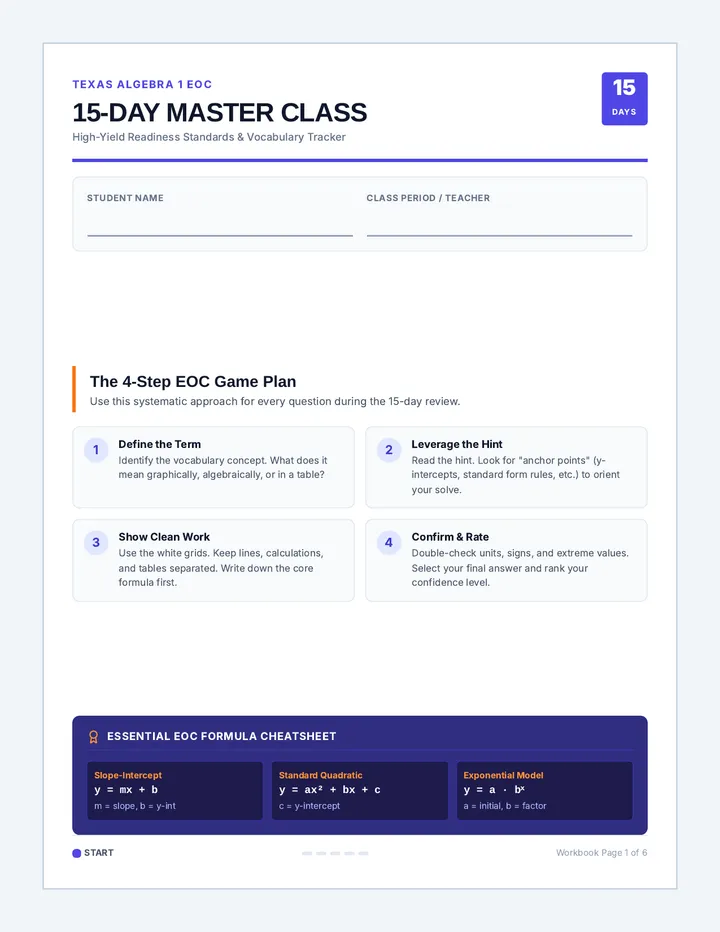
A specialized intervention sequence designed for Algebra I students to master TEKS A2A and A6A, focusing on the domain and range of linear and quadratic functions through tiered small-group instruction.
Une introduction complète aux statistiques universitaires, couvrant la classification des données, les mesures descriptives, la visualisation et les fondements de la loi normale. L'approche est axée sur l'analyse de données réelles et la compréhension conceptuelle.
A lesson sequence focusing on the algebraic and graphical properties of radical equations, bridging the gap between symbolic manipulation and visual intersection points.
A series of higher-level mathematics lessons exploring calculus foundations through engaging, thematic activities and visual demonstrations.
A series of geometry lessons focused on points of concurrency and their real-world applications in urban planning and design.
A specialized unit focused on identifying and correcting algebraic misconceptions in function transformations, specifically reflections. Students develop critical analysis skills by acting as "Error Doctors" to diagnose and treat common mathematical pitfalls.
A lesson sequence for Algebra 2 focusing on the relationship between rational exponents and radical expressions, including conversion, simplification, and negative exponents.
A lesson sequence focusing on the transition from expanded ellipsis notation to formal Sigma notation within the context of arithmetic series proofs. Students analyze a standard proof and reformulate it using summation properties.
A series of lessons exploring exponential functions, their components, graphs, and real-world applications in Algebra 1.
A lesson sequence focusing on advanced factoring techniques, specifically targeting the difference of squares with higher-degree exponents (4, 6, 8) through visual recognition and verification.
A high-level Honors Algebra lesson focused on complex recursive sequences where students analyze notation, explore the Fibonacci sequence, and engage in a 'Sequence Maker' activity to reverse-engineer formulas.
A specialized unit on advanced exponent rules, focusing on simplifying complex algebraic expressions involving fractions and negative powers.
A specialized unit exploring the geometric properties of slope, connecting algebraic rates of change to trigonometric functions and the geometry of inclination.