Rational Rules Reference Sheet
Rational Rules
Part 1: Integer Operations
Name:
Reference Guide • 1 / 3
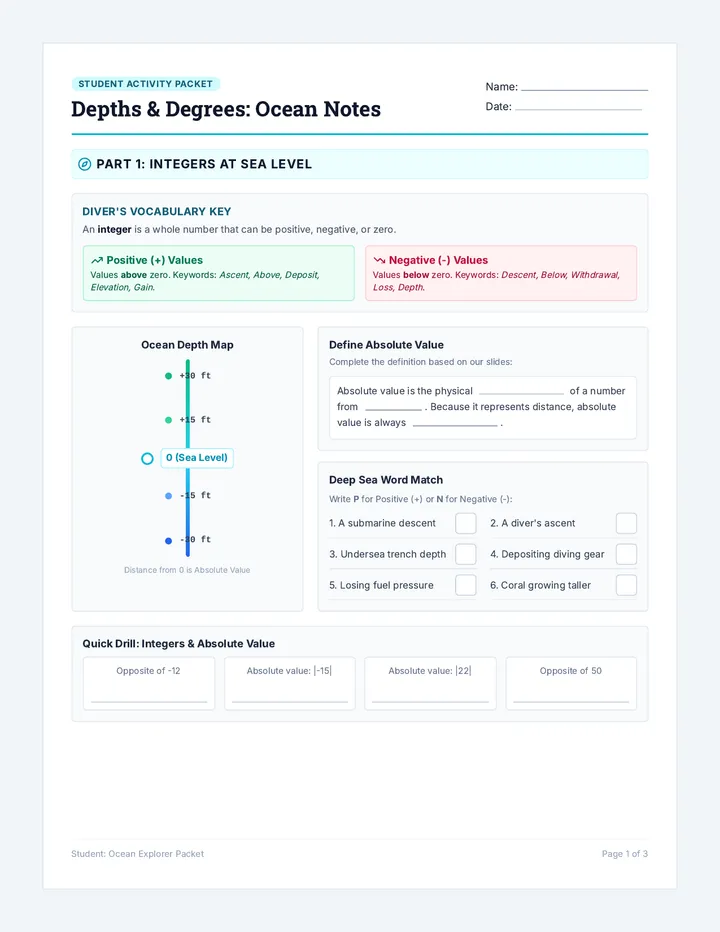
| -n | = n Distance is Always (+)
Absolute Value
The distance a number is from zero. Because it is distance, it can never be negative. Think of it as the "magnitude" or "size" of the number without its sign.
| -15 | = 15 | | 8 | = 8 | | 0 | = 0
Addition & Subtraction
Scenario A
Same Signs
ADD the absolute values. KEEP the sign.
-5 + (-3) = -8
4 + 12 = 16
Scenario B
Different Signs
SUBTRACT smaller from larger. KEEP the sign of larger value.
-12 + 4 = -8 (12 > 4)
10 + (-2) = 8 (10 > 2)
Subtraction: "KCC"
Keep • Change • Change
Never subtract! Change every subtraction problem into an addition problem first.
7 - (-3) → 7 + 3
Result: 10
-4 - 5 → -4 + (-5)
Result: -9
"Keep the first, Change sign to plus, Change the sign of the last."
Multiplication & Division
Same Signs
POSITIVE Result
(-4) × (-7) = 28
20 ÷ 5 = 4
-
Different Signs
NEGATIVE Result
(-8) × 3 = -24
-15 ÷ 3 = -5
Sign Trick Grid
-
-
-
-
-
-
Pick any 3 in a row, diagonal or straight!
Rational Rules • Integer Operations • Page 1 of 3
Rational Rules
Part 2: Decimal Operations
Precision Toolkit
Reference Guide • 2 / 3
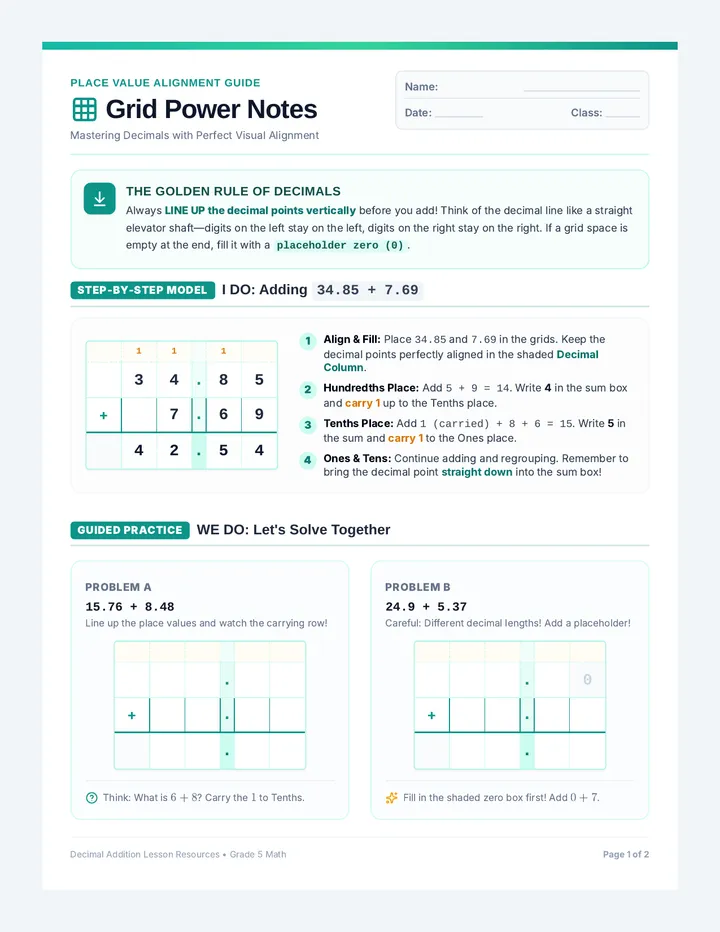
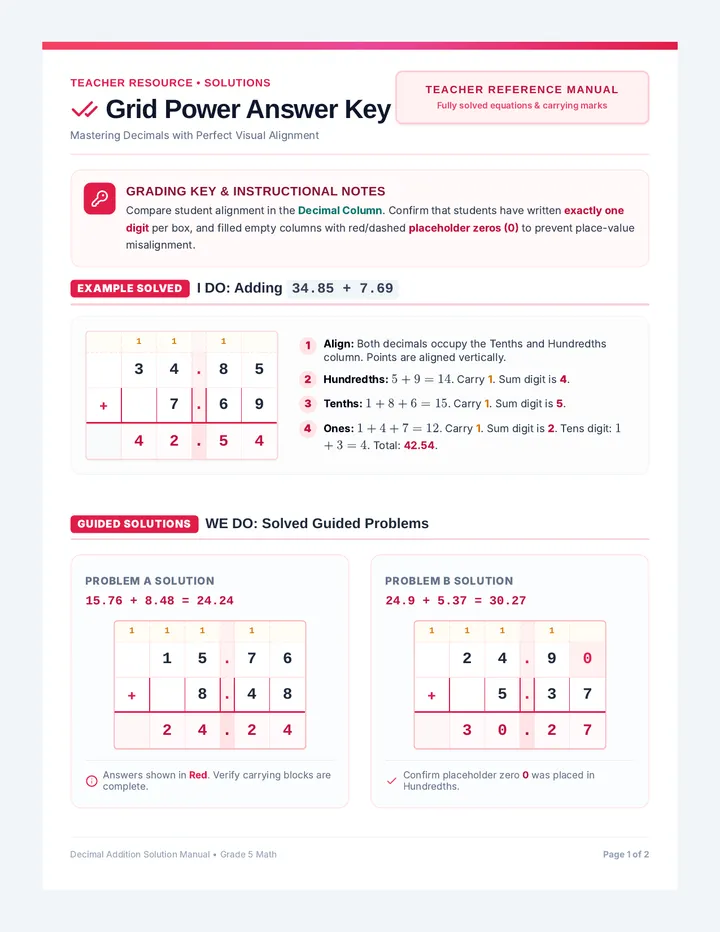
Addition & Subtraction
Line up the decimals!
The points MUST be in a perfectly vertical line.
.
.
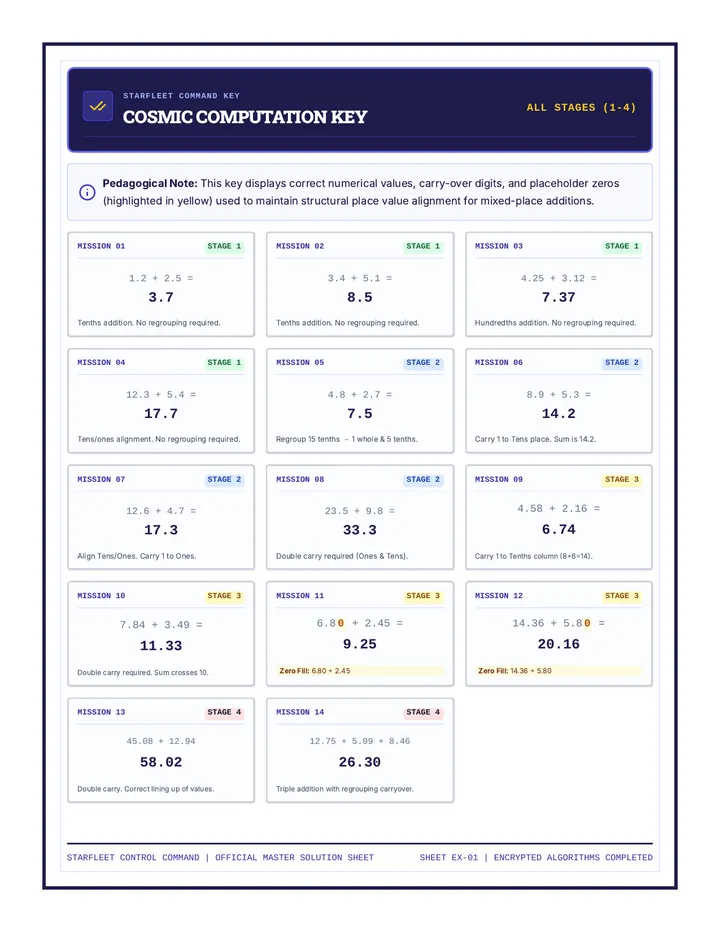
34.50
+ 1.25
35.75
Multiplication
1
Ignore dots. Multiply like whole numbers.
2
Total places. Count numbers behind decimals.
3
The "Swoop". Move dot in from the right.
Example
1.2(1)
× 0.04(2)
0.048 (3 total)
Division
Top
Bottom
Bottom Top
1
OUTSIDE: Move right to make a whole number.
2
INSIDE: Move the exact same amount.
Example A
Equal Moves
Solve: 1.25 ÷ 0.5
1 move
1 move
2.5 0.5
1.25
Move dot 1 spot right in 0.5 to make it 5.
Move dot 1 spot right in 1.25 to make it 12.5.
Example B
Placeholder Zeros
Solve: 1.5 ÷ 0.05
2 moves
2 moves
- 0.05
1.50
Move 2 spots in 0.05 to make 5.
Move 2 spots in 1.5 → Add a 0 to make 150.
Rational Rules • Decimal Operations • Page 2 of 3
Rational Rules
Part 3: Fraction mastery
Conversion & Logic
Reference Guide • 3 / 3
Addition & Sub
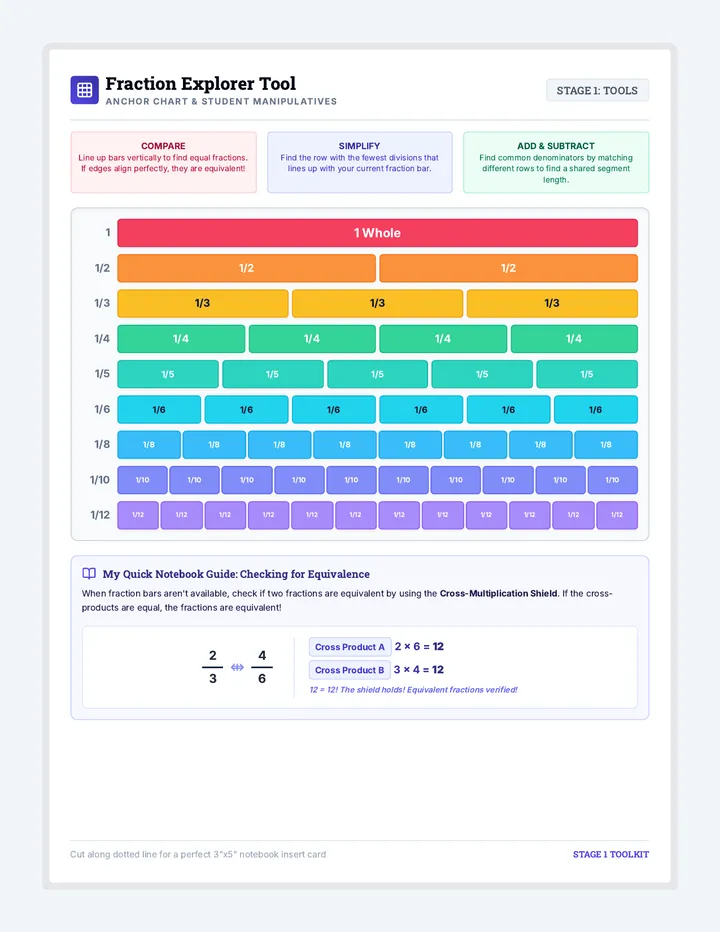
Must have common denominators!
\[ \frac{2}{5} + \frac{1}{2} \rightarrow \frac{4}{10} + \frac{5}{10} = \frac{9}{10} \]
Step 1: Find LCM for bottoms.
Step 2: Change both fractions.
Step 3: Add/Sub tops, Keep the bottoms.
Mult & Division
Multiply: "Straight Across"
\[ \frac{3}{4} \times \frac{2}{7} = \frac{6}{28} = \frac{3}{14} \]
Division: "KCF"
KEEP 1st CHANGE × FLIP 2nd
\[ \frac{2}{5} \div \frac{3}{4} \rightarrow \frac{2}{5} \times \frac{4}{3} = \frac{8}{15} \]
Mixed → Improper
M
Multiply Whole × Bottom
A
Add the Numerator
D
Denominator stays same
\( 4\frac{1}{3} = \frac{13}{3} \)
Common Conversions
| Frac | Dec | % |
|---|
| 1/2 | 0.5 | 50% |
| 1/4 | 0.25 | 25% |
| 3/4 | 0.75 | 75% |
| 1/5 | 0.2 | 20% |
| 1/8 | 0.125 | 12.5% |
| 1/3 | 0.33... | 33.3% |
The Reality Check
Before you calculate, ESTIMATE! Logic is more powerful than rules.
Signs
"I'm multiplying a negative by a negative. My answer must be positive."
Magnitude
"Half of 0.4 should be 0.2. If I get 2.0, I moved my decimal the wrong way!"
Rational Rules • Fraction Mastery • Page 3 of 3