Lenny.com
Explore
Create
ActivitiesNewCurriculumNewMathEnglish Language ArtsScience & EngineeringSocial StudiesGlobal LanguagesHealth & Physical EducationSpecial EducationCounseling & Life SkillsArts & CreativityESL
Lenny.com
Lenny.com
Explore
Create
ActivitiesNewCurriculumNewMathEnglish Language ArtsScience & EngineeringSocial StudiesGlobal LanguagesHealth & Physical EducationSpecial EducationCounseling & Life SkillsArts & CreativityESL
Lenny.com
Lenny.com

Solutions

Lenny for EducatorsLenny for SchoolsLenny for Districts

Product

ExploreSign inCreateSupportAbout

Resources

Getting startedMTSS Acceleration Program

Newsletters

School Funding Newsletter

© 2026 Lenny Learning Inc.

TermsPrivacyAccessibility
LinkedInInstagramX
Lenny
MathNumbers & CountingCounting ObjectsNumber NamesComparing NumbersNumber OperationsCounting SequenceNumbers 0-10Place Value Understanding and SystemAdd and Subtract Within 20Addition and Subtraction ConceptsAddition and Subtraction EquationsAddition and Subtraction ProblemsFoundations for MultiplicationMultiplication and Division PropertiesMultiply and Divide Within 100Multiplication and Division ProblemsFactors and MultiplesProperties of OperationsPatterns and RelationshipsGenerate and Analyze PatternsMulti-Digit ArithmeticPlace Value OperationsMulti-Digit and Decimal OperationsNumerical ExpressionsFour Operations and PatternsFour Operations Problem SolvingMeasurement & DataMeasurable AttributesMeasuring LengthsMeasure and Estimate Lengths in Standard UnitsRelate Addition and Subtraction to LengthClassifying and Counting ObjectsTime and MoneyArea Concepts and MeasurementPerimeter and Area MeasuresAngle Concepts and MeasurementTime, Volume, and MassMeasurement Unit ConversionsGeometryIdentifying ShapesShapes and AttributesShape Attributes and ReasoningShapes and CompositionClassifying 2D FiguresGeometric Figures and RelationshipsLines, Angles, and ShapesAngle, Area, and VolumeGeometric MeasurementVolume of 3D ShapesCoordinate Plane ApplicationsTransformations in the PlaneCongruence and SimilarityUnderstand congruence in terms of rigid motionsSimilarity and TransformationsProve Theorems Involving SimilarityPythagorean TheoremTrigonometry for General TrianglesMake Geometric ConstructionsProve Geometric TheoremsTheorems About CirclesFind Arc Lengths And Areas of Sectors of CirclesVolume FormulasRelationships Between Two-Dimensional and Three-Dimensional ObjectsProve Simple Geometric Theorems AlgebraicallyTranslate Between Geometric Description and Equation for Conic SectionApply Geometric Concepts in Modeling SituationsFractions & DecimalsFractions as NumbersBuilding FractionsFraction Equivalence and OrderingAdding and Subtracting FractionsMultiplying and Dividing FractionsDividing FractionsDecimal FractionsMulti-Digit Computation and FactorsAdd, Subtract, Multiply, and Divide Rational NumbersRational Number SystemIrrational Numbers and ApproximationsRatiosRatios and ProportionsProportional RelationshipsUnit RateAlgebraAlgebraic ExpressionsGenerate Equivalent ExpressionsQuantitative RelationshipsProportional Relationships and Linear EquationsEquations and InequalitiesEquation Solving and ReasoningLinear Equations and SystemsGraph Equations and InequalitiesSystems of EquationsReal-World Algebraic ProblemsQuantitative Reasoning with UnitsExpression StructureEquivalent Expression FormsRadicals and Integer ExponentsRational ExponentsRational and Irrational NumbersPolynomial OperationsPolynomial IdentitiesPolynomial Zeros and FactorsRational ExpressionsComplex Number OperationsComplex Numbers in PolynomialsComplex Numbers on PlaneStatistics & ProbabilityRepresent and Interpret DataData DistributionsStatistical VariabilityProbability ModelsCompound Event ProbabilitiesStatistical SamplingInterpret Categorical and Quantitative DataBivariate Data PatternsInterpret Linear ModelsComparing Two PopulationsRandom Processes in StatisticsIndependence and Conditional ProbabilityExpected ValuesProbability-Based Decision MakingStatistical Inference and ConclusionsFunctionsFunction Concepts and NotationDefine and Compare FunctionsInterpret Functions in ContextAnalyze Function RepresentationsModel Relationships with FunctionsIdentify Linear vs Exponential GrowthDistinguish Between Function TypesCompare Growth RatesInterpret Function ExpressionsBuild Functions from RelationshipsConstruct and Model FunctionsTransform and Combine FunctionsModel Comparison and SelectionSolve Exponential EquationsTrigonometryTrigonometric Ratios Involving Right TrianglesTrigonometric Functions and Unit CircleModel with Trigonometric FunctionsTrigonometric IdentitiesVectors & MatricesIntroduction to Vectors and MatricesVector QuantitiesVector OperationsMatrix OperationsCalculusLimits and ContinuityDerivative Concepts and NotationDerivative Rules and TechniquesApplications of DerivativesOptimization ProblemsRelated RatesCurve Sketching and AnalysisIntegration Concepts and NotationAntiderivatives and Indefinite IntegralsDefinite Integrals and AreaFundamental Theorem of CalculusIntegration TechniquesApplications of IntegrationDifferential EquationsSequences and SeriesParametric and Polar FunctionsVector-Valued Functions

Point Slope Graphing Anchor Chart

A 2-page SPED-friendly Algebra anchor chart and practice sheet for graphing a line from point-slope form. Page 1 features color-coded formula connections, a 4-step graphing checklist, a worked coordinate plane with rise/run slope arrows, and a sign-flip cheat sheet. Page 2 provides a scaffolded practice problem given a slope and a point, with blank work boxes and a coordinate plane.

KWKevin Wells

You might also like

Equal Parts Slides

Fraction Builders

A three-day Grade 3/4 math sequence introducing fraction identification and equivalent fractions through visual models, hands-on fraction walls, and real-world bakery problems.

J

jnparrella

9
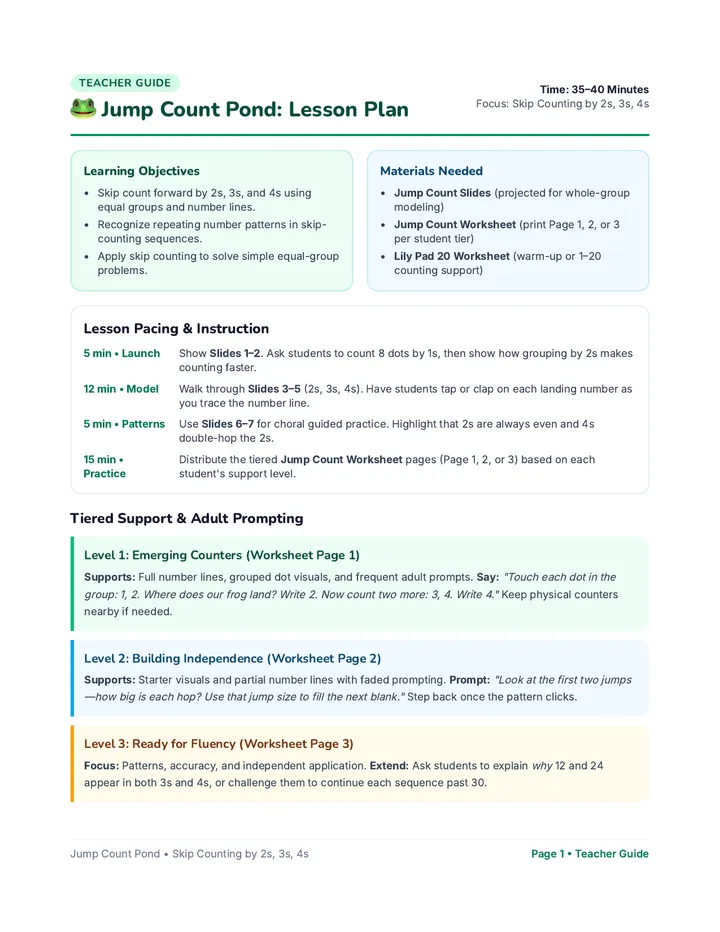
Jump Count Slides

Jump Count Pond

A differentiated lesson on skip counting by 2s, 3s, and 4s using number lines, visual groups, and pattern spotting. Includes instructional slides, a three-tier student worksheet, and a teacher guide with differentiation prompts and an answer key.

CM

Cody Meacham

4
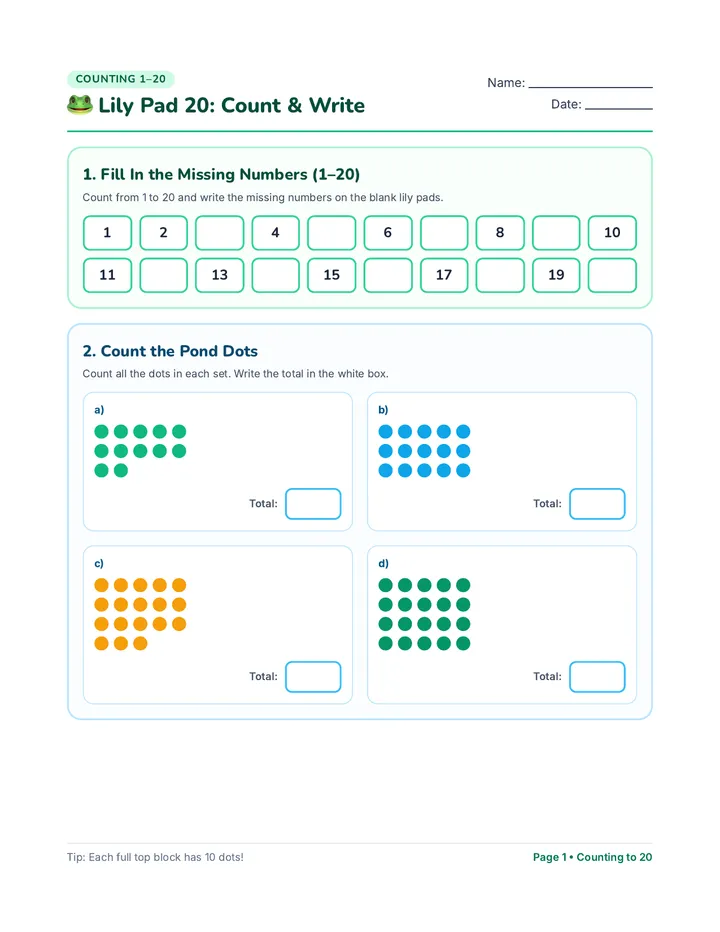
Lily Pad 20 Worksheet

Lily Pad 20 Worksheet

A two-page counting worksheet for numbers 1 to 20 featuring a 1–20 lily-pad number path, ten-frame object counting, matching, and make-20 activities in the Jump Count Pond theme.

CM

Cody Meacham

Elevation Line Slides

Zero Line Explorers

A four-day instructional sequence building fluency with integers and rational numbers—comparing and ordering on number lines, adding and subtracting, multiplying and dividing, and applying all operations in mixed review. Anchored in an elevation and expedition theme, each lesson pairs visual slides with a print-ready student worksheet and teacher answer key.

M

morticia.walston

12
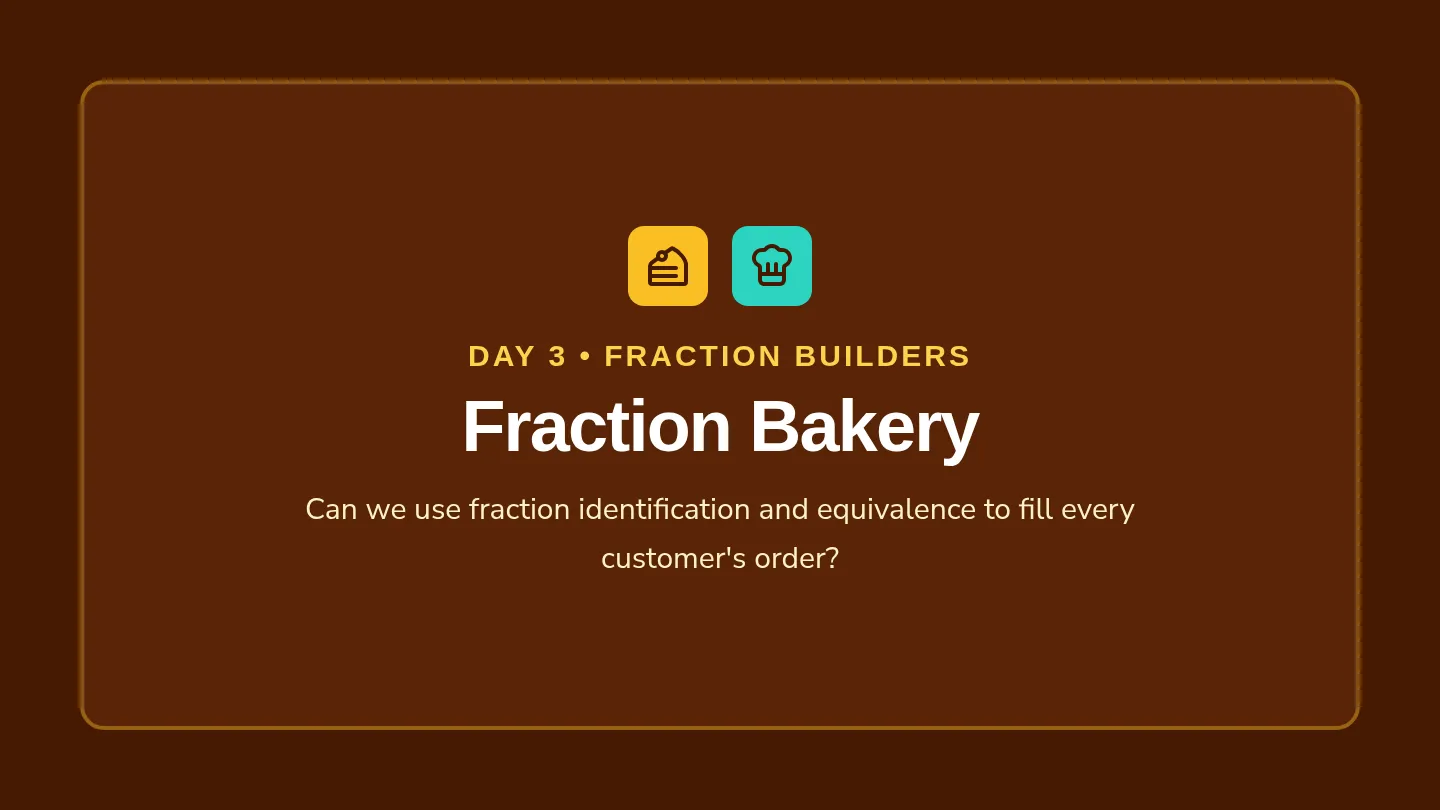
Fraction Bakery Slides

Fraction Bakery

Students apply fraction identification and equivalence to generate equivalent fractions and solve real-world bakery order challenges.

J

jnparrella

3
Jump Count Teacher Guide

Jump Count Teacher Guide

A two-page teacher guide with lesson pacing, modeling scripts, tiered differentiation prompts for all three support levels, and a complete answer key for all worksheets and slides.

CM

Cody Meacham

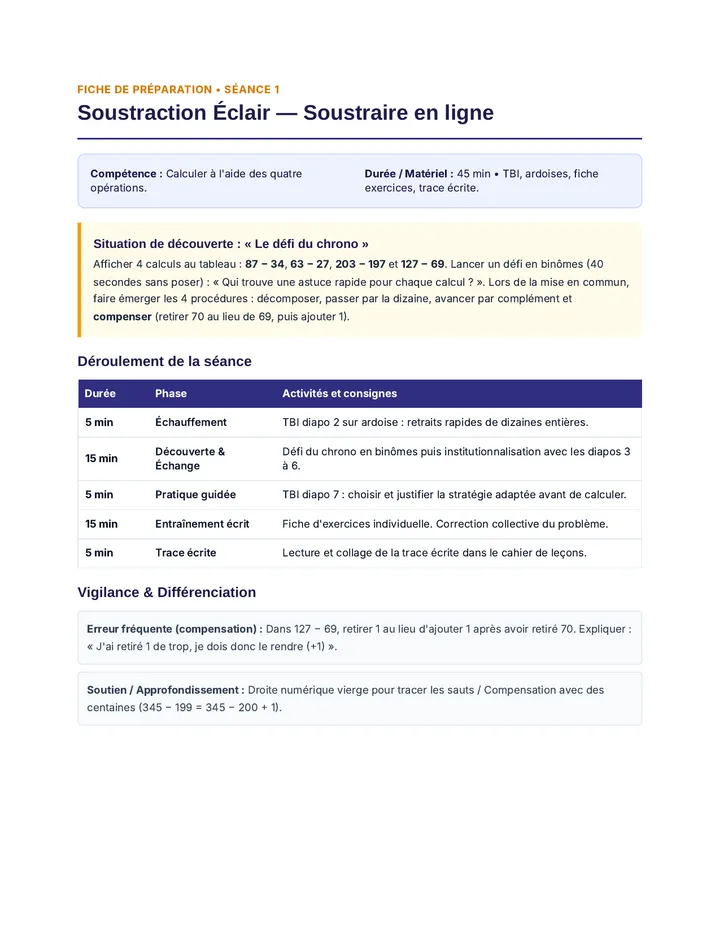
Soustraction Éclair Préparation

Calcul Malin

Séquence de 4 séances en mathématiques sur la compétence « Calculer à l'aide des quatre opérations » (cycle 3 / CM1-CM2). Les élèves apprennent à soustraire en ligne, estimer l'ordre de grandeur d'un résultat, poser et effectuer des soustractions en colonnes avec et sans retenue, puis consolident l'ensemble à travers des défis et problèmes.

LP

LAURENT PERCHE

17
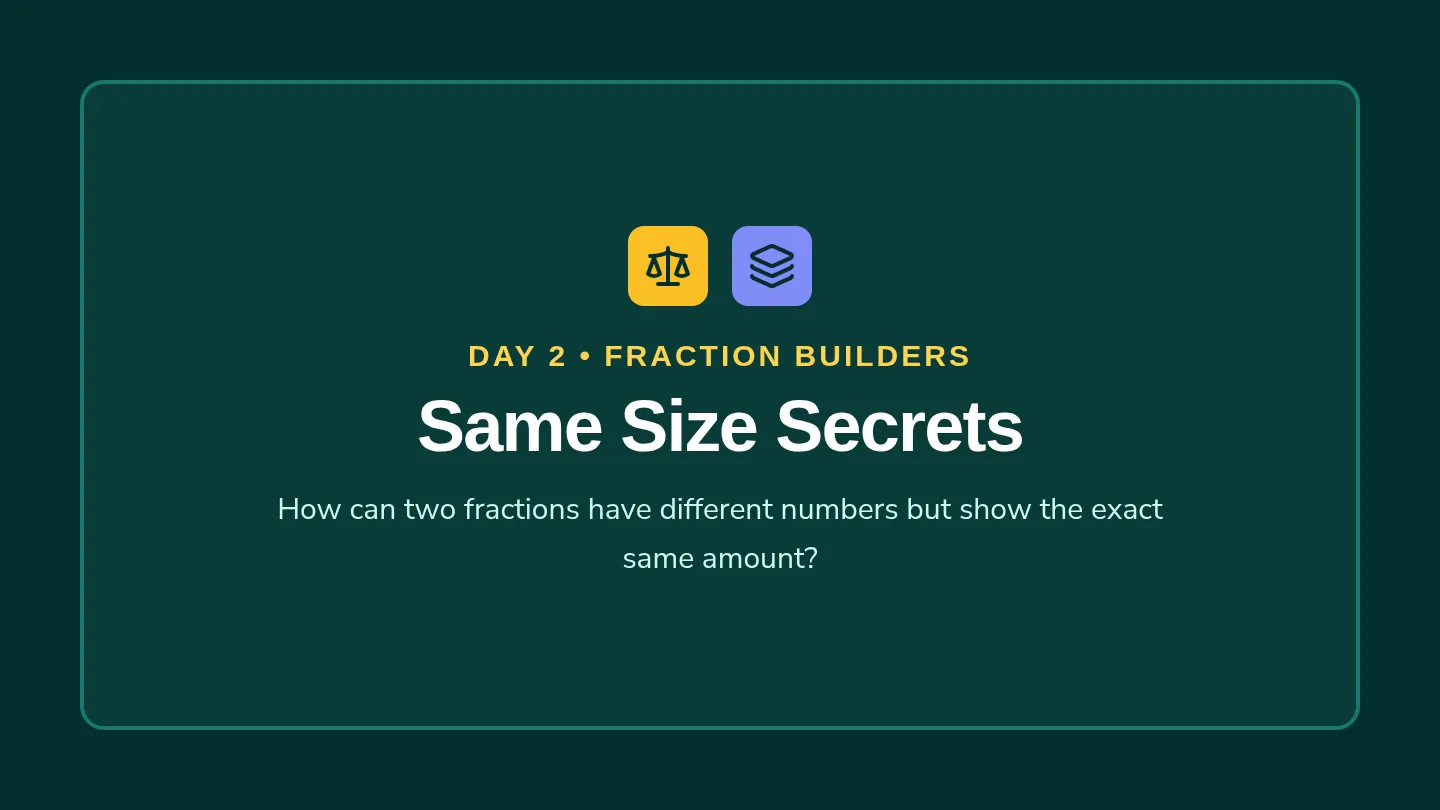
Same Size Slides

Same Size Secrets

Students discover how different fractions can represent the exact same amount by comparing fraction walls, area models, and number lines.

J

jnparrella

3
Jump Count Worksheet

Jump Count Worksheet

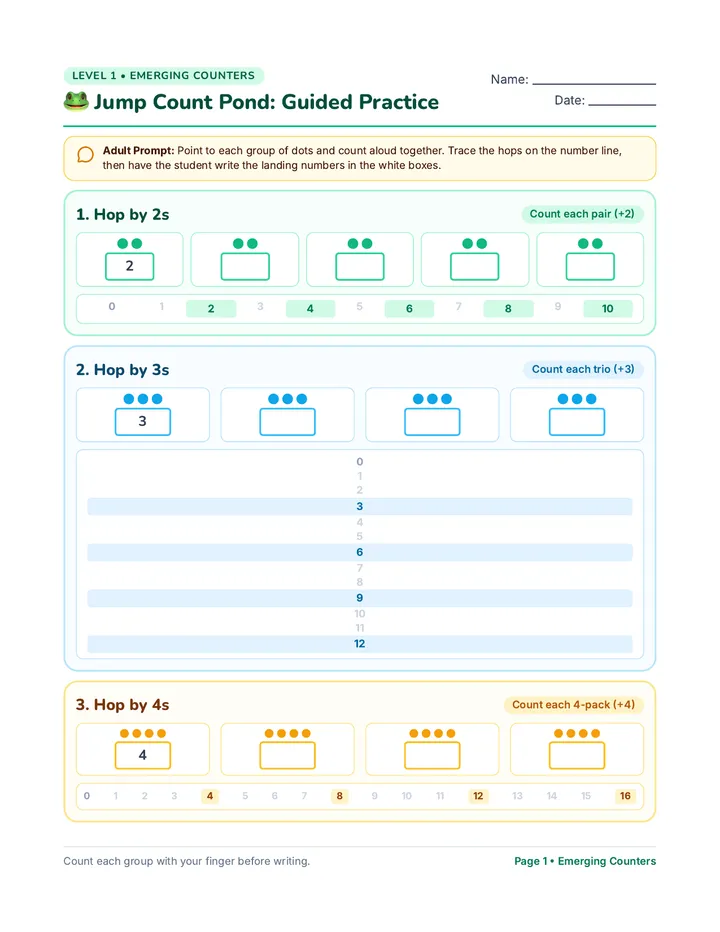
A three-page differentiated student worksheet for skip counting by 2s, 3s, and 4s, with dedicated pages for Emerging Counters, Building Independence, and Ready for Fluency.

CM

Cody Meacham

Card Shark Slides

Card Shark Academy

A 6-day project-based unit where student groups of 3-5 master a classic card game (Hearts, Gin Rummy, Euchre, or Oh Hell), design a peer-teaching method, and lead the class in learning and playing each game.

SH

Sarah Hurdle

14
Equal Parts Slides

Equal Parts Lab

Students explore equal parts, unit fractions, and how numerators and denominators work together using area models, fraction bars, and set models.

J

jnparrella

3
Jump Count Slides

Jump Count Slides

An engaging 7-slide presentation introducing skip counting by 2s, 3s, and 4s with lily-pad number lines, grouped objects, pattern spotting, and guided practice.

CM

Cody Meacham