A student worksheet designed as a clinic ward where students complete factor trees for composite numbers, applying their knowledge of divisibility rules to 'cure' the numbers into their prime factors.
A visual example and mockup of a completed 'Evidence Board' poster for Case 202, demonstrating how students should present their visual plot, statistics, verdict, and outlier analysis. Revised for single-page layout.
An answer key for the Distribution Debrief Exit Ticket, providing correct answers and brief pedagogical explanations.
A brief end-of-lesson assessment checking student understanding of how outliers affect mean vs median and when to use specific statistical measures. Two tickets per page for efficient printing. Revised for layout and uniform answer choices.
A guide for the collaborative poster activity featuring specific case studies for students to analyze and 'peer review' cards for a gallery walk. Revised with larger peer review cards and better layout.
An answer key for the Case Notes handout, providing calculations for mean and median and clear explanations of why certain measures are preferred in symmetric vs skewed data. Revised for layout and clarity.
A student practice worksheet with two real-world scenarios comparing symmetric data to data with an outlier, requiring students to calculate measures and justify their selection. Layout optimized for 8.5x11 printing. Revised for single-page fit.
Visual presentation for the lesson including outlier identification, impact on mean vs median, and selection criteria for symmetric vs skewed data.
A detailed 90-minute teacher guide for a 6th grade math lesson on statistical measures and outliers, featuring a 'Data Detective' theme with a clear timeline, learning objectives, and teaching tips. Revised for better page breaks.
A set of 10 printable task cards featuring diverse binomial distribution scenarios. Perfect for station activities, group work, or extra practice bank. Includes integrated answer key. Now updated to include Expected Value (E[X]) calculations for every case.
A comprehensive answer key for the task-card edition of the Binomial Breakdown Worksheet, reformatted into individual 1/3-page cards to facilitate separate distribution or physical cutting. Each card provides detailed logic, modern BINOM.DIST syntax, and correctly rendered manual formulas. Updated for density and usability.
A 21-question practice worksheet for 12th-grade statistics, reformatted as a modular task-card bank. Designed with three horizontal cut-lines per page for easy physical division. Covers BINS criteria, spreadsheet formulas (BINOM.DIST), hand-calculation theory, and now includes questions on Expected Value (n*p). Card IDs and questions are aligned 1:1.
A visual presentation accompanying the Binomial Breakdown lesson. Covers BINS criteria, expected value (mean), spreadsheet formula syntax (BINOM.DIST), and the hand-calculation formula connection. Updated with a new slide for expected value (n*p) and improved summary visuals.
Teacher-facing answer key for the summative assessment. Refined to align with the single-column parabola analysis and updated problem layouts.
Teacher-facing answer key for the review worksheet. Updated to match the refined single-column parabola analysis items.
A formal summative assessment with 6 items, evaluating student proficiency in solving quadratic equations through graphing analysis, algebraic factoring, and guided quadratic formula steps. Graphing items feature single-column layouts and explicitly displayed equations. Fixes layout bugs in the formula section.
A 12-question comprehensive review worksheet covering quadratic equations via graphing, factoring, and the quadratic formula, styled with a professional 'blueprint' aesthetic. This version features single-column graph layouts, explicitly displayed equations, and refined formula templates.
Set of unique, pre-filled randomized Bingo cards for the Stat Squad activity. Each card features 24 numbers from the evidence pool and a free space. Optimized for 8.5 x 11 printing. Card set IDs #001 to #030.
Bingo activity presentation for calling variability problems in class. Features large, readable data sets and distinct case numbers to match the teacher's calling guide. Includes step-by-step solution slides.
Teacher Calling Sheet for Stat Squad Bingo. Features a complete answer key for Case #01 through #27, facilitation tips, and an Evidence Pool reference.
Teacher's answer key for the "Variability Vitals" worksheet, providing step-by-step solutions for MAD and IQR calculations. Optimized to fit on a single page.
A high-quality 6th-grade math worksheet titled "Variability Vitals" focused on calculating MAD and IQR with structured work areas for students. Optimized to fit on a single 8.5 x 11 page. Improved header sizes and work area spacing.
Updated slide deck for Variability Vitals, now including detailed step-by-step examples for Mean Absolute Deviation and Interquartile Range to facilitate teacher explanation.
A detailed 90-minute lesson plan for 6th grade math covering Mean Absolute Deviation and Interquartile Range with a "Stat Squad" theme. Updated with requested title and single-page layout.
A teacher-facing guide for the Green Thumb Architects lesson, including TEKS alignment, grading rubric, project answer keys, and task card solutions.
A set of 12 thematic task cards for 4th-grade math, focusing on multi-step word problems, decimal addition and subtraction, and fraction-to-decimal relationships within a community garden context. Now includes a 2-page student recording sheet with ample workspace.
A 3-page project-based learning guide where students design a community garden on a 100-unit grid, perform fraction-to-decimal conversions, and manage a $250.00 budget using multi-step decimal operations.
A curated list of store-bought board games for families, categorized by age and highlighting specific math skills like spatial reasoning and logic. Includes tips for simplifying complex games. Corrected inaccuracies and ensured single-page layout.
An activity guide for parents focused on using the Kindergarten Math Kit and common household items to support math learning. It includes detailed instructions for the 'Sleeping Bears' and 'Make 10 Go Fish' games demonstrated in the workshop. Workspace enlarged for counting bears. Delivery method for newsletters updated to ParentSquare app. Corrected instructions and added Math Snack content.
A parent handout focused on fostering positive math attitudes and a growth mindset at home, based on Stanford DREME research. Corrected spelling and layout to fit on one page with a space for parent notes. Hand-writing area spacing improved. Body text font size slightly increased for legibility.
An updated bridge handout for parents that illustrates the major mathematics goals for First Grade, using descriptive full sentences to explain addition types, place value, measurement, and geometry. Layout tightened to fit on a single page. Darkened footer for better contrast.
An updated parent handout outlining the major math focuses for Kindergarten, using more descriptive full sentences to explain counting, comparing groups, operations within 10, and geometry concepts. Layout tightened to fit on a single page. Now includes a mention of the zipper pouch math kit. Body text font size increased for legibility.
A revised 16:9 slide presentation for a Family Math Workshop, featuring updated demo games (Sleeping Bears, Make 10 Go Fish), a focus on the Kindergarten Math Kit (zipper pouch), and DREME-aligned advice on building positive math attitudes using full, professional sentences. Newsletter delivery method updated to ParentSquare app. Hierarchy issues and spacing overlap corrected. Contrast on kit cards improved. Title colors corrected.
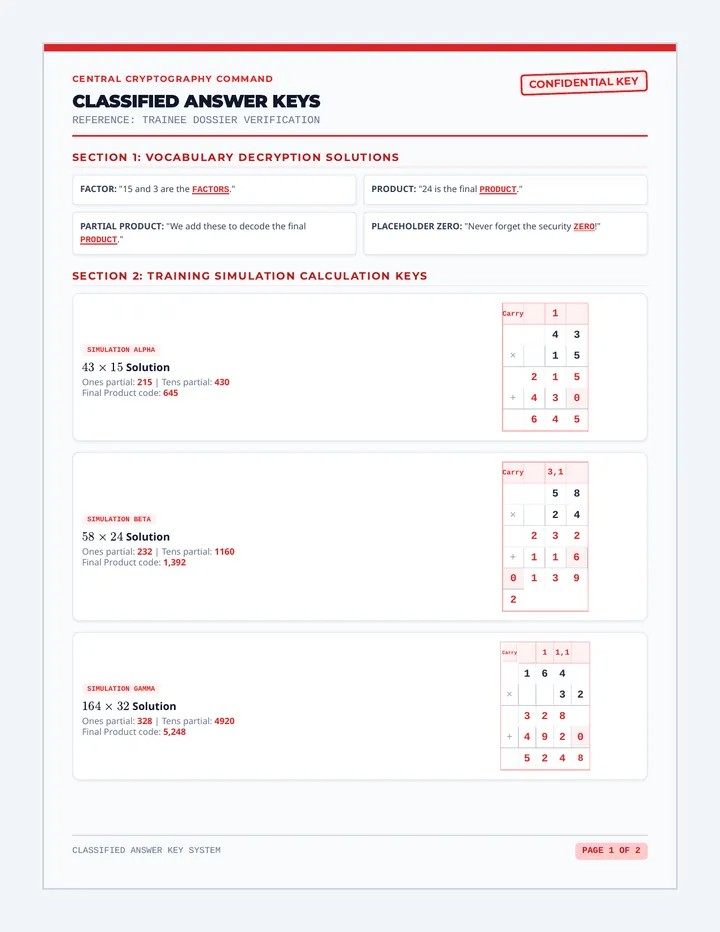
A teacher-facing resource providing the answer key, lesson script, common misconceptions, and differentiation strategies for the Code Breakers activity.
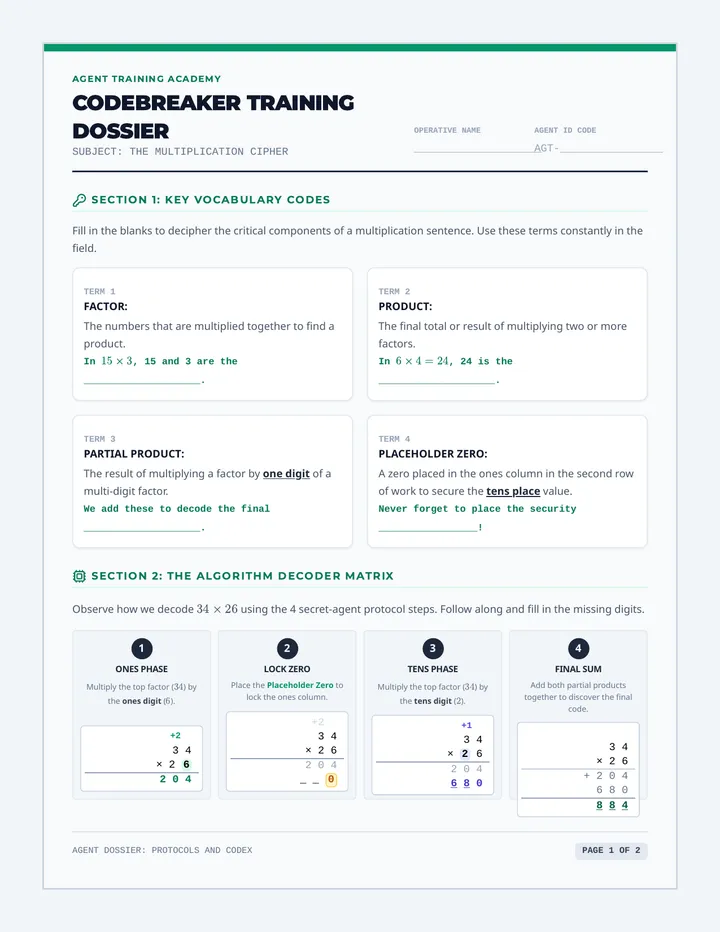
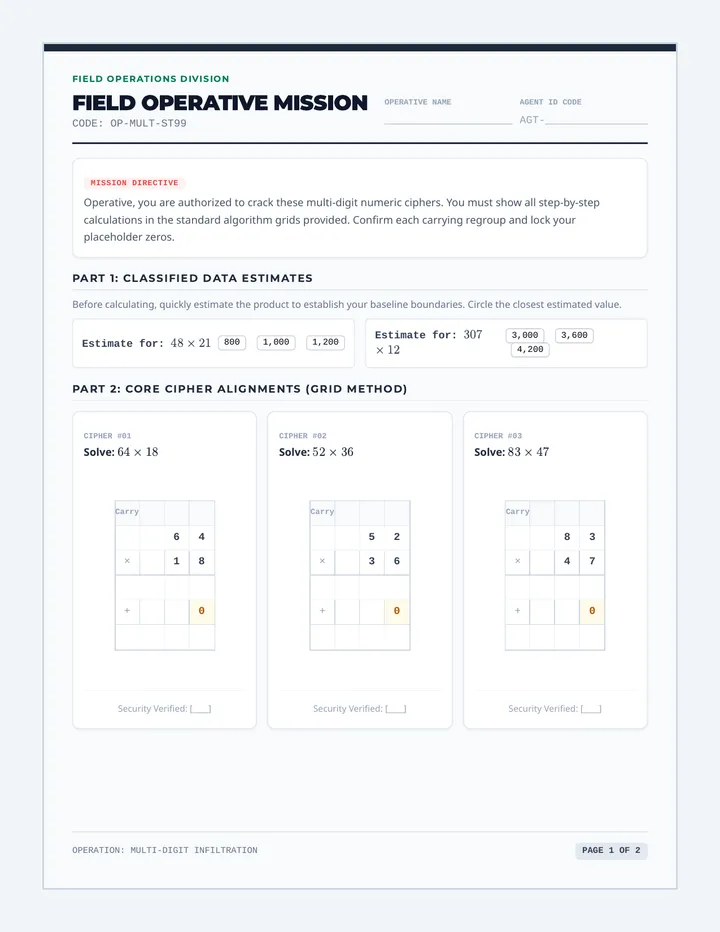
A student-facing math worksheet with a spy-themed cipher. Students solve 16 equations covering multiplication, division, PEMDAS, and money to decode the "Top Secret" message: TOP SECRET MISSION.
An interactive presentation that frames mathematical concepts (multiplication, division, PEMDAS, money) within a "spy mission" context to engage 5th-grade students.