Math Quest Spiral Slides
Virginia Standards of Learning
Grade 4 Mathematics
SOL Math Spiral Mastery Quest
20 comprehensive spiral review challenges across every major 4th grade SOL strand, complete with step-by-step strategy keys.
Strand 1
Number Sense
SOL 4.1 – 4.3
Strand 2
Computation
SOL 4.4 – 4.6
Strand 3
Measurement & Geo
SOL 4.7 – 4.12
Strand 4
Data & Patterns
SOL 4.13 – 4.16
Review Roadmap & Instructions
Overview
Student Mission
- • Read each question stem carefully and underline key mathematical words.
- • Show your work on scratch paper or your student recording grid.
- • Eliminate unreasonable answer choices before choosing your final answer.
Review Structure
- • Part 1 features 20 SOL-aligned review questions (Slides 3–22).
- • Part 2 features the comprehensive Answer Key with strategy walkthroughs (Slides 24–43).
- • Pacing: Great for 4 daily warm-ups of 5 questions or a complete unit benchmark!
Ready to test your math mastery? Let us launch into Question 1!
Questions Ahead →
Question 1 of 20 Strand 1: Number & Number Sense
SOL 4.1a
In the number 847,293, what is the value of the digit 4?
A 400
B 4,000
C 40,000
D 400,000
Hint: Determine the place-value column of the underlined digit. Write your choice on your sheet
Question 2 of 20 Strand 1: Number & Number Sense
SOL 4.1c
When rounded to the nearest thousand, which number does 685,429 become?
A 680,000
B 685,000
C 686,000
D 690,000
Hint: Look at the digit in the hundreds place to determine whether to round up or down. Write your choice on your sheet
Question 3 of 20 Strand 1: Number & Number Sense
SOL 4.2a
Which fraction is equivalent to \( \frac{3}{4} \)?
A \( \frac{6}{10} \)
B \( \frac{9}{12} \)
C \( \frac{8}{12} \)
D \( \frac{12}{15} \)
Hint: Multiply or divide both the numerator and denominator by the same whole number. Write your choice on your sheet
Question 4 of 20 Strand 1: Number & Number Sense
SOL 4.2b
Which comparison statement is true?
A \( \frac{2}{3} < \frac{3}{5} \)
B \( \frac{5}{8} > \frac{3}{4} \)
C \( \frac{4}{6} = \frac{2}{3} \)
D \( \frac{5}{6} < \frac{7}{12} \)
Hint: Find common denominators or simplify each fraction to verify the relationship. Write your choice on your sheet
Question 5 of 20 Strand 1: Number & Number Sense
SOL 4.3b
Which list orders the decimals from least to greatest?
A 0.82, 0.805, 0.8, 0.089
B 0.089, 0.8, 0.805, 0.82
C 0.089, 0.805, 0.8, 0.82
D 0.8, 0.089, 0.805, 0.82
Hint: Line up decimals by the decimal point and fill in placeholder zeros (0.800, 0.820). Write your choice on your sheet
Question 6 of 20 Strand 2: Computation & Estimation
SOL 4.4b
A school auditorium has 28 rows of seats. Each row has 34 seats. What is the total number of seats in the auditorium?
A 852 seats
B 922 seats
C 952 seats
D 1,052 seats
Hint: Multiply 28 by 34 using partial products or standard algorithm. Write your choice on your sheet
Question 7 of 20 Strand 2: Computation & Estimation
SOL 4.4c
A bakery prepared 248 muffins. Each gift box holds 6 muffins. How many full boxes can be packed, and how many muffins will be left over?
A 40 boxes, 8 left over
B 41 boxes, 2 left over
C 41 boxes, 5 left over
D 42 boxes, 0 left over
Hint: Divide 248 by 6. The remainder cannot be equal to or greater than 6. Write your choice on your sheet
Question 8 of 20 Strand 2: Computation & Estimation
SOL 4.4d
Maya earned $45 on Friday and $68 on Saturday. She then spent $29 on a backpack and $14 on art supplies. How much money does Maya have left?
A $70
B $84
C $99
D $113
Hint: First find total earned, then find total spent, then subtract. Write your choice on your sheet
Question 9 of 20 Strand 2: Computation & Estimation
SOL 4.5b
Liam drank \( \frac{3}{8} \) quart of juice in the morning and \( \frac{1}{4} \) quart in the afternoon. What total fraction of a quart of juice did Liam drink?
A \( \frac{4}{12} \) quart
B \( \frac{1}{2} \) quart
C \( \frac{5}{8} \) quart
D \( \frac{7}{8} \) quart
Hint: Rename \( \frac{1}{4} \) to an equivalent fraction with a denominator of 8. Write your choice on your sheet
Question 10 of 20 Strand 2: Computation & Estimation
SOL 4.6b
A long-distance cycling route is 15.4 kilometers long. Jaden rode 6.85 kilometers before resting. How many kilometers does Jaden have left to ride?
A 8.55 km
B 8.65 km
C 9.45 km
D 9.55 km
Hint: Write 15.4 as 15.40 so both numbers have the same number of decimal digits. Write your choice on your sheet
Question 11 of 20 Strand 3: Measurement & Geometry
SOL 4.7
A rectangular community garden has a length of 14 feet and a width of 8 feet. What are the area and perimeter of the garden?
A Area = 112 sq ft; Perimeter = 44 ft
B Area = 44 sq ft; Perimeter = 112 ft
C Area = 112 sq ft; Perimeter = 22 ft
D Area = 96 sq ft; Perimeter = 44 ft
Hint: \( \text{Area} = l \times w \) and \( \text{Perimeter} = 2l + 2w \). Write your choice on your sheet
Question 12 of 20 Strand 3: Measurement & Geometry
SOL 4.8
Which measurement is equivalent to 3 yards?
A 36 inches
B 72 inches
C 9 feet
D 12 feet
Hint: Remember that 1 yard = 3 feet = 36 inches. Write your choice on your sheet
Question 13 of 20 Strand 3: Measurement & Geometry
SOL 4.9
A science club presentation started at 1:45 p.m. and ended at 4:10 p.m. What was the total elapsed time of the presentation?
A 2 hours 15 minutes
B 2 hours 25 minutes
C 2 hours 35 minutes
D 3 hours 25 minutes
Hint: Count forward from 1:45 p.m. to 3:45 p.m., then add the remaining minutes to 4:10 p.m. Write your choice on your sheet
Question 14 of 20 Strand 3: Measurement & Geometry
SOL 4.10
Which term describes an angle that measures greater than \( 90^\circ \) and less than \( 180^\circ \)?
A Acute angle
B Right angle
C Obtuse angle
D Straight angle
Hint: Acute is less than \( 90^\circ \); right is exactly \( 90^\circ \); straight is \( 180^\circ \). Write your choice on your sheet
Question 15 of 20 Strand 3: Measurement & Geometry
SOL 4.12
Which quadrilateral always has four right angles and opposite sides that are parallel and equal in length, but does not necessarily have four equal sides?
A Rhombus
B Trapezoid
C Rectangle
D Parallelogram
Hint: Review the properties of squares, rectangles, rhombuses, and trapezoids. Write your choice on your sheet
Question 16 of 20 Strand 4: Probability, Statistics & Patterns
SOL 4.13
A velvet pouch contains 7 blue marbles, 2 red marbles, and 1 yellow marble. Which word best describes the probability of drawing a red marble without looking?
A Impossible
B Unlikely
C Equally likely
D Certain
Hint: Find the ratio of red marbles to the total number of marbles (2 out of 10). Write your choice on your sheet
Question 17 of 20 Strand 4: Probability, Statistics & Patterns
SOL 4.14
A 4th grade class survey of favorite animals recorded: Dogs (16), Cats (12), and Fish (8). How many more students chose dogs or cats combined than fish?
A 16 more students
B 20 more students
C 24 more students
D 28 more students
Hint: Combine dogs and cats first: \( 16 + 12 \). Then subtract the number of fish. Write your choice on your sheet
Question 18 of 20 Strand 4: Probability, Statistics & Patterns
SOL 4.15
Examine this pattern: 4, 12, 36, 108, ___. What is the rule for the pattern, and what is the next number?
A Add 8; next number is 116
B Multiply by 3; next number is 324
C Multiply by 3; next number is 216
D Add 72; next number is 180
Hint: Check how each term changes to get to the next term (\( 4 \times ? = 12 \)). Write your choice on your sheet
Question 19 of 20 Strand 4: Probability, Statistics & Patterns
SOL 4.16a
Which equation demonstrates the Distributive Property of Multiplication over Addition?
A \( 7 \times (5 + 3) = (7 \times 5) + (7 \times 3) \)
B \( 6 \times (4 \times 2) = (6 \times 4) \times 2 \)
C \( 9 + 8 = 8 + 9 \)
D \( 12 \times 1 = 12 \)
Hint: Look for the factor outside the parentheses distributed to each addend inside. Write your choice on your sheet
Question 20 of 20 Strand 4: Probability, Statistics & Patterns
SOL 4.16b
Which value of \( m \) makes this equation true? \( 42 - m = 18 + 9 \)
A \( m = 13 \)
B \( m = 15 \)
C \( m = 27 \)
D \( m = 69 \)
Hint: Calculate the value of the right side first (\( 18 + 9 = 27 \)), then solve for \( m \). Congratulations! All questions complete
Solution Walkthrough
Questions 1 to 20
Complete Answer Key & Strategy Breakdown
Step-by-step mathematical reasoning, SOL test-taking strategies, and common misconceptions for all 20 questions.
Teacher & Student Discussion Guide
Advance slide-by-slide to review each problem and unpack the thinking behind each solution.
Begin Review →
Question 1 Solution SOL 4.1a • Place Value
Correct: C
Mathematical Strategy
In 847,293, the digits are in the following places:
8 = hundred-thousands (800,000)
4 = ten-thousands (40,000)
7 = thousands (7,000)
2 = hundreds (200), 9 = tens (90), 3 = ones (3)
Trap Alert & Misconceptions
Students often confuse the ten-thousands place (40,000) with the thousands place (4,000) or hundred-thousands (400,000). Always write digits into a place-value chart to double check!
Final Answer: C (40,000) because 4 ten-thousands equals \( 4 \times 10,000 = 40,000 \).
Question 2 Solution SOL 4.1c • Rounding Numbers
Correct: B
Rounding Rule
Target place: thousands (digit is 5, representing 5,000). Look at the helper digit to the right in the hundreds place: 4.
Since 4 < 5, we round down to the nearest thousand: 685,000.
Trap Alert
Choosing 686,000 is a mistake from rounding up. Choosing 690,000 is rounding to the nearest ten-thousand, not thousand!
Final Answer: B (685,000).
Question 3 Solution SOL 4.2a • Equivalent Fractions
Correct: B
Multiplying by Identity
To generate an equivalent fraction, multiply numerator and denominator by 3:
\( \frac{3 \times 3}{4 \times 3} = \frac{9}{12} \)
Trap Alert
\( \frac{6}{10} \) simplifies to \( \frac{3}{5} \), not \( \frac{3}{4} \). \( \frac{8}{12} \) simplifies to \( \frac{2}{3} \). Only \( \frac{9}{12} \) simplifies directly back to \( \frac{3}{4} \).
Final Answer: B (\( \frac{9}{12} \)).
Question 4 Solution SOL 4.2b • Comparing Fractions
Correct: C
Verification
Simplify \( \frac{4}{6} \) by dividing numerator and denominator by 2:
\( \frac{4 \div 2}{6 \div 2} = \frac{2}{3} \)
Trap Alert
In A: \( \frac{2}{3} = \frac{10}{15} \) and \( \frac{3}{5} = \frac{9}{15} \), so \( \frac{2}{3} > \frac{3}{5} \) (A is false). In B: \( \frac{5}{8} < \frac{6}{8} = \frac{3}{4} \) (B is false).
Final Answer: C (\( \frac{4}{6} = \frac{2}{3} \)).
Question 5 Solution SOL 4.3b • Ordering Decimals
Correct: B
Place-Value Lineup
Pad with placeholder zeros to the thousandths place:
0.089 → 89 thousandths (least)
0.800 → 800 thousandths
0.805 → 805 thousandths
0.820 → 820 thousandths (greatest)
Trap Alert
Students often think 0.8 is smaller than 0.089 because 8 < 89. Remind them to compare tenths first: 0 tenths is far less than 8 tenths!
Final Answer: B (0.089, 0.8, 0.805, 0.82).
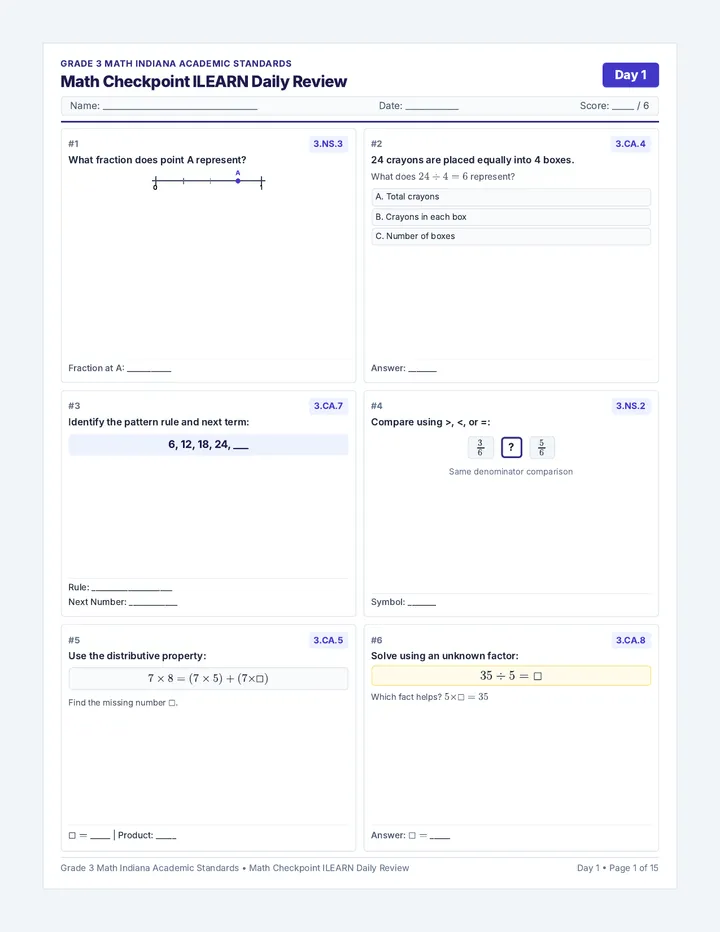
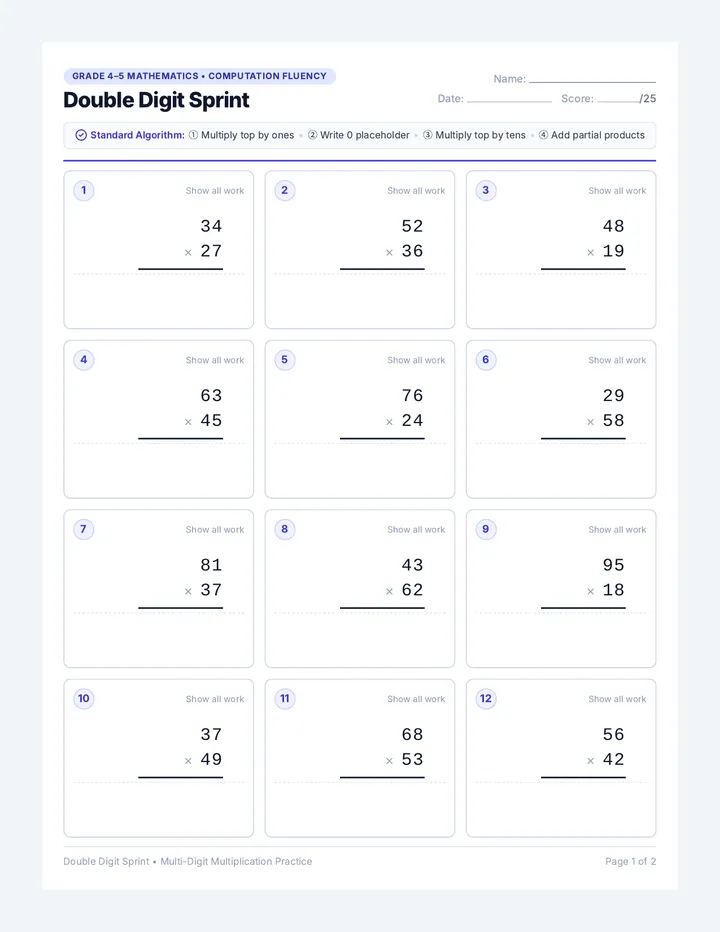
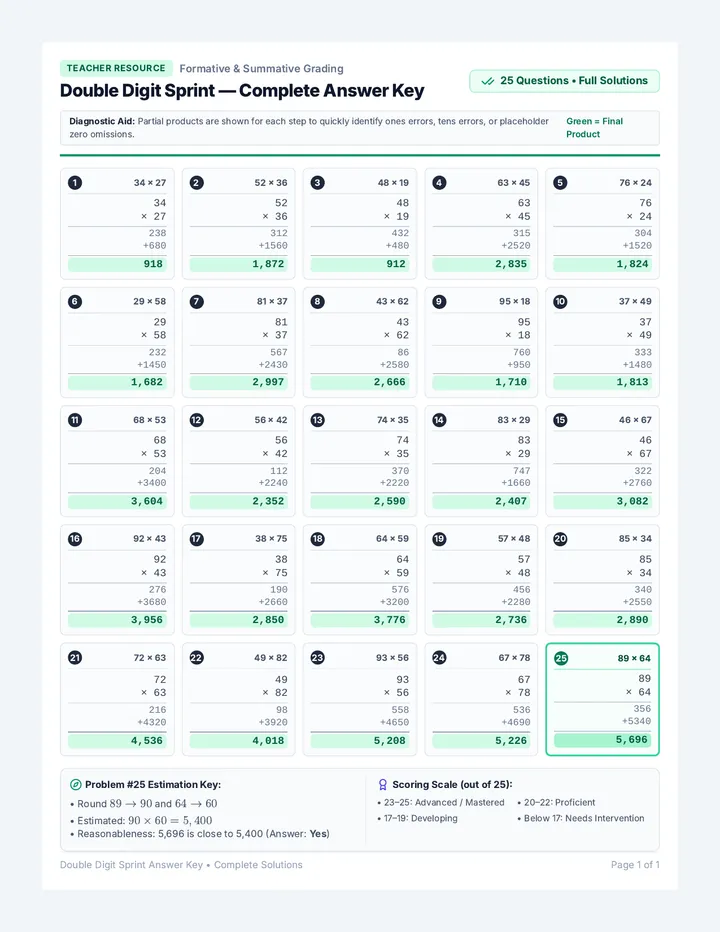
Question 6 Solution SOL 4.4b • 2-Digit Multiplication
Correct: C
Partial Products Method
28 rows × 34 seats = ?
28 × 30 = 840
28 × 4 = 112
840 + 112 = 952 seats
Trap Alert
A common mistake in traditional algorithm is forgetting to place a zero in the ones place when multiplying by the tens digit (30).
Final Answer: C (952 seats).
Question 7 Solution SOL 4.4c • Division with Remainders
Correct: B
Division Calculation
248 ÷ 6 = ?
24 tens ÷ 6 = 4 tens (40 × 6 = 240)
Remaining: 248 - 240 = 8
8 ÷ 6 = 1 box with 2 remaining
Total: 41 boxes, 2 left over
Trap Alert
Choice A has a remainder of 8. In division by 6, the remainder can never be 6 or greater because another group of 6 can be formed!
Final Answer: B (41 boxes, 2 left over).
Question 8 Solution SOL 4.4d • Multistep Practical Problem
Correct: A
Step-by-Step Solution
Step 1 (Earned): $45 + $68 = $113
Step 2 (Spent): $29 + $14 = $43
Step 3 (Left over): $113 - $43 = $70
Trap Alert
Choice D ($113) represents only total money earned without subtracting purchases. Multistep problems require reading the full story!
Final Answer: A ($70).
Question 9 Solution SOL 4.5b • Fraction Addition
Correct: C
Common Denominator
\( \frac{1}{4} = \frac{1 \times 2}{4 \times 2} = \frac{2}{8} \)
\( \frac{3}{8} + \frac{2}{8} = \frac{5}{8} \) quart
Trap Alert
Choice A (\( \frac{4}{12} \)) comes from incorrectly adding across both numerators and denominators (\( 3+1=4 \), \( 8+4=12 \)). Fractions must have like denominators!
Final Answer: C (\( \frac{5}{8} \) quart).
Question 10 Solution SOL 4.6b • Decimal Subtraction
Correct: A
Vertical Alignment
15.40 (regroup from 4 tenths)
- 6.85
8.55 km
Trap Alert
A common mistake is subtracting without annexing zero, writing 5 in the hundredths place without borrowing (\( 5 - 0 = 5 \) instead of \( 10 - 5 = 5 \)).
Final Answer: A (8.55 km).
Question 11 Solution SOL 4.7 • Perimeter & Area
Correct: A
Formulas
Area = \( l \times w = 14 \times 8 = 112 \) sq ft
Perimeter = \( 2(14) + 2(8) \)
Perimeter = 28 + 16 = 44 ft
Trap Alert
Choice C (22 ft) is just \( 14 + 8 \), adding only 2 sides instead of all 4 sides of the perimeter! Choice B swaps area and perimeter values.
Final Answer: A (Area = 112 sq ft; Perimeter = 44 ft).
Question 12 Solution SOL 4.8 • Equivalent Measurements
Correct: C
Conversions
1 yard = 3 feet
3 yards = \( 3 \times 3 = 9 \) feet
In inches: \( 9 \text{ ft} \times 12 = 108 \) inches
Trap Alert
36 inches is only 1 yard, not 3 yards! 72 inches is 2 yards. Therefore, 9 feet is the only equivalent choice.
Final Answer: C (9 feet).
Question 13 Solution SOL 4.9 • Elapsed Time
Correct: B
Timeline Hop Method
1:45 p.m. → 3:45 p.m. = 2 hours
3:45 p.m. → 4:00 p.m. = 15 minutes
4:00 p.m. → 4:10 p.m. = 10 minutes
Total = 2 hours + 25 minutes
Trap Alert
Standard subtraction without base-60 conversion leads to errors: \( 4:10 - 1:45 \neq 3:35 \). Always break time jumps into whole hours and minute benchmarks!
Final Answer: B (2 hours 25 minutes).
Question 14 Solution SOL 4.10 • Angle Classifications
Correct: C
Angle Definitions
Acute: \( > 0^\circ \) and \( < 90^\circ \)
Right: exactly \( 90^\circ \)
Obtuse: \( > 90^\circ \) and \( < 180^\circ \)
Straight: exactly \( 180^\circ \)
Trap Alert
Remember: "acute" is a small ("cute") angle less than \( 90^\circ \), while "obtuse" is wide and greater than a square right-angle corner.
Final Answer: C (Obtuse angle).
Question 15 Solution SOL 4.12 • Quadrilaterals
Correct: C
Shape Properties
A rectangle is defined as a parallelogram with four right angles. Opposite sides are congruent and parallel. It does not require all 4 sides to be equal (that would make it a square).
Trap Alert
A rhombus always has 4 congruent sides (not 4 right angles). A trapezoid only has 1 pair of parallel sides. A general parallelogram does not need right angles.
Final Answer: C (Rectangle).
Question 16 Solution SOL 4.13 • Probability Terms
Correct: B
Probability Breakdown
Total marbles: 7 + 2 + 1 = 10
P(Red) = \( \frac{2}{10} = \frac{1}{5} = 20\% \)
Since 20% is well under 50%, it is unlikely.
Trap Alert
It is not "impossible" because there are red marbles in the bag (probability > 0). "Equally likely" would require 5 out of 10.
Final Answer: B (Unlikely).
Question 17 Solution SOL 4.14 • Interpreting Data
Correct: B
Two-Step Calculation
Step 1 (Dogs + Cats): 16 + 12 = 28
Step 2 (Compare with Fish): 28 - 8
Difference = 20 students
Trap Alert
Choice D (28) stops after adding dogs and cats together without subtracting the 8 fish. Always complete both steps when questions ask "how many more... than"!
Final Answer: B (20 more students).
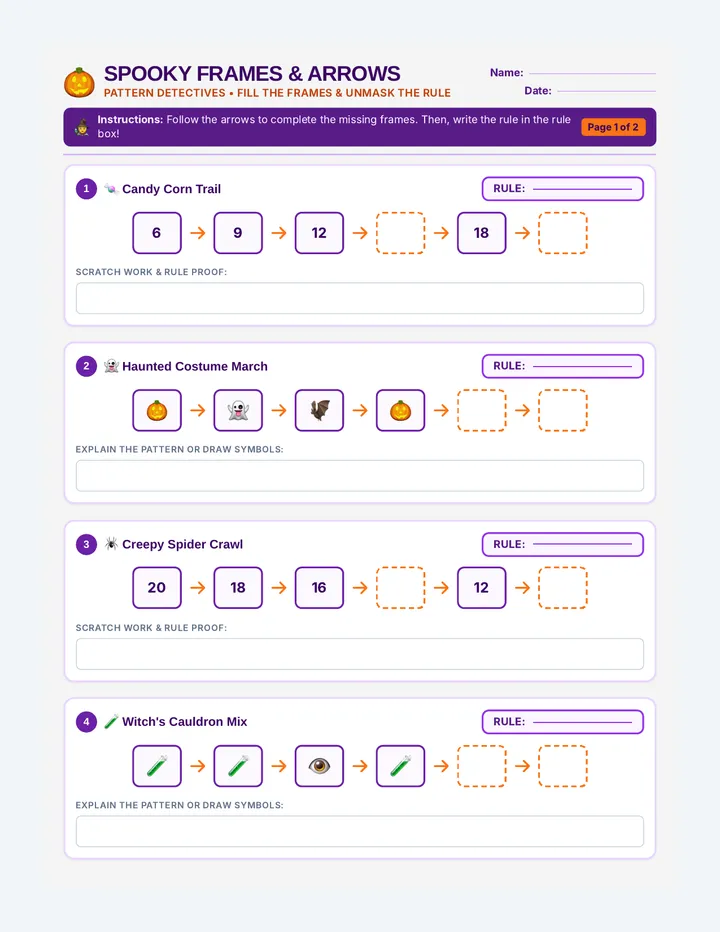
Question 18 Solution SOL 4.15 • Patterns & Rules
Correct: B
Pattern Rule
4 × 3 = 12
12 × 3 = 36
36 × 3 = 108
108 × 3 = 324
Trap Alert
Choice A assumes an addition pattern based only on the first jump (\( 4 + 8 = 12 \)), but \( 12 + 8 \neq 36 \). Patterns must work across every number in the sequence!
Final Answer: B (Multiply by 3; next number is 324).
Question 19 Solution SOL 4.16a • Distributive Property
Correct: A
Distributive Property
\( a \times (b + c) = (a \times b) + (a \times c) \). The outside factor 7 is distributed to both 5 and 3:
\( 7 \times (5 + 3) = (7 \times 5) + (7 \times 3) = 56 \)
Other Properties
- Choice B = Associative (regrouping factors).
- Choice C = Commutative (changing order).
- Choice D = Identity (multiplying by 1).
Final Answer: A (\( 7 \times (5 + 3) = (7 \times 5) + (7 \times 3) \)).
Question 20 Solution SOL 4.16b • Balancing Equations
Correct: B
Balancing the Scale
Equation: \( 42 - m = 18 + 9 \)
Evaluate right side: \( 18 + 9 = 27 \)
Now: \( 42 - m = 27 \)
\( m = 42 - 27 = 15 \)
Trap Alert
Choice C (27) is just the value of the right side, not \( m \)! Choice D (69) comes from mistakenly adding 42 + 27 instead of subtracting.
Final Answer: B (\( m = 15 \)).