Mastering Systems Notes System Showdown
Solving Systems by Substitution & Elimination
Name:
Date:
Mission Objectives
• Identify when a variable is isolated and use substitution to solve for both unknowns.
• Use multiplication to create additive opposites for the elimination method.
• Translate real-world scenarios into systems of equations and interpret the results.
PART 1
Substitution: The Swap Out
Concept: Isolated Variables
When one equation is already solved for \(x\) or \(y\), we can "plug" its equivalent expression into the other equation.
Example 1:
\(y = 3x - 5\)
\(2x + 3y = 29\)
Step 1: Substitute the expression
Step 2: Solve for the first variable
Step 3: Back-substitute for the second variable
Check: Write your final answer as a coordinate pair: ________________
PART 2
Elimination: The Multiplier Effect
The Goal: Creating Opposites
Sometimes variables don't cancel out immediately. We must multiply one or both equations by a constant to create matching coefficients with opposite signs.
\(3x + 2y = 10\)
\(x - 4y = 8\)
Strategy: Which variable is easier to eliminate? Why?
Work Area: Multiply & Add
Work Area: Solve & Find Other Variable
PART 3
The Field Test: Word Problems
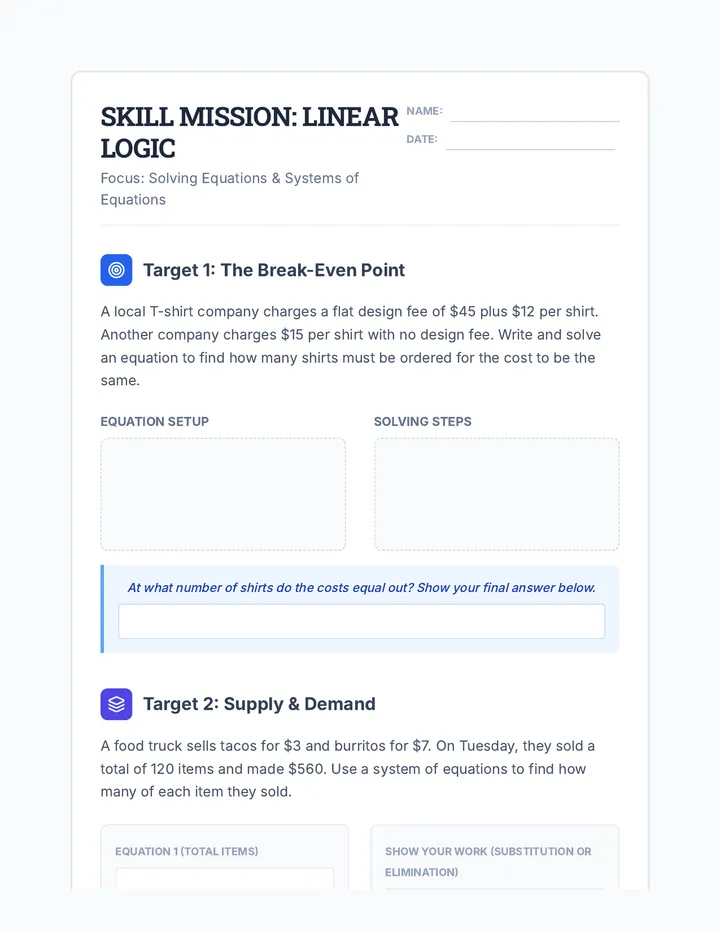
At a local bakery, 3 croissants and 2 coffees cost $12.00. Another customer buys 1 croissant and 4 coffees for $14.00. What is the individual price of a croissant and a cup of coffee?
Define Variables
\(c =\) __________________
\(f =\) __________________
Write the System
Eq 1: _____________________________
Eq 2: _____________________________
Show Your Strategy & Solution
Final Conclusion: A croissant costs $__________ and a coffee costs $__________.
System Pro-Tip: Choosing Your Weapon
SUBSTITUTION
Use when you see a "lonely" variable (coefficient of 1 or -1) already isolated or easy to isolate.
ELIMINATION
Use when variables are lined up in columns (\(Ax + By = C\)) and you can easily create matching numbers.
System Showdown Slides System Showdown
Substitution • Elimination • Application
Target: Solutions
The Ultimate Goal
Find the single point \((x, y)\) that makes BOTH equations true at the same time.
Graphing
Intersection
Substitution
Algebraic Swap
Elimination
Additive Opposites
Technique #1
Substitution
Look For:
x = ... or y = ...
1
Identify the Isolated Variable
2
Plug that expression into the OTHER equation
3
Solve for the first variable, then back-substitute
y = 3x - 5
2x + 3(y) = 29
2x + 3(3x - 5) = 29
Technique #2
Elimination
Look For:
Standard Form
"Sometimes they don't cancel nicely... so we MAKE them."
3x + 2y = 10
x - 4y = 8
Multiply the 2nd equation by -3 to eliminate x, or by 2 to eliminate y!
The Multiplier Rule
If you multiply EVERY term, the balance of the equation stays exactly the same.
Don't forget to multiply the constant term after the equals sign!
The Field Mission
Word Problem Blueprint
Define
Declare your unknowns.
"Let \(x = \)..."
Translate
Look for "total", "each", "and" to build your equations.
Solve & Map
Solve algebraically and map values back to the real world.
"Math without context is just numbers; word problems are where the magic happens."
Summary: Choose Your Weapon
Substitution
Variables are already isolated.
One variable has a coefficient of 1.
Best for input/output relationships.
Elimination
Equations are in Standard Form.
Opposites can be created by multiplication.
Best for totals and mixture problems.
Strategy Selector Organizer Strategy Selector
Graphic Organizer: Systems of Equations
Unit 4 Reference
Substitution
When to use:
One variable is isolated (e.g., \(y = 2x + 1\)) or has a coefficient of 1 or -1 .
1
Isolate a variable if not already done.
2
Substitute the expression into the OTHER equation using parentheses.
3
Solve for the remaining variable.
4
Back-substitute the numerical value to find the 2nd variable.
Quick Workspace:
\(y = 2x + 4\)
\(3x + y = 9\)
Elimination
When to use:
Both equations are in Standard Form (\(Ax + By = C\)). Variables line up vertically.
1
Multiply one (or both) equations to create opposites (e.g., \(4y\) and \(-4y\)).
2
Add the equations together to "cancel" one variable.
3
Solve for the remaining variable.
4
Plug back into either original equation for the 2nd variable.
Quick Workspace:
\(2x + 3y = 8\)
\(x - y = 4\) (Multiply by 3!)
PITFALLS
• Forgetting the sign change
• Not multiplying the constant
• Adding instead of subtracting
THE CHECK
Always plug your final point \((x, y)\) into BOTH equations. If it's only true for one, it's NOT the solution!
KEY WORDS
Total Difference Sum Each Twice
System Showdown Slides Final System Showdown
Substitution • Elimination • Application
Target: Solutions
The Ultimate Goal
Find the single point \((x, y)\) that makes BOTH equations true.
Graphing
Intersection
Substitution
Algebraic Swap
Elimination
Additive Opposites
Technique #1
Substitution
Look For:
x = ... or y = ...
1
Identify the Isolated Variable
2
Plug into the OTHER equation
3
Solve and then back-substitute
y = 3x - 5
2x + 3(y) = 29
2x + 3(3x - 5) = 29
Technique #2
Elimination
Look For:
Standard Form
"Sometimes they don't cancel nicely... so we MAKE them."
3x + 2y = 10
x - 4y = 8
Multiply the 2nd eq by 2 to eliminate y!
The Multiplier Rule
Multiply every term to keep the equation balanced.
Don't forget the constant term after the equals sign!
The Field Mission
Word Problem Blueprint
Define
Declare your unknowns.
"Let \(x = \)..."
Translate
Look for "total", "each", and "and" to build.
Solve
Solve and map values back to the real world.
"Context gives meaning to the math."
Choose Your Weapon
Substitution
Variables are already isolated.
One variable has a coefficient of 1.
Elimination
Equations are in Standard Form.
Opposites can be created by multiplication.