Stats Snapshot Reference Stats Snapshot
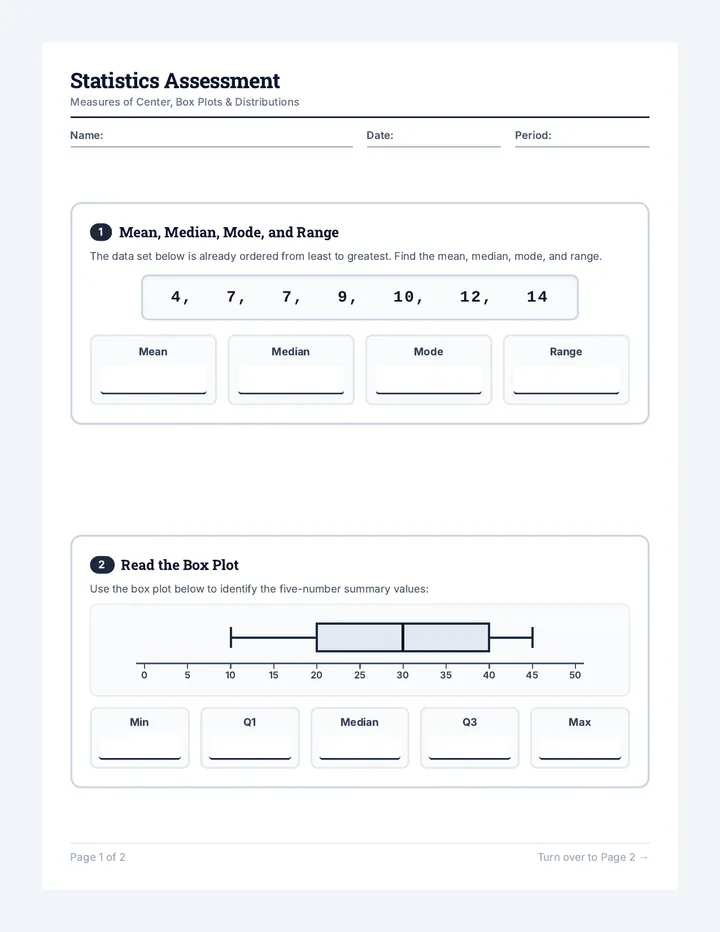
Reference Sheet // Measures of Variability (7.SP.B.4)
Center (The "Middle")
Mean (Average)
Add all values, then divide by the total count.
Median (Middle)
The exact center value of an ordered list.
Variability (The "Spread")
How spread out or consistent is the data?
Range
The distance from the Max to the Min.
Max - Min = Range
Interquartile Range (IQR)
The spread of the middle 50%. Distance between the "box" ends.
Q3 - Q1 = IQR
Visualizing Spread
Box Plot: IQR & Consistency
IQR (Middle 50%) Min Max Range (Entire Width)
Dot Plot: Distribution
Total Range
Close dots = Consistent. Spread out dots = High variability.
What variability tells you
High variability (Large Range/IQR) means the group is **unpredictable**. Low variability means the group is **consistent**.
Comparing Two Groups
Look for overlap! If two boxes (IQRs) in a box plot don't touch, the difference in the groups is likely **significant**.
Data Detective Notes Data Detective Notes
Primary Focus: Measures of Variability
Name:
Phase 1: Center & Range
Measures of Center (Review):
Mean: The ____________ value. (Add then divide).Median: The exact ____________ of an ordered list.
Measures of Variability (Start):
Range: The difference between the largest value (Max) and the ____________ value (Min).
Phase 2: Interquartile Range (IQR)
The IQR measures the middle 50% of the data. It is the distance from Q1 to Q3.
Q1 Q3 IQR = ______ - ______
Why do we use IQR?
Phase 3: Visualizing Variability
Which group is more consistent? Which group is more varied? Label them below.
Group A: Commute Times
Range: ____________
Group B: Commute Times
Range: ____________
Identify the Variability:
Which group is more consistent (lower variability)? ____________
Why? (Look at the distance from Min to Max) _________________________________________
Phase 4: Informal Inferences
When the IQRs of two populations have ____________ overlap, we can infer that the difference between the groups is likely ____________.
Comparison Challenge Problems Variability Challenge
Practice Problems // Comparing Spread (7.SP.B.4)
Name:
1
Compare the variability in the number of texts sent daily by two students.
Student A
5
10
15
20
Range: ______ texts
Student B
12
13
14
15
Range: ______ texts
Based on the Range , which student is more consistent (predictable)? Use the data to justify your answer.
2
Which battery lasts longer? Which is more predictable?
PowerBox Brand Q1: 10 hrs Q3: 40 hrs
DuraCell Brand Q1: 23 hrs Q3: 27 hrs
Calculate the Interquartile Range (IQR) for both. If you needed a battery for a critical 20-hour device, which brand would you choose and why?
3
Comparing Variety in Cereal Boxes (Net Weight in oz)
Brand X Machine
18.0
18.1
18.2
Brand Y Machine
17.0
18.0
19.0
Compare the Variability (spread) of both machines. Which brand has a more accurate packing process? Use Range or IQR in your explanation.
4
Does the difference in heights matter?
Team Red (IQR: 65" - 70")
Team Blue (IQR: 72" - 77")
60"65"70"75"80"
Analyze the Overlap:
Is there significant overlap between the boxes (the middle 50%)? Based on this spread, can we confidently say Team Blue is taller overall? Justify your inference.
5
The Power of Spread
Data Set Mean Range IQR Set A 100 200 80 Set B 100 40 15
Critical Thinking:
Both sets have the exact same average (mean) . However, one is much more variable than the other. Explain which set a scientist would prefer if they were looking for reliable, consistent results.
Stat Showdown Slides Unit 7: Statistics
Spread
Showdown
Mastering Measures of Variability
Beyond the Middle
The average (mean) is only part of the story. Variability tells you how much the data spreads out.
Consistency
Data values are close together. (Low Spread)
Unpredictability
Data values are scattered far apart. (High Spread)
Spread Toolkit
Range
The distance from the absolute Max to the absolute Min.
Max - Min
IQR
The spread of the Middle 50%. Measures the box length.
Q3 - Q1
Dot Plot Comparison
Group A (Consistent)
Very Low Range
Group B (Varied)
High Range
Data Detective Tool
Both groups have a center of 150. But Group B is much more spread out.
Group A is more PREDICTABLE.
The Box Spread
Large IQR = Unpredictable Middle 50%
Small IQR = Consistent Middle 50%
Look at the size of the box !
A wide box means scores are varied.
A narrow box means scores are consistent.
The Overlap Rule
"If the boxes don't overlap, the groups are clearly different."
Large Gap = Significant Difference
Spread Mastery
Ready to calculate and compare?
Start Practice
Case Closed Answer Key Case Closed
Teacher Answer Key // Variability Challenge
Answer Key
1 Daily Texts (Range)
The Answer:
Student B is more consistent.
Calculations: Student A: 20 - 5 = 15. Student B: 15 - 12 = 3.
2 Battery Predictability (IQR)
The Answer:
Choose DuraCell for the 20-hour device.
Calculations: PowerBox IQR: 40 - 10 = 30 hrs. DuraCell IQR: 27 - 23 = 4 hrs.
3 Packing Machines
The Answer:
Brand X is more accurate.
Calculations: Brand X Range: 18.2 - 18.0 = 0.2 oz. Brand Y Range: 19.0 - 17.0 = 2.0 oz.
4 Team Height Inferences
The Answer:
Yes, Team Blue is significantly taller.
Justification: There is no overlap between the boxes (IQRs). Team Red’s middle 50% ends at 70", while Team Blue’s starts at 72". Since even the typical "short" players on Blue are taller than the typical "tall" players on Red, the difference is significant.
5 Reliable Results
The Answer:
Set B is preferred for reliability.
Justification: Although they share a mean of 100, Set A has extreme variability (Range of 200). A scientist would prefer Set B because its low IQR (15) and Range (40) mean the results are concentrated near the mean and are repeatable.
Stats Signal Notes Stats Signal
Guided Notes: Comparing Centers & Variability
Name:
1. Measures of Center
Center tells us where the "middle" or "typical" value of a group is located.
Greater Center
When the typical value (Mean or Median) is higher .
Visual Signal:
Typical point is further RIGHT on axis.
Lesser Center
When the typical value (Mean or Median) is lower .
Visual Signal:
Typical point is further LEFT on axis.
2. Measures of Variability
Variability tells us how much the data "spreads out" from the center.
Greater Variability
When the data is more spread out (Higher IQR/Range).
Visual Signal:
Values are scattered/unpredictable.
Lesser Variability
When the data is more consistent (Lower IQR/Range).
Visual Signal:
Values are clumped/predictable.
Detective's Logic
1. Higher Center Inferences:
If Population A has a greater center than Population B, it means Population A typically has ________________ values.
2. Low Variability Inferences:
If Population A has lesser variability than Population B, it means Population A is more ________________.
Statistical Comparison Guide // Code 7.SP.4
Verified