A high school mathematics lesson focusing on the arithmetic series formula, using a real-world stadium seating scenario to move from abstract derivation to practical application.
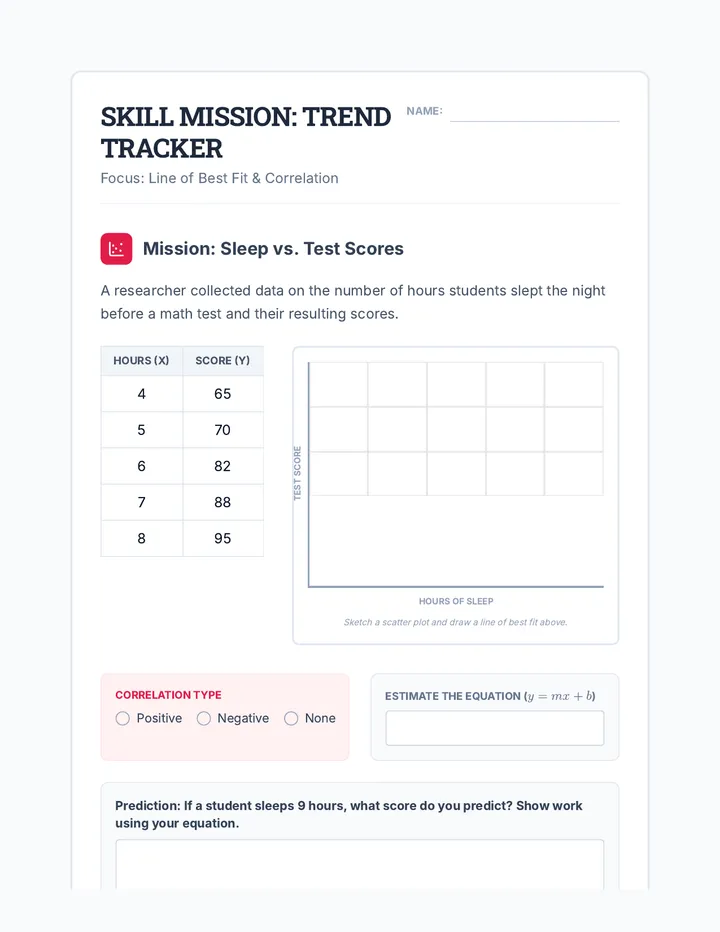
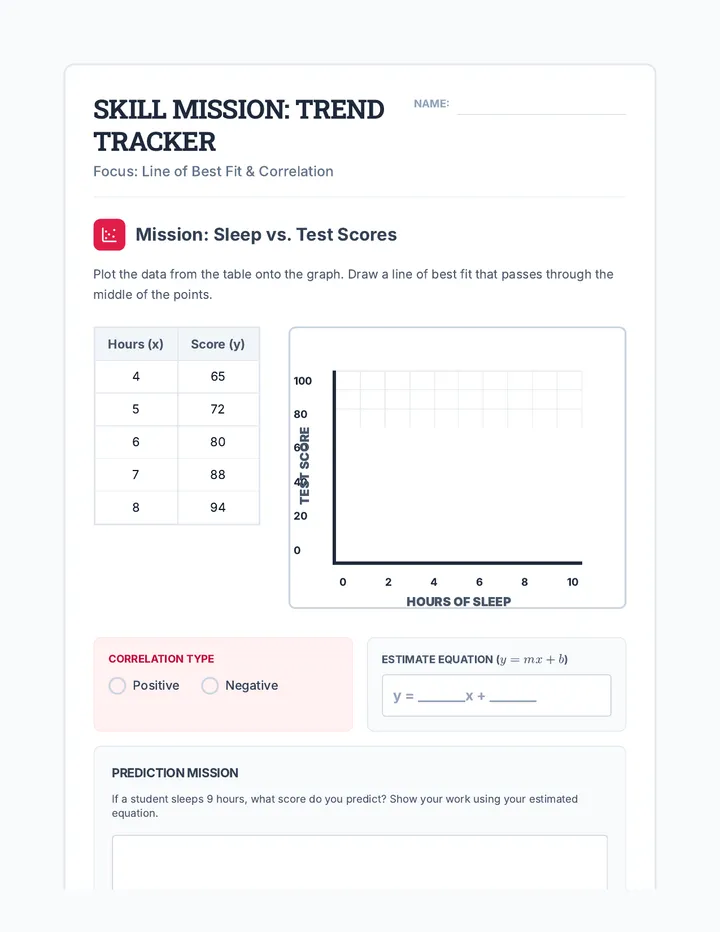
Students learn to plot bivariate data, identify trends, and spot outliers using a real-world scenario of sleep and mood.
A comprehensive guide to analyzing and graphing rational functions, covering all key features from asymptotes to holes.
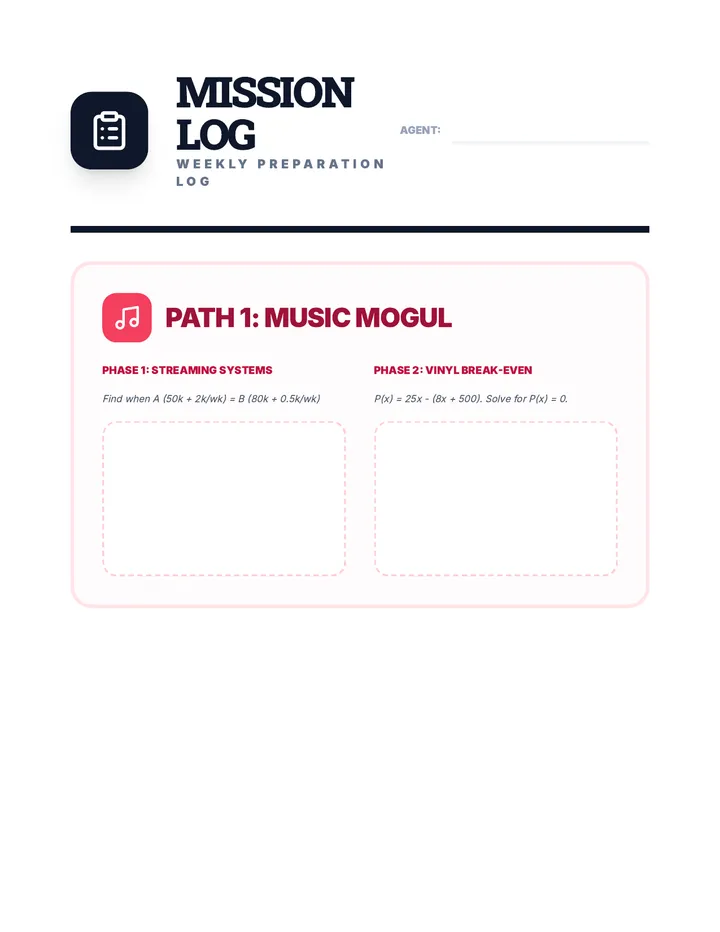
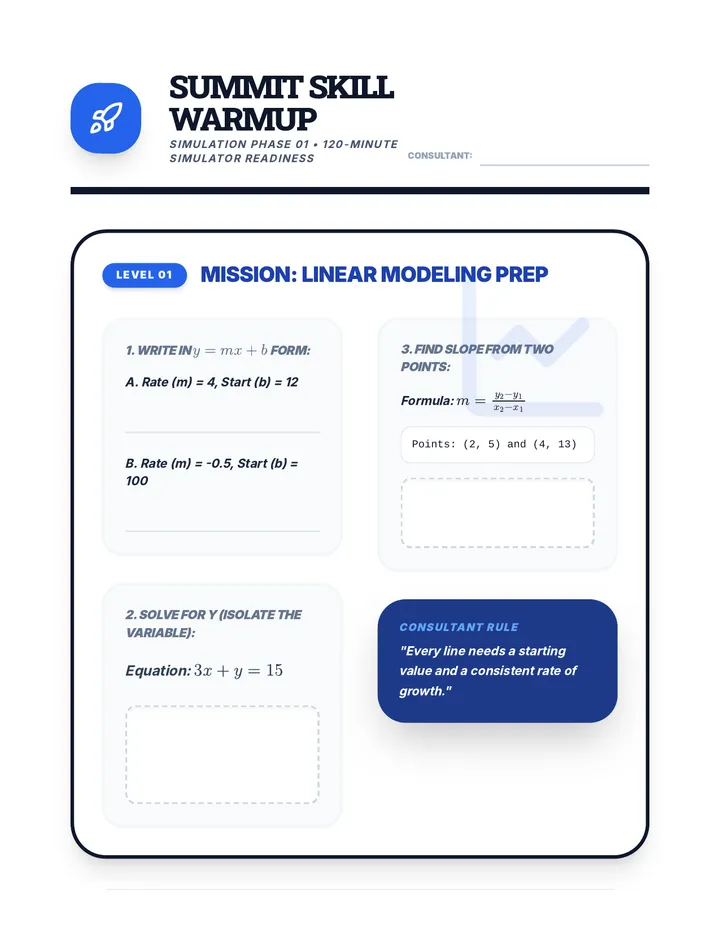
An advanced look at slope as a rate of change, including calculation from coordinates and understanding special cases like zero and undefined slopes.
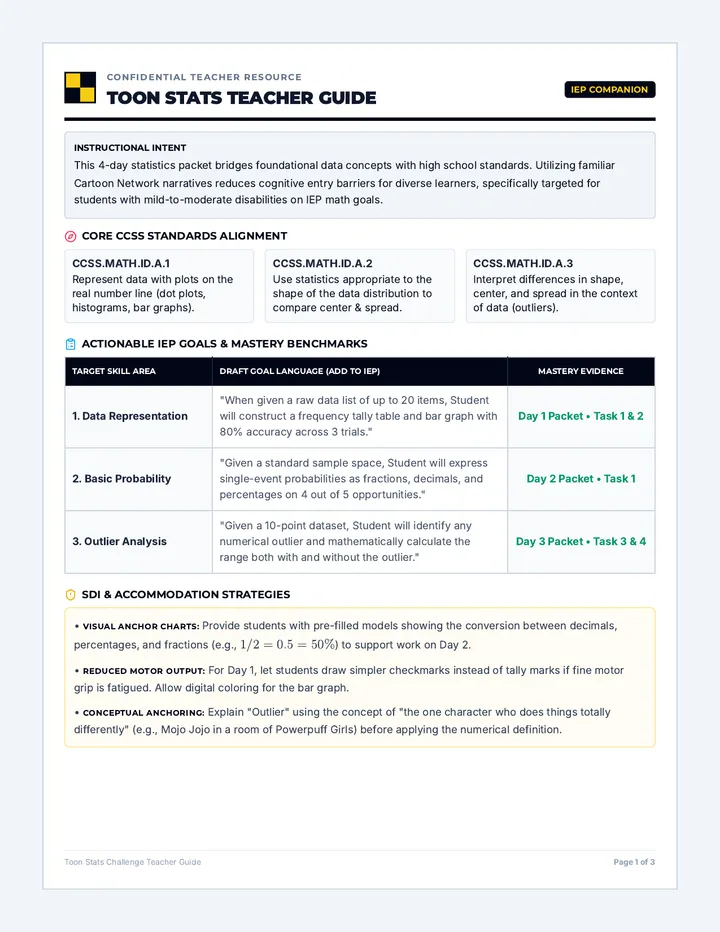
Advanced applications of central tendency and spread, including algebraic problem-solving, weighted means, and the mathematical impact of outliers for high school students.
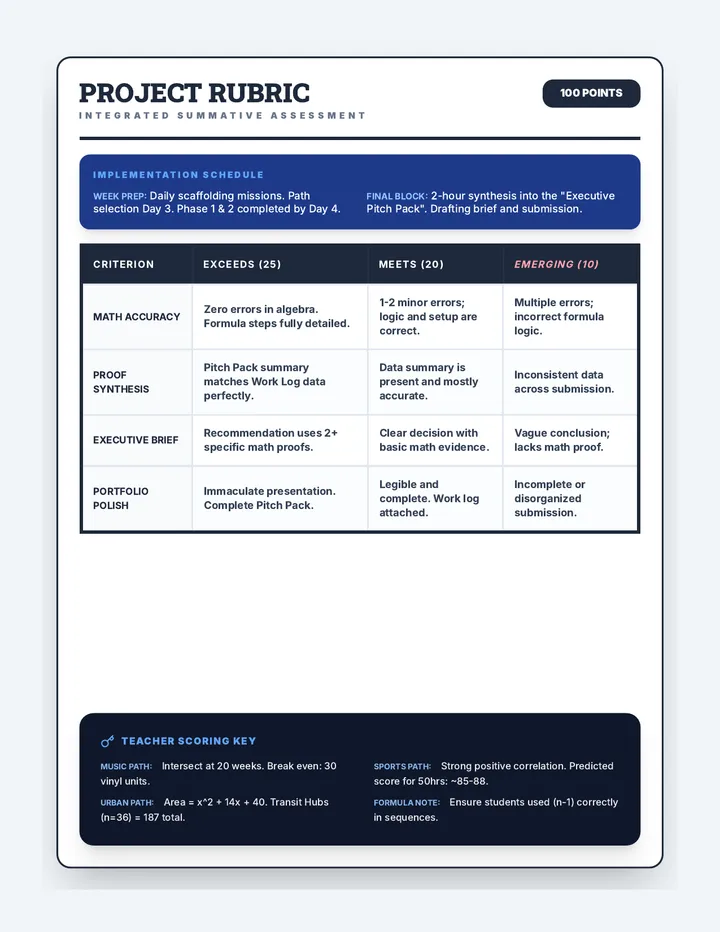
A comprehensive assessment covering Level 1, Level 2, and Level 3 data analysis, designed to evaluate mastery of mean, median, mode, and range in both numerical and narrative contexts.
Students interpret and solve word problems involving mean, median, mode, and range, focusing on extracting data from narrative contexts and real-world scenarios.
A foundational lesson designed for SIFE students to understand fractions greater than one using visual models and fraction strips. Focuses on bridging concrete models to number lines with minimal text reliance.
A collection of extra practice cases for mean, median, mode, and range, ranging from single-digit warmups to double-digit challenges, themed as unsolved detective files.
Students apply their knowledge of mean, median, mode, and range to data sets featuring two-digit numbers, focusing on multi-digit addition and division.
Students learn to calculate mean, median, mode, and range using single-digit data sets through structured, step-by-step guided practice and visual aids.
Review of symmetry concepts followed by a final challenge activity and a short assessment.
Identifying symmetry in everyday objects and nature, such as butterflies, leaves, and common household items.
Exploring symmetry in geometric shapes like squares, circles, and triangles, focusing on matching halves.
Introduction to the concept of symmetry and the 'line of symmetry' using mirror images and simple shapes.
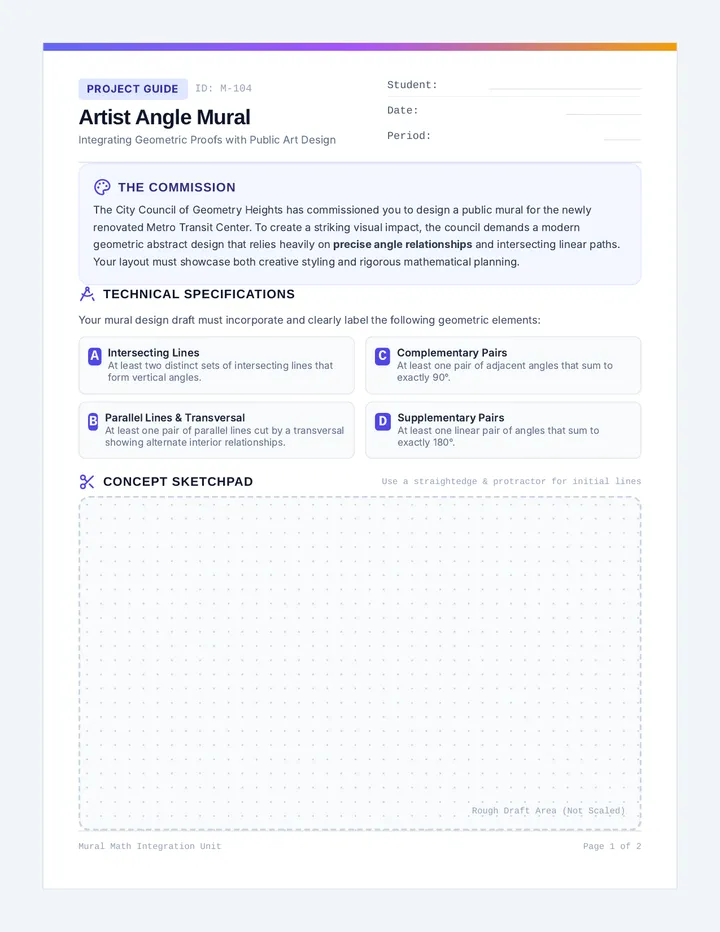
A lesson focused on the geometric and algebraic relationships of parallel and perpendicular lines, teaching students how to identify slopes and write new equations using a technical blueprint aesthetic.