Logic Lab Facilitator Guide Logic Lab Facilitator Guide
Topic: Quadratic Selection & Complex Solutions
Tier 2 Intervention
45 Minutes
Small Group (3-5 Students)
CO Standard HS.A-REI.B.4
Learning Objectives
Select the most efficient method (factoring, square roots, quadratic formula) based on equation structure.
Use the discriminant (\(b^2 - 4ac\)) to predict the nature of roots (real vs. complex).
Express complex solutions using the imaginary unit \(i\).
Pre-requisite Skills
Students should be familiar with the Quadratic Formula and basic factoring of trinomials. This lesson focuses on discrimination between methods rather than first-time instruction of the algorithms themselves.
Instructional Sequence
01
The "Why" (5 mins)
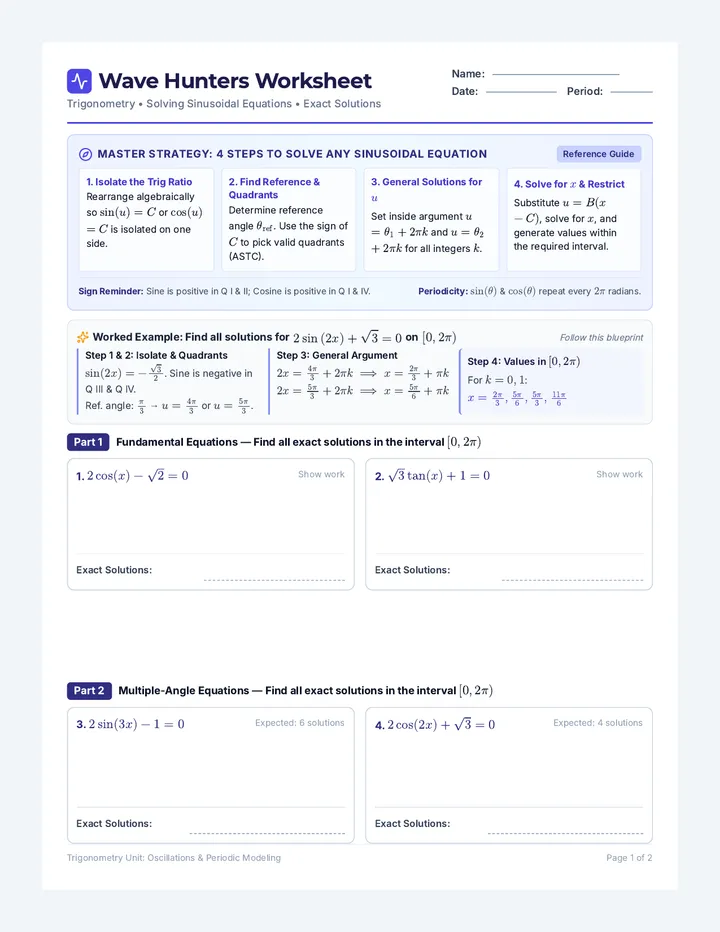
Present three different quadratics: \(x^2 - 9 = 0\), \(x^2 + 5x + 6 = 0\), and \(2x^2 - 3x + 7 = 0\). Ask: "If you had 2 minutes to solve all three, which would you do first and why?" Highlight that efficiency prevents errors.
02
The Blueprint (10 mins)
Distribute the Decision Blueprint . Model the decision-making process using "Think-Alouds." Specifically target the question: "Is \(b^2 - 4ac\) negative?" Introduce the concept of complex solutions as a "dead end" in the real number line that requires the \(i\) "bridge."
03
Sorting Solutions (15 mins)
Use the Complex Cases Worksheet . For the first 4 problems, do not solve yet. Have students only identify the best method and the value of the discriminant. Discuss why they chose each method.
04
The Mastery Exit (10 mins)
Students complete the Mastery Check independently. Facilitator uses the Intervention Tracker to note specific sticking points (e.g., struggling with the discriminant vs. factoring errors).
Support Strategies
Scaffolding for Struggling Learners
Provide a multiplication chart for factoring checks.
Use "Method Cards" that students can physically place on top of equations.
Focus solely on finding the discriminant value first before solving.
Common Misconceptions
Sign Errors: Losing the negative when calculating \(-4ac\).Over-Factoring: Trying to factor equations that have complex or irrational roots.Imaginary Unit: Forgetting to move the negative outside the radical as an \(i\). Decision Blueprint Handout Decision Blueprint
Quadratic Method Selection Guide
Name:
Date:
Standard Form: \(ax^2 + bx + c = 0\)
Is \(b = 0\)?
YES
Use Method: Square Roots
Isolate \(x^2\) and take the \(\pm\) root.
NO
Is it easily factorable?
YES
Use Method: Factoring
Zero Product Property.
NO
Is \(a=1\) and \(b\) even?
YES
Use Method: Completing the Square
NO
Use Method: Quadratic Formula
The "Stop & Check" Rule
Always calculate the Discriminant (\(D = b^2 - 4ac\)) before solving a difficult equation.
\(D > 0\)
2 Real Solutions
Graph crosses the x-axis twice.
\(D = 0\)
1 Real Solution
Vertex touches the x-axis.
\(D < 0\)
2 Complex Solutions
Roots involve \(i\). No x-intercepts.
Quadratic Quest Slides Logic Lab
Choosing Your Toolbox
Solving Quadratics Efficiently and Mastering Complex Solutions
Factoring Square Roots Quad Formula \(i\) Solutions
Efficiency Challenge
You have 30 seconds to solve this equation. Which method do you choose?
\(x^2 - 16 = 0\)
Factoring?
Square Roots?
Formula?
The "Pro" Choice
"Because \(b=0\), Square Roots is the fastest. If I factor, I have more steps. If I use the formula, I'm wasting time on arithmetic."
The Secret Weapon
The Discriminant
\(b^2 - 4ac\)
Positive
2 Real Roots
Zero
1 Real Root
Negative
2 Complex Roots
Enter the \(i\)
Complex Logistics
The Rule of \(i\)
Whenever you see a negative under the radical, pull it out as \(i\).
Example:
\(\sqrt{-25} \rightarrow \sqrt{25} \cdot \sqrt{-1} \rightarrow 5i\)
Practice Together
Simplify the result of the formula:
\(\frac{4 \pm \sqrt{-16}}{2}\)
\(2 \pm 2i\)
Logic Lab Protocol
1
Check \(b\). If it's zero, use Square Roots .
2
Try to Factor . (Quick mental check for \(ac\) factors that sum to \(b\)).
3
Calculate Discriminant . Negative? Use Quadratic Formula + \(i\).
You are ready for the Lab!
Complex Cases Worksheet Complex Cases Lab
Efficiency and Imaginary Solutions
Name:
Date:
Part 1: Strategic Sorting
Before solving, examine the structure. Choose the most efficient method and explain why.
\(x^2 - 49 = 0\)
Method
Reason
\(x^2 + 8x + 12 = 0\)
Method
Reason
\(3x^2 - 2x + 5 = 0\)
Method
Reason
Part 2: Complex Root Analysis
Problem 04: \(x^2 + 4 = 0\) Show Work
Solutions:
Problem 05: \(x^2 - 4x + 13 = 0\) Show Work
Solutions:
Self-Monitoring Question
Before you finished, did you pull out the \(i\) for every negative root?
Intervention Tracker Checklist Intervention Tracker
Quadratic Method Mastery & Complex Roots
Group ID:
Date:
Student Name Discriminant Analysis Strategic Method Selection Handling \(i\) Notation Algebraic Accuracy
|
|
|
| | | | | |
| | | | | |
| | | | | |
| | | | | |
Scale: Low ◦ Med ◦ High Mastery
Qualitative Observational Notes
Successes & Growth
Immediate Re-teaching Needs
Next Steps
Based on tracker data, which standard requires continued focus?
Quadratic Apps
Graphing Roots
Higher Degree Eq.
Mastery Check Exit Ticket Logic Lab Mastery Check
Exit Ticket • Quadratic Selection
Student Name
Date
1
Without solving, predict the nature of the roots for:
\(x^2 - 4x + 7 = 0\)
Two Real Solutions
One Real Solution
Two Complex Solutions
2
Which method is most efficient for \(x^2 = -36\)? Solve it below.
Factoring
Sq. Roots
Quad Formula
Self-Assessment
I'm lost
I've got it!