Menagerie Measurements Teacher Guide Menagerie Measurements
The Great Animal Weigh-In: Teacher Guide
Grades 2 & 4
Learning Objectives
Grade 2: Estimate and measure mass using grams (g) and kilograms (kg). Compare the mass of two or more objects.
Grade 4: Convert between grams and kilograms. Solve multi-step word problems involving animal mass and habitat capacity.
Essential Question
"How do we use measurement and conversion to ensure every animal gets the right transport habitat?"
Materials Needed
Menagerie Slides
Habitat Hauler Activity
Weigh-In Worksheets
Classroom scales
Instructional Flow
1
The Hook: The Zoo Dispatch (10 mins)
Display the first slide. A new shipment of animals has arrived, but the labels are smudged! Students must use their math skills to identify the mass and assign the correct "Habitat Hauler" truck based on weight limits.
Prompt: "Why is it dangerous to put a 5,000kg elephant in a truck meant for 500kg?"
2
Direct Instruction: Grams vs. Kilograms (15 mins)
Use the slide deck to introduce mass units. Grade 2: Focus on benchmark objects (1g = paperclip, 1kg = pineapple). Grade 4: Introduce the conversion rule (1 kg = 1,000 g). Practice multiplying and dividing by 1,000.
3
Guided Practice: Habitat Haulers (20 mins)
Distribute the Habitat Hauler Sorting Activity . Students work in pairs to match animal mass cards to the correct truck. Differentiation: Grade 2 matches weights directly. Grade 4 must convert mixed units (e.g., 2.5kg to 2,500g) to find the match.
4
Independent Work & Assessment (15 mins)
Students complete the Weigh-In Worksheet individually. Use the Zoologist Quiz as an exit ticket or summative assessment for the lesson.
Pro-Zoologist Tips
Common Misconception: Students often think larger volume always means larger mass. Remind them that a giant balloon weighs less than a small rock.
Vocabulary: Emphasize "Mass" instead of "Weight" for scientific accuracy, though they are often used interchangeably in 2nd grade math.
Menagerie Measurements Slides Menagerie Measurements
The Great Animal Weigh-In
Calling all Junior Zoologists: Transport Mission Ready!
The Mission
The Menagerie Express has just arrived with 5 new animals.
We must weigh them and choose the Safe Habitat Haulers for their journey.
Mission Goal:
Precise Mass Matching!
Measuring Mass
Gram (g)
Grams are for
Small things.
A Hummingbird (4g)
Kilogram (kg)
Kilograms are for
Big things.
A Large Dictionary (1kg)
Advanced Zoologist Lab
The 1,000 Rule
1 kg
1,000 g
To find Grams (kg → g)
× 1,000
To find Kilograms (g → kg)
÷ 1,000
Time to Sort!
Grab your Habitat Hauler Cards. Match the animal mass to the correct transport truck!
Grade 2: Estimate
Grade 4: Convert
Habitat Hauler Sorting Activity Habitat Hauler Sorting
Instruction: Place the Animal Cards onto the correct Transport Truck based on their mass.
Zoologist Name: _____________________
Date: _____________________
Truck A: Tiny Travelers
CAPACITY: 1g — 500g
Drop Zone for Gram (g) Cards
Truck B: Heavy Haulers
CAPACITY: 1kg — 50kg
Drop Zone for Kilogram (kg) Cards
✂️ Animal Inventory Cards (Cut These) ✂️
Hummingbird
4 g
Lightweight flyer
Golden Retriever
30 kg
Large Mammal
Hercules Beetle
120 g
Heavy insect
African Serval
Grade 4: Convert!
15,000 g
Hunter
Field Mouse
20 g
Tiny mammal
European Eel
Grade 4: Convert!
0.5 kg
Swimmer
Weigh-In Worksheet Weigh-In Worksheet
Official Zoologist Data Log
NAME:
DATE:
Section 1: Massive Estimates
Desert Rabbit
2 g 2 kg
Garden Snail
25 g 25 kg
Baby Elephant
100 g 100 kg
Honey Bee
1 g 1 kg
Section 2: Conversion Lab
Field Challenge
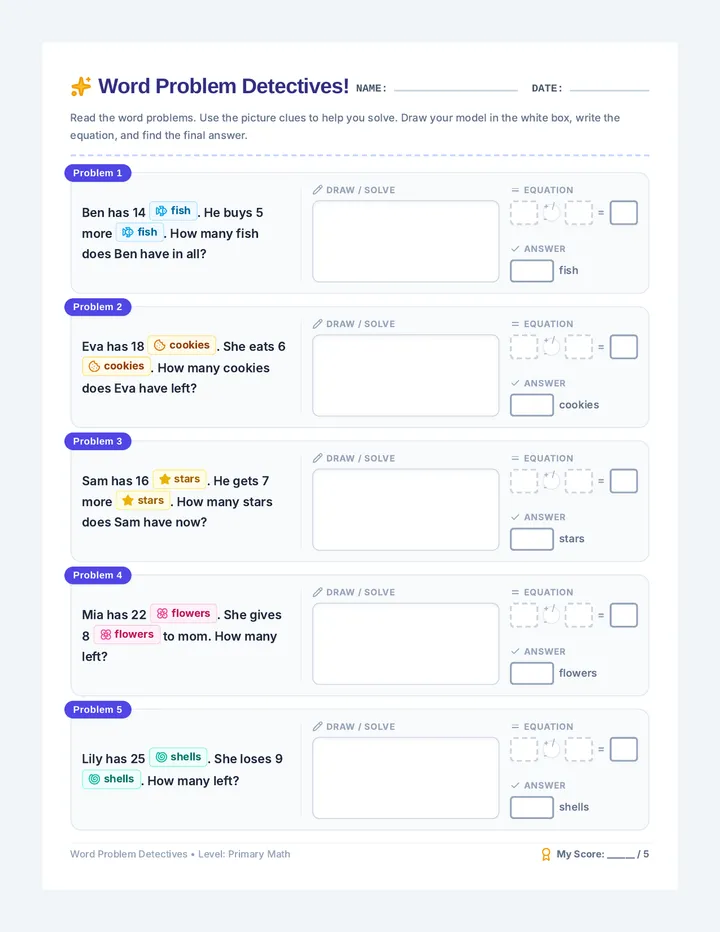
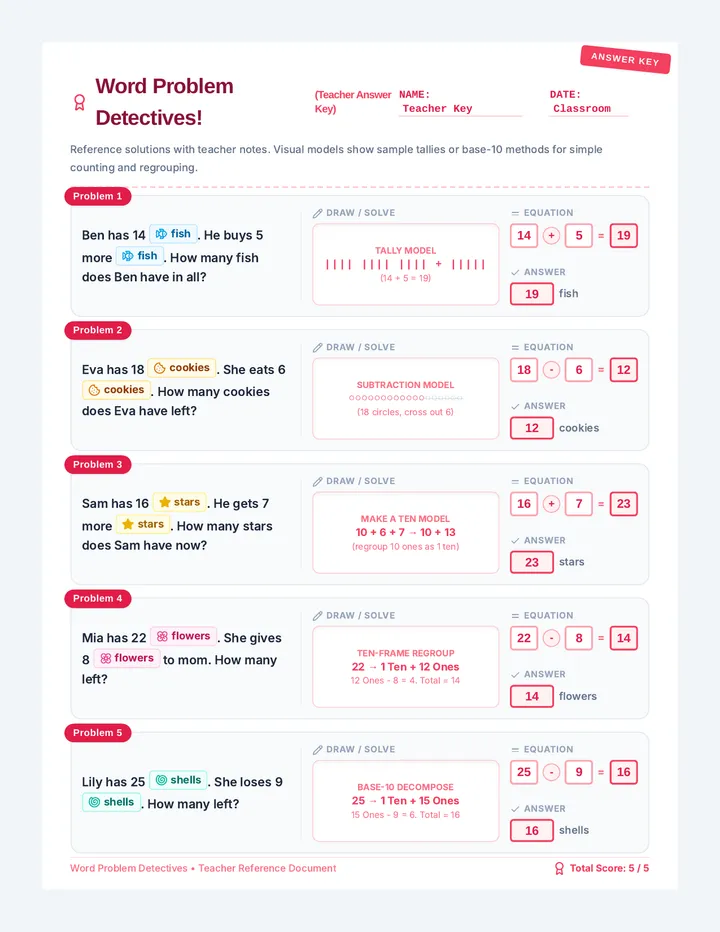
A crate has a 2kg Fox and a 1,500g Hare. What is the total mass in grams?
Total: ________ g
Section 3: Comparisons & Bonus
500 g Gecko
1 kg Parrot
2,000 g Red Panda
2 kg Penguin
Bonus: Design-a-Dose
Dose is 5g per 1kg weight. How many grams for a 4kg Sloth?
Answer: ____ g
Zoologist Quiz Zoologist Certification Quiz
Evaluation for the Great Animal Weigh-In Mission
NAME: __________________________ SCORE: ________ / 10
Part 1: Unit Selection
1. Which unit would you use to measure the mass of an African Elephant?
A) Grams (g)
B) Kilograms (kg)
C) Milliliters (mL)
D) Centimeters (cm)
2. How many grams (g) are in one kilogram (kg)?
A) 10
B) 100
C) 1,000
D) 10,000
Part 2: Calculations
3. A Snowy Owl has a mass of 2,400 grams. How many kilograms is this?
Show your work below:
Answer: ________________ kg
4. Can a 5kg truck safely carry a 3kg Koala and a 2,500g Tree Kangaroo?
Circle One & Explain Why:
YES NO
Part 3: Zoologist Reflection
5. Draw one animal that you think weighs about 10 grams and one animal that weighs about 10 kilograms. Explain your thinking.
Target: 10 Grams
Target: 10 Kilograms
Reasoning Area:
Zoologist Answer Key Answer Key
Zoologist Certification Quiz & Worksheet Reference
TEACHER USE ONLY
Quiz Answers
B) Kilograms (kg)
C) 1,000
2.4 kg (Calculation: 2,400 g ÷ 1,000 = 2.4 kg)
4. NO. 3 kg (Koala) + 2.5 kg (Kangaroo) = 5.5 kg. This exceeds the 5 kg limit.
5. Variable. Expect tiny birds/insects for 10g; medium dogs/cats for 10kg.
Worksheet Reference
Section 1: Estimates
Rabbit: 2kg | Snail: 25g | Baby Elephant: 100kg | Honey Bee: 1g
Section 2: Table
8kg = 8,000g | 12kg = 12,000g | 4kg = 4,000g
Field Challenge
2,000g (Fox) + 1,500g (Hare) = 3,500g
Bonus Challenge
5g/kg × 4kg = 20g medicine
Section 3: Comparisons
500g < 1kg | 2,000g = 2kg