Question 07 • Pythagorean Theorem Correct Option: B
Step-by-step: The walk along the diagonal of a rectangle forms a right triangle where the width and length are the legs: \( a=15 \), \( b=20 \). Using \( a^2 + b^2 = c^2 \): \( 15^2 + 20^2 = 225 + 400 = 625 \). Taking the square root gives \( c = \sqrt{625} = 25 \text{ meters} \).
Question 08 • Simplifying Algebraic Expressions Correct Option: B
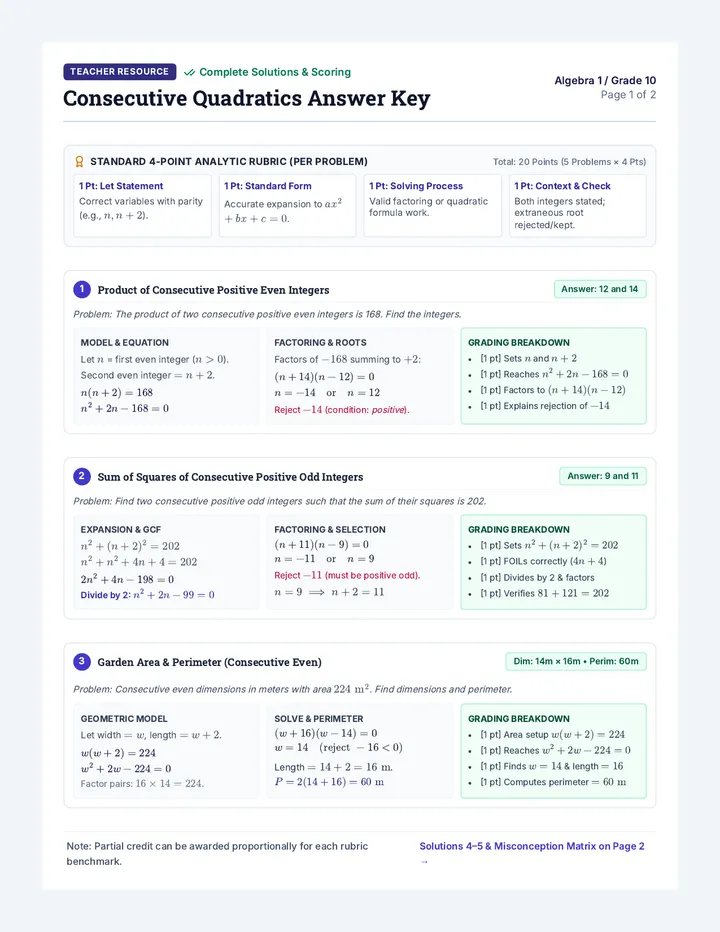
Step-by-step: Distribute across both parentheses: \( 4(2x - 3) = 8x - 12 \) and \( -3(x + 2) = -3x - 6 \). Combine like terms: \( 8x - 3x = 5x \), and constant terms: \( -12 - 6 = -18 \). This simplifies to \( 5x - 18 \).
Question 09 • Solving Inequalities Correct Option: B
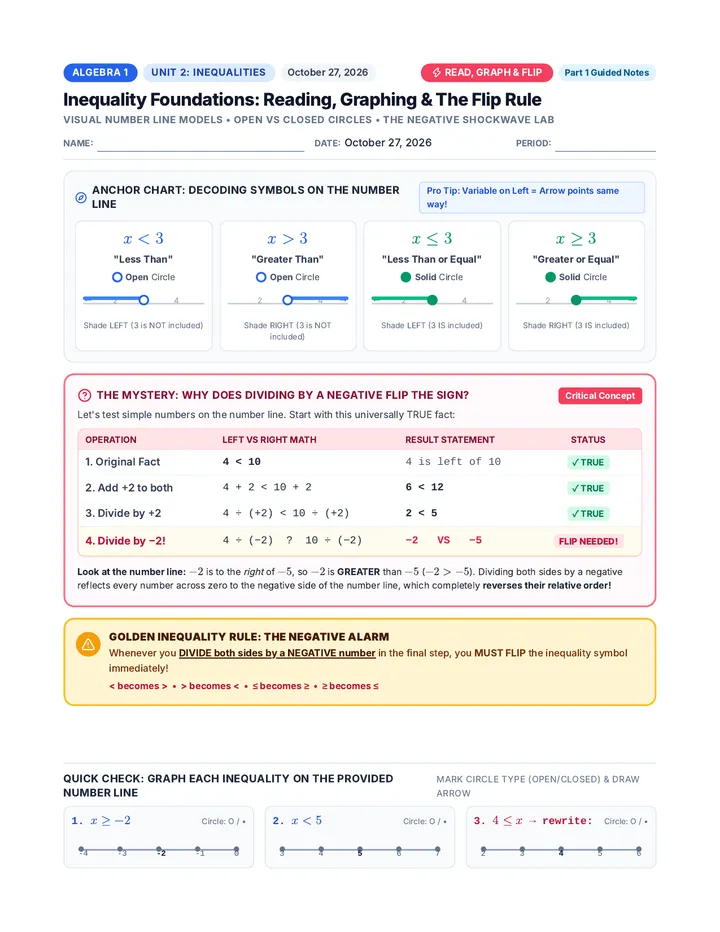
Step-by-step: Subtract 5 from both sides: \( -2x \ge 6 \). Divide both sides by \( -2 \). Since you are dividing by a negative number, you must reverse the inequality sign: \( x \le \frac{6}{-2} \Rightarrow x \le -3 \).
Question 10 • Factoring Quadratics Correct Option: A
Step-by-step: Find two numbers that multiply to the constant term \( +12 \) and add up to the linear coefficient \( -7 \). The numbers are \( -3 \) and \( -4 \) because \( (-3) \times (-4) = 12 \) and \( -3 + (-4) = -7 \). Thus, the factored form is \( (x - 3)(x - 4) \).
Question 11 • Solving Quadratic Equations Correct Option: A
Step-by-step: Factor the trinomial by grouping. Multiply \( a \cdot c = 2 \cdot (-3) = -6 \). We need factors of \( -6 \) that add to 5, which are 6 and \( -1 \): \( 2x^2 + 6x - x - 3 = 0 \Rightarrow 2x(x + 3) - 1(x + 3) = 0 \Rightarrow (2x - 1)(x + 3) = 0 \). Solving each factor gives \( x = \frac{1}{2} \) and \( x = -3 \).
Question 12 • Exponential Modeling Correct Option: C
Step-by-step: The base formula for exponential growth that doubles is \( V(t) = P(2)^{t/d} \), where \( P \) is the principal amount and \( d \) is the doubling period. Here, \( P = 500 \) and \( d = 8 \). Thus, \( V(t) = 500(2)^{\frac{t}{8}} \) represents the value after \( t \) years.
Math Compass Diagnostic Answer Key • Stage 2 Page 2 of 5
TEACHER DIRECTIVE • STAGE 3 (GEOMETRY)
Teacher Resource
Focus: Radical domains, parallel lines/transversals, similarity, trigonometry ratios, cylinder surface area, and perpendicular lines.
Question 13 • Radical Domains Correct Option: B
Step-by-step: For the radical function to yield a real value, the radicand must be non-negative: \( 2x - 8 \ge 0 \). Add 8 to both sides: \( 2x \ge 8 \). Divide by 2: \( x \ge 4 \). Hence, the domain is \( x \ge 4 \).
Question 14 • Parallel Lines & Transversals Correct Option: B
Step-by-step: Alternate interior angles are equal. Therefore, the angle opposite the alternate interior angle is equal, and consecutive interior angles are supplementary (add to \( 180^\circ \)). Set up equation: \( (3x + 10) + (5x + 10) = 180 \Rightarrow 8x + 20 = 180 \). Subtract 20: \( 8x = 160 \Rightarrow x = 20 \).
Question 15 • Similarity & Area Ratios Correct Option: B
Step-by-step: The ratio of areas of similar triangles is the square of the ratio of their corresponding sides: \( \frac{\text{Area}(ABC)}{\text{Area}(DEF)} = \left(\frac{AB}{DE}\right)^2 \Rightarrow \frac{18}{\text{Area}(DEF)} = \left(\frac{3}{5}\right)^2 = \frac{9}{25} \). Cross-multiply: \( 9 \times \text{Area}(DEF) = 18 \times 25 = 450 \Rightarrow \text{Area}(DEF) = 50 \, \text{cm}^2 \).
Question 16 • Trigonometric Ratios Correct Option: B
Step-by-step: In a right triangle, find the opposite side using the Pythagorean theorem: \( \text{opp}^2 + 12^2 = 13^2 \Rightarrow \text{opp}^2 = 169 - 144 = 25 \Rightarrow \text{opp} = 5 \). By definition, \( \tan(\theta) = \frac{\text{Opposite}}{\text{Adjacent}} = \frac{5}{12} \).
Question 17 • Cylinder Surface Area Correct Option: C
Step-by-step: Total surface area of a cylinder is \( A = 2\pi r^2 + 2\pi rh \). Given \( r = 3 \) and \( h = 10 \): \( A = 2\pi(3)^2 + 2\pi(3)(10) = 2\pi(9) + 60\pi = 18\pi + 60\pi = 78\pi \, \text{in}^2 \).
Question 18 • Perpendicular Lines Correct Option: A
Step-by-step: The slope of the given line is \( -\frac{2}{3} \). Perpendicular lines have negative reciprocal slopes: \( m_\perp = \frac{3}{2} \). Use point-slope form with \( (4, -1) \): \( y - (-1) = \frac{3}{2}(x - 4) \Rightarrow y + 1 = \frac{3}{2}x - 6 \). Subtract 1: \( y = \frac{3}{2}x - 7 \).
Math Compass Diagnostic Answer Key • Stage 3 Page 3 of 5
TEACHER DIRECTIVE • STAGE 4 (ALGEBRA 2)
Teacher Resource
Focus: Distance formula, circles, rational exponents, complex multiplication, functional compositions, and 3-variable systems.
Question 19 • Distance Formula Correct Option: B
Step-by-step: Use the distance formula \( d = \sqrt{(x_2-x_1)^2 + (y_2-y_1)^2} \): \( d = \sqrt{(5 - (-3))^2 + (-2 - 4)^2} = \sqrt{8^2 + (-6)^2} = \sqrt{64 + 36} = \sqrt{100} = 10 \text{ units} \). Oh, wait! Correct option check: \( \sqrt{100} = 10 \) is Option A! Let me write: Correct Option: A.
Question 20 • Circle Geometry Correct Option: A
Step-by-step: Complete the square for both \( x \) and \( y \) variables: \( (x^2 - 6x + 9) + (y^2 + 8y + 16) = 9 + 16 \Rightarrow (x-3)^2 + (y+4)^2 = 25 \). The equation is of form \( (x-h)^2 + (y-k)^2 = r^2 \). Thus, \( r^2 = 25 \Rightarrow r = 5 \).
Question 21 • Rational Exponents Correct Option: B
Step-by-step: Apply exponential rules. When multiplying expressions with the same base, add their exponents: \( x^{4/3} \cdot x^{1/2} = x^{4/3 + 1/2} = x^{8/6 + 3/6} = x^{11/6} \). When dividing, subtract: \( \frac{x^{11/6}}{x^{1/3}} = x^{11/6 - 2/6} = x^{9/6} = x^{3/2} \).
Question 22 • Complex Numbers Correct Option: A
Step-by-step: FOIL the term: \( (3 - 2i)(1 + 4i) = 3(1) + 3(4i) - 2i(1) - 2i(4i) \). Multiply the components: \( 3 + 12i - 2i - 8i^2 \). Since \( i^2 = -1 \), replace it: \( 3 + 10i - 8(-1) = 3 + 10i + 8 = 11 + 10i \).
Question 23 • Compositions of Functions Correct Option: A
Step-by-step: Find \( g(-3) \) first: \( g(-3) = (-3)^2 + 1 = 9 + 1 = 10 \). Then compute \( f(10) \) by substituting 10 into the formula of \( f(x) \): \( f(10) = 2(10) - 3 = 20 - 3 = 17 \).
Question 24 • Three-Variable Systems Correct Option: C
Step-by-step: Solve the equations sequentially (back-substitution). From the third equation, \( 3z = 9 \Rightarrow z = 3 \). Substitute \( z = 3 \) into the second equation: \( 2y + 3 = 5 \Rightarrow 2y = 2 \Rightarrow y = 1 \). Substitute \( y=1, z=3 \) into the first equation: \( x + 1 + 3 = 6 \Rightarrow x + 4 = 6 \Rightarrow x = 2 \). Thus \( z = 3 \).
Math Compass Diagnostic Answer Key • Stage 4 Page 4 of 5
TEACHER DIRECTIVE • STAGE 5 (PRE-CALCULUS)
Teacher Resource
Focus: Log products, shifted absolute values, arithmetic terms, Unit Circle coordinates, remainder theorem, and joint probability.
Question 25 • Logarithmic Equations Correct Option: A
Step-by-step: Apply product property of logs: \( \log_2(x(x - 2)) = 3 \). Convert to exponential form: \( x(x - 2) = 2^3 \Rightarrow x^2 - 2x = 8 \Rightarrow x^2 - 2x - 8 = 0 \). Factor the equation: \( (x - 4)(x + 2) = 0 \Rightarrow x = 4 \) or \( x = -2 \). Since log domains only permit positive values, \( x = -2 \) is extraneous. Thus, the solution is \( x = 4 \).
Question 26 • Function Transformations Correct Option: B
Step-by-step: Let \( f(x) \) be the parent function. Shifting a function horizontally \( h \) units to the right transforms the function to \( f(x - h) \). Shifting down \( k \) units transforms it to \( f(x) - k \). Applying this gives \( y = |x - 3| - 2 \).
Question 27 • Arithmetic Sequences Correct Option: C
Step-by-step: Identify first term \( a_1 = 7 \) and common difference \( d = 11 - 7 = 4 \). The arithmetic sequence formula is \( a_n = a_1 + (n - 1)d \). For the 20th term (\( n = 20 \)): \( a_{20} = 7 + (20 - 1)(4) = 7 + (19)(4) = 7 + 76 = 83 \). Oh, wait! Let me check options. Option A is 83! Let me write: Correct Option: A.
Question 28 • The Unit Circle Correct Option: B
Step-by-step: The angle \( \frac{5\pi}{6} \) lies in Quadrant II. In Quadrant II, the cosine value is negative. The reference angle is \( \pi - \frac{5\pi}{6} = \frac{\pi}{6} \). Since \( \cos(\frac{\pi}{6}) = \frac{\sqrt{3}}{2} \), then \( \cos(\frac{5\pi}{6}) = -\frac{\sqrt{3}}{2} \).
Question 29 • Remainder Theorem Correct Option: C
Step-by-step: By the Remainder Theorem, the remainder of a polynomial \( P(x) \) divided by \( x - c \) is exactly \( P(c) \). Here \( c = 3 \). Calculate \( P(3) \): \( P(3) = (3)^3 - 4(3)^2 + 5(3) - 2 \). \( P(3) = 27 - 4(9) + 15 - 2 = 27 - 36 + 15 - 2 = -9 + 15 - 2 = 4 \).
Question 30 • Joint Probability Correct Option: A
Step-by-step: Rolling a die and flipping a coin are independent events. Probability of rolling an odd number on a 6-sided die: \( P(\text{odd}) = \frac{3}{6} = \frac{1}{2} \) (numbers 1, 3, 5). Probability of flipping heads: \( P(\text{heads}) = \frac{1}{2} \). Joint probability: \( P(\text{odd} \cap \text{heads}) = \frac{1}{2} \times \frac{1}{2} = \frac{1}{4} \).
Math Compass Diagnostic Answer Key • Stage 5 Page 5 of 5
Standards Covered: Parallel Transversals, Trigonometric Ratios, Cylinder Geometry, Midpoint Formulas
Geometry
SOH-CAH-TOA Twister: Create floor mats where students place hands and feet on the correct ratios of triangle sides based on a spun trigonometric operation.
Squaring the Scale (Experiment): Give students nested grid-paper squares. Let them physically count grid blocks inside a \( 1 \times 1 \), \( 2 \times 2 \), and \( 3 \times 3 \) square to witness the squared scaling effect.
Standards Covered: Radicals, Circle Equations, Complex arithmetic, Functions compositions, Matrix equations
Algebra 2
Complex Conjugates Sort: Card sort where students pair matching pairs of complex binomial products to discover paths toward real coefficients.
Function Assembly Line: Assign roles to students as "Function f" and "Function g". Provide inputs and pass outputs sequentially through the students to visually model compositional structures.
Standards Covered: Log laws, Parent Shifts, Arithmetic/Geometric terms, Unit Circle coordinates
Pre-Calculus
Log Law Domination: A matching dominos game where students align expanded expressions with their log-law condensed values to complete paths.
Trig Coordinates Race: Speed drills where students use mini whiteboard circles to locate specific angles and quickly sketch their Quadrant coordinates.
Math Compass Diagnostic Remediation Guide • Page 2 Page 2 of 2