Local Linearity Slides Local Linearity
The Best Linear Approximation
AP Calculus AB/BC
Today's Mission
Objective
Conceptualize the tangent line as the "best linear approximation" of a curve at a point.
Agenda
1 The Skipping Stone (Warm-up)
2 Video: Defining Tangents
3 Activity: The Great Zoom
4 Reflection Journal
The Skipping Stone
"Like a rock skipping across a lake without going under the surface."
How does this analogy describe a line that is "tangent" to a curve?
3-Minute Partner Chat
Defining Tangent Lines
Watch the clip below (4:40 - 5:38)
Embedded media
Watch For:
• Point of tangency
• "Touching" vs "Crossing"
• Approximating behavior
The Power of Zooming
\( \cup \)
Standard View
Clearly curved parabola.
10x Zoom
\( \smile \)
Intermediate
Curvature starts to fade.
1000x Zoom
\( / \)
Local Linearity
The curve IS a line.
"At a small enough scale, every smooth curve is indistinguishable from its tangent line."
The Great Zoom
25 Minutes
1
Open your graphing software (Desmos/GeoGebra) and graph the assigned function.
2
Zoom into the specific point until the curve appears to be a perfectly straight line .
3
Pick two points on this "line" to calculate a visual slope .
The Challenge
Compare your visual slope to the Calculus Slope calculated using the limit of the difference quotient:
\[ m = \lim_{x \to a} \frac{f(x) - f(a)}{x - a} \]
Reflection Journal
Complete these in your digital/physical journal.
Q1
Why is a straight line a "good" approximation for a curved function? What happened when you zoomed in?
Q2
When might this linear approximation fail? Think of "pointy" graphs or graphs with breaks.
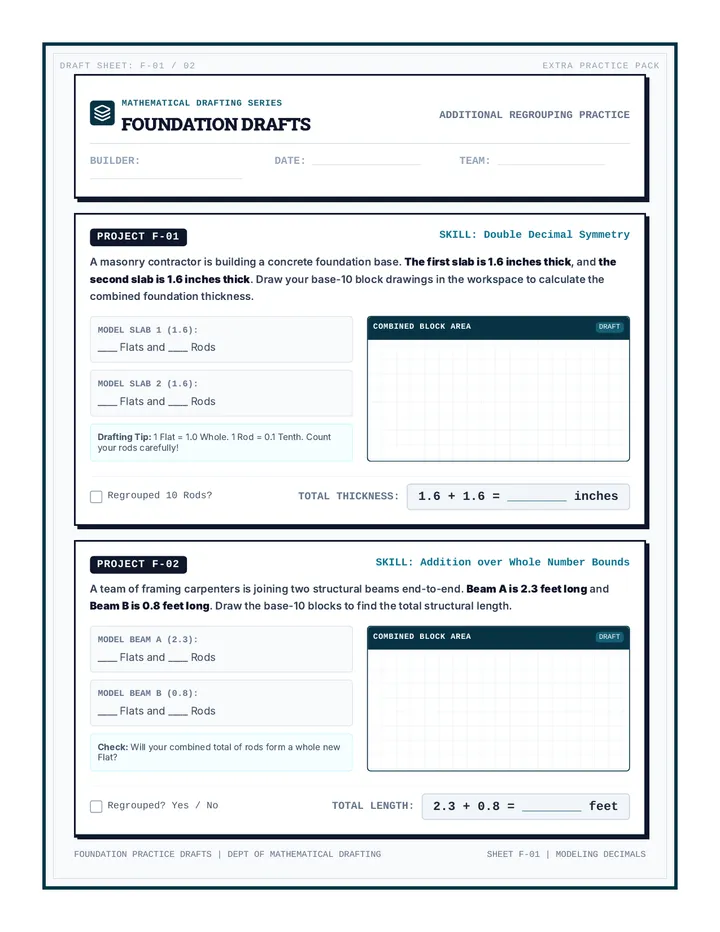
The Great Zoom Worksheet The Great Zoom
AP Calculus: Investigating Local Linearity
Name:
Date:
The Concept
"At a small enough scale, every smooth curve is indistinguishable from its tangent line." Today, we test this theory by magnifying curves until they appear linear, then comparing our visual data to formal calculus calculations.
Protocol
Graph the assigned function \( f(x) \) in your software.
Center the viewport on the target point \( a \).
Zoom in repeatedly until the curve appears to be a perfectly straight line .
Identify two points on this magnified "line" to find the Visual Slope .
Use the limit definition to find the Calculus Slope .
Formula Box
Limit Definition of Slope
\[ m = \lim_{x \to a} \frac{f(x) - f(a)}{x - a} \]
Slope Formula (2 Points)
\[ m_{visual} = \frac{y_2 - y_1}{x_2 - x_1} \]
Investigation Log
Function & Point Visual Calculation Calculus Calculation Visual vs. Actual Trial 1
\( f(x) = 0.25x^2 \)
at \( a = 4 \)
|
\( m_{vis} = \) _________
|
\( m_{calc} = \) _________
| Does the zoom view perfectly match the calculus? How close was your approximation?
|
|
Trial 2
\( g(x) = \sin(x) \)
at \( a = 0 \)
|
\( m_{vis} = \) _________
|
\( m_{calc} = \) _________
| Compare your zoom level here to Trial 1. Did you have to zoom "further"?
|
The "Zoom-In" Sketch
Pick one of your trials. Sketch what the curve looked like before zooming and after zooming.
Natural View
Magnified View (Local Linearity)
Calculus Reflection Journal Prompts AP Calculus AB/BC
Reflection Journal
Topic 2.1: Local Linearity
Student Name
Date
1
Why is a straight line considered a "good" approximation for a curved function? Describe what happened to the curvature during the "Great Zoom" activity.
2
When might this linear approximation fail? Consider types of functions or specific points where "zooming in" would not eventually produce a straight line.
Calculus Reflection Log
"The tangent line is the best linear approximation."
Best Linear Approximation Teacher Guide Best Linear Approximation
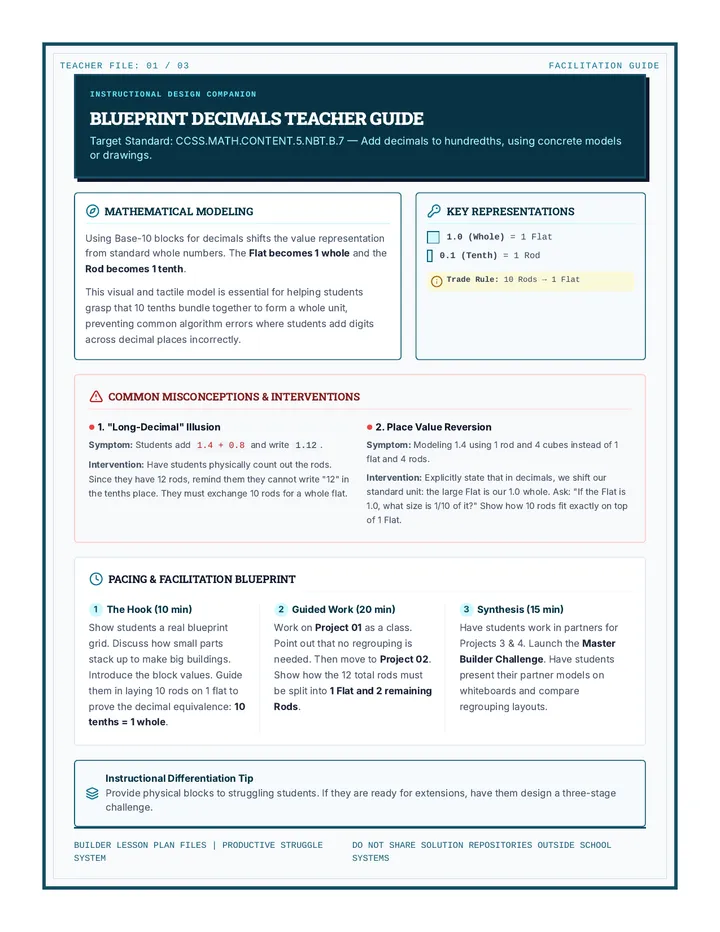
Teacher Facilitation Guide
Lesson Duration: 45-50 Min
Lesson Goal
This lesson bridge the gap between algebraic slope and calculus-based tangents. By the end of this session, students should intuitively understand that for differentiable functions, a curve can be "linearized" at any point.
Key Vocabulary
Local Linearity Tangent Line Linear Approximation Differentiability
Materials Needed
Laptops/Tablets
Desmos / GeoGebra
Zoom Worksheets
Reflection Journals
Instructional Flow
5 Min
Warm-up: The Skipping Stone
Display the quote from the video. Ask: "If a line touches a curve at one point and doesn't 'go under,' what can we say about the slope of that line relative to the curve?" Teacher Tip: Clarify that while the line doesn't cross *at that point*, it can cross elsewhere.
5 Min
Video Viewing (4:40 - 5:38)
Focus on the visual transition from secant to tangent. Pause at 5:30 to discuss why "zooming in" is the key to approximation.
25 Min
Main Activity: The Great Zoom
Students use Desmos. Probing Question: "As you zoom in, does the function *become* a line, or does it just *look* like one? Why does this matter?"
Calculus Slope Solutions (For Table)
Trial 1: \( m = \lim_{x \to 4} \frac{0.25x^2 - 4}{x-4} = 2 \)
Trial 2: \( m = \lim_{x \to 0} \frac{\sin(x) - \sin(0)}{x-0} = 1 \)
10 Min
Closure: Reflection
Guide students toward identifying sharp turns (like \( |x| \) at \( x=0 \)) or discontinuities as points where local linearity fails.
Anticipating Pitfalls
"The line is the curve."
Students may think that zooming in actually changes the nature of the function. Reinforce that the tangent line is an approximation that gets better as the interval gets smaller.
Zooming in on Sharp Points
Students might try to zoom in on a cusp or corner. Explain that no matter how far you zoom, a "pointy" part will never look like a single straight line.