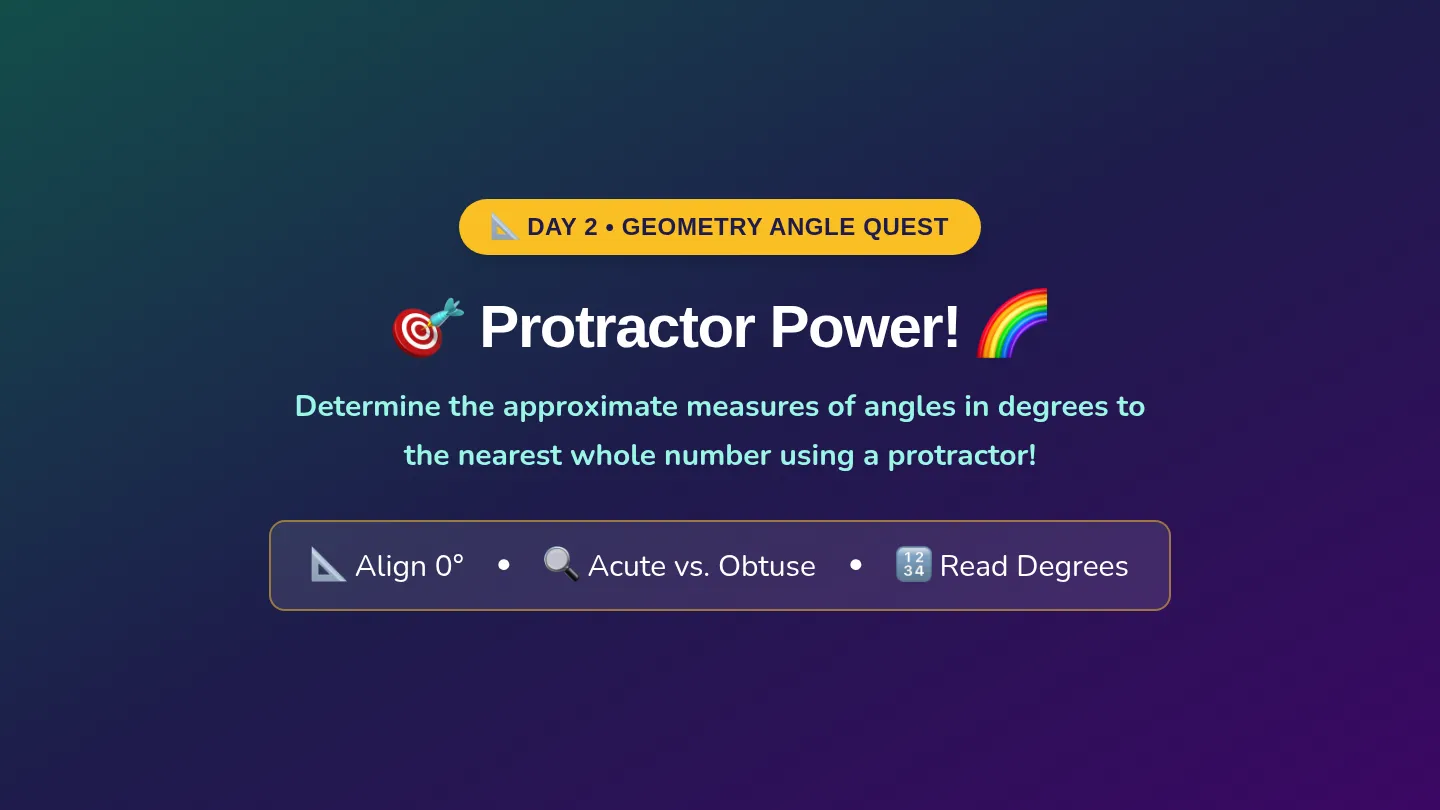
Factor vs Multiple Slides MATH WORKSHOP
Grades 4–5 • Number Sense
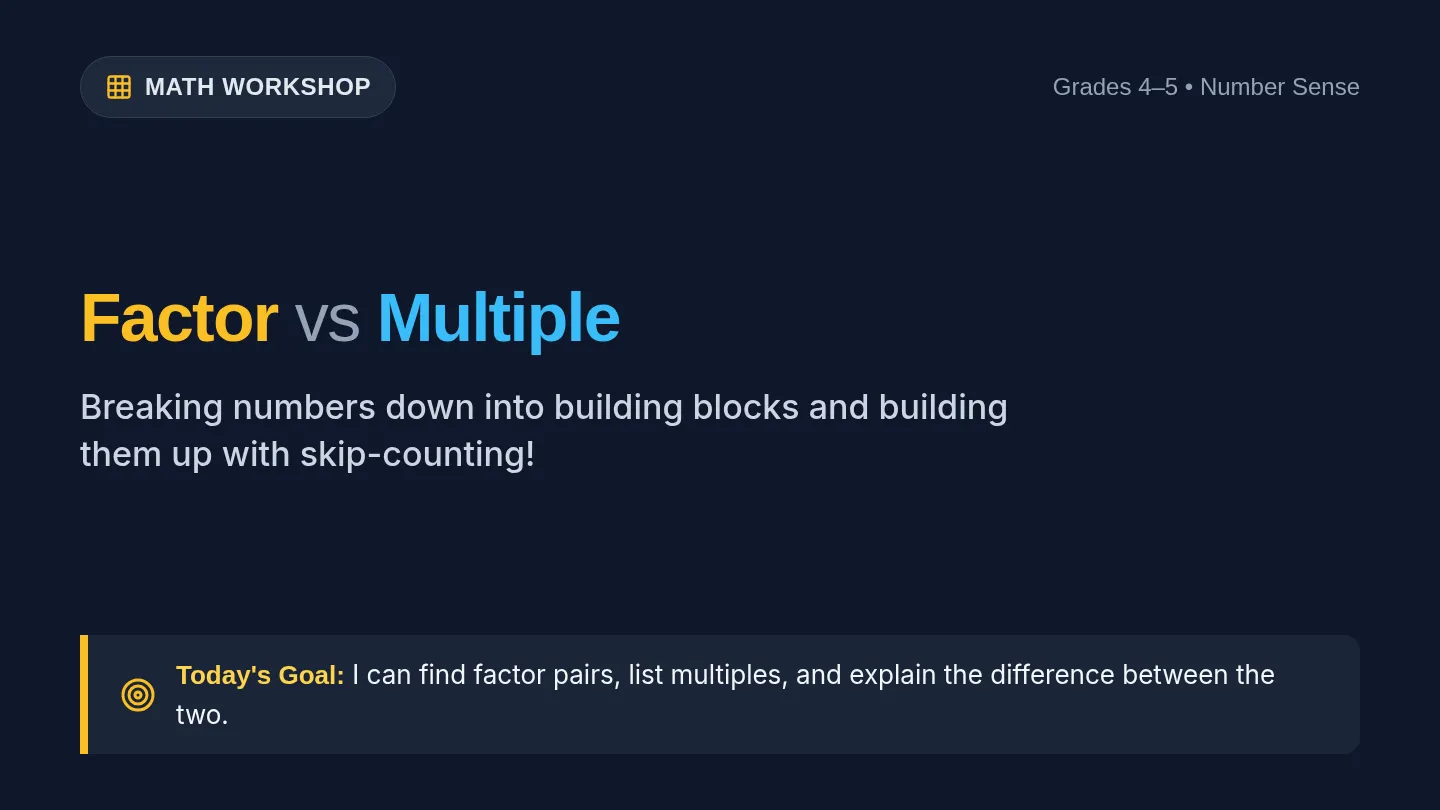
Factor vs Multiple
Breaking numbers down into building blocks and building them up with skip-counting!
Today's Goal: I can find factor pairs, list multiples, and explain the difference between the two.
WARM-UP
The 12-Tile Challenge
Imagine you have 12 square tiles .
How many different rectangles can you build using all 12 tiles with no leftovers?
Turn & Talk: What side lengths work for a 12-tile rectangle?
1 × 12
2 × 6
3 × 4
Every side length you just found (1, 2, 3, 4, 6, 12) is a FACTOR of 12!
CONCEPT 1
Factors: The Building Blocks
A factor is a whole number that divides evenly into another number with no remainder.
Factors come in factor pairs that multiply to the target.
Factors are always less than or equal to the number.
Every number has a limited (finite) list of factors.
Factor Pairs of 12
1 × 12
= 12
2 × 6
= 12
3 × 4
= 12
Factors of 12: 1, 2, 3, 4, 6, 12
Tip: Always start with 1 × the number , then test 2, 3, 4... until pairs repeat!
CONCEPT 2
Multiples: Skip-Count Ladders
A multiple is the product you get when you multiply a number by 1, 2, 3, 4, and so on.
Think of skip-counting forward from the number.
Multiples are always greater than or equal to the number.
Multiples go on forever (infinite) !
First 5 Multiples of 4
4 × 1 = 4
4 × 2 = 8
4 × 3 = 12
4 × 4 = 16
4 × 5 = 20
Tip: M ultiple sounds like M ultiply — multiply to make it grow!
COMPARE
Factor vs Multiple Showdown
FACTORS of 12
Break Down
Numbers you multiply to get 12:
1, 2, 3, 4, 6, 12
• Size: 12 or smaller
• How many? Limited (6 total)
• Question: "What divides into 12?"
MULTIPLES of 12
Build Up
Skip-counting by 12:
12, 24, 36, 48, 60...
• Size: 12 or larger
• How many? Endless (infinite!)
• Question: "What do I get skip-counting?"
Secret Connection: 12 is BOTH a factor of 12 AND a multiple of 12!
GUIDED PRACTICE
You Try Together!
CHALLENGE 1
Find all factors of 18.
Work with a partner to list every factor pair of 18.
Hint: There are 3 pairs!
CHALLENGE 2
List 5 multiples of 6.
Start at 6 and skip-count to find the first five multiples.
6, ___, ___, ___, ___
CHALLENGE 3
Factor or Multiple?
Is 8 a factor of 24, a multiple of 24, or neither?
Be ready to explain why!
Write your ideas on your whiteboard or scratch paper, then hold them up on 3!
YOUR TURN
Show What You Know
On Your Worksheet
1. Find factor pairs using T-charts.
2. List the first 5 multiples.
3. Compare factors vs. multiples.
4. Spot the mistake & solve the word problem.
Quick Exit Question
How can you tell right away that 36 is a multiple of 9, not a factor of 9?
Remember: Factors are ≤ the number. Multiples are ≥ the number!
Check your work with the anchor box at the top of page 1 if you get stuck!
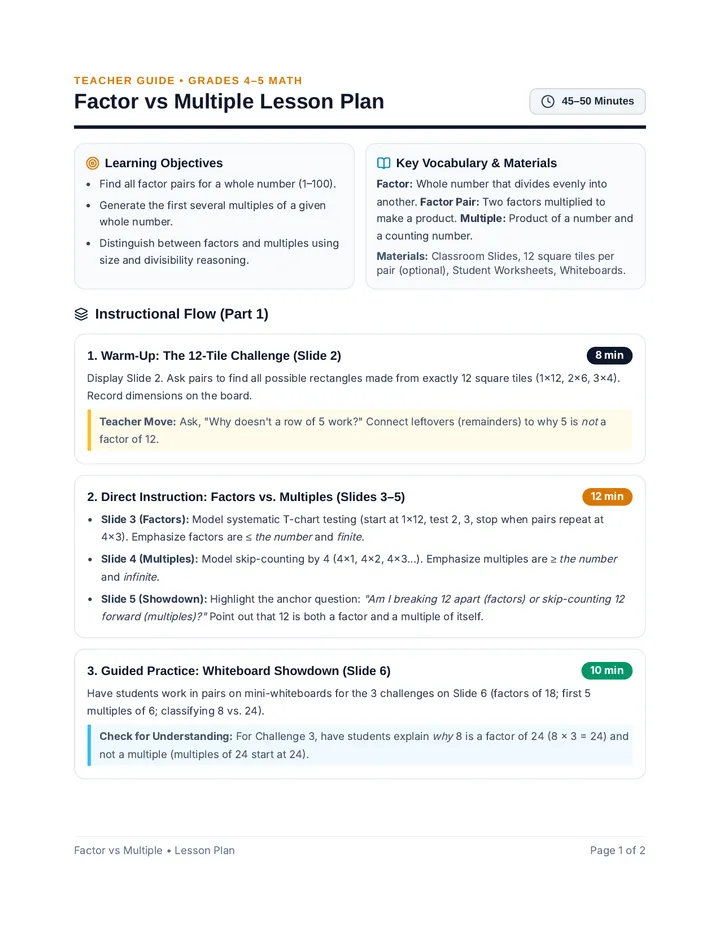
Factor vs Multiple Lesson Plan Teacher Guide • Grades 4–5 Math
Factor vs Multiple Lesson Plan
45–50 Minutes
Learning Objectives
Find all factor pairs for a whole number (1–100).
Generate the first several multiples of a given whole number.
Distinguish between factors and multiples using size and divisibility reasoning.
Key Vocabulary & Materials
Factor: Whole number that divides evenly into another. Factor Pair: Two factors multiplied to make a product. Multiple: Product of a number and a counting number.
Materials: Classroom Slides, 12 square tiles per pair (optional), Student Worksheets, Whiteboards.
Instructional Flow (Part 1)
1. Warm-Up: The 12-Tile Challenge (Slide 2) 8 min
Display Slide 2. Ask pairs to find all possible rectangles made from exactly 12 square tiles (1×12, 2×6, 3×4). Record dimensions on the board.
Teacher Move: Ask, "Why doesn't a row of 5 work?" Connect leftovers (remainders) to why 5 is not a factor of 12.
2. Direct Instruction: Factors vs. Multiples (Slides 3–5) 12 min
Slide 3 (Factors): Model systematic T-chart testing (start at 1×12, test 2, 3, stop when pairs repeat at 4×3). Emphasize factors are ≤ the number and finite .Slide 4 (Multiples): Model skip-counting by 4 (4×1, 4×2, 4×3...). Emphasize multiples are ≥ the number and infinite .Slide 5 (Showdown): Highlight the anchor question: "Am I breaking 12 apart (factors) or skip-counting 12 forward (multiples)?" Point out that 12 is both a factor and a multiple of itself.
3. Guided Practice: Whiteboard Showdown (Slide 6) 10 min
Have students work in pairs on mini-whiteboards for the 3 challenges on Slide 6 (factors of 18; first 5 multiples of 6; classifying 8 vs. 24).
Check for Understanding: For Challenge 3, have students explain why 8 is a factor of 24 (8 × 3 = 24) and not a multiple (multiples of 24 start at 24).
Factor vs Multiple • Lesson Plan Page 1 of 2
Instructional Flow (Part 2) & Supports
Teacher Reference
4. Independent Practice: Student Worksheet 12 min
Distribute the Factor vs Multiple Worksheet . Encourage students to use the Anchor Box at the top of Page 1 when they feel stuck. Circulate to check T-charts on Part 1 and ensure students include 1 and the number itself as factors.
5. Wrap-Up & Quick Check (Slide 7) 5 min
Display Slide 7's exit question: "How can you tell right away that 36 is a multiple of 9, not a factor of 9?" Have 2–3 students share aloud before collecting worksheets.
Common Misconceptions & Fixes
Misconception 1: Confusing which list is larger (e.g., listing "12, 24, 36" as factors of 12).
Fix: Use the physical "Inside vs. Outside" rule: Factors fit inside the number (≤ 12); Multiples multiply out beyond the number (≥ 12).
Misconception 2: Forgetting 1 and the number itself as factors, or forgetting the number itself as its first multiple.
Fix: Require every T-chart to start with Row 1: 1 | N, and every multiple list to start with N × 1 = N.
Misconception 3: Missing middle factor pairs (like 4 × 6 for 24).
Fix: Teach students to test numbers in order (1, 2, 3, 4, 5...) until they reach a factor they already wrote.
Differentiation Strategies
Support & Scaffolding
Provide a multiplication chart or 100-chart for skip-counting multiples.
Use color-coded highlighters: yellow for factors, blue for multiples.
Pre-fill the left column of T-charts (1, 2, 3...) for Part 1.
Extension & Challenge
Ask: "Find a number between 20 and 50 that has an odd number of factors. Why?" (Square numbers: 25, 36, 49).
Find common factors and the Greatest Common Factor (GCF) of 24 and 30.
Factor vs Multiple • Lesson Plan Page 2 of 2
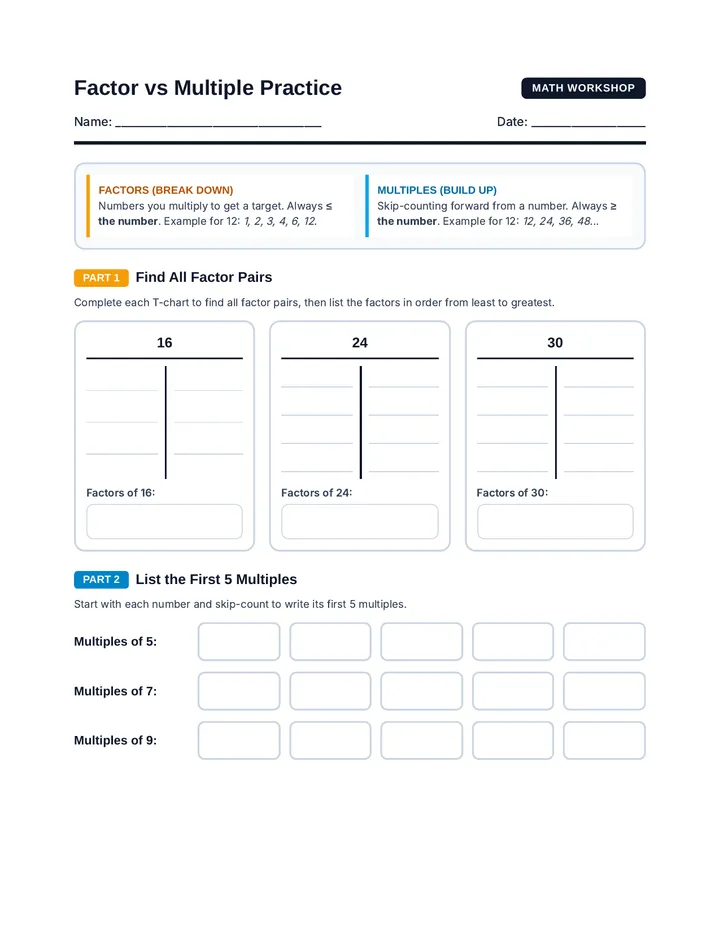
Factor vs Multiple Worksheet Factor vs Multiple Practice
Math Workshop
Name: ____________________________________ Date: ____________________
Factors (Break Down)
Numbers you multiply to get a target. Always ≤ the number . Example for 12: 1, 2, 3, 4, 6, 12 .
Multiples (Build Up)
Skip-counting forward from a number. Always ≥ the number . Example for 12: 12, 24, 36, 48...
PART 1
Find All Factor Pairs
Complete each T-chart to find all factor pairs, then list the factors in order from least to greatest.
16
Factors of 16:
24
Factors of 24:
30
Factors of 30:
PART 2
List the First 5 Multiples
Start with each number and skip-count to write its first 5 multiples.
Multiples of 5:
Multiples of 7:
Multiples of 9:
PART 3
Factor, Multiple, or Both?
Circle the choice that makes each statement true.
1. The number 6 is a ___________ of 18.
Factor Multiple Both Neither
2. The number 32 is a ___________ of 8.
Factor Multiple Both Neither
3. The number 15 is a ___________ of 15.
Factor Multiple Both Neither
4. The number 7 is a ___________ of 20.
Factor Multiple Both Neither
PART 4
Spot & Fix the Mistake
Maya wrote: "The factors of 8 are 8, 16, 24, and 32."
PART 5
Real-World Challenge
Mr. Diaz has 24 markers. He wants to put the same number of markers into each bin with none left over. (a) List all the different bin sizes he could use (more than 1 marker per bin). (b) Are those numbers factors or multiples of 24? Explain how you know.
Factor vs Multiple Answer Key Teacher Reference • Answer Key
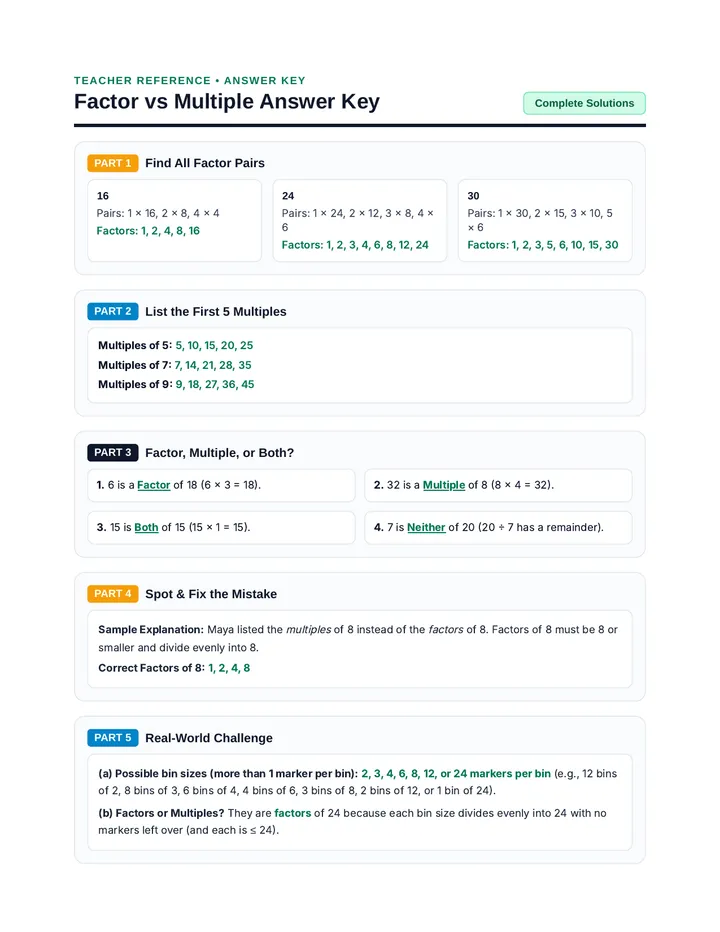
Factor vs Multiple Answer Key
Complete Solutions
PART 1
Find All Factor Pairs
16
Pairs: 1 × 16, 2 × 8, 4 × 4
Factors: 1, 2, 4, 8, 16
24
Pairs: 1 × 24, 2 × 12, 3 × 8, 4 × 6
Factors: 1, 2, 3, 4, 6, 8, 12, 24
30
Pairs: 1 × 30, 2 × 15, 3 × 10, 5 × 6
Factors: 1, 2, 3, 5, 6, 10, 15, 30
PART 2
List the First 5 Multiples
Multiples of 5: 5, 10, 15, 20, 25
Multiples of 7: 7, 14, 21, 28, 35
Multiples of 9: 9, 18, 27, 36, 45
PART 3
Factor, Multiple, or Both?
1. 6 is a Factor of 18 (6 × 3 = 18).
2. 32 is a Multiple of 8 (8 × 4 = 32).
3. 15 is Both of 15 (15 × 1 = 15).
4. 7 is Neither of 20 (20 ÷ 7 has a remainder).
PART 4
Spot & Fix the Mistake
Sample Explanation: Maya listed the multiples of 8 instead of the factors of 8. Factors of 8 must be 8 or smaller and divide evenly into 8.
Correct Factors of 8: 1, 2, 4, 8
PART 5
Real-World Challenge
(a) Possible bin sizes (more than 1 marker per bin): 2, 3, 4, 6, 8, 12, or 24 markers per bin (e.g., 12 bins of 2, 8 bins of 3, 6 bins of 4, 4 bins of 6, 3 bins of 8, 2 bins of 12, or 1 bin of 24).
(b) Factors or Multiples? They are factors of 24 because each bin size divides evenly into 24 with no markers left over (and each is ≤ 24).