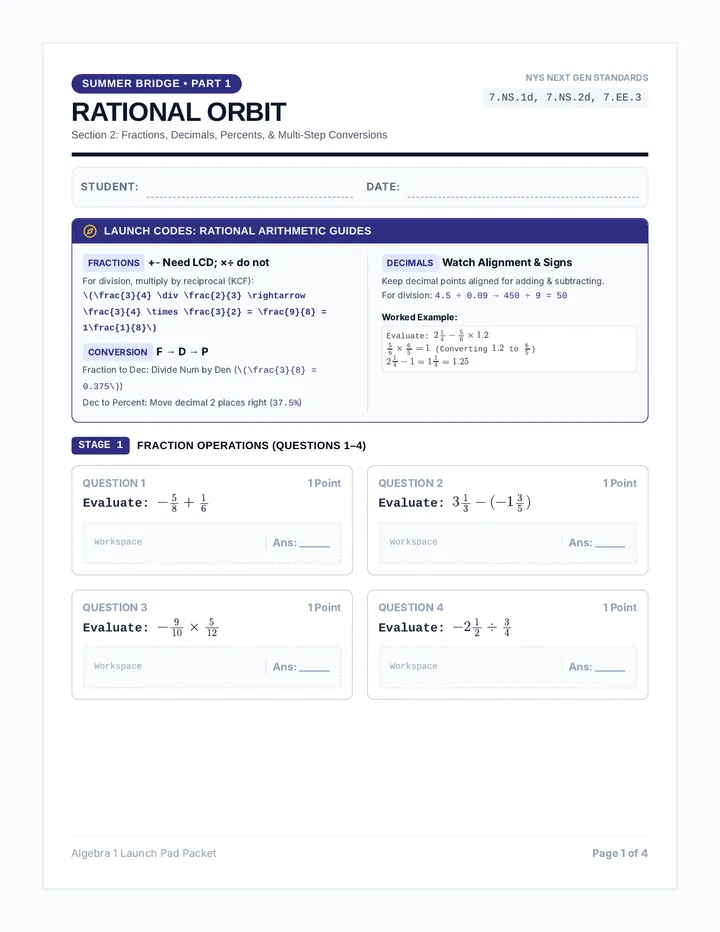
A math foundations lesson for 9th and 10th grade students focusing on solving equations with fractions through organized, line-by-line computation on grid-style layouts.
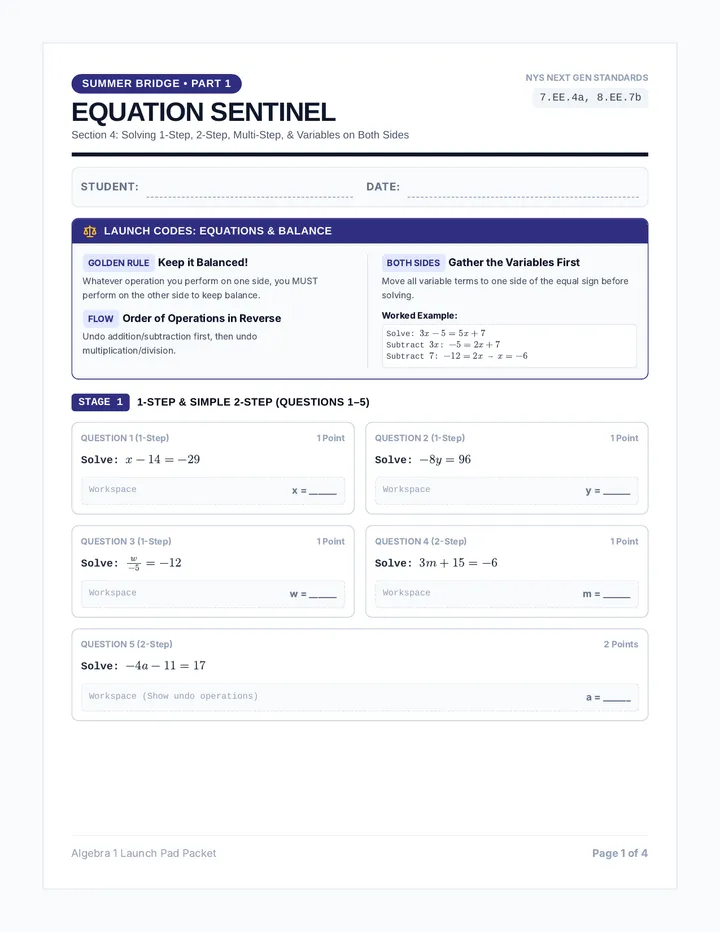
A comprehensive assessment lesson focusing on mastering one-step equations involving multiplication, division, and basic addition/subtraction.
A foundational lesson on the coordinate plane designed for IEP students, focusing on vocabulary, quadrant identification, and step-by-step plotting and reading of points.
A focused lesson on identifying and comparing the domain and range of quadratic functions and their square root inverses using interval notation and graphical analysis.
A lesson focused on graphing and analyzing inverse relations for absolute value and quadratic functions. Students learn to reflect functions across y=x and evaluate if the resulting relation is a function.
A lesson focused on understanding and calculating inverse functions through multiple representations: numerical tables, algebraic equations, and graphical reflections. Students will practice reversing operations and reflecting functions across the line y=x.
A high-energy, investigative lesson where honors students apply the quadratic formula to solve problems with rational and irrational roots to solve a 'case'.
A comprehensive review of angle relationships and triangle properties, featuring guided scaffolds and visual equation solving. Students will master identifying angles, solving for unknowns, and applying triangle theorems.
A focused mini-lesson on identifying, calculating, and analyzing complementary and supplementary angles using color-coded visual supports and real-world architect-themed scenarios.
A comprehensive practice set and review presentation for the TSIA2 Math exam, covering Quantitative, Algebraic, Geometric, and Statistical reasoning.
A comprehensive preparation set for the TSIA2 Mathematics assessment, featuring a full-length practice test, detailed step-by-step solutions, and a strategic review presentation.
A lesson focused on applying binomial distribution concepts to real-world scenarios through a creative coloring activity. Students translate narrative word problems into mathematical models to calculate probabilities, means, and variances.