Fundamental techniques for drawing, painting, sculpture, and photography alongside modern digital design principles. Analyzes historical artistic movements while building skills in printmaking and graphic media.
A discovery-based journey for 1st graders into digital photography and basic image editing, moving from device handling to creative storytelling through filters and digital elements.
This 2nd-grade sequence introduces students to the fundamentals of digital photography and user interface design. Students progress from capturing and editing clear images to understanding and designing the icons and layouts that make digital apps functional and visually appealing.
This sequence introduces 3rd-grade students to digital photography basics, focusing on light, composition, and visual storytelling. Students will move from learning about light and shadow to mastering angles and the rule of thirds, ultimately creating their own photo essay.
A comprehensive 9th-grade visual arts unit focusing on translating 2D drawings into 3D wire sculptures. Students explore contour lines, tool safety, spatial volume, and presentation through the lens of 'drawing in space.'
A 5th-grade art sequence exploring Land Art and environmental sculpture. Students learn to collaborate with nature using foraged materials to create ephemeral installations, emphasizing patterns, site-specificity, and documentation through photography.
This undergraduate sequence explores the conceptual and technical dimensions of Found Object Assemblage. Students move from semiotic analysis and material sourcing to advanced joinery techniques, culminating in site-specific installations that communicate complex social or personal narratives.
This advanced 12th-grade sequence guides students through the rigorous process of subtractive sculpture. From conceptual clay maquettes to final surface treatments, students master the relationship between mass and negative space to create portfolio-ready 3D works.
A sequence introducing Kindergarteners to the intersection of digital photography and creative manipulation. Students move from basic framing to surrealist digital collages.
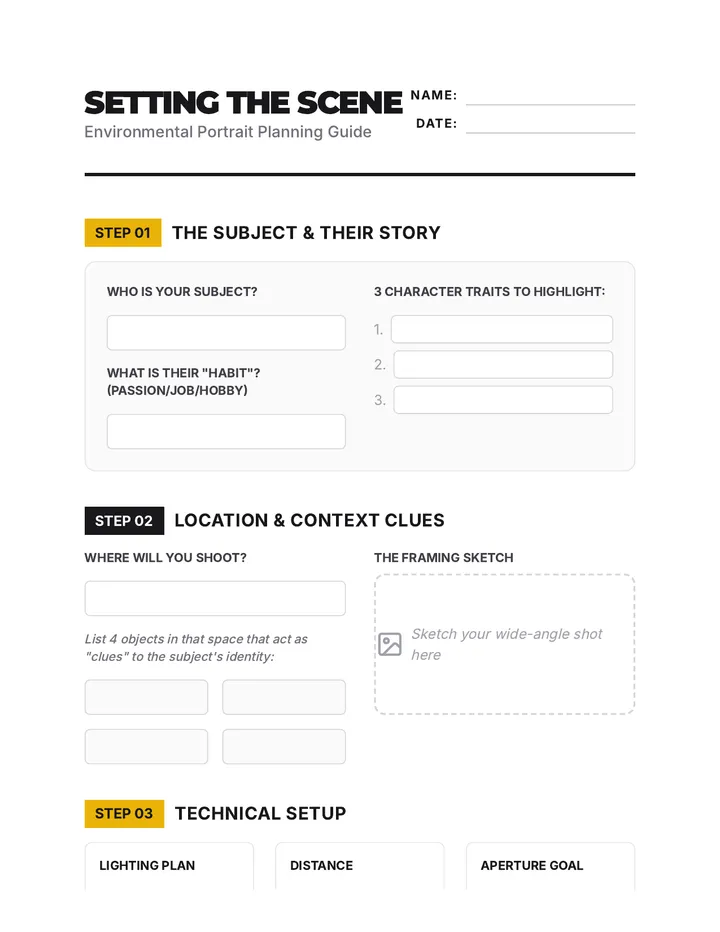
This sequence guides 12th-grade students through the transition from single-image photography to complex visual storytelling. Students will learn to plan, shoot, and curate photo essays, culminating in a professional portfolio presentation that explores narrative arcs and conceptual themes.
A comprehensive 12th-grade photography sequence focusing on professional digital workflow, non-destructive editing, and the ethics of post-processing. Students progress from basic organization to advanced color grading and retouching while debating the boundaries of photographic truth.
A comprehensive 12th-grade photography sequence exploring the physics and artistry of light, from natural environments to controlled studio setups, focusing on form, texture, and mood.
This advanced photography sequence for 12th graders moves beyond basic framing to explore complex compositional structures like the Golden Ratio, negative space, and color psychology. Students learn to use geometry and color to dictate the viewer's psychological experience, ultimately mastering the art of breaking rules intentionally to create visual tension.
Students present their completed campaigns to a panel representing school administrators or local council members. They deliver a verbal pitch accompanied by their visual materials and answer questions regarding feasibility and impact.
Students enter a production phase to create the physical or digital assets for their campaign. They apply principles of design hierarchy to ensure their message is visually accessible. The lesson emphasizes the intersection of aesthetics and communication.
Focusing on rhetoric, students draft the core messaging for their campaign, including a slogan, a mission statement, and an 'elevator pitch.' They analyze successful advertising techniques to understand tone and audience targeting.
Students present their comprehensive campaigns to a mock panel and practice high-stakes elevator pitches.
Students design visual advocacy materials, focusing on branding and media literacy to capture public attention.
Students learn to blend emotional appeals and factual evidence to craft a compelling persuasive narrative for their arts cause.
Learners map out stakeholders and use empathy mapping to understand the values and priorities of different audience groups.
Students analyze hypothetical scenarios where arts programs face budget cuts or closure to identify root causes and specific advocacy needs.
Students explore real-world advocacy case studies to understand how data supports arts funding. They select relevant statistics to bolster their specific campaign and practice translating dry data into compelling infographics.
Students print the second color layer, tackling the difficulty of aligning tight registration. The sequence concludes with reclaiming screens (cleaning) and a discussion on the commercial viability of screen printing.
Students conduct an audit of their current school or neighborhood arts landscape to identify gaps in access or funding, eventually selecting one specific issue to advocate for.
In a simulated print shop environment, students work in teams to print a run of posters or t-shirts. They manage the drying rack workflow and clean up, emphasizing the industrial nature of the medium.
In this culminating critique, students present a major work executed in a monochromatic or analogous scheme that conveys a complex narrative usually reserved for full-color spectrums. Peers critique the work based on how effectively value and saturation were used to replace hue as the primary storytelling device.
Focusing on complementary contrasts and simultaneous contrast, students create a composition designed to produce visual vibration or 'shimmer.' The lesson explores the boundary between aesthetic harmony and physiological visual discomfort, pushing the limits of what is comfortable for the viewer to observe.
Students restrict their materials to the 'Zorn Palette' (Yellow Ochre, Vermilion, Ivory Black, and White) to master temperature control without relying on high-chroma pigments. By removing the crutch of convenient tube colors, students must demonstrate sophisticated mixing skills to achieve lifelike flesh tones and atmospheric depth.
This seminar-style lesson examines the psychological impact of color and its cultural specificities through a global lens. Students analyze case studies of contemporary artists who leverage color for political or emotional manipulation, then draft a proposal for a piece that utilizes color to subvert traditional cultural associations.
Students curate their series for final review, sequencing work to control narrative flow and drafting a professional artist statement.
Students master the integration of subject and background through glazing, scumbling, and edge manipulation to create a unified spatial reality.
A formal critique simulation utilizing the Critical Response Process to provide actionable feedback and drive iterative refinement of works-in-progress.
Students address the physical and perceptual challenges of large-scale work by transferring small studies to large formats, focusing on brush economy and viewing distance.
Students brainstorm and propose a thematic series of 3-5 works, defending their choice of subject matter and medium while analyzing contemporary thematic consistency.
Mastering all-over compositions that lack a traditional focal point, focusing on rhythm and repetition to maintain cohesion in 'chaos'.
Mapping the chronological 'eye path' through a composition by manipulating contrast, edge quality, and directional lines to hijack viewer gaze.
Challenging linear perspective by integrating multiple vanishing points and distorted geometries to create physically impossible but visually coherent spaces.
A structured technical artist statement template for graduate students to articulate the synthesis of material process and conceptual intent.
A student analysis worksheet for researching and planning the conceptual use of non-traditional substrates and found objects.
A visual presentation for graduate students exploring the semiotics of substrate and how choice of surface impacts conceptual narrative.
A planning document for students to map out 3D layers, material compatibility, and conceptual intent for mixed media works.
A technical facilitation guide for graduate instructors focusing on mixed media synthesis, archival stability, and 3D surface disruption techniques.
A technical recording sheet for students to track the effects of various acrylic additives and viscosity ratios on their experimental works.
A visual presentation for graduate students exploring the intersection of viscosity, surface tension, and chemical additives in acrylic painting.
A student process log for recording technical results and conceptual reflections during the subtractive drawing workshop.
A technical facilitation guide for graduate instructors focusing on subtractive drawing techniques using charcoal, ink, and various solvents.
Teacher guide for Lesson 5: Backstage Organization and Prop Tables. Includes relay race hook instructions, "darkness test" simulation tips, and a unit reflection guide.
Student worksheet for Lesson 5: Stage Management organization. Features a prop table mapping activity for a specific scene.
Educational slide deck for Lesson 5: Backstage Organization and Prop Tables. Covers the importance of organization, prop table setup, and the concept of "spiking" furniture.
Final reflection journal for students to assess their growth, project impact, and the power of student advocacy after completing their campaign.
Evaluation rubric for the final advocacy pitch, assessing problem identification, evidence usage, visual design, and oral delivery.
A comprehensive teacher guide for facilitating the 5-lesson advocacy sequence, updated with larger fonts and clearer sections.
Slide deck for Lesson 5, introducing tips for body language, analyzing a high-stakes pitch, and the structure of a two-minute advocacy presentation.
A 2-page rubric and reflection form for the final "Elevator Pitch" presentation, including peer feedback sections. Updated for better font legibility.
Worksheet for students to plan and sketch the production of their multi-channel advocacy campaign assets, including color palettes and asset lists.
A campaign blueprint worksheet for planning visual elements like color, fonts, and layout for advocacy materials.
Practice activity where students apply the CRAP principles (Contrast, Repetition, Alignment, Proximity) to redesign a poorly structured flyer.
A drafting worksheet where students practice writing for different audiences using Logos, Pathos, and Ethos.
A teacher resource for setting up registration jigs and managing alternative substrate printing during the hybrid layering phase.
Slide deck for Lesson 4, introducing the CRAP principles of design (Contrast, Repetition, Alignment, Proximity) and discussing different media channels for advocacy.
Slides for Lesson 3 focusing on rhetorical strategies (Logos, Pathos, Ethos) applied specifically to arts advocacy messaging.
Students repeat the carve-ink-print cycle for subsequent darker colors, effectively destroying the previous image states. The lesson culminates in curating a consistent edition, signing prints according to convention, and a critique of the technical execution.
Students print their first light color layer, focusing on consistent ink slab preparation (the 'hiss' sound) and using registration pins or jigs. They troubleshoot common issues like over-inking or paper shifting.
Students begin the irreversible carving process, removing areas intended to remain the color of the paper. Instruction focuses on tool handling safety, varying line weights, and textural mark-making to create dynamic negative space.
This technical workshop guides students through prepping linoleum blocks, including sanding and toning, before transferring their reversed designs. Students learn to secure their registration systems to ensure alignment for multiple print layers.
Students use hand pressure or a press to transfer their image to paper. They analyze the results, often surprised by how the texture translates, and reflect on the transformation from junk material to art.
Students analyze their finished posters as public advertisements, discussing visual impact, communication effectiveness, and design choices through a formal critique process.
Students install their posters in a public or semi-public context to test readability and impact. The lesson concludes with a seminar discussing the role of the graphic artist in contemporary visual culture and the effectiveness of their design choices.
Students set up hinge clamps and registration tabs to print their first color layer. The lesson emphasizes the angle, pressure, and speed of the squeegee pull to ensure crisp edges and avoid bleeding.
Using a press (or heavy hand-rubbing with a barren), students print their collographs on damp paper. They examine the resulting embossing, where the paper physically molds to the texture of the plate.
Students mix acrylic screen inks and practice the physical technique of the 'flood' and the 'pull.' They focus on angle, pressure, and speed to produce crisp prints without bleeding.
A graduate-level studio sequence focused on the transition from technical exercises to a cohesive, professional body of work. Students develop a thematic series, tackle the challenges of large-scale execution, engage in rigorous formal critiques, and curate a final presentation.
A graduate-level exploration of the intersection between medium and meaning. Students innovate with traditional materials, exploring chemical interactions, substrate manipulation, and mixed-media synthesis to develop a unique 'mark-making' vocabulary where physical texture contributes to conceptual depth.
This advanced sequence for graduate students explores the deconstruction of classical composition through dynamic symmetry, edge tension, non-Euclidean perspective, and visual hierarchy. Students will move from rigid geometric analysis to 'anti-compositional' strategies to create contemporary, tension-filled imagery.
An intensive graduate-level investigation into the physics, psychology, and application of color in fine art, focusing on relativity, semiotics, and narrative.
Students investigate how costumes and properties (props) function as tools for character development and storytelling. The sequence guides students through the process of distinguishing between prop types, exploring costume psychology, fabricating safe props, and mastering backstage organization.
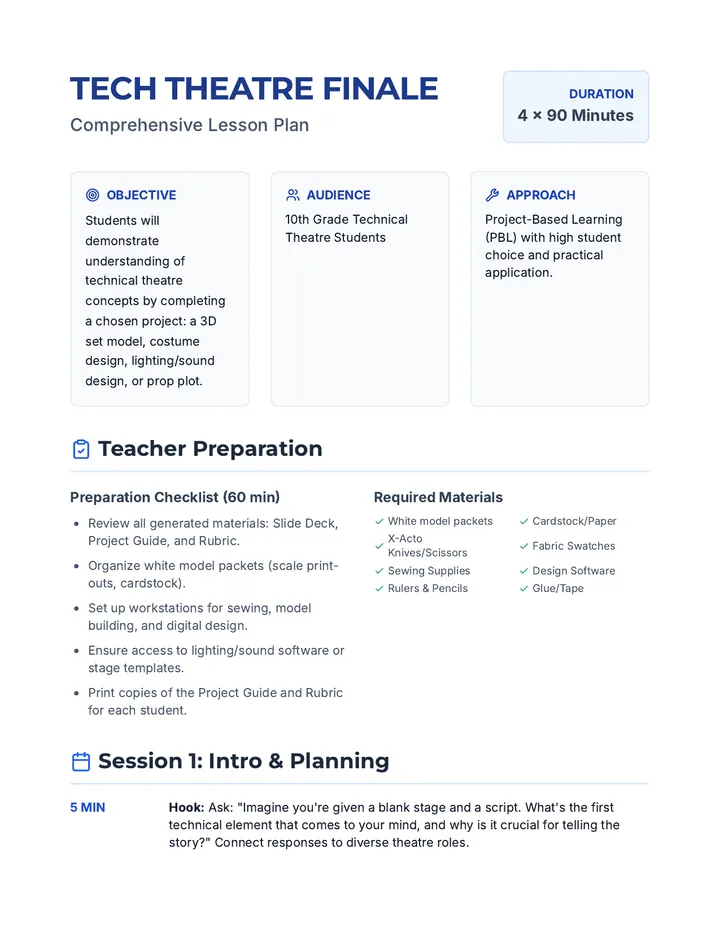
This hands-on sequence introduces 4th graders to the visual and engineering side of theater. Students analyze scripts to design environments, draft scale floor plans, build 3D scenic models, and fabricate props, emphasizing spatial reasoning and storytelling through physical space.
Students step into the shoes of a set designer to transform a written script into a physical world through script analysis, floor planning, mood boards, and 3D model construction. The sequence emphasizes how visual choices in color, texture, and space support the storytelling.
A comprehensive 12th-grade unit on intaglio drypoint printing, covering historical context, plate preparation, incising techniques, inking/wiping, press operation, and chine-collé integration. Students move from raw plate preparation to pulling professional-grade prints.
A comprehensive 11th-grade unit on the mechanics of intaglio printmaking, focusing on drypoint techniques, plate preparation, the chemistry of wiping, and chine-coll\u00e9 integration. Students master the relationship between physical pressure and visual atmosphere.
A 5-lesson sequence exploring the experimental nature of monoprinting. Students investigate ink properties, transparency, and layering through additive/subtractive methods, found object textures, masking, and ghost printing, culminating in a curated portfolio.
A 4th-grade printmaking unit where students transform found textures into complex printing plates. Through inquiry and experimentation, students explore collography by building, sealing, inking, and pressing tactile 'matrices'.
An inquiry-based art sequence where 4th graders explore multi-layer stencil printing, focusing on color theory, registration, and visual deconstruction. Students move from analyzing professional prints to creating their own multi-layered color compositions.