Manipulating materials to create form and volume in three-dimensional space. Focuses on additive and subtractive techniques using media such as clay, wire, and found objects.
Students refine their successful experimental techniques into polished, gallery-ready pieces. They produce a technical artist statement explaining how their material handling supports their conceptual intent.
Students abandon traditional canvas to paint on found objects and raw materials. They analyze how the history and texture of a surface change the narrative and conceptual impact of the work.
Students combine incompatible media and incorporate collage to disrupt the picture plane. The focus is on the 'edge' where materials meet, using resistance techniques and heavy gels to create sculptural topography.
Investigating the properties of viscosity and flow, students treat painting as a controlled chemical reaction. They experiment with pouring mediums and high-flow acrylics to create organic, non-brush textures.
Students explore the concept of emergence by reversing the drawing process. By covering substrates in charcoal or ink and revealing images through subtraction, they treat light as a physical presence.
Students step into the role of Stage Managers to learn about organization. They create a 'prop table' map, outlining where items go ensuring actors can find them in the dark, and practice resetting a scene quickly.
Students create a costume rendering for a specific character using drawing or collage techniques. They must annotate their design to explain how their choices relate to the character's age, job, and personality.
Focusing on safety and resourcefulness, students learn to build a specific hand prop using cardboard, tape, and safe adhesives. The lesson covers structural integrity and how to make lightweight objects look heavy or metallic.
Students explore how color, condition, and fit of clothing communicate character traits. They analyze character descriptions and select fabric swatches or colors that represent the character's personality and status.
Students learn to categorize items as Hand Props, Set Props, or Set Dressing through sorting activities. They analyze a scene to determine which items are handled by actors versus which items just set the scene.
Students identify and fabricate a key hand prop from their script, solving problems of durability and appearance.
Students apply color and texture to their models using scenic painting techniques to convey mood and reality.
A structured technical artist statement template for graduate students to articulate the synthesis of material process and conceptual intent.
A student analysis worksheet for researching and planning the conceptual use of non-traditional substrates and found objects.
A visual presentation for graduate students exploring the semiotics of substrate and how choice of surface impacts conceptual narrative.
A planning document for students to map out 3D layers, material compatibility, and conceptual intent for mixed media works.
A technical facilitation guide for graduate instructors focusing on mixed media synthesis, archival stability, and 3D surface disruption techniques.
A technical recording sheet for students to track the effects of various acrylic additives and viscosity ratios on their experimental works.
A visual presentation for graduate students exploring the intersection of viscosity, surface tension, and chemical additives in acrylic painting.
A student process log for recording technical results and conceptual reflections during the subtractive drawing workshop.
A technical facilitation guide for graduate instructors focusing on subtractive drawing techniques using charcoal, ink, and various solvents.
Teacher guide for Lesson 5: Backstage Organization and Prop Tables. Includes relay race hook instructions, "darkness test" simulation tips, and a unit reflection guide.
Student worksheet for Lesson 5: Stage Management organization. Features a prop table mapping activity for a specific scene.
Educational slide deck for Lesson 5: Backstage Organization and Prop Tables. Covers the importance of organization, prop table setup, and the concept of "spiking" furniture.
A graduate-level exploration of the intersection between medium and meaning. Students innovate with traditional materials, exploring chemical interactions, substrate manipulation, and mixed-media synthesis to develop a unique 'mark-making' vocabulary where physical texture contributes to conceptual depth.
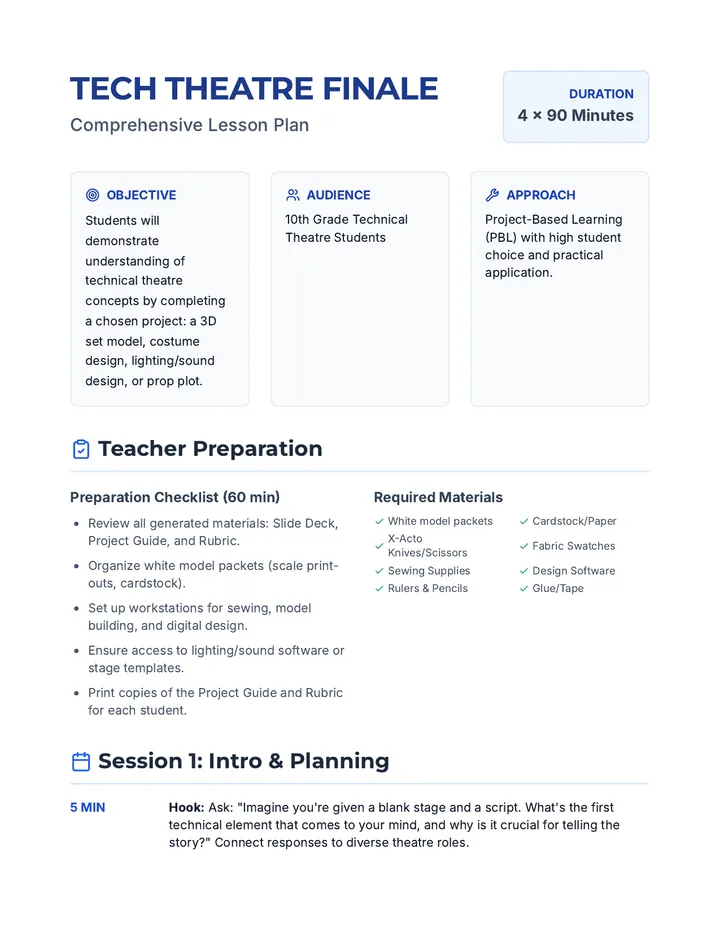
Students investigate how costumes and properties (props) function as tools for character development and storytelling. The sequence guides students through the process of distinguishing between prop types, exploring costume psychology, fabricating safe props, and mastering backstage organization.
This hands-on sequence introduces 4th graders to the visual and engineering side of theater. Students analyze scripts to design environments, draft scale floor plans, build 3D scenic models, and fabricate props, emphasizing spatial reasoning and storytelling through physical space.
A design-focused sequence for 3rd graders on how costumes and props communicate character. Students analyze traits, select costume elements, and build cardboard props to bring characters to life.
A project-based unit where 3rd-grade students learn the art of set design by transforming story descriptions into miniature 3D scale models. Students analyze text, draft layouts, and construct shoebox dioramas to communicate time, place, and mood.
A project-based sequence for 4th graders exploring the technical world of theater production. Students learn to manipulate space, materials, sound, and light to tell compelling stories, culminating in a design showcase.
Students step into the shoes of a set designer to transform a written script into a physical world through script analysis, floor planning, mood boards, and 3D model construction. The sequence emphasizes how visual choices in color, texture, and space support the storytelling.
A comprehensive 5th-grade art sequence introducing the subtractive process of relief printing. Students progress from conceptualizing mirrored imagery and carving soft blocks to mastering ink application and producing a numbered edition of prints.
A graduate-level exploration of the artist book, integrating letterpress printing, relief graphics, and structural binding to investigate the relationship between physical form and narrative sequence.
A Kindergarten sequence introducing the fundamentals of relief printing. Students explore texture, create their own stamps, and learn to make repeating patterns through hands-on exploration.
A Kindergarten sequence exploring the traditional arts and crafts of Native peoples across North America, focusing on pottery, weaving, totem poles, beadwork, and regalia. Students learn about cultural symbolism, functional art, and regional styles through hands-on creation.
This workshop-style sequence immerses 1st-grade students in the artistic traditions of various Native American nations, focusing on patterns, symbols, and craftsmanship. Students explore pottery, weaving, and carving to understand how art reflects community history and personal identity.