Techniques for relief, intaglio, and screen printing alongside digital graphic design principles. Examines plate preparation, ink application, and the integration of typography within visual layouts.
Students repeat the carve-ink-print cycle for subsequent darker colors, effectively destroying the previous image states. The lesson culminates in curating a consistent edition, signing prints according to convention, and a critique of the technical execution.
Students print their first light color layer, focusing on consistent ink slab preparation (the 'hiss' sound) and using registration pins or jigs. They troubleshoot common issues like over-inking or paper shifting.
Students begin the irreversible carving process, removing areas intended to remain the color of the paper. Instruction focuses on tool handling safety, varying line weights, and textural mark-making to create dynamic negative space.
Students print the second color layer, tackling the difficulty of aligning tight registration. The sequence concludes with reclaiming screens (cleaning) and a discussion on the commercial viability of screen printing.
In a simulated print shop environment, students work in teams to print a run of posters or t-shirts. They manage the drying rack workflow and clean up, emphasizing the industrial nature of the medium.
This technical workshop guides students through prepping linoleum blocks, including sanding and toning, before transferring their reversed designs. Students learn to secure their registration systems to ensure alignment for multiple print layers.
Students use hand pressure or a press to transfer their image to paper. They analyze the results, often surprised by how the texture translates, and reflect on the transformation from junk material to art.
Students analyze their finished posters as public advertisements, discussing visual impact, communication effectiveness, and design choices through a formal critique process.
Students install their posters in a public or semi-public context to test readability and impact. The lesson concludes with a seminar discussing the role of the graphic artist in contemporary visual culture and the effectiveness of their design choices.
Students set up hinge clamps and registration tabs to print their first color layer. The lesson emphasizes the angle, pressure, and speed of the squeegee pull to ensure crisp edges and avoid bleeding.
Using a press (or heavy hand-rubbing with a barren), students print their collographs on damp paper. They examine the resulting embossing, where the paper physically molds to the texture of the plate.
Students mix acrylic screen inks and practice the physical technique of the 'flood' and the 'pull.' They focus on angle, pressure, and speed to produce crisp prints without bleeding.
An advanced printmaking sequence focusing on the reduction lino-cut method. Students explore historical context, strategic planning, technical carving, and the precise mechanics of registration and editioning to create multi-colored prints from a single, evolving block.
A high school sequence exploring the intersection of digital design and traditional printmaking. Students learn to bridge vector precision with analog texture through zine production and professional practice.
A comprehensive 12th-grade unit on intaglio drypoint printing, covering historical context, plate preparation, incising techniques, inking/wiping, press operation, and chine-collé integration. Students move from raw plate preparation to pulling professional-grade prints.
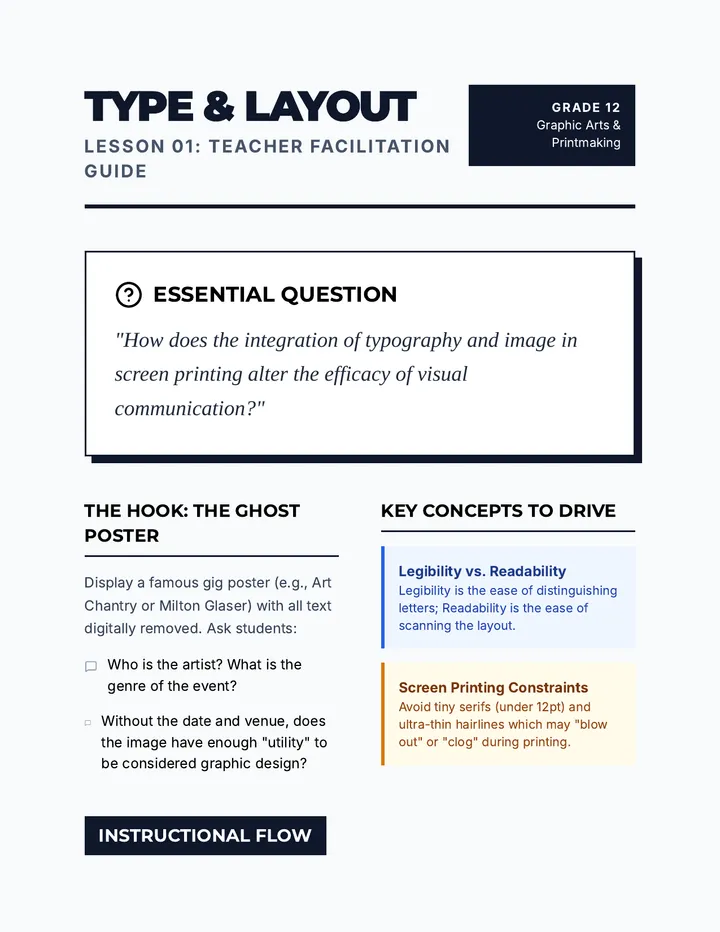
A comprehensive high school sequence exploring the technical and artistic intersection of screen printing and typographic design, from emulsion chemistry to final editioning.
A comprehensive 8th-grade sequence on relief printmaking, covering design reversal, carving safety, ink application, and the reduction printing process. Students move from basic concepts to producing a professional multi-color edition.
A comprehensive 8th-grade unit bridging traditional printmaking concepts with modern digital graphic design. Students explore typography anatomy, vector illustration, grid-based layouts, and digital color theory to create professional-quality visual communications.
An introduction to the intaglio printmaking family through drypoint etching on plastic plates. Students explore line weight, tonal variation, wiping techniques, and mixed media additions like chine-collé.
An 8th-grade unit exploring the intersection of Pop Art and screen printing. Students learn technical printmaking skills while investigating the social impact of mass-produced imagery.
A comprehensive 10th-grade course on screen printing, covering its historical roots, technical darkroom processes, and professional production workflows. Students transform graphic designs into mass-produced art.
A comprehensive introduction to digital graphic design and typography for 10th-grade students. This sequence bridges the gap between traditional art and modern vector-based technology, focusing on anatomy, hierarchy, logo design, and print preparation.
Students transition from relief printing to intaglio, mastering drypoint etching on plexiglass. The sequence covers plate preparation, scribing for texture and value, inking/wiping techniques, press operation, and advanced chine-collé methods.
This sequence explores the intersection of digital design and traditional printmaking. Students learn to combine the precision of vector graphics with the tactile, organic qualities of analog transfers and mixed media to create a professional 'hybrid' portfolio.
A teacher resource for setting up registration jigs and managing alternative substrate printing during the hybrid layering phase.
Discussion prompt cards for peer critique sessions, focusing on technical execution, mark-making, color theory, and conceptual growth in relief printing.
A professional self-assessment rubric and reflection sheet for students to evaluate their technical execution and conceptual growth during the reduction printing process.
A teacher guide for facilitating the final print exchange, managing the mock art fair, and evaluating the hybrid printmaking portfolios.
Final slides covering the reduction cycle culmination, edition curation standards, and professional signing conventions for fine art prints.
Final studio responsibility checklist for screen reclamation and equipment maintenance.
A student artist statement and valuation worksheet for participation in the final print exchange portfolio.
Teacher evaluation rubric and facilitation guide for Lesson 5, focusing on the creative pitch and final project mastery criteria.
A slide deck for the final print exchange, focusing on professional artist statements, valuation, and networking within the artistic community.
A troubleshooting guide for students to diagnose and correct common relief printing issues like over-inking, under-inking, and registration shifts.
Student reflection sheet for synthesizing typographic choices, technical challenges, and the essential question for the final portfolio.
Visual presentation for Lesson 5, exploring studio responsibility through screen reclamation and the synthesis of work through artist statements and portfolio assembly.