Communication strategies and policy frameworks for promoting the cultural and economic value of the arts. Addresses funding models, community engagement, and legislative outreach.
A comprehensive final project where students act as a creative agency to design a professional advertisement for a mini-brand, integrating photography, Photoshop editing, and design principles.
A collaborative art project where students navigate financial constraints to create high-quality mixed media sculptures, mimicking real-world commission and grant structures.
In this lesson, high school students explore the power of public art as a tool for social justice and community advocacy. They will analyze visual rhetoric in famous murals and design their own mural concept that honors the history and future of Camden, NJ.
A high school lesson exploring public art as a tool for social justice, specifically focused on the history and future of Camden, NJ. Students analyze visual rhetoric and design their own mural concepts.
Students gain 'x-ray vision' over large datasets by learning to sort and filter information. They explore conditional formatting to visualize trends and identify specific target segments within their market research data.
Students transition from data entry to data analysis by mastering fundamental spreadsheet formulas. They learn the power of the equals sign, cell referencing, and essential functions like =SUM, =AVERAGE, and =COUNT to automate business calculations.
Students explore the efficiency of automated data collection by linking their market research forms to live spreadsheets. They learn the concept of real-time data syncing and master the 'Freezing Rows' skill to manage large datasets effectively.
Students learn the art of professional survey design to gather market intelligence. They distinguish between quantitative and qualitative data, identify biased questioning, and build a multi-format survey in Google Forms or Microsoft Forms to collect clean data from their target audience.
This lesson introduces students to the fundamental structure of spreadsheet software. They learn about cells, rows, columns, and addresses while performing basic data entry and formatting to align with their brand identity.
Students transition from brand design to market analysis by distinguishing between demographic data (external facts) and psychographic data (internal values). They apply these concepts by building a formal User Persona for their brand, justifying their earlier design choices based on audience data.
Students participate in a professional 'Gallery Walk' to provide and receive constructive feedback on their Brand Style Guides and One-Pagers. They apply the 'Glow and Grow' framework to refine their designs, fulfilling standards for artistic critique and professional communication.
Students master the principle of visual hierarchy to lead a customer's eye through a design. They apply the 'Rule of Three' (Size, Weight, and Contrast) to create a professional brand 'One-Pager' in Canva, ensuring their most important brand assets receive maximum visibility.
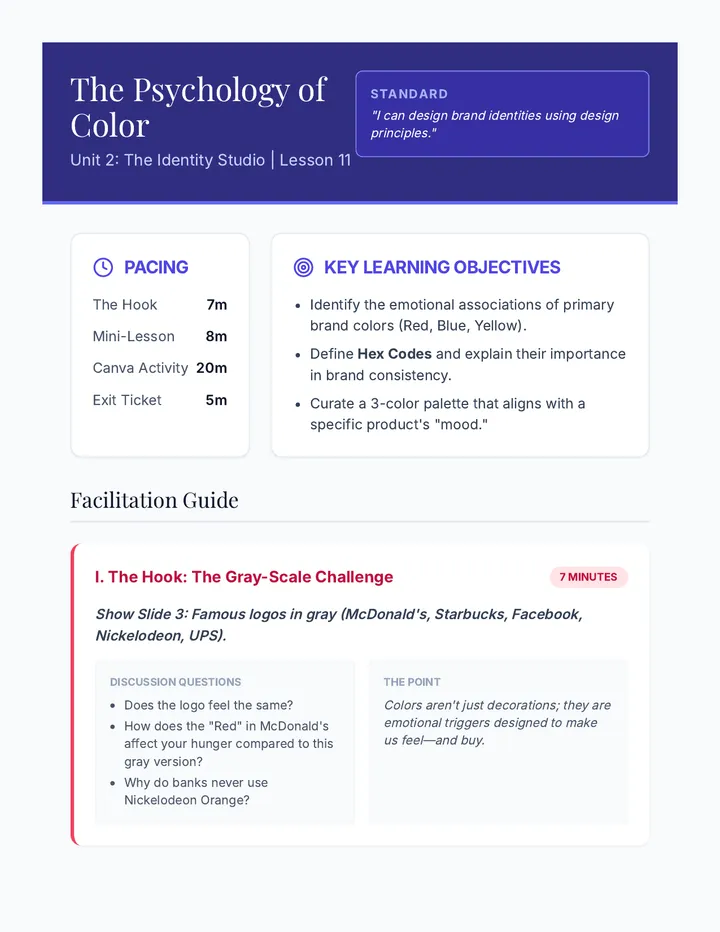
A unit focused on the visual principles of brand identity, moving from theory (color, type) to creation using vector-based tools like Google Drawing.
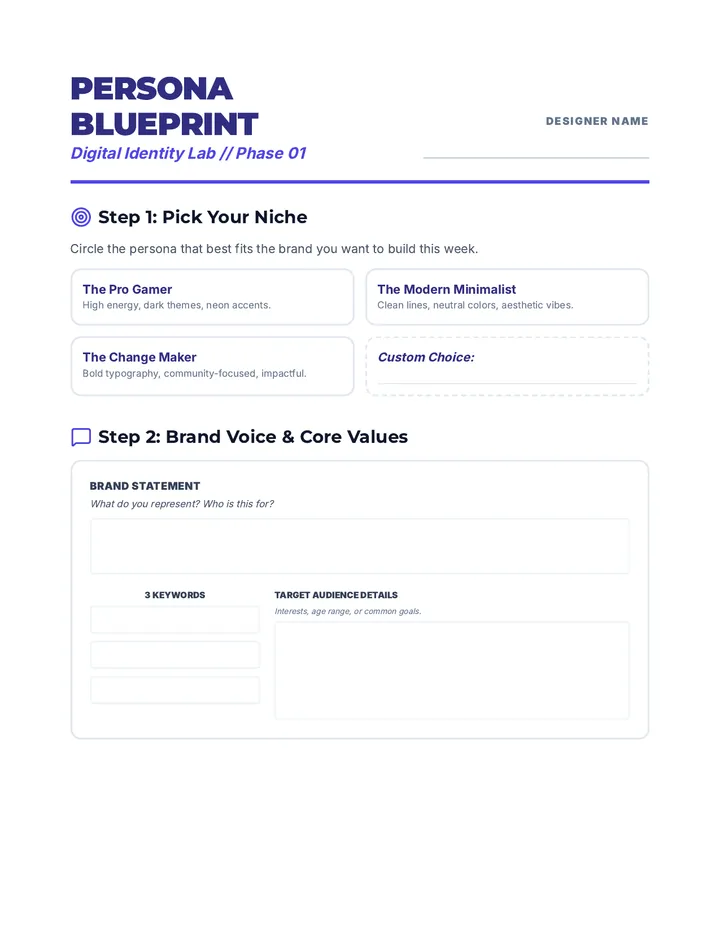
A 4-day project sequence where high school students explore their digital identity through personal branding in Canva and short-form video production in CapCut. Students choose a personal 'niche'—such as gaming, fashion, or social advocacy—to build a cohesive visual presence.
A comprehensive unit for Carl Hiaasen's Hoot, featuring chapter-by-chapter comprehension quizzes, teacher keys, and interactive slide decks.
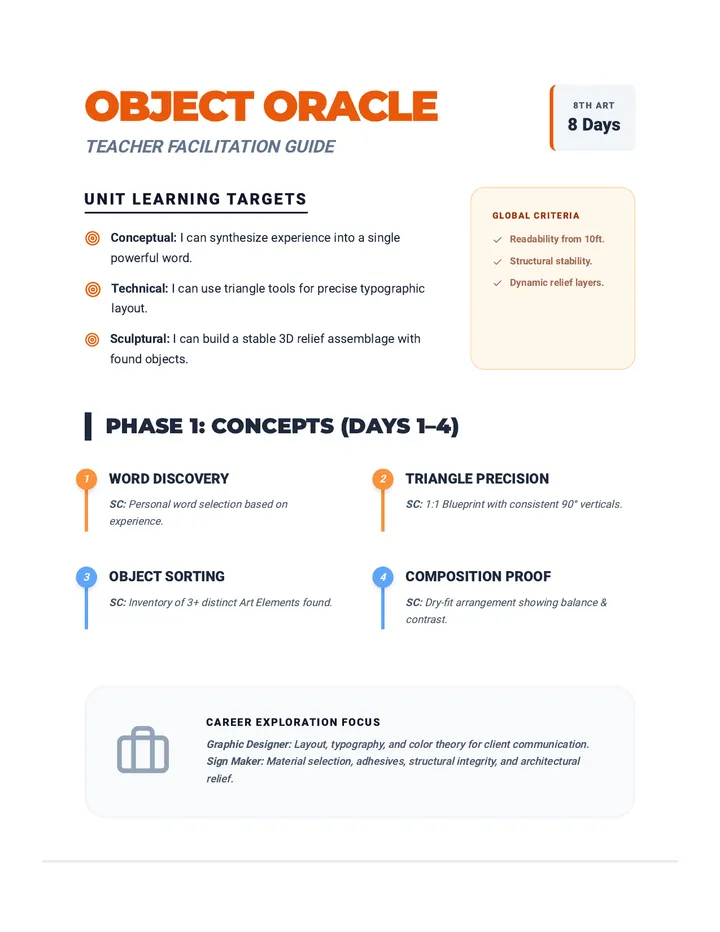
An 8-day 8th-grade art unit where students explore found object assemblage to create a 3D 'Word Art Poster'. The unit focuses on studio habits, careers in graphic design and sign making, and the integration of design principles into sculptural work.
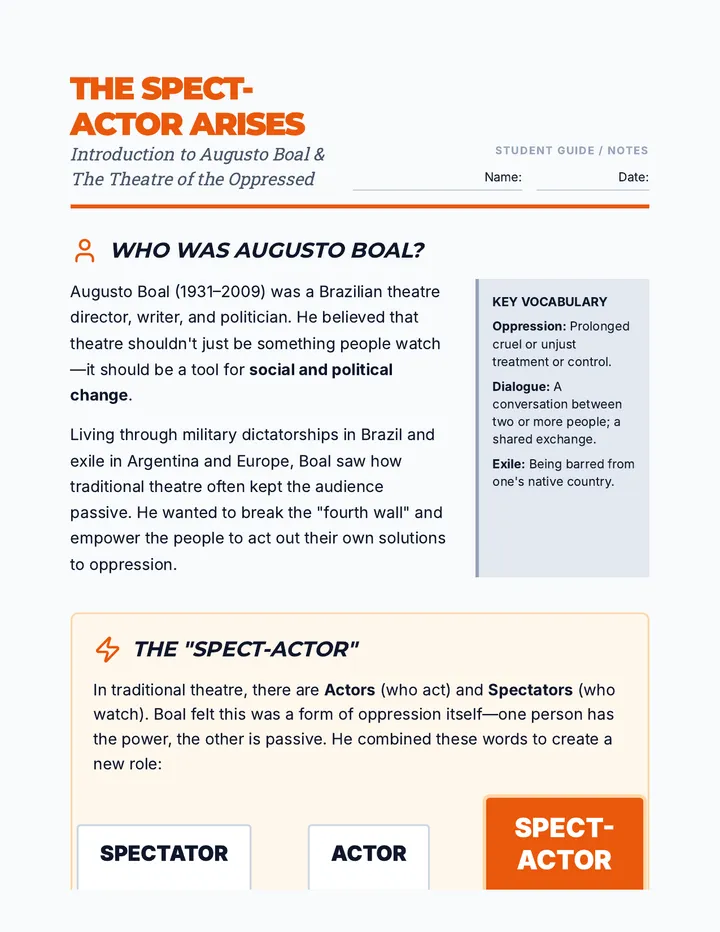
A multi-day unit exploring Augusto Boal's Theatre of the Oppressed, focusing on the transition from spectator to 'spect-actor' through Image and Forum Theatre to address contemporary social issues.
Une formation pour les professeurs-documentalistes centrée sur la médiation culturelle et l'accompagnement des pratiques de lecture des adolescents. L'objectif est de concilier la réalité de l'édition actuelle avec les missions pédagogiques du CDI.
This graduate-level sequence explores the intersection of labor law, fiscal strategy, safety protocols, and crisis management within professional theater production. Students develop the leadership skills necessary to navigate union environments and high-stakes technical environments.
An advanced course for graduate students focusing on the intersection of leadership, psychology, and complex logistics in professional theater production. Students master the art of stage management from script analysis to long-run performance maintenance.
This graduate-level sequence explores strategic communication for arts advocacy, focusing on cognitive framing, digital mobilization, crisis management, and media relations. Students develop a comprehensive campaign plan to influence public opinion and policy.
A graduate-level sequence exploring how arts leaders can build powerful, equitable cross-sector coalitions to sustain cultural ecosystems. Students move from systems mapping to governance design and grassroots organizing, culminating in a collective impact proposal.
A 10th-grade sequence exploring the economic systems that support the arts. Students analyze funding models, the multiplier effect, gentrification, and grant allocation, culminating in the creation of a professional economic impact statement.
A project-based sequence where 7th-grade students act as community organizers to launch an arts advocacy campaign, moving from needs assessment to a final pitch.
A teacher-facing rubric for assessing "The Big Pitch" project across photography, Photoshop editing, design principles, and presentation skills. Final single-page layout.
An introductory slide deck for "The Big Pitch" project, outlining the creative brief, timeline, photography requirements, and Photoshop workflow.
A professional milestone checklist for students to track their progress through the "Big Pitch" project, covering concept development, DSLR photography, Photoshop editing, and final graphic design. Updated to reflect classroom lighting and presentation prep.
Simplified teacher-facing guide for the Miniature Market project, focusing on core goals: money management, material variety, and scale. Logistics and pricing are updated for consistency and clarity.
Simplified project guide and market ledger for the Miniature Market micro-sculpture assignment, with punchy goals and clear rules. Washi tape and brads have been removed as per earlier instructions.
Introductory slides for the Miniature Market project, with simplified goals focusing on size, material variety, and budget management. Masking tape is included and brads are removed.
A structured project guide that leads students through the process of designing a community mural, from conceptualizing themes to choosing a location and drafting a visual composition.
A worksheet designed to guide students through the analysis of a real-world mural, focusing on color, symbolism, and audience to understand how public art communicates social messages.
A vibrant slide deck exploring the definition of public art, the principles of visual rhetoric, and the cultural history of Camden to inspire students' mural designs.
A comprehensive teacher's guide for the Mural Manifestos lesson, outlining instructional steps, learning objectives, and necessary materials to lead students through a project on public art and community advocacy in Camden.
A final 2-page project activity sheet with high-contrast grid lines, accessible labels (12px), and optimized page boundaries to ensure the footer remains on the second page.
A final version of the Camden Canvas Worksheet with optimized question grouping to prevent orphaned headers, larger work areas, and a cohesive 2-page flow.