Evolution of global dance traditions from ancient ritual roots to contemporary stage performances. Connects cultural movements, historical contexts, and key choreographic innovations across diverse societies.
Students work in small groups to 'curate' a stage for a world music festival. They select a region, choose instruments to feature, and explain why that music is unique.
Students listen to the drumming and singing styles of Native American tribes. They discuss the importance of the drum as the 'heartbeat' and the preservation of culture through powwow music.
Students investigate the wind and percussion instruments of South America, such as panpipes and maracas, and explore the connection between music and dance in Latin American cultures.
This lesson introduces the Pentatonic scale (5-note scale) common in traditional Chinese and Japanese music. Students listen to string instruments like the Koto or Erhu and compare them to the violin.
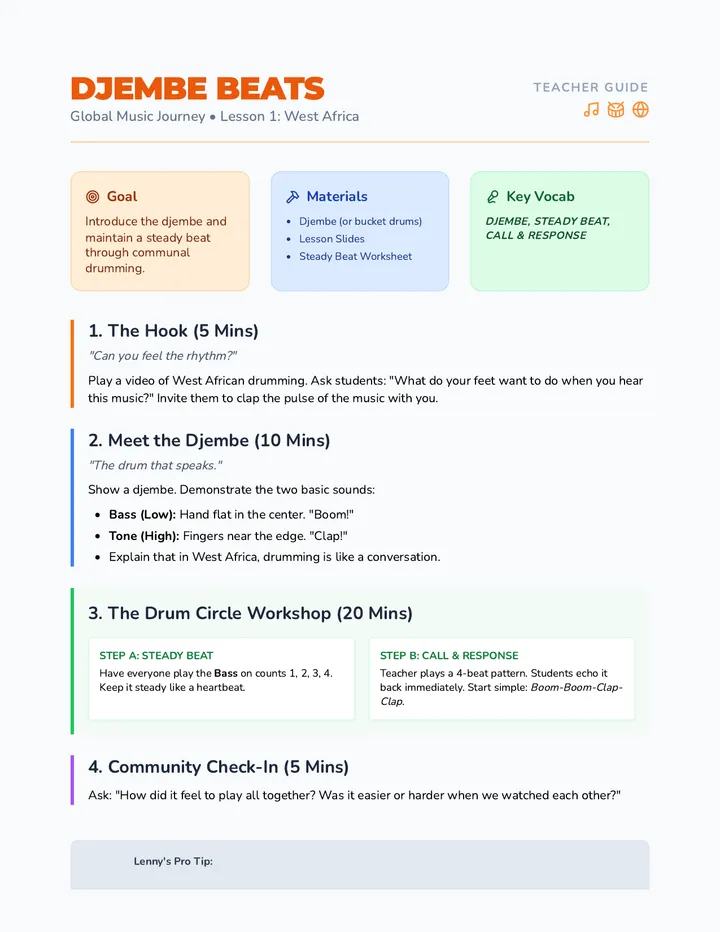
Students explore polyrhythms and the role of the Djembe drum in West African culture, learning how rhythm serves as a form of communication and community celebration.
A cumulative celebration where students synthesize their learning by creating a musical passport and identifying universal themes in global music making.
An exploration of American folk music where students discover the banjo and fiddle while learning how songs tell stories of history and daily life.
Students investigate the pan flute and the charango, learning about Andean festivals and experiencing traditional dance and pitch variation.
Learners explore the peaceful sounds of the guzheng and the pentatonic scale, practicing melodic improvisation on simple instruments.
Students discover the djembe and the vibrant traditions of West African drumming, focusing on maintaining a steady beat and participating in a call-and-response circle.
A celebratory final lesson where students combine their musical skills for a classroom parade, taking turns as musicians and dancers.
Through a game of Musical Statues, students differentiate between fast and slow tempos, practicing active listening and self-regulation.
Comprehensive teacher answer key and reference guide covering all five lessons in the "Global Rhythm Quest" sequence.
Student project planner for the "World Stage" festival, including budget tracking, a written pitch for a selected region, and a stage design blueprint area.
Visual presentation slides for Lesson 5, introducing the "World Stage" festival project, defining the curator's role, and providing an instrument catalog with "budget" pricing.
Teacher reference guide for Lesson 4, focusing on cultural protocols for teaching Indigenous North American music, key terminology, and listening facilitation strategies.
Student reflection worksheet for Lesson 4, featuring listening questions for Powwow music, vocabulary matching, and a creative response on cultural preservation.
Visual presentation slides for Lesson 4, exploring the spiritual significance of the drum in Native American cultures, the tradition of the Powwow, and the Native American flute.
Teacher guide for Lesson 3, covering the science of pitch in panpipes, facilitation for the straw activity, and instructions for teaching the Huayno dance step.
Student activity worksheet for Lesson 3, guiding students through a panpipe construction experiment with straws, pitch predictions, and material analysis.
Visual presentation slides for Lesson 3, introducing Andean geography, the physics of panpipes (Siku), and cultural instruments like the Charango and Maracas.
Teacher reference guide for Lesson 2, providing cultural context, scale theory, suggested listening tracks, and discussion prompts for Asian musical traditions.
Student worksheet for Lesson 2, including pentatonic scale visualization, instrument comparison (Erhu vs. Violin), and a listening log for Silk Road melodies.
Visual presentation slides for Lesson 2, exploring the Silk Road, the Pentatonic scale, and traditional instruments like the Koto and Erhu.
A 5-lesson sequence for 3rd graders exploring the music and instruments of West Africa, Asia, the Andes, and North America, focusing on how geography and culture shape sound.
A global musical journey for Kindergarten students to explore traditional folk music, instruments, and rhythms from West Africa, East Asia, the Andes, and North America. Students build cultural awareness and musical skills through hands-on drumming, melodic improvisation, and storytelling songs.
A vibrant and active introduction to Hispanic music and culture for Kindergarten students. Students explore the Spanish guitar, maracas, dance steps like Salsa, and concepts of tempo through hands-on making, movement games, and collaborative performance.
A first-grade introduction to global dance traditions, exploring dance as communication, storytelling, community building, and performance art. Students learn basic movements from Hula, folk dances, and ballet while developing cultural appreciation and creative expression.
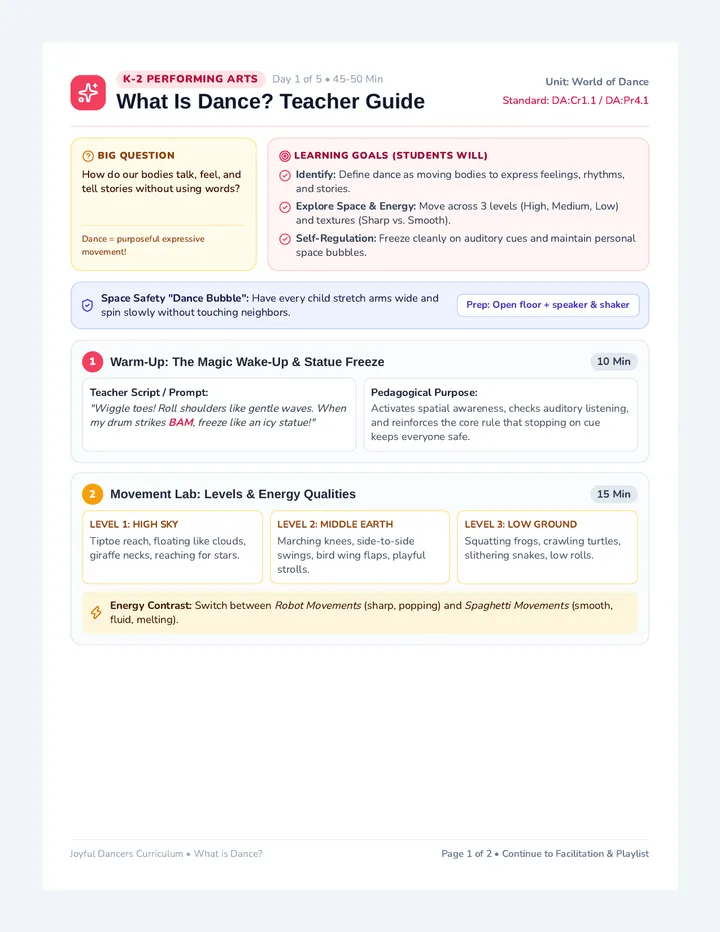
A Kindergarten dance unit exploring global traditions, storytelling through movement, and community celebration. Students learn how different cultures use dance to express feelings and history.
A comprehensive 12th-grade dance sequence investigating how rhythmic structures shape body mechanics across West African, Latin, Urban, and contemporary dance forms. Students engage in physical practice and cultural analysis to understand dance as a global percussive language.
This 10th-grade sequence explores the intersection of globalization, technology, and dance culture. Students analyze Bollywood's fusion, K-Pop's global marketing, the ethics of cultural appropriation, and the impact of social media on choreography, culminating in a respectful cross-cultural fusion proposal.
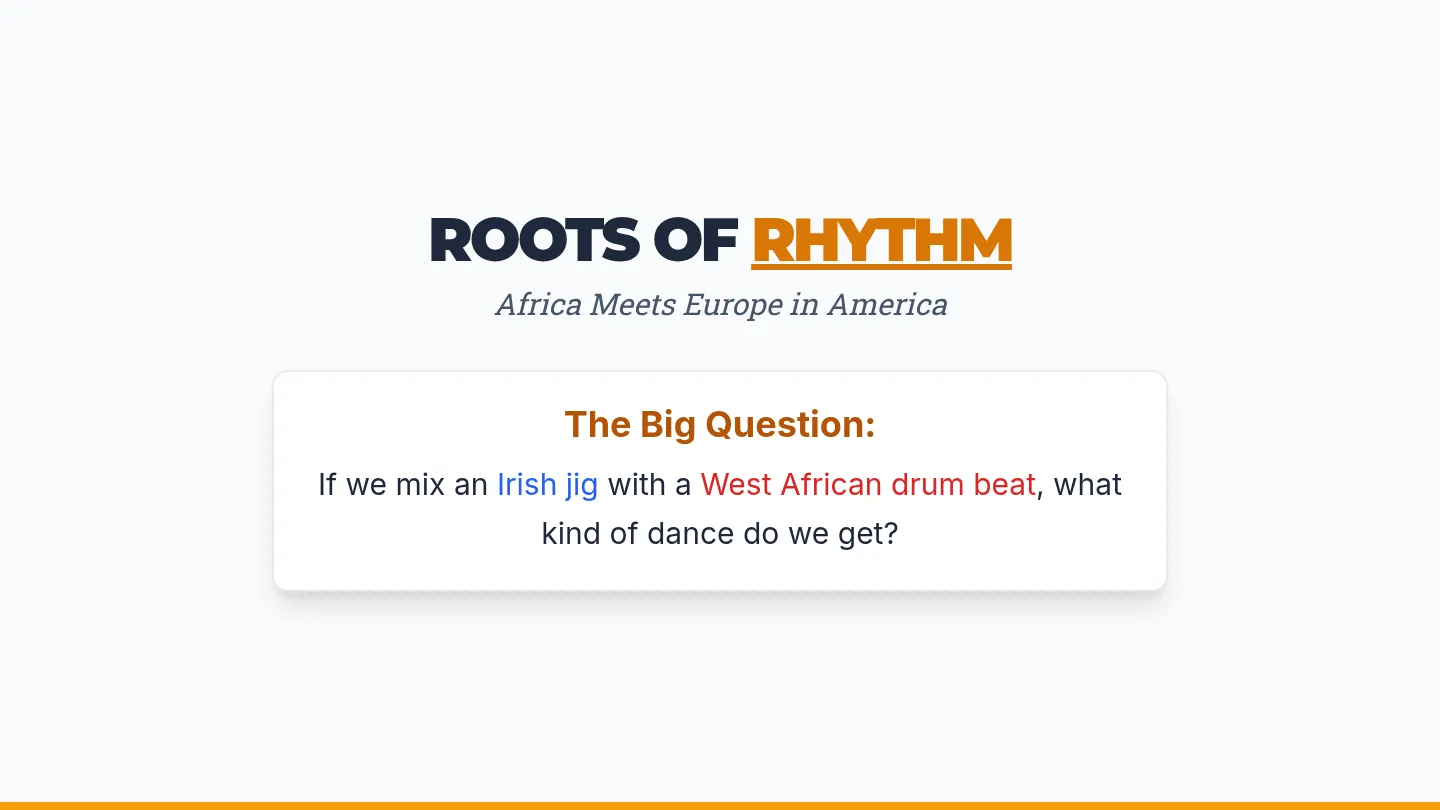
A comprehensive exploration of the African Diaspora's influence on global vernacular dance, tracing movement traditions from West Africa through the plantation era to the birth of Jazz, Tap, and Hip Hop. Students analyze how rhythmic innovation served as a tool for cultural preservation and resistance.
A comprehensive 10th-grade dance history unit tracing ballet from its origins in Renaissance courts to its 20th-century neoclassical evolution. Students analyze how political power, social structures, and technological innovations shaped technique and aesthetics.
A comprehensive 10th-grade sequence exploring the evolution of modern dance from the early 20th century to the post-modern era. Students analyze the philosophical and social drivers behind movement revolutions, connecting dance to psychology, politics, and the definition of art.
A 10th-grade dance history sequence exploring the anthropological roots of dance. Students investigate how ancient and indigenous cultures utilized movement for ritual, social cohesion, and martial purposes, eventually analyzing the ethics of modern preservation.
This sequence explores the evolution of dance in the 20th and 21st centuries, focusing on how globalization and the African Diaspora have reshaped the concert dance canon. Students analyze Hip Hop, Butoh, and contemporary fusion to understand the shifting boundaries of 'high art'.