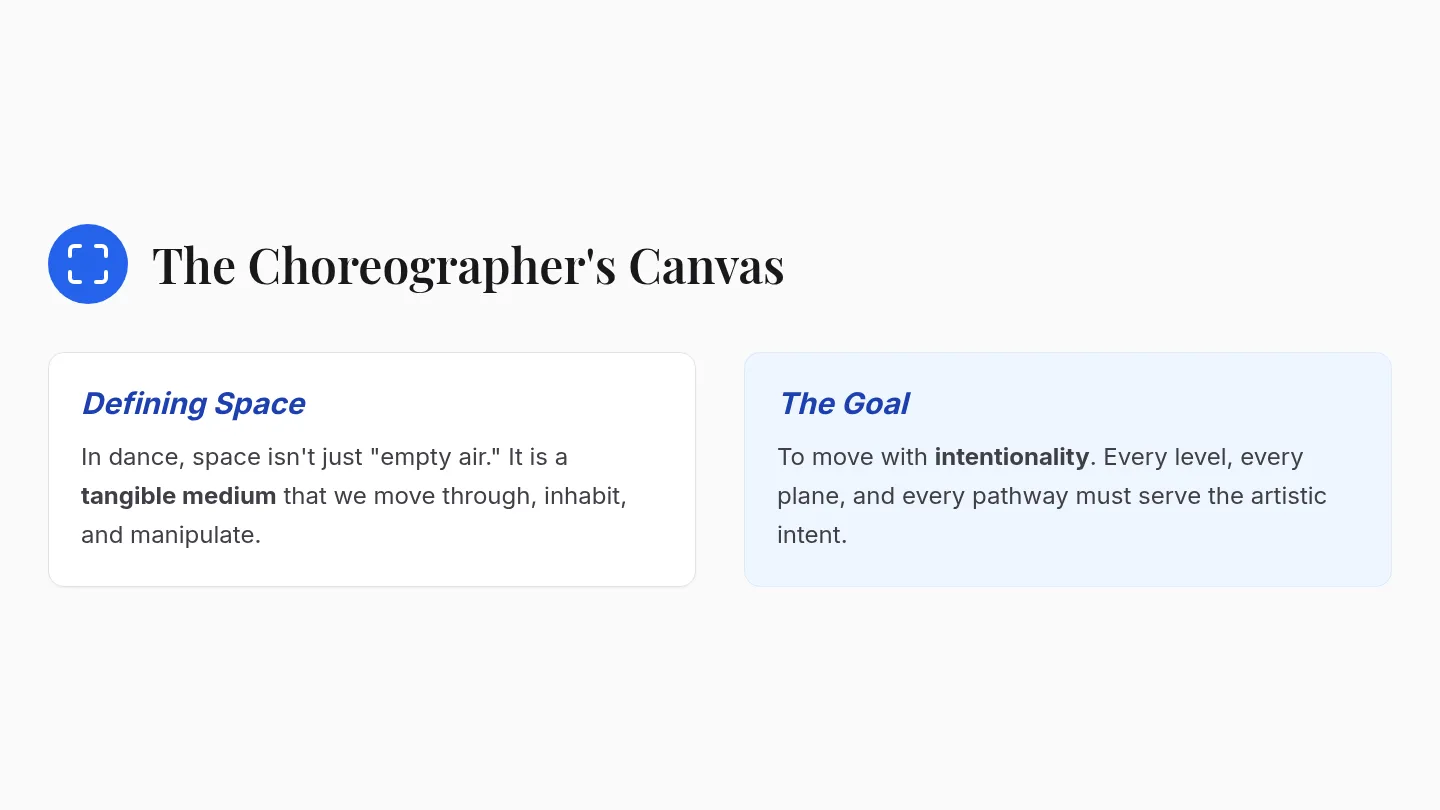
Movement composition, spatial awareness, and rhythmic structure. Develops skills in motif development, improvisation techniques, and stagecraft for performance-ready sequences.
A final mastery-based lesson where students present research findings through performance-lectures.
Translating dense theoretical abstracts into choreographic scores to analyze the architecture of arguments.
Learning to codify movement using Laban's Effort factors as a tool for qualitative data analysis.
Utilizing the Mover/Witness discipline to access and transcribe subconscious kinetic data.
Students engage with Merleau-Ponty and Husserl, translating theoretical 'lived body' concepts into movement experiments.
Culminates the sequence with a long-form instant composition performance, demonstrating ensemble mastery and compositional rigor.
Investigates the history and practice of indeterminate scoring, using constraints to drive experimental movement.
Develops the skill of real-time editing, distinguishing intentional composition from unstructured 'jamming.'
Explores Contact Improvisation as a performance tool, emphasizing weight-sharing and physical listening to create narrative tension.
Focuses on deconstructing the Viewpoints technique to heighten spatial and temporal awareness within an ensemble.
A culminating practicum where students lead a creative movement session and receive peer critique on their facilitation techniques.
Research and apply sensory-friendly practices and scaffolding techniques for neurodiverse populations in movement settings.
Planning worksheet for the final performance-lecture presentation, featuring a multi-column timeline for scripting and movement scoring.
Research-focused assessment rubric for the final performance-lecture, evaluating somatic integration, theoretical rigor, and movement analysis application.
Final slide deck for Lesson 5, defining the performance-lecture format and its role in embodied research presentation.
Worksheet for mapping a theoretical text to a choreographic score, featuring a spatial floor plan area and a detailed transcription table.
Introductory presentation for Lesson 4, exploring the transposition of theoretical texts into choreographic scores for research analysis.
A sleek, minimalist program template for students to document their ensemble performance and list their specific movement scores.
Comprehensive feedback and reflection tool for both peer observers and the lead facilitator following the practicum session.
Final performance protocol slides for the Ensemble Instant Composition Showcase, detailing duration, success criteria, and prompts.
Worksheet for practicing the codification of movement using Laba Effort factors, with sections for gesture analysis and research synthesis.
Planning document for the facilitation practicum, requiring students to architect a 5-minute movement session with somatic anchors and safety audits.
Final slide deck for the culminating practicum, focusing on the concepts of group flow, collective attunement, and the peer critique framework.
A structured template for graduate students to design and document their own indeterminate movement scores and algorithms.
A graduate-level sequence exploring creative movement as a rigorous Practice-as-Research (PaR) methodology. It bridges phenomenological philosophy and somatic practice to investigate academic questions through the body.
A high-level graduate sequence exploring the transition from solo improvisation to complex ensemble instant composition, utilizing Viewpoints, Contact Improvisation, and indeterminate scoring.
A graduate-level sequence exploring advanced pedagogical frameworks for creative movement facilitation. Students deconstruct somatic cues, developmental patterns, trauma-informed practices, and neurodiverse scaffolding to design inclusive and effective movement workshops.
This Pre-K dance sequence explores how students can use their bodies to tell stories and express emotions. Students move from identifying feelings and simple actions to choreographed nature cycles and character studies, culminating in a collaborative narrative dance performance.
Students explore movement dynamics including speed, weight, and texture to understand how energy changes choreography. This Pre-K unit uses imagery and play to build foundational dance skills and creative expression.
Kindergarten students explore the foundations of dance composition through creative play, investigating how to link movements into coherent patterns and sequences.
A vibrant and active introduction to Hispanic music and culture for Kindergarten students. Students explore the Spanish guitar, maracas, dance steps like Salsa, and concepts of tempo through hands-on making, movement games, and collaborative performance.
A first-grade introduction to global dance traditions, exploring dance as communication, storytelling, community building, and performance art. Students learn basic movements from Hula, folk dances, and ballet while developing cultural appreciation and creative expression.
A Kindergarten dance unit exploring global traditions, storytelling through movement, and community celebration. Students learn how different cultures use dance to express feelings and history.
A high-energy dance sequence for Pre-K students focusing on body isolations, dynamics, rhythm, and stylized movement through a 'Neon Jungle' theme. Students will learn the building blocks of jazz dance while developing coordination and musicality.
A whimsical introduction to spatial awareness and body control for Pre-K dancers, using the 'personal bubble' concept to teach safety, levels, pathways, and the art of the freeze. Students progress from static space-making to dynamic obstacle course navigation.
A high-energy introduction to Jazz dance for Kindergarteners, focusing on rhythm, isolations, parallel alignment, and movement dynamics. Students learn to find the beat, move individual body parts, and perform a basic jazz combination.