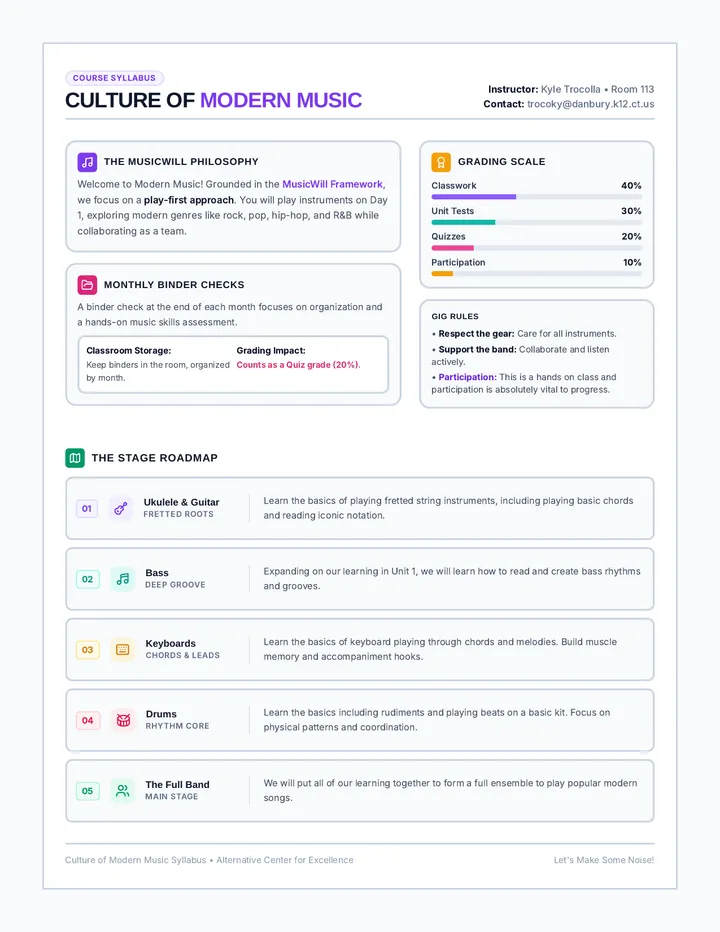
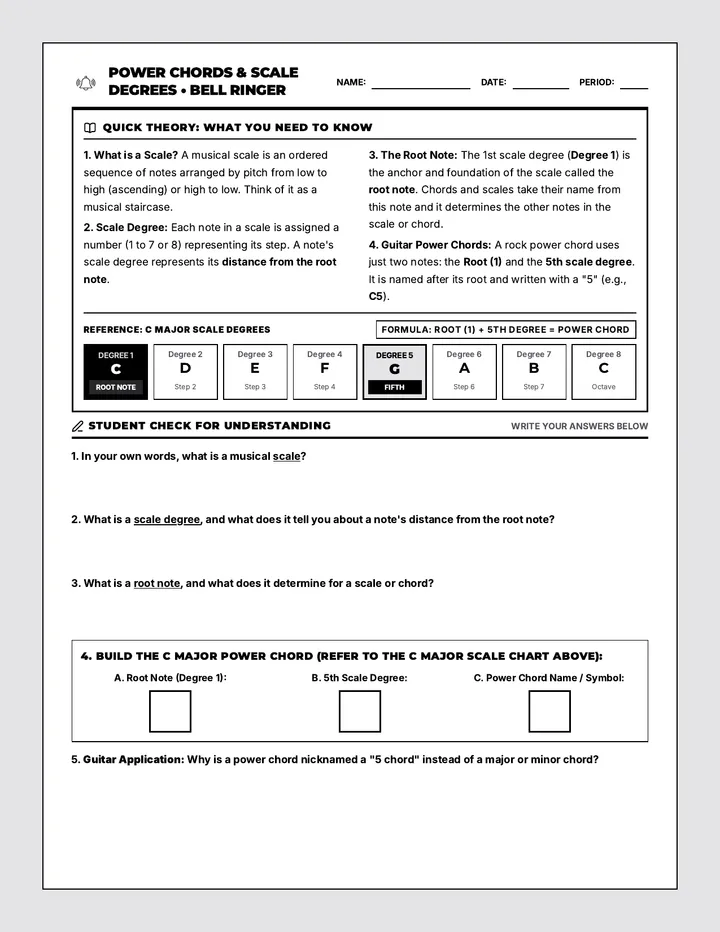
Fundamental notation, instrumental proficiency, and vocal techniques across various genres. Connects historical analysis with original composition and creative performance skills.
An advanced exploration of Homestuck's universe, focusing on Sburb/Sgrub game mechanics, Troll hierarchy, classpect taxonomy, and complex narrative timelines.
A highly niche, technical trivia lesson analyzing the creative paths, obscure internet lore, and overlapping fanbases of cult figures Ryan Ross, Toby Fox, and Andrew Hussie. Designed for adult or college-level pop culture and game design fans.
A comprehensive poetry and music production unit for adult HSED students. It integrates poetry analysis, hip-hop lyricism, emotional self-expression (SEL), and digital audio production concepts into a cohesive, print-ready student workbook and teacher guide.
A creative lyric analysis and songwriting lesson exploring Ryan Ross's influential role as a lyricist in the mid-2000s alternative and baroque-pop music scene. Students analyze his verbose, theatrical style and write their own historically-inspired lyrics.
A comprehensive lesson that breaks down the structural, rhythmic, and poetic elements of hip-hop and rap lyrics. Students learn complex rhyming, flow cadence, figurative imagery, and wordplay, then plan and write a complete 16-bar verse using highly visual scaffolding.
A lesson dedicated to learning the fundamentals of major scales on the piano, beginning with pentatonic scales. Contains an interactive multi-page mini booklet with keyboard coloring, staff notation trace-and-write, and fingering guides.
An exploration of nineteenth-century Portsmouth shipyards through historical sea shanteys, teaching upper elementary students about rhythm, labor history, and call-and-response song structures.
A comprehensive digital music portfolio project where students curate, analyze, and reflect on their musical creations using DAWs, notation tools, and audio recordings. This unit guides students through selecting their best work, performing deep artist analysis, and presenting a professional digital portfolio.
A Disney-inspired interdisciplinary choice board and support materials for 2nd grade. Students explore math, language arts, art, music, and science through engaging, magical challenges that promote agency and creativity.
An energetic introduction to syncopation and rhythmic complexity where students learn to identify, count, and compose 'off-beat' patterns. Students explore how shifted accents create groove in modern and historical music styles.
Курс з екстремального скату та сучасного музичного продакшну, що поєднує абсурдну фонетику з агресивними бітами (phonk, hardbass, trap).
An advanced exploration of microtonal music, covering the physics of pitch, tuning systems beyond 12-TET, and practical experimentation with quarter-tones and just intonation.
An interactive 4-page worksheet booklet that introduces Major Pentatonic Scales. Students learn C, G, F, and D Major Pentatonic scales through keyboard coloring, staff notation trace-and-write, and finger-number matching guides.
A granular pedagogical manual detailing Lessons 19 to 36 of the Kindergarten Music Curriculum. Each lesson plan outlines a precise 25-minute chronological guide covering advanced solfege, ensemble playing, simple bordun, and improvisation.
A granular pedagogical manual detailing Lessons 1 to 18 of the Kindergarten Music Curriculum. Each lesson plan outlines a precise 25-minute chronological guide covering voice exploration, steady beat, high/low, and fast/slow.
The comprehensive year-long curriculum map, pacing guide, and repertoire list for Kindergarten Music, detailing the pedagogical approach, 25-minute class routine, quarterly focal points, and a curated master repertoire list.
Iconic notation song chart for Creedence Clearwater Revival's classic 'Fortunate Son'. Revised to incorporate the steady eighth-note '1+2+3+4+' strumming pattern (Down-Up Down-Up Down-Up Down-Up) directly into the Intro section.
A 25-question multiple-choice exam for primer-level piano students, covering posture, finger numbering, keyboard geography, notation, and basic theory concepts. Revised with robust SVG-based musical symbols and a condensed layout for better printing.
A 25-question multiple-choice exam for primer-level piano students, covering posture, finger numbering, keyboard geography, notation, and basic theory concepts. Revised with CSS-based musical symbols to ensure consistent rendering and improved page flow.
A teacher's answer key for the Piano Primer Exam, including correct answers, key concept tags, and a basic scoring rubric. Revised with full text answers, higher contrast, and corrected terminology.
A 25-question multiple-choice exam for primer-level piano students, covering posture, finger numbering, keyboard geography, notation, and basic theory concepts. Revised with proper musical symbols, corrected terminology, and optimized page flow.
A teacher's answer key for the Piano Primer Exam, including correct answers, key concept tags, and a basic scoring rubric. Revised with full text answers and improved layout.
A 25-question multiple-choice exam for primer-level piano students, covering posture, finger numbering, keyboard geography, notation, and basic theory concepts. Revised to include the C major chord and improved page breaks.
An introductory exploration of jazz music for K-2 students, centering its Black American roots and legendary pioneers through listening, speaking, and creative expression.
A K-12 collaborative music video project where students across all grade levels work together to produce a 'Playing for Change' style cover of a protest song centered on equality and cultural identity. High school students lead production, while K-8 students provide the musical and visual heart of the performance.
A comprehensive 6-lesson unit for 5th graders exploring the history, evolution, and legendary figures of American Jazz, from its New Orleans roots to its global legacy today.
An immersive workshop-style sequence for 2nd graders exploring the roots of Jazz, Blues, and Folk music through call-and-response, syncopation, and improvisation. Students trace American musical history from work songs to the Swing era through active music-making.
Students explore the world of Jazz through rhythm, syncopation, and improvisation. They'll meet legends like Louis Armstrong and Ella Fitzgerald while learning to find their own musical voice through 'swing' and scat singing.
A 5th-grade music history sequence exploring the development of Jazz and Blues, from African call-and-response roots to the birth of Rock n' Roll. Students investigate structural forms like the 12-bar blues, concepts like syncopation and improvisation, and the cultural resilience behind the music.
This sequence introduces Kindergarteners to the distinctly American art forms of Jazz and Blues, focusing on emotion and spontaneity. Students explore the 'swing' feel, improvisation, and scat singing through active movement and vocal play.
Students explore the relationships between notes, focusing on intervals (steps, skips, leaps) and the construction of the C Major scale. Using solfege, hand signs, and aural analysis, students learn to identify and dictate melodic patterns in simple folk music.
A 5-lesson sequence for 2nd graders to master reading pitch on the musical staff, moving from high/low discrimination to reading 3-note melodies using Solfege.
An inquiry-based journey into the logic of pitch organization, covering the Grand Staff, major scale construction, the Circle of Fifths, relative minors, and sight-singing applications. Students use a 'decoding' lens to master the patterns that govern tonal music.
A 1st-grade music sequence focusing on pitch discrimination, melodic contour, Sol-Mi intervals, and the basics of the musical staff through movement and composition.
A rigorous sequence on music theory, covering intervals, triads, seventh chords, Roman numeral analysis, and four-part voice leading for 12th-grade students.
A comprehensive, year-long curriculum for Kindergarten Music. It contains a detailed Scope and Sequence Document and two highly granular Lesson Structure Manuals detailing 36 distinct bi-weekly lesson plans.
A first-week music lesson that scaffolds decoding names into rhythmic patterns. Students map syllables to quarter notes (Ta) and eighth notes (Ti-Ti) to create a collective classroom rhythm groove.
A high-energy, 100-question trivia game designed for middle school students, covering modern music, movies, fashion, and black history. The lesson promotes cultural literacy and engagement through a competitive game format.
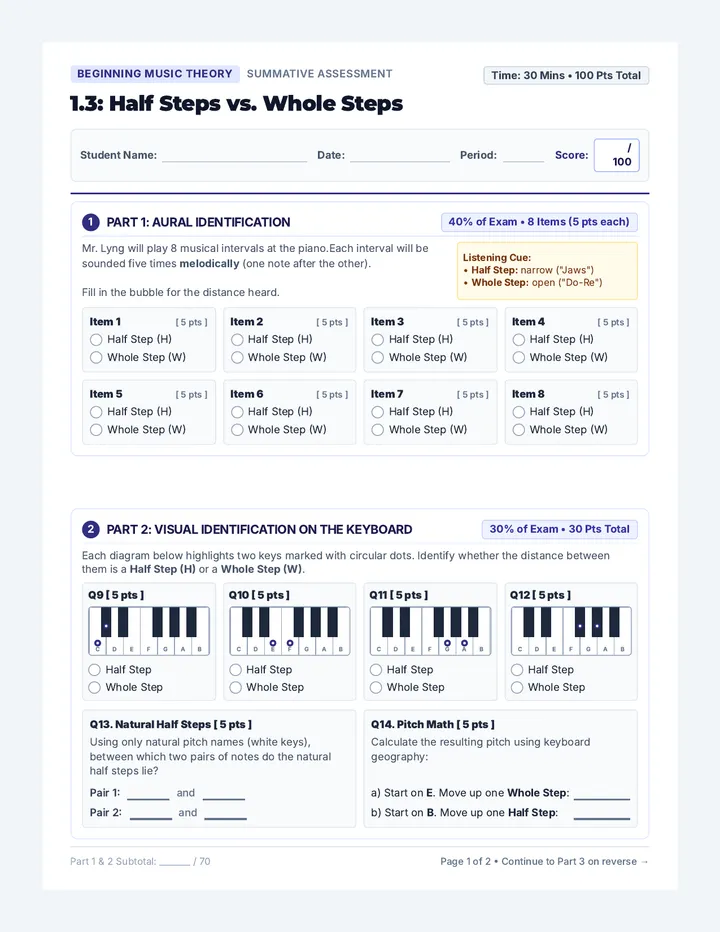
A comprehensive assessment covering foundational piano concepts for beginner students, including posture, notation, rhythms, and basic theory.
A delightful introduction to melody and pitch through the lens of Idaho's native birds. Students use scarves and vocal play to connect physical movement with melodic contour.
A complete 4-hour substitute teacher plan exploring the history of the Harlem Renaissance and its modern influence on jazz music and culture.
Students climb the musical mountains to distinguish between high and low sounds through active listening and visual mapping.
An adventure through the desert to discover piano and forte, using environmental sounds and vocal exploration to understand volume.
Students explore the difference between steady beat and rhythm using animal movements and simple rhythmic patterns (quarter and eighth notes).
A comprehensive make-up assignment for students who missed a performance, requiring a detailed 5-paragraph review of a world-class orchestral concert with research and personal critique.
A journey through the 20th and 21st centuries, exploring how technology like electric guitars and synthesizers shaped genres from Rock 'n' Roll to Pop. Students analyze rhythm, structure, and sound to build a chronological timeline of musical evolution.
A global musical expedition for 2nd graders to discover how geography and culture shape instruments and traditions across four continents. Students explore materials, physics of sound, and the cultural roles of music through inquiry and hands-on activities.
A 5-lesson sequence for 2nd graders exploring how classical composers use musical elements to tell stories and express emotions. Students 'meet' famous composers like Vivaldi and Beethoven, identifying tempo, dynamics, and leitmotifs in iconic works.
A comprehensive introduction to the four families of the orchestra for 2nd graders. Students explore timbre, mechanics, and historical roles of strings, woodwinds, brass, and percussion, culminating in a conductor simulation.
A 5-lesson sequence for 3rd graders exploring the music and instruments of West Africa, Asia, the Andes, and North America, focusing on how geography and culture shape sound.
This sequence explores how technology—from the electric guitar to digital software—transformed music from the mid-20th century to today, focusing on genre evolution, song structure, and production.
A comprehensive introduction to the orchestra and the Classical era for 3rd graders, covering instrument families, specific sections, key composers (Mozart and Beethoven), and the art of conducting.
A 3rd-grade music history and appreciation unit exploring the roots of American folk and blues music, focusing on oral traditions, storytelling, and musical structures like call-and-response and the AAB blues form.
This sequence investigates how the technological explosion of the 20th and 21st centuries, from the electric guitar to AI, redefined music genres and creation. Students analyze production techniques, listen for layers, and explore the concept of technology as a musical instrument.
This project-based sequence takes students on a global tour as ethnomusicologists, examining how geography and culture influence musical instruments and sounds. Students classify instruments using the Hornbostel-Sachs system and explore rhythms and scales from Africa, Asia, and Latin America.