A comprehensive 60-minute introductory music lesson exploring rhythm, melody, dynamics, and tempo through the lens of a 'Sound Lab'. Students act as scientists to experiment with musical elements.
A creative craft lesson where students color and create their own finger puppets of favorite Zootopia characters to practice storytelling and role-playing.
A primary art lesson exploring the beauty of nature and our role in keeping the Earth clean. Students observe natural wonders and create their own "Earth Treasures" using drawing and sculpting materials.
A hands-on activity for students to identify and match various line types used in art, from basic directional lines to complex decorative patterns.
A comparison of Shakespearean theater practices, focusing on the historical context of boy actors and social reactions to the stage across different reading levels.
A high-energy, creative workshop for 4th-grade ESL students to explore cultural music and dance through storytelling and instrument making. Designed to be fun and engaging after state testing, focusing on oral language and creative expression.
A fun, creative lesson for 4th-grade ESL students focusing on the intersection of music, dance, and storytelling. Designed for a substitute teacher to implement after state testing, it includes a presentation, a storyboard activity, and a hands-on mask-making craft.
A 45-minute TAB-style lesson where students explore cardboard construction techniques to create sculptures that represent their personal preferences and experiences. Students practice distinguishing their artistic choices from those of their peers.
A creative art lesson focused on watercolor techniques using Easter-themed outlines, designed for upper elementary and middle school students.
A collaborative Earth Day lesson where students create a class book inspired by Louis Armstrong's 'What a Wonderful World'. Includes a detailed teacher guide and presentation slides with a video embed.
The final premiere of the music video at the All-town Music Tech Showcase, followed by a live performance and student reflection on the collaborative process.
The technical phase involving on-location recordings at elementary and middle schools, followed by high school student-led mixing and video production.
Introduction to the 'Playing for Change' concept, exploring the themes of the chosen protest song, and laying the groundwork for the K-12 collaboration.
A comprehensive lesson on the seven Elements of Art (Line, Shape, Color, Value, Form, Texture, and Space) culminating in a Jeopardy-style review game to test student knowledge and application.
A theatrical exploration of Saint-Saëns' 'The Carnival of the Animals' where 2nd graders act as casting directors to match musical traits like tempo and pitch to animal characters.
Students explore the science and art of sound by constructing DIY instruments from recycled materials. The lesson emphasizes individual creative design followed by a collaborative team performance.
An introductory lesson on the anatomy and mechanics of the violin, including labeling parts and understanding their functions.
A series of rhythm reading flashcards and a teacher's guide covering basic to advanced rhythmic patterns. Activities progress from quarter notes and rests to complex sixteenth notes and triplets across multiple time signatures.
A creative art lesson inspired by 'The Dot' by Peter H. Reynolds, focusing on growth mindset and artistic experimentation. Students will learn that 'making your mark' starts with just one small step.
A creative art lesson where students explore identity and diversity by creating their own mixed-up animals inspired by Eric Carle's colorful collage style. Students will learn the 'painted paper' technique to create vibrant textures.
In this 60-minute art lesson, students transform everyday waste—cardboard and bottle caps—into imaginative 'Eco-Creatures,' learning about the importance of recycling and creative reuse for Earth Day.
Students design and build their own paper finger puppets and a tabletop stage using markers and paper. This project combines visual arts with storytelling and performance.
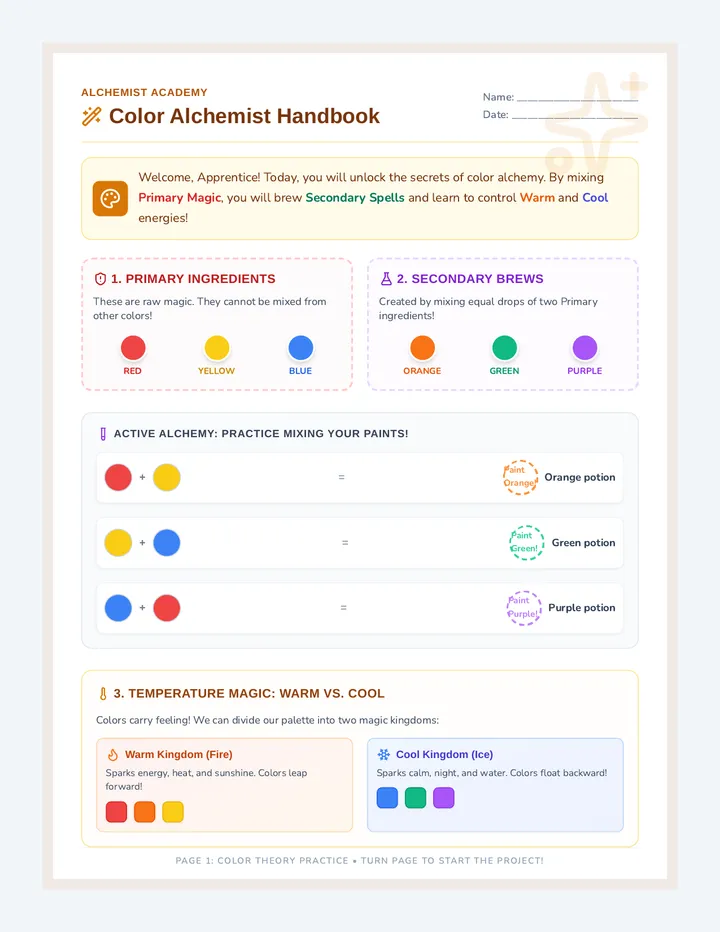
A hands-on art and language arts lesson where students explore color temperature by pairing warm and cool colors with antonyms. Students create a visual 'Opposite Wheel' to demonstrate their understanding of both color theory and vocabulary.
Focusing on 'The Mixed-Up Chameleon,' this lesson explores the vibrant world of colors and animal traits through layered collage and mixed-media art.
Focusing on 'The Very Busy Spider,' this lesson explores the themes of hard work and persistence while teaching students how to create tactile textures in their art using mixed media.
Focusing on 'The Very Hungry Caterpillar,' this lesson teaches students about the life cycle of a butterfly through the lens of Eric Carle's signature tissue paper collage technique.
A guide for young artists on navigating a makerspace with respect and creativity, focusing on material exploration and studio etiquette.
A creative art and science lesson where second graders explore bilateral symmetry through monotype printing. Students learn about pollinator anatomy and color mixing while creating unique butterfly or moth prints.
A hands-on exploration of primary color mixing using colored transparencies. Students act as 'Color Chemists' to discover how layering red, blue, and yellow creates new colors.
A high-energy, multi-sensory lesson for 3rd and 4th graders focusing on the pentatonic scale through movement and tactile manipulatives. This lesson is specifically designed to support students with dyslexia and ADHD.