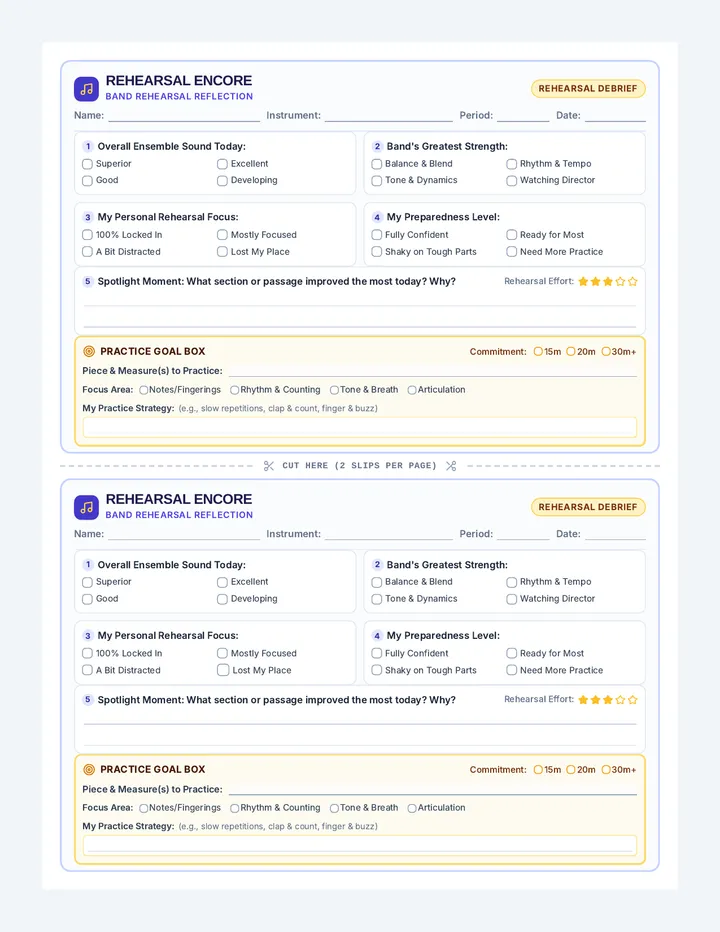
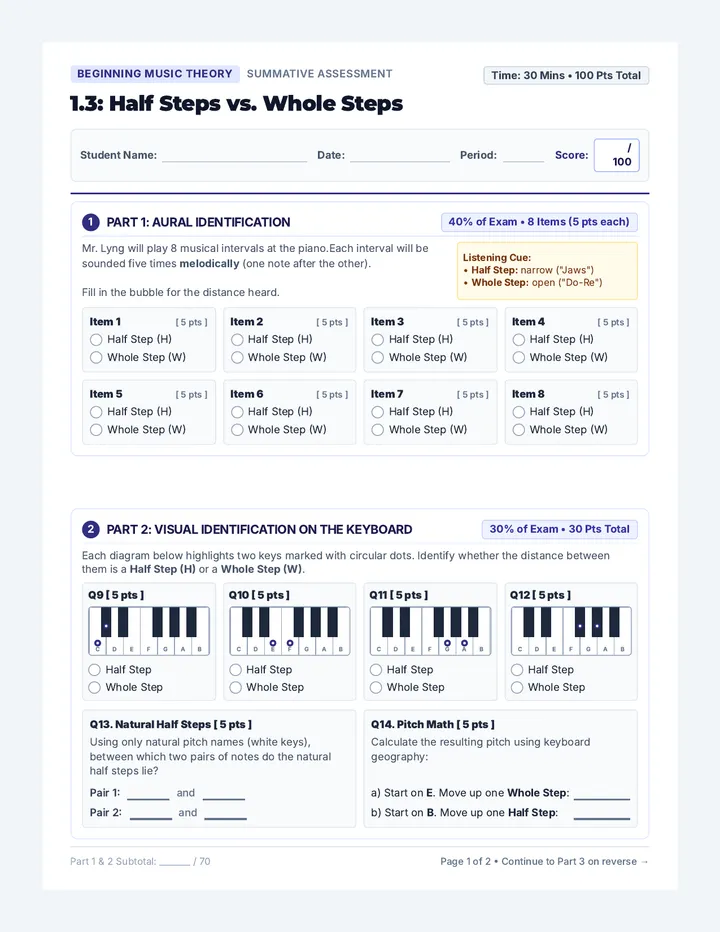
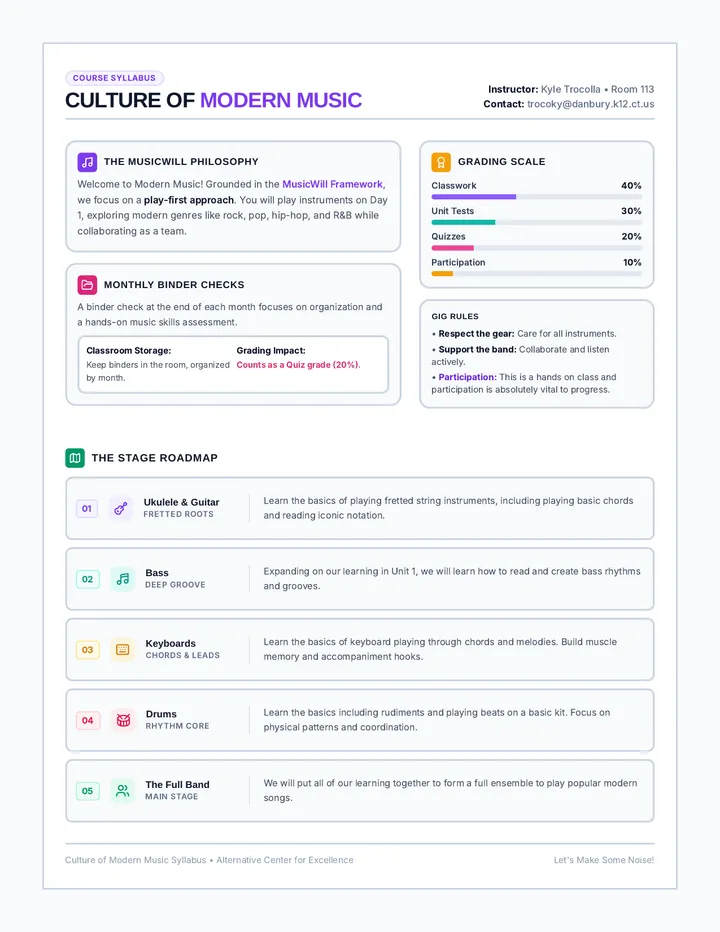
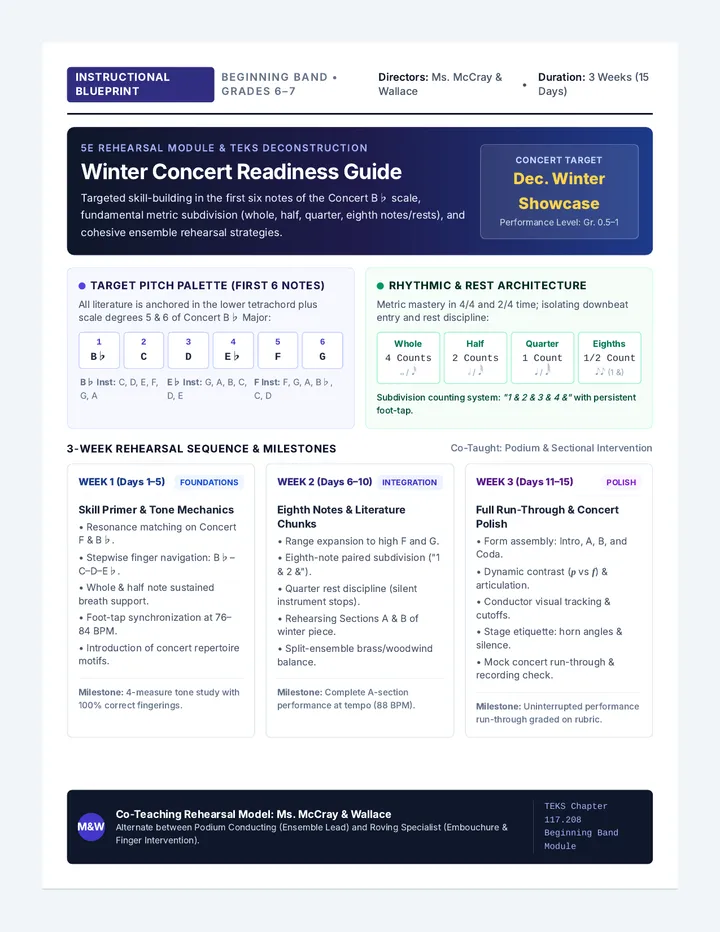
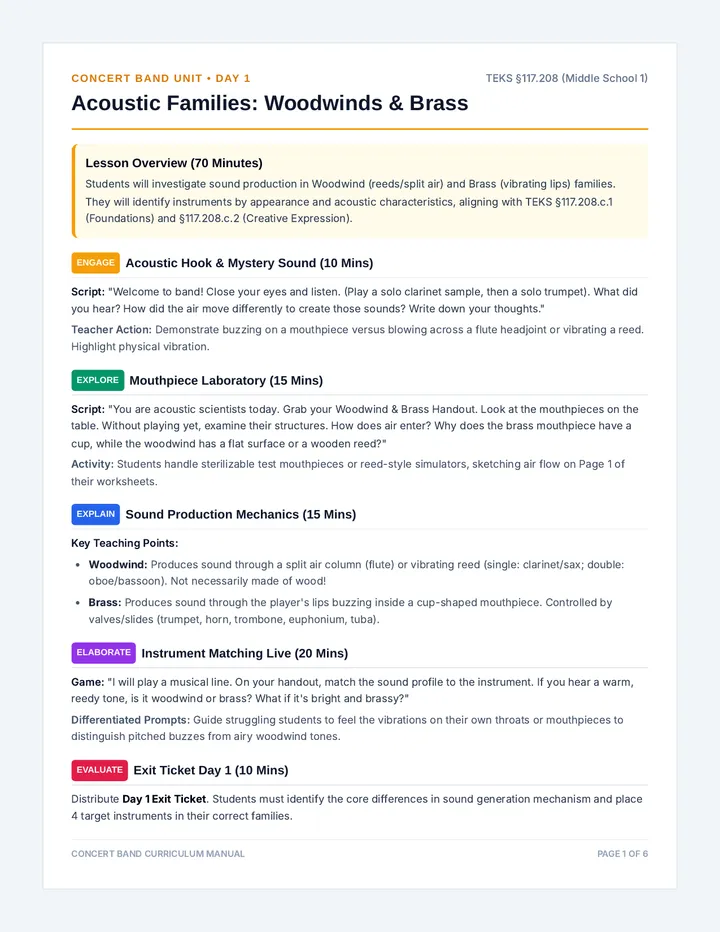
Technical proficiency across string, woodwind, brass, and percussion instruments. Develops music notation literacy, rhythmic accuracy, and ensemble performance techniques.
A comprehensive daily warm-up sequence for middle school woodwind players, focusing on tone production, chromatic dexterity, and mastery of all 12 major keys.
A K-12 collaborative music video project where students across all grade levels work together to produce a 'Playing for Change' style cover of a protest song centered on equality and cultural identity. High school students lead production, while K-8 students provide the musical and visual heart of the performance.
An 8-week intensive for band students to level up their music literacy, moving from basic note identification to fluently reading complex scores. Students will master ledger lines, key signatures, navigation markings, and ensemble sight-reading through a "Music Mission Control" theme.
A comprehensive exploration of world music and dance, focusing on cultural heritage, musical elements, and creative expression through drumming, melody, and global fusion.
An exploration of music written for and inspired by dance across cultures and eras. From the modern concert band work 'Spirit Dance' to global traditions like Samba and Indigenous Hoop dancing, students analyze the relationship between rhythmic pulse and movement.
A comprehensive 6-lesson unit for 5th graders exploring the history, evolution, and legendary figures of American Jazz, from its New Orleans roots to its global legacy today.
A comprehensive unit for middle school band students to master the chromatic scale, focusing on note identification, enharmonics, and instrument-specific fingerings through a 'blueprint' technical aesthetic.
A journey through the 20th and 21st centuries, exploring how technology like electric guitars and synthesizers shaped genres from Rock 'n' Roll to Pop. Students analyze rhythm, structure, and sound to build a chronological timeline of musical evolution.
A global musical expedition for 2nd graders to discover how geography and culture shape instruments and traditions across four continents. Students explore materials, physics of sound, and the cultural roles of music through inquiry and hands-on activities.
A comprehensive introduction to the four families of the orchestra for 2nd graders. Students explore timbre, mechanics, and historical roles of strings, woodwinds, brass, and percussion, culminating in a conductor simulation.
A 5-lesson sequence for 3rd graders exploring the music and instruments of West Africa, Asia, the Andes, and North America, focusing on how geography and culture shape sound.
A comprehensive introduction to the orchestra and the Classical era for 3rd graders, covering instrument families, specific sections, key composers (Mozart and Beethoven), and the art of conducting.
An interactive 4-page worksheet booklet that introduces Major Pentatonic Scales. Students learn C, G, F, and D Major Pentatonic scales through keyboard coloring, staff notation trace-and-write, and finger-number matching guides.
A granular pedagogical manual detailing Lessons 19 to 36 of the Kindergarten Music Curriculum. Each lesson plan outlines a precise 25-minute chronological guide covering advanced solfege, ensemble playing, simple bordun, and improvisation.
A granular pedagogical manual detailing Lessons 1 to 18 of the Kindergarten Music Curriculum. Each lesson plan outlines a precise 25-minute chronological guide covering voice exploration, steady beat, high/low, and fast/slow.
The comprehensive year-long curriculum map, pacing guide, and repertoire list for Kindergarten Music, detailing the pedagogical approach, 25-minute class routine, quarterly focal points, and a curated master repertoire list.
Iconic notation song chart for Creedence Clearwater Revival's classic 'Fortunate Son'. Revised to incorporate the steady eighth-note '1+2+3+4+' strumming pattern (Down-Up Down-Up Down-Up Down-Up) directly into the Intro section.
A 25-question multiple-choice exam for primer-level piano students, covering posture, finger numbering, keyboard geography, notation, and basic theory concepts. Revised with robust SVG-based musical symbols and a condensed layout for better printing.
A 25-question multiple-choice exam for primer-level piano students, covering posture, finger numbering, keyboard geography, notation, and basic theory concepts. Revised with CSS-based musical symbols to ensure consistent rendering and improved page flow.
A teacher's answer key for the Piano Primer Exam, including correct answers, key concept tags, and a basic scoring rubric. Revised with full text answers, higher contrast, and corrected terminology.
A 25-question multiple-choice exam for primer-level piano students, covering posture, finger numbering, keyboard geography, notation, and basic theory concepts. Revised with proper musical symbols, corrected terminology, and optimized page flow.
A teacher's answer key for the Piano Primer Exam, including correct answers, key concept tags, and a basic scoring rubric. Revised with full text answers and improved layout.
A 25-question multiple-choice exam for primer-level piano students, covering posture, finger numbering, keyboard geography, notation, and basic theory concepts. Revised to include the C major chord and improved page breaks.
A lesson dedicated to learning the fundamentals of major scales on the piano, beginning with pentatonic scales. Contains an interactive multi-page mini booklet with keyboard coloring, staff notation trace-and-write, and fingering guides.
A comprehensive, year-long curriculum for Kindergarten Music. It contains a detailed Scope and Sequence Document and two highly granular Lesson Structure Manuals detailing 36 distinct bi-weekly lesson plans.
An engaging guitar lesson focused on Creedence Clearwater Revival's 'Fortunate Son', introducing intermediate rock strumming patterns, chord transitions (G, F, C, D), and visual lyric tracking.
A comprehensive assessment covering foundational piano concepts for beginner students, including posture, notation, rhythms, and basic theory.
A comprehensive make-up assignment for students who missed a performance, requiring a detailed 5-paragraph review of a world-class orchestral concert with research and personal critique.
A complete bulletin board kit featuring vibrant, rainbow-themed musical elements and diverse student illustrations to celebrate music as a universal language.
Second and third graders explore the history of American folk music on the Idaho Trail, focusing on the unique sounds of the banjo, fiddle, and washboard while practicing call-and-response.
Students explore the art of conducting, learning to lead an ensemble through 4/4 and 3/4 time signatures while controlling dynamics and tempo with physical gestures. This lesson emphasizes leadership, non-verbal communication, and collaborative music-making.
The foundational daily routine for 7th-grade woodwind students, covering the essential technical pillars of long tones, chromatic movements, and scale patterns.
A comprehensive set of daily warm-up exercises for 7th-grade woodwind players, focusing on tone production, chromatic dexterity, and scale mastery across all 12 keys.
A comprehensive workshop on chamber music communication, focusing on non-verbal cues, shared breathing, and collective phrasing to achieve a unified ensemble sound without a conductor.