F Major Mastery Worksheet EXPEDITION LOGBOOK: PART I
F Major Pentascale
NAME: ______________________
DATE: ______________________
Objective: Chart the first 5 notes of the Concert F Major scale and master the dynamics of land navigation: Piano (\(p\)) and Forte (\(f\)). (TEKS Music MS 1.1.A, 1.1.B)
SECTION 1
Vocabulary Trail (Matching)
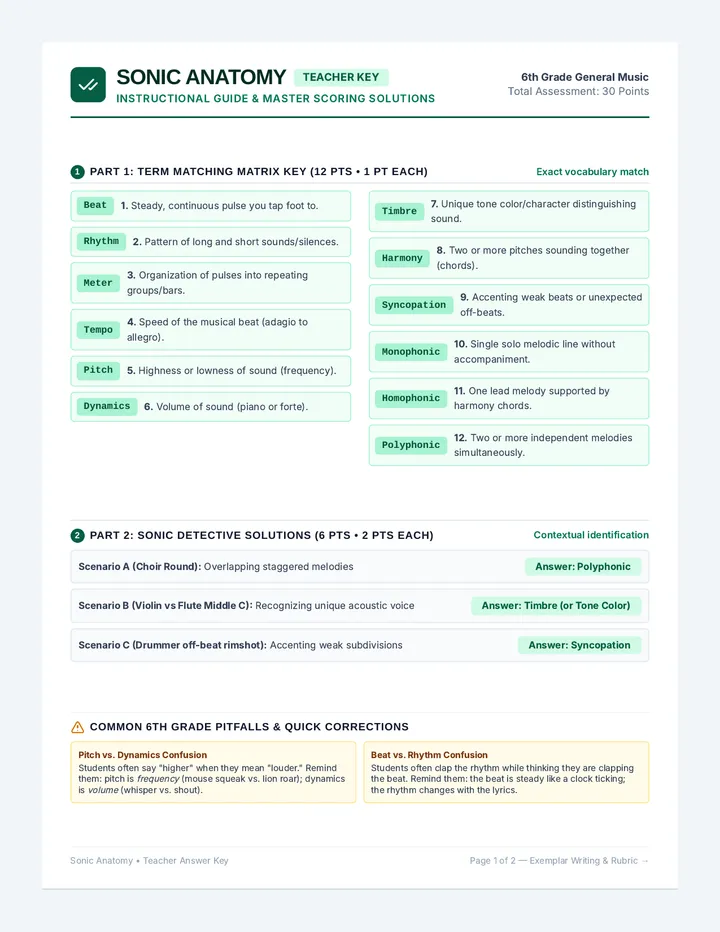
1. ____ Concert Pitch
A. A series of five consecutive notes ascending or descending in pitch.
2. ____ Pentascale
B. The absolute standard sound reference shared globally across different instruments.
3. ____ Forte (\(f\))
C. Sharp, flat, or natural signs at the start of a staff indicating the home key.
4. ____ Piano (\(p\))
D. Dynamic marker instructing the explorer to perform with a strong, loud voice/air.
5. ____ Key Signature
E. Dynamic marker instructing the explorer to perform with a soft, quiet voice/air.
SECTION 2
Mapping the Notes (Staff Work)
Identify the note names for the Concert F Major Pentascale. Write the letter name in each corresponding box.
𝄞 ♭ Q6 Q7 Q8 Q9 Q10
Q6 (1st Note)
Q7 (2nd Note)
Q8 (3rd Note)
Q9 (4th Note)
Q10 (5th Note)
SECTION 3
Dynamic Horizons (Analysis)
Q11. Which interval step describes the distance between the 3rd note (A) and 4th note (B-flat) of this pentascale? (Circle one): Half-Step or Whole-Step
Q12. Describe how a player adjusts their air stream and embouchure when moving from forte (\(f\)) to piano (\(p\)):
Q13 - Q15: Dynamic Wilderness Decibel Chart
Write Piano (\(p\)) or Forte (\(f\)) for each sound source scenario.
Q13. Rustling Leaves
Q14. Rolling Thunder
Q15. Waterfall Crash
F Major Frontiers Expedition Guide • Page 1 of 2
EXPEDITION LOGBOOK: PART II
F Major Summit
NAME: ______________________
DATE: ______________________
The Summit Quest: Scale the final 3 notes of the Concert F Major scale (D, E, F) to complete the octave. Master the dynamic shifts: Crescendo (<) and Decrescendo (>). (TEKS Music MS 1.1.A, 1.1.B, 1.2.A, 1.2.C)
SECTION 4
Summit Vocabulary (Matching)
16. ____ Crescendo
A. Extra short lines drawn above or below the staff to extend pitch limits.
17. ____ Decrescendo
B. Gradually increasing the volume and velocity of sound.
18. ____ Ledger Line
C. Performing the 1st, 3rd, 5th, and 8th notes of a scale in sequence.
19. ____ Arpeggio
D. Gradually decreasing the volume and intensity of sound.
20. ____ Octave
E. The distance of eight full scale steps between two pitches of the same letter.
SECTION 5
Scaling the Heights (Pitch Construction)
Q21. Write the letter names of the final THREE notes (Steps 6, 7, and 8) needed to complete the ascending Concert F Major Scale:
Step 6: [ _____ ] Step 7: [ _____ ] Step 8 (Octave): [ _____ ]
Q22. Briefly explain how a ledger line allows music notes to go above or below the standard 5-line staff:
Q23 - Q25: Scale Mechanics (Circle True or False)
Q23. A standard major scale contains exactly two half-steps. TRUE / FALSE
Q24. An arpeggio skips steps, playing only the 1st, 3rd, 5th, and 8th notes. TRUE / FALSE
Q25. Step 7 (E) to Step 8 (F) in the Concert F major scale is a whole-step. TRUE / FALSE
SECTION 6
The Breath of the Wind (Dynamic Shifts)
Q26. Sketch the standard symbol for a Crescendo and Decrescendo inside the boxes:
Crescendo (<)
Decrescendo (>)
Q27. To produce a smooth decrescendo, a player must gradually (reduce / increase) air support.
Q28 - Q30: Expedition Scenarios (Short Fill)
Q28. A hiker notices a storm coming closer and thunder getting louder. This represents a: _______________
Q29. To maintain instrument tone quality when playing louder, we need more ( airspeed / air temperature ).
Q30. Write the four pitch letter names of the Concert F Major Arpeggio : [ ___ ] [ ___ ] [ ___ ] [ ___ ]
F Major Frontiers Expedition Guide • Page 2 of 2
Pentascale Pioneer Teacher Guide TEACHER FIELD NOTES
Pentascale Pioneer Guide
WEEK 1: THE PENTASCALE
DURATION: 70 MINUTES
TEKS Alignment MS 1.1.A, 1.1.B, 1.2.A
Key Dynamics Piano (\(p\)), Forte (\(f\))
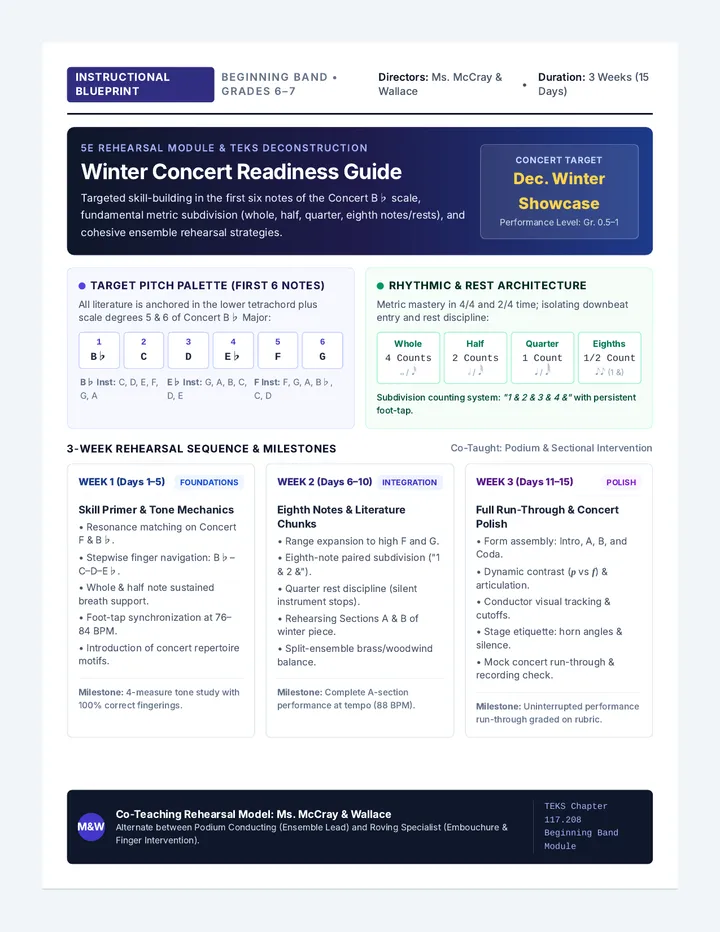
Scale Targets Concert F, G, A, B♭, C
Academic Vocabulary Trail
Concert Pitch: Standardized global pitch reference.
Pentascale: A 5-note scale built on whole/half step pattern.
Key Signature: Sharps/flats at the staff's start.
Piano (\(p\)) / Forte (\(f\)): Soft / loud expression markings.
The 5E Map & Pacing
ENGAGE 0-10 Mins
The Whisper & The Shout: Start class in an absolute whisper (\(p\)). Use high dramatic context (an expedition quiet check). Instantly switch to a resounding clap & greeting (\(f\)). Have students replicate the immediate change.
Focus: Introduces physical energy differences between \(p\) and \(f\).
EXPLORE 10-25 Mins
Sounding the Wilderness: Have students play a single drone note. Encourage them to find their absolute softest playable tone without losing pitch, then their loudest controlled tone. Guide them to navigate "by feel" the physical air speeds needed for both levels.
Focus: Exploring air speed, resistance, and key physical differences of static dynamics.
EXPLAIN 25-40 Mins
Mapping the Blueprint: Introduce the Concert F Pentascale pitches on the board: F - G - A - B♭ - C . Teach the interval structure: W - W - H - W . Explicitly explain that \(p\) requires slow, high-pressure air, whereas \(f\) requires fast, high-volume air.
Focus: Linking vocabulary, step-by-step theory, and musical notation to physical habits.
ELABORATE 40-60 Mins
Echoes of the Canyon: Lead a call-and-response drill. Play 3-note patterns in the F Pentascale using random dynamics. Students repeat. Then hand out F Major Mastery Worksheet (Part I) . Allow students to complete Questions 1-15 in expedition pairs.
Focus: Real performance integration alongside physical scale-reading comprehension.
EVALUATE 60-70 Mins
The Pass-Check: Conduct a rapid individual or small-group performance check. Have each student play the Concert F Major Pentascale ascending in \(f\) and descending in \(p\). Collect Page 1 of the logbook worksheet for formal checks.
Focus: Assessing individual performance proficiency and structural theory understanding.
Pentascale Pioneer Slides Pioneer Expedition: Week 1
F MAJOR FRONTIERS
Charting the Concert F Pentascale & Static Dynamics
PENTASCALE PIONEER SLIDE 1 OF 8
Stage 1: ENGAGE
Campfire Warmup
Prepare Your Air & Tone
Before ascending the musical trail, we must prepare our lungs and timing. Echo your guide's rhythm on a single open tone:
PIONEER ECHO CHALLENGE:
4 quarter notes ➔ 2 half notes ➔ 1 whole note
Posture Checklist
Tall posture, back off the back of the chair
Relaxed shoulders, open chest area
Warm, steady air support
PENTASCALE PIONEER SLIDE 2 OF 8
Stage 2: EXPLORE
Discovering the Pentascale
A Pentascale is our basic path. It contains the first five notes of the Concert F Major scale:
F Step 1
G Step 2
A Step 3
B♭ Step 4
C Step 5
The Interval Pattern
Let's explore the physical distance between notes using Whole steps (W) and Half steps (H):
F → W → G → W → A → H → B♭ → W → C
PENTASCALE PIONEER SLIDE 3 OF 8
Stage 3: EXPLAIN (Part 1)
The Transposition Map
In band, orchestra, and choir, "Concert F" means different starting pitches depending on your instrument's key! Find your path:
C Instruments
Flute, Oboe, Trombone, Baritone, Tuba, Mallets
F - G - A - B♭ - C
B♭ Instruments
Trumpet, Clarinet, Bass Clarinet, Tenor Sax
G - A - B - C - D
E♭ Instruments
Alto Sax, Baritone Sax
D - E - F# - G - A
F Instruments
French Horn
C - D - E - F - G
PENTASCALE PIONEER SLIDE 4 OF 8
Stage 3: EXPLAIN (Part 2)
Dynamic Horizons
Forte
f
Perform with a strong, full, loud sound . Keep your tone focused and clear!
Airflow: Fast, warm, high volumeCore support: Strong and stableTone: Rich and round, never forced
Piano
p
Perform with a soft, quiet, focused sound . Never let the energy drop!
Full Scale Expedition Teacher Guide TEACHER FIELD NOTES
Full Scale Expedition Guide
WEEK 2: THE SUMMIT
DURATION: 70 MINUTES
TEKS Alignment MS 1.1.A, 1.1.B, 1.2.A, 1.2.C
Dynamic Shifts Crescendo, Decrescendo
Octave Targets Steps 6-8: D, E, F
Summit Vocabulary Trail
Crescendo (<): Gradually increasing the dynamic level.
Decrescendo (>): Gradually decreasing the dynamic level.
Ledger Line: Extension lines for extreme high/low pitches.
Arpeggio: Performing steps 1, 3, 5, and 8 sequentially.
The 5E Map & Pacing
ENGAGE 0-10 Mins
The Rising Wind: Raise your hand slowly as a conductor. Prompt students to hum or sizzle, starting whisper-quiet and growing to maximum volume as your hand rises, then shrinking as it falls. Introduce the physical term crescendo and decrescendo .
Focus: Establishing physical connection to volume transition symbols.
EXPLORE 10-25 Mins
The Final Ascent: Play the Week 1 pentascale (F to C). Ask students what happens next when we go higher. Have them play "by ear" to find the last three pitches needed to complete the scale (D, E, F) and share fingerings.
Focus: Student-led ear training and problem solving to find the full scale octave.
EXPLAIN 25-40 Mins
Summit Topography: Write the full 8-note scale. Focus heavily on Steps 6-8: D - E - F . Introduce ledger lines for the upper octave. Explain that a crescendo requires a steady increase of air speed and physical support, while maintaining solid oral shape.
Focus: Linking dynamic transitions to mechanics and high-range air support.
ELABORATE 40-60 Mins
The Summit Trail: Perform the full scale ascending as a crescendo and descending as a decrescendo . Introduce the arpeggio (1-3-5-8). Have students work on F Major Mastery Worksheet (Part II - Questions 16-30) .
Focus: Reinforcing technical skills and theoretical concepts through team practice.
EVALUATE 60-70 Mins
Performance Summit: Students play the Concert F Major scale (1 octave) ascending & descending with conducter-led crescendos and decrescendos. Grade and collect Page 2 of the worksheet to check for full 30-question mastery.
Full Scale Expedition Slides Pioneer Expedition: Week 2
F MAJOR SUMMIT
Scaling the Full Octave & Dynamic Transitions
FULL SCALE EXPEDITION SLIDE 1 OF 8
Stage 1: ENGAGE
Campfire Warmup
High-Register Air Speed
To reach the scale's octave summit (notes D, E, and F), our lungs need high-speed, pressurized air streams.
SIZZLE CHALLENGE:
Inhale for 4 counts ➔ Sizzle ("Tss") out for 8 counts with continuous core support!
Summit Prep Check
No neck or shoulder tension on high notes
Faster cold air (rather than slower warm air)
Keep jaw relaxed and embouchure firm
FULL SCALE EXPEDITION SLIDE 2 OF 8
Stage 2: EXPLORE
Reaching the Summit
To scale the entire mountain, we must add the final three pitches of our scale to the Week 1 pentascale:
D Step 6
E Step 7
F Step 8 (Peak)
The Full 1-Octave Scale
The full scale ascends and descends through all 8 steps:
F → G → A → B♭ → C → D → E → F (Octave)
FULL SCALE EXPEDITION SLIDE 3 OF 8
Stage 3: EXPLAIN (Part 1)
Transposition Summit
Scale the full octave peak based on your instrument's key! Match Concert F to your pitch track:
C Instruments
Flute, Oboe, Trombone, Tuba, Mallets
F, G, A, B♭,
B♭ Instruments
Trumpet, Clarinet, Bass Clarinet, Tenor Sax
G, A, B, C,
E♭ Instruments
Alto Sax, Baritone Sax
D, E, F#, G,
F Instruments
French Horn
C, D, E, F,
FULL SCALE EXPEDITION SLIDE 4 OF 8
Stage 3: EXPLAIN (Part 2)
Dynamic Shifts
Crescendo
<
Gradually increase the volume of sound.
Airflow: Gradually accelerate airspeedCore support: Engage muscles deeperThroat: Keep wide, relaxed, and open
Decrescendo
>
Gradually decrease the volume of sound.
Airflow: Gradually decelerate airspeed