Blastoff Master Launch Plan Unified 5-Day Curriculum Guide
Blastoff Master Launch Plan
Sequence: B-Flat Blastoff | Beginning Band Concert B♭ Major Scale & Tempo Mastery
TEKS ALIGNMENT
MS1: 1A, 1C, 2A, 2B, 3A
Mission Directives
Over 5 days (70 mins/day), students build tone, master the 8-note Concert B♭ scale, navigate instrumental transpositions, execute 1-3-5-8 arpeggios, and transition across the full Italian tempo spectrum.
5-Day Curriculum Flight Roadmap
DAY 1
Ignition First Four Concert B♭, C, D, E♭ | Embouchure & Air Support
ADAGIO (60–76 BPM) Slow, stately tone stability
DAY 2
Climbing Orbit Top Half Concert F, G, A, B♭ | Upper Register Compression
ANDANTE (76–108 BPM) Walking pace, connected air
DAY 3
Pitch Telemetry Transposition Full 8-Note Scale | C, B♭, E♭, F Instrument Decoding
MODERATO (108–120 BPM) Medium speed integration
DAY 4
Trajectory Patterns & Arpeggios 1-3-5-8 Chord Arpeggio & Thirds | Dexterity Drills
ALLEGRO (120–168 BPM) Quick, crisp articulation
DAY 5
Mission Complete Flight Audit Scale Performance, Rubric Diagnostic & Self-Audit
PRESTO & RIT. Fast sprint & safe decelerations
Transposition Telemetry Quick Reference
C INSTRUMENTS Flute, Oboe, Trombone Plays Concert B♭ Key: 2 Flats (B♭, E♭)
B♭ INSTRUMENTS Clarinet, Trumpet, Tenor Sax Plays Written C Key: Natural / 0 Flats
E♭ INSTRUMENTS Alto & Baritone Sax Plays Written G Key: 1 Sharp (F♯)
F INSTRUMENTS French Horn Plays Written F Key: 1 Flat (B♭)
Standard 70-Minute Flight Architecture:
00-10m: Engage (Breathing/Pulse) 10-25m: Explore (Tone discovery) 25-40m: Explain (Notes & Transposition) 40-60m: Elaborate (Tempo drills) 60-70m: Evaluate (Exit sign-off)
PAGE 1 OF 2 | RETRO SPACE MISSION CONTROL CODE: B-FLAT-MASTER
TEACHER FLIGHT DIRECTOR MANUAL
Flight Directives & Instructional Dialogue
Master Script & Troubleshooting
Complete Teacher Prompts & Pedagogical Fixes for Days 1–5
STAGE
DAYS 1 - 5 SCRIPT
TRANSMISSION SCRIPT (DAILY PROMPTS)
MISSION CONTROL TRANSMITTER
[DAY 1 - IGNITION]:
"Flight crew, lock into launch posture. Fuel tanks full: breathe 4 counts of cool air. Release on Concert B♭ with steady air pressure. Listen across the section. At 60 BPM (Adagio ), our long tones must be unwavering beams of laser sound."
[DAY 2 - CLIMBING ORBIT]:
"We are breaking through the atmosphere into our upper four notes: F, G, A, and high B♭. Increase your air stream velocity like a jet nozzle. At Andante (walking speed), keep your tone supported as your fingers step cleanly through each note."
[DAY 3 - TRANSPOSITION TELEMETRY]:
"Why do trumpets play C when flutes play B♭? Because our instruments speak different regional dialects! Check your cockpit translation grid. Today we bridge both halves into the full 8-note scale at Moderato (108 BPM)."
[DAY 4 - ARPEGGIO TRAJECTORY]:
"Engage Allegro ! We are skipping steps to launch the 1-3-5-8 major arpeggio. Keep fingers curved like astronauts gripping the joystick. Light, crisp 'too' tongue articulation—no sloppy valve lag!"
[DAY 5 - MISSION COMPLETE AUDIT]:
"Final diagnostic check! Demonstrate high-speed Presto propulsion, followed by a controlled Ritardando deceleration to a resonant final landing note. Fill out your flight logs for peer and director sign-off."
Aerospace Malfunction Diagnostics & Field Fixes
Pitch Sag / Dropping Flat
Diagnosis: Loss of air velocity or collapsed embouchure corners.Field Fix: Direct students to push from the abdominal wall and firm the mouth corners ("pointed chin, flat cushion").
Valve & Slide Lag at Fast Tempos
Diagnosis: Flat fingers, tense wrists, or lazy slide movement.Field Fix: Emphasize curved "C" fingers directly over valve buttons; trombone wrist flick with loose elbow.
Transposition Miscommunication
Diagnosis: Clarinet/Trumpet reading Concert note names instead of written.Field Fix: Prompt with "Director says Concert B♭, your cockpit sees Written C." Require students to pencil names above notes.
Ritardando Coordination Breakdown
Diagnosis: Eyes glued down on page rather than watching conductor.Field Fix: Stand in performance posture with stands at eye level; conduct exaggerated deceleration patterns.
Assessment Certification: Pair with the 4-page Blastoff Cadet Logbook for daily tracking and final diagnostic sign-off.
MISSION CONTROL READY
PAGE 2 OF 2 | RETRO SPACE MISSION CONTROL CODE: B-FLAT-MASTER
CONFIDENTIAL TEACHER UTILITY
Blastoff Master Slides MISSION CONTROL // STAGE 1: IGNITION
First Four Notes
TEMPO: ADAGIO 60–76 BPM // SLOW & STATELY
DEGREE 1
B♭
Base Engine
DEGREE 2
C
First Step
DEGREE 3
D
Major Third
DEGREE 4
E♭
Half Step Lift
Inhale 4 counts. Sustain each tone for 4 full beats. No wobbling air!
SLIDE 1 OF 6
MISSION CONTROL // STAGE 2: CLIMBING ORBIT
Reaching Upper Orbit
TEMPO: ANDANTE 76–108 BPM // WALKING PACE
DEGREE 5
F
Dominant Core
DEGREE 6
G
High Thrust
DEGREE 7
A
Leading Tone
DEGREE 8
B♭
High Octave Orbit
Fast air velocity supports higher pitches. Keep embouchure corners firm!
SLIDE 2 OF 6
MISSION CONTROL // STAGE 3: TELEMETRY
Transposition Matrix
TEMPO: MODERATO 108–120 BPM // MEDIUM PACE
C VOICES
Flute, Trombone, Baritone B.C.
PLAYS Concert B♭
B♭ VOICES
Clarinet, Trumpet, Tenor Sax
PLAYS Written C
E♭ VOICES
Alto Sax, Baritone Sax
PLAYS Written G
F VOICES
French Horn
PLAYS Written F
Different written notes produce the EXACT same sound across our ensemble!
SLIDE 3 OF 6
MISSION CONTROL // STAGE 4: TRAJECTORY
Scale Arpeggios
TEMPO: ALLEGRO 120–168 BPM // FAST & CRISP
ROOT [ 1 ]
B♭
Tonic Base
THIRD [ 3 ]
D
Major Trajectory
FIFTH [ 5 ]
F
Orbit Anchor
OCTAVE [ 8 ]
B♭
Summit Target
Skip notes with snappy fingers! Pattern: 1 - 3 - 5 - 8 - 5 - 3 - 1.
SLIDE 4 OF 6
MISSION CONTROL // STAGE 5: RE-ENTRY
Presto & Ritardando
DYNAMIC SHIFTS FAST SPRINT TO SLOWDOWN
PRESTO 168–200 BPM // VERY FAST
Maximum flight speed! Requires immediate finger reflexes, light tongue articulation, and unwavering diaphragmatic air flow.
Blastoff Cadet Logbook Flight Log // Stages 1 & 2
Scale Engine Coordinates
MISSION LOGBOOK PAGE 1 OF 4
Cadet Name:
Instrument:
Flight Date:
Section 1: Cockpit Fingering & Slide Coordinates (Fill in for your instrument)
Write your instrument's Written Note Name and record your Valves / Slide Position for each scale degree:
DEGREE 1 Concert B♭
Written:
Fingering/Pos:
DEGREE 2 Concert C
Written:
Fingering/Pos:
DEGREE 3 Concert D
Written:
Fingering/Pos:
DEGREE 4 Concert E♭
Written:
Fingering/Pos:
DEGREE 5 Concert F
Written:
Fingering/Pos:
DEGREE 6 Concert G
Written:
Fingering/Pos:
DEGREE 7 Concert A
Written:
Fingering/Pos:
DEGREE 8 Concert B♭
Written:
Fingering/Pos:
Section 2: Propulsion Speed Analysis (Adagio vs. Andante)
ADAGIO CALIBRATION
Speed: 60–76 BPM (Slow and stately). Describe your breathing focus when sustaining long tones at Adagio:
ANDANTE PROPULSION
Speed: 76–108 BPM (Walking pace). How does moving to the upper register change your air stream velocity?
Pre-Flight Embouchure Audit: Flat chin, firm corners, relaxed throat, teeth apart.
CADET CHECK: [ ] PASS
CADET FLIGHT LOGBOOK // MISSION: B-FLAT BLASTOFF
PAGE 1 OF 4
Flight Log // Stage 3
Transposition Telemetry
MISSION LOGBOOK PAGE 2 OF 4
Section 1: The Transposition Decoder Matrix
When the Band Director calls out a Concert Pitch , each instrument family must read its unique Written Pitch . Complete the missing cells below:
Instrument Family Key Signature Concert B♭ Starts On Concert F (5th) Sounds As C Voices (Flute, Trombone) 2 Flats (B♭, E♭) Written B♭ B♭ Voices (Clarinet, Trumpet) 0 Flats / Naturals Written C
|
| E♭ Voices (Alto, Bari Sax) | 1 Sharp (F♯) | Written G |
TEKS Deconstruction Guide Teacher Resource Deck
TEKS Deconstruction Guide
Curriculum Alignment: §117.118. Music, Middle School 1
SEQUENCE ALIGNMENT
B-FLAT BLASTOFF
Section 1: Active Standards Labeled in Sequence
The following Texas Essential Knowledge and Skills (TEKS) under §117.118 (Music, Middle School 1) are directly targeted across our 5-day launch sequence:
117.118(c)(1)(A)
Foundations (Music Literacy): Identify and write notes on treble/bass clefs. Targeted: Day 1, 2 & 3 Student Worksheets (pitch spelling and transposition checks).
117.118(c)(2)(A)
Creative Expression (Performance): Demonstrate correct posture, embouchure, hand position, and fingering. Targeted: Daily Slide Decks (visual posture prompts) and Day 5 Rubric assessment.
117.118(c)(2)(B)
Creative Expression (Tone): Play wind/percussion instruments with characteristic tone quality. Targeted: Day 1 Long Tones, Day 2 Altitude adjustments, Day 4 Arpeggio sweeps.
117.118(c)(3)(A)
Critical Evaluation: Evaluate exemplary and personal musical performances. Targeted: Day 5 Diagnostic Rubric peer-audit, self-assessments, and grading matrix.
Section 2: Deep Deconstruction of TEKS (2)(A)
Let's isolate and deconstruct our sequence's primary mechanical standard, **§117.118.(c)(2)(A)**:
1. Cognitive Verb & Depth
"Demonstrate"
This is an active **psychomotor-domain** verb. It goes beyond simple identification (recognizing a fingering on a page) to immediate, physical real-time execution while playing.
2. Core Content Nouns
Posture (spine alignment)Embouchure (lip, jaw musculature)Hand Position (finger arches)Fingering (valve/slide choices)
3. Sequence Implementation
Scaffolded Path: Day 1 isolates spinal setup and jaw embouchure. Day 2 narrows the embouchure for higher register notes. Day 3 couples these with finger transposition maps. Day 4 develops snappy fingers on arpeggio leaps.
4. Classroom Evidence Metrics
Checked via Day 5 **Diagnostic Flight Log Rubric** scoring. Evaluators grade hand curves, mouthpiece alignments, and slide position extensions to record observable psychomotor proof.
Instructional Action Plan for Directors
To fulfill TEKS (2)(A) successfully, beginning band directors should not separate mechanical setup from tone production. Posture is the fuel-tank structure; embouchure is the engine nozzle. If the posture collapses, air velocity drops immediately, leading to a cascade failure in pitch accuracy. Use the "Mission Control" prompts across our launch plans to frame these physical mechanics as high-stakes, exciting aerospace controls!
Mission Vocabulary Glossary Flight Data Manual
Mission Vocabulary Glossary
Academic Vocabulary for Concert B♭ Scale & Tempo Studies
TEKS ALIGNMENT
MS1: 1A, 1C, 2B
Category 1: Italian Tempo Markings
The four core Italian tempo markings indicating the speed and pacing parameters of our musical propulsion engines:
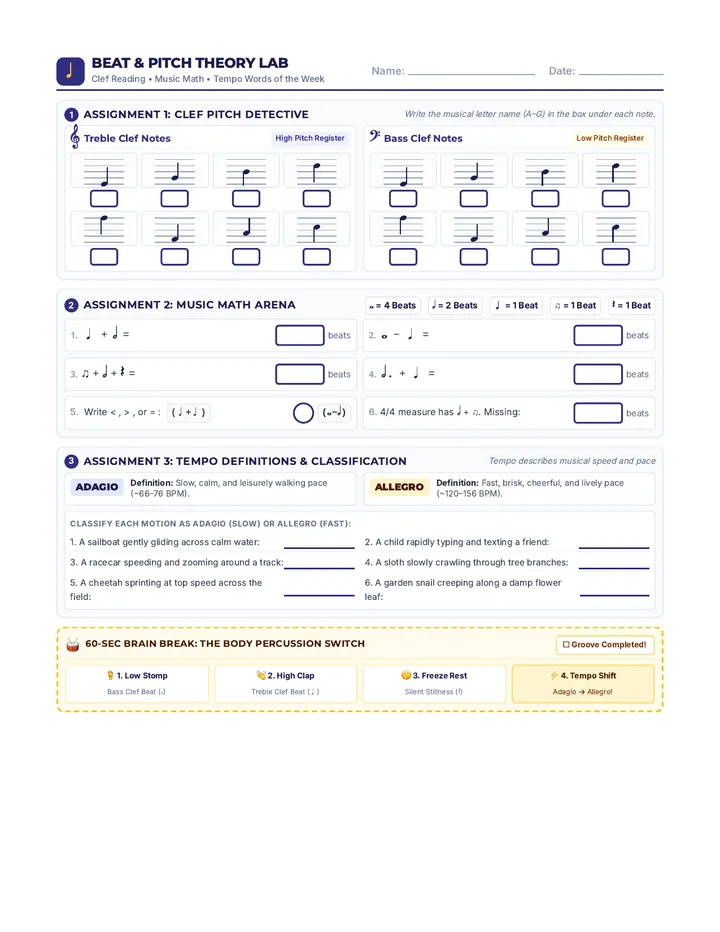
ADAGIO (60–76 BPM)
Slow and stately pacing. Used during early scale ignition for tone production, maximum air volume, and relaxed embouchure alignment.
ANDANTE (76–108 BPM)
Moderate, walking pace. Provides steady forward momentum while practicing upper register climbing and smooth interval navigation.
MODERATO (96–112 BPM)
Medium tempo. A comfortable, balanced speed designed for compiling bottom and top half scale lines with consistent tone quality.
ALLEGRO (120–168 BPM)
Fast, bright, and cheerful tempo. Demands snappy finger transfers, agile air compression, and crisp, lightweight tongue articulation.
Category 2: Pitch Telemetry
Acoustic and structural vocabulary mapping notes across different transposing cockpits:
Concert Pitch
The standard system frequency reference (matching C instruments like Flute/Trombone) to which all ensemble voices coordinate.
Transposition
The formula of shifting written pitches up or down so different tubing lengths sound the same Concert pitch together in unison.
Arpeggio
Playing the 1st, 3rd, 5th, and 8th scale degrees in succession. Creates the structural harmonic framework of a major key.
Category 3: Instrumental Mechanics
The physical psychomotor control vocabulary necessary for generating tone and changing notes:
EMBOUCHURE
The precise positioning and muscular shape of the lips, facial muscles, and tongue on the mouthpiece to produce a steady vibration.
DIAPHRAGM SUPPORT
Using the deep core abdominal muscles to compress and push a continuous, high-velocity stream of air through the instrument tubing.
Director's Vocabulary Tip
Have students echo these four core tempo definitions during the warm-up and practice phases. Connect Italian speed changes directly to metronome settings and conducting patterns!
RETRO SPACE MISSION CONTROL CODE: B-FLAT-GLOSSARY
UNIVERSAL ACADEMIC HANDOUT