A comprehensive 3-week world percussion curriculum for high school general music, guiding students through foundational West African and Afro-Latin drumming traditions, instrument anatomy, polyrhythms, and culminating ensemble performance.
Sound Distinction (Clear difference between B, T, and S)
|
|
|
| Tempo Stability (Holding steady ostinato without rushing) |
|
|
|
|
| Ensemble Awareness (Listening across the circle to Dunduns) |
|
|
|
|
My personal technical goal for tomorrow's rehearsal:
High School General Music • Mandé Drumming Traditions Turn in to Teacher at conclusion of Week 1
Day 5
Ensemble Circle & Jeli Synthesis
Run continuous 4-minute Kuku groove cycle; complete guided listening journal and student self-assessment rubric.
Pulse of the Drum: High School Curriculum Guide Page 1 of 2
Facilitation Toolkit • Lesson 1
Rehearsal Techniques & Diagnostics
Teacher Guide • Page 2
The Universal Mandé Call ("Blocage")
Start & Stop Signal
In traditional Mandé ensembles, the lead djembe plays a specific musical phrase known as the call to initiate the groove, change tempo, or cue a synchronized stop. Drummers respond in lockstep.
Lead Drummer Call: Tone-Slap-Slap-Tone-Slap / Unison Crash
Vocal Mnemonic:"Lis-ten to the beat and STOP to-GETH-ER!"
Student is pressing hand flat into head; drum base is flush on floor.
Instruct student to bounce hand off instantly like a trampoline; tilt drum base 2 inches forward.
Tone sounds identical to Slap
Fingers are splayed open or wrist is too loose on Tone strike.
Have student imagine tape wrapping fingers together; strike edge with firm pads, keeping flat hand.
Ensemble accelerates tempo (rushing)
Djembe 2 players anticipatorily pull beat 2 forward during slaps.
Designate one student on Kenkeni bell as the steady reference; prompt all drummers to tap right foot on quarter note.
Hand pain or redness on knuckle rim
Striking too deep into drum; drum rim hitting joints instead of fleshy pads.
Move hand back 1 inch so main knuckles rest just beyond the bearing edge of the wooden shell.
Differentiation & Accommodations
Support & Scaffolding:
• Assign students struggling with independence to the Kenkeni bell or simple downbeat bass tone.
• Use colored tape on drum edges: Blue dot = Bass center, Red stripe = Tone perimeter.
• Allow students with joint sensitivity to use felt mallets or tubanos.
Extension & Honors:
• Challenge advanced percussionists to play both Sangban drum stick and Kenken bell concurrently.
• Designate student soloists to improvise 8-bar variations over the Kuku accompaniment using call motifs.
• Have student conductors cue section entrances using traditional hand gestures.
End-of-Week Debrief Question: "How did listening across the circle to your neighbors change the way you timed your own hands?"
High School General Music • Teacher Facilitation Guide Page 2 of 2
Martillo
Switches to Campana (Bongo bell) during high-energy mambo sections.
Timbales & Cáscara
Metal Paila
Shallow metal shell drums played with sticks. The Cáscara pattern taps directly on the side shell to interlock with the Clave.
Invented in Cuba to replace European orchestral timpani in Charanga bands.
Güiro & Maracas
Gourd Scraper
The natural dried gourd güiro is scraped with a wooden pua: "Long-Short-Short" stroke pattern providing continuous rhythmic friction.
Indigenous Taíno root merged with Afro-Cuban dance music.
Ensemble Balance: Auxiliary instruments provide texture, not overpowering volume. They frame the Congas and Clave!
Cultural Crossroads
Syncretism: Rhythms of Resilience
Yoruba • Congo • Spain • New York
What is Musical Syncretism?
The blending of two or more distinct religious or musical cultures to forge an entirely new, vibrant tradition.
African Roots: Complex polyrhythms, Batá sacred drums, call-and-response vocal forms, and the timeline concept.
Spanish Roots: Guitars (Tres), brass harmonies, decima poetry, and European string arrangements.
The Cabildo & Preservation
Enslaved Africans organized mutual aid societies called Cabildos in Havana and Matanzas, secretly preserving sacred Yoruba Orisha rhythms by masking them within Catholic saint festivals.
"The drum was not just an instrument—it was an ancestral passport that could never be confiscated."
Class Connection: When we play Afro-Cuban percussion today, we are honoring centuries of resilience and cultural endurance.
Performance Criteria
4 - Mastered
3 - Consistent
2 - Developing
1 - Novice
Clave Alignment (Strictly holding the 3:2 or 2:3 pattern)
|
| Dynamic Balance (Supporting lead solos without overpowering) |
|
|
|
|
My personal technical goal for tomorrow's rehearsal:
High School General Music • Afro-Latin Traditions Turn in to Teacher at conclusion of Week 2
Assemble full multi-part groove using the Clave Pyramid entrance; practice dynamic transitions.
Day 10
Diaspora Synthesis & Listening
Guided listening to Tito Puente and Celia Cruz; analyze Cabildo history; complete Lesson 2 check.
Pulse of the Drum: High School Curriculum Guide Page 1 of 2
Classroom Rehearsal Score • Lesson 2
Afro-Cuban Son Groove Score & Diagnostics
Teacher Guide • Page 2
Classroom Multi-Part Score (3:2 Son Feel)
Measure 1: 3-Side • Measure 2: 2-Side
Instrument 1&2& 3&4& 1&2& 3&4&
Son Clave X••• ••X• •••• X••• ••X• ••X• •••• ••••
Conga Tumbao HT ST HT OO HT ST HT OO
Güiro Dud• Dud• Dud• Dud• Dud• Dud• Dud• Dud•
Campana Bell 1••• 2••• 3••• 4••• 1••• 2••• 3••• 4•••
Syncopation Diagnostics Guide
Observed Student Error
Root Cause
Actionable Rehearsal Fix
Clapping beat 3 instead of the & of 2 on clave
Instinctive pull toward playing on the downbeat instead of off-beat syncopation.
Have student say aloud: "ONE ... and-TWO-AND ... FOUR" while clapping only on the capitalized words.
Conga open tones rush or collapse into beat 1
Student gets excited by open tones and speeds up through count 4&.
Emphasize the Heel stroke on beat 1 as a firm physical brake that stops the momentum cleanly.
Bongo player drowns out Conga and Clave
Playing with heavy fist or full hand instead of light finger pads on the Martillo.
Instruct student that bongo Martillo is a high-frequency "whisper" that should never overpower the conga slap.
Differentiation & Formative Assessment
Scaffolding & Adaptations:
• Provide handheld claves with finger notches for ergonomic stability.
• Simplify conga part to just Bass (1, 3) and Slap (2, 4) for drummers struggling with Heel-Toe roll.
Formative Assessment Checkpoint:
• Conduct 30-second "Clave Isolations": Point to individual students around the room to clap the 3:2 clave solo without stopping.
• Verify clear distinction between muted conga slap and ringing open tones.
High School General Music • Teacher Facilitation Guide Page 2 of 2
Performance Mastery
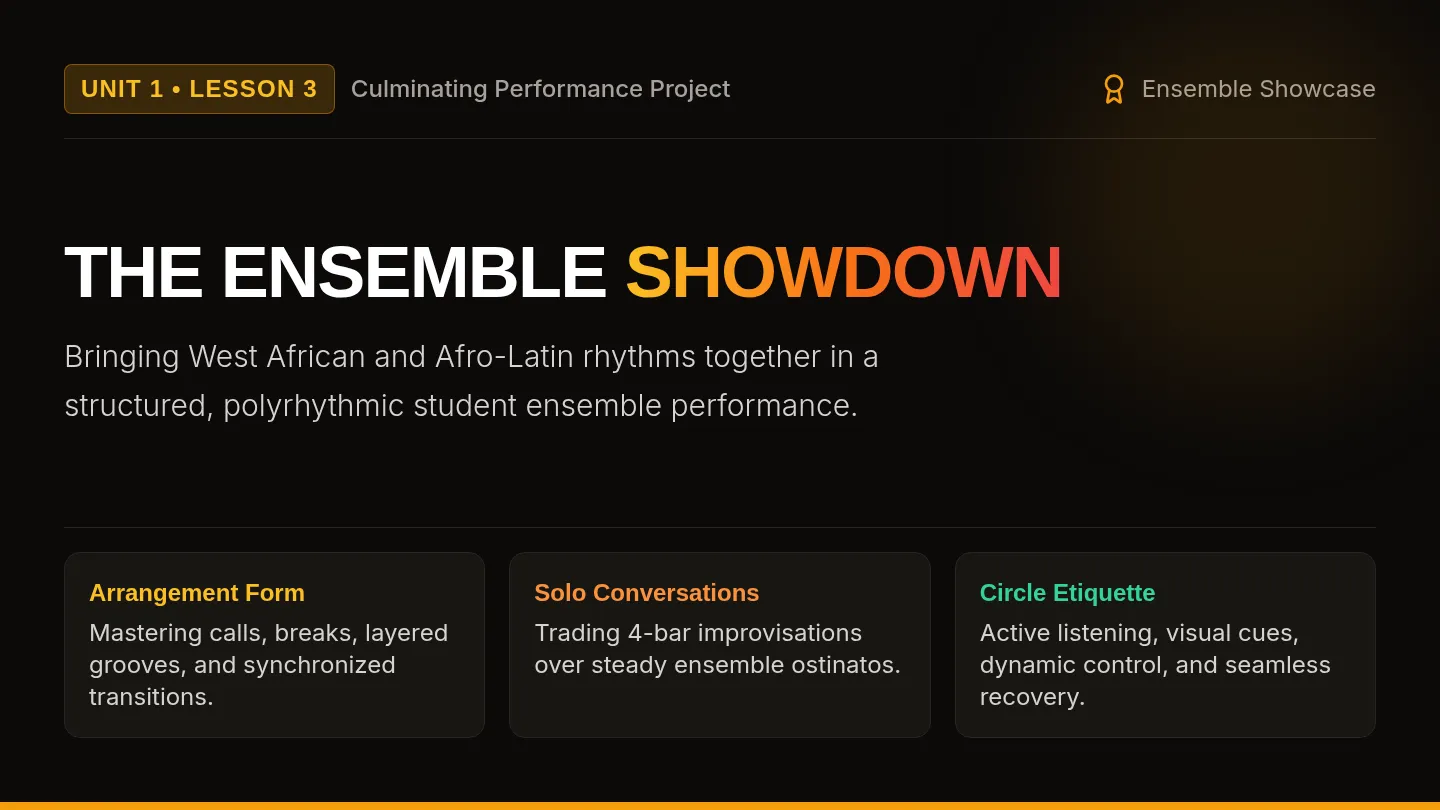
Stage Presence & Circle Etiquette
Professional Musician Protocols
Eyes Across the Circle
Never look down exclusively at your hands. Keep eye contact with your section leader and the soloist to catch cues.
Dynamic Discipline
When someone solos, the entire accompaniment must immediately drop to piano (p) so the solo cuts through clearly.
The Recovery Protocol
If you make a mistake or drop a beat, never stop playing or make a face. Listen for the bell, breathe, and step back in on beat 1.
The Golden Rule: A small mistake is invisible to an audience; stopping completely is unmissable. Keep the groove moving!
Summative Assessment
Showdown Evaluation Criteria
100 Total Points
25 PTS
Rhythmic Accuracy
Steady tempo without rushing or dragging; accurate execution of assigned ostinato pattern.
25 PTS
Tone & Technique
Crisp sonic distinction between strikes (Bass vs Tone vs Slap or Heel-Toe vs Open).
25 PTS
Polyrhythmic Interlock
Holding independent rhythmic line while listening and locking with complementary parts.
25 PTS
Ensemble Presence
Clean starts, dynamic sensitivity during solos, unison breaks, and resilient recovery.
Showcase Schedule: Final ensemble rehearsals take place this week. Live showcase and video recording on Friday!
Point Summary:
Rhythmic Accuracy: ___ / 25
Tone Production: ___ / 25
Polyrhythmic Interlock: ___ / 25
Ensemble Presence: ___ / 25
TOTAL SCORE: ___ / 100
Teacher Commendations & Growth Recommendations:
Evaluator Signature: _______________________________ Final Letter Grade: [ ____ ]
Pulse of the Drum: World Percussion Curriculum • Performance Assessment Tool National Core Arts Standards MU:Pr6.1.HSI
III Cultural Context & Diaspora Synthesis (14 Points)
Respond in complete, thoughtful sentences
10. Explain the social and historical significance of the Griot (Jeli) in West African Mandé culture. Why is the drum considered a "living voice" rather than simply an instrument?
11. Define syncretism as it applies to Afro-Cuban music. How did enslaved African communities in Cuba preserve their ancestral Yoruba rhythms and drum traditions despite colonial prohibitions?
IV Ensemble Reflection & Personal Artistry (8 Points)
Self-evaluation of rehearsal growth
12. Polyrhythmic Challenge: When rehearsing your ensemble piece, what specific strategies did you use to maintain your independent rhythm while listening to contrasting syncopated parts around the circle?
13. Modern Connections: How has learning the foundational African and Afro-Latin rhythms in this unit changed the way you hear contemporary popular music (such as hip-hop, reggaeton, pop, or Afrobeats)?
I certify that this work represents my own musical understanding and effort. Student Signature: ____________________________________
High School General Music • Unit Summative Exam Page 2 of 2