Historical evolution of performance, technical stagecraft, and core acting techniques. Develops playwriting skills and fosters imaginative expression through script development and production management.
A professional, portrait-oriented video production storyboard and visual guide for the 'AI Superstar' promotional video. It features a detailed scene-by-scene script breakdown, presenter framing instructions, exact 3D cartoon asset descriptions, AI image generation prompts, and editing tips.
A student-facing 1-page discussion cards resource. Features a grid of 6 beautifully designed, cut-out-ready prompt cards with vintage dashed borders to guide student partners in character development, vocal warmups, and collaborative oral play.
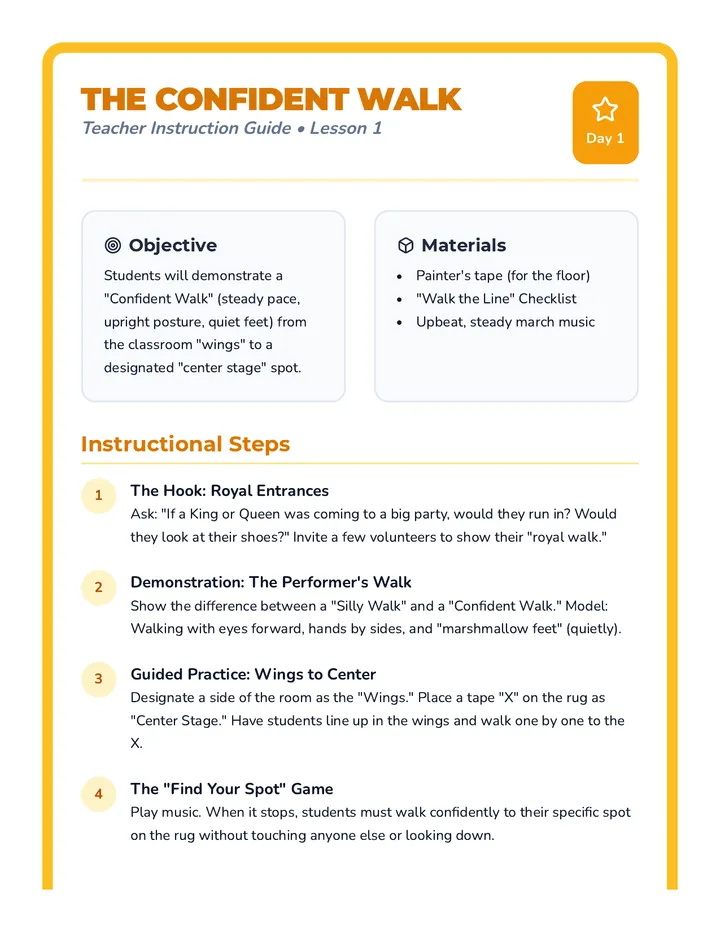
A student-facing 2-page activity packet. Page 1 provides an guided, lined template for writing a three-step dialogue script with a scene-selection grid. Page 2 includes 4 retro-themed finger puppet cutouts ready for students to color, cut, and loop around their fingers.
An elegant 5-slide presentation designed for Grade 2 instruction. Guides students through understanding character voice, writing a 3-step script, building puppets, and demonstrating good audience manners. Uses larger, easy-to-read text of 24px and up.
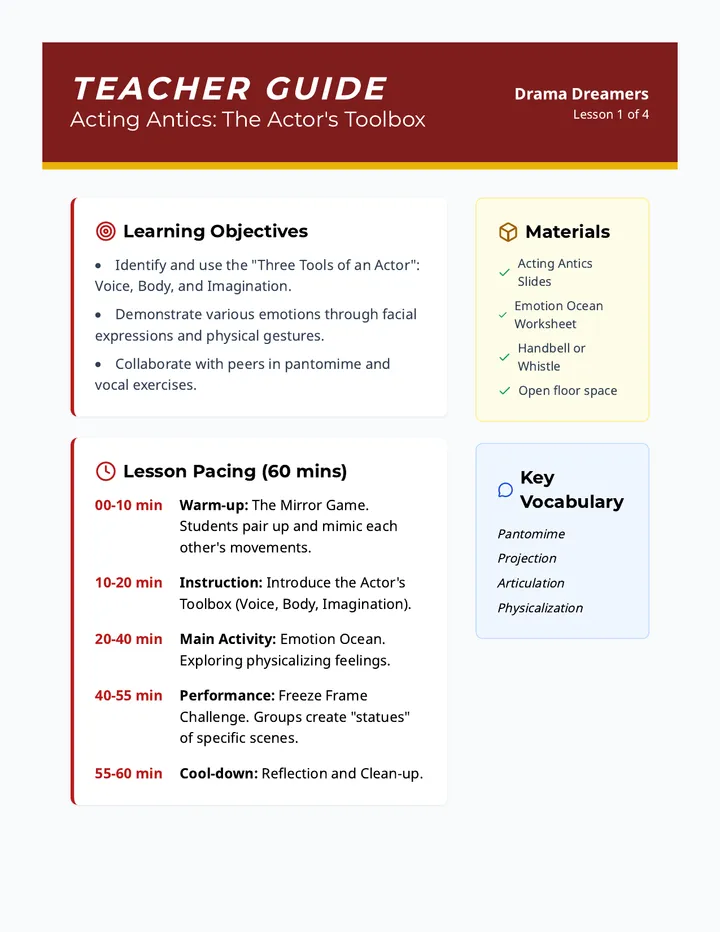
A comprehensive 2-page teacher's guide and lesson plan for running a classroom puppet theater lesson. Includes detailed pacing, materials checklist, step-by-step facilitation prompts, oral reflection questions, and a kid-friendly grading rubric.
High-impact student slide deck for Lessons 6-8: The Animation Studio. Designed for a 16:9 widescreen layout with big, readable fonts, structured pacing following the block map, and clean visual graphics.
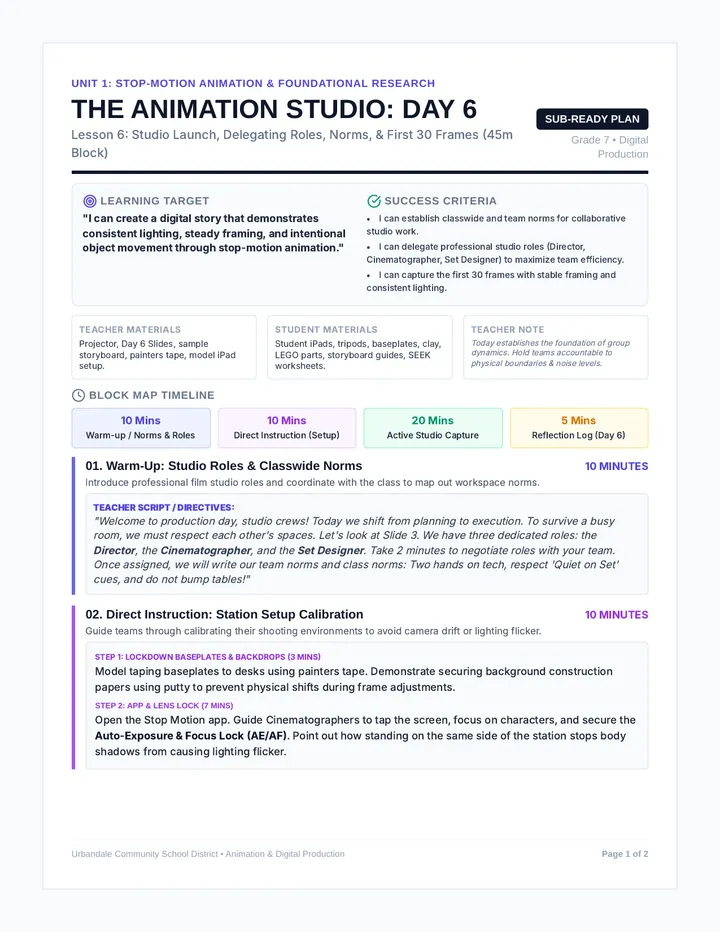
A 3-day sub-ready teacher lesson plan for Lessons 6-8: The Animation Studio. Outlines professional team roles, industry production cues (Quiet on Set, Check the Gate, Rolling), daily shooting milestones, and a step-by-step block breakdown.
High-impact student slide deck for Lesson 5: The Physics of Animation. Designed for a 16:9 widescreen layout with big, readable fonts, structured pacing following the block map, and clean visual graphics.
A complete, sub-ready teacher lesson plan for Lesson 5: The Physics of Animation. Focuses on set design, lighting, the iPad Stop Motion app guide, expectations, and physics of motion.
An 8-frame storyboard template student worksheet. Each frame features a blank drawing area, writing lines for the punchy script sentence, and camera angle checkboxes (CU, MS, WS).
High-impact student slide deck for Lesson 4: Storyboarding the Micro-Script. Designed for a 16:9 widescreen layout with big, readable fonts, structured pacing following the block map, and clean visual graphics.
A complete, sub-ready teacher lesson plan for Lesson 4: Storyboarding the Micro-Script. Outlines the infographic presentation warm-up, anatomy of a storyboard, camera directions, what-if transitions, and a step-by-step block breakdown.
A hands-on, creative storytelling lesson where second-grade students write simple scripts, design paper finger puppets, and practice expressive reading and oral storytelling. Helps boost reading fluency, collaboration, and character development in an engaging classroom theater format.
A short, comedic lesson featuring a modern play about Egyptian gods managing their cosmic duties. Includes a complete script with Ra, Isis, Osiris, and Anubis, character introduction slides, and a creative design worksheet.
A short, humorous, and educational lesson featuring a 10-minute modern play about the Greek gods adapting to modern life. Includes a complete performance script, character introduction slides, and an interactive student worksheet to design modern adaptations of other mythological figures.
A dynamic lesson on non-verbal communication with two paths: a challenging 'Mime Master' level for older students and a simplified 'Lunch Bunch' version designed for 2nd grade social-emotional learning and casual play.
A practical and humorous script where characters use the STEP problem-solving method to navigate a playground disagreement.
Inspired by the themes of 'Love That Dog', students perform a script about discovering the power and freedom of writing poetry.
A readers theater script featuring an armadillo, a springbok, and a monarch butterfly demonstrating their unique survival strategies.
Students explore the different parts of the human brain and how they work together to control thoughts, feelings, and movements through a fun performance script.
A deep dive into Stanislavski's 'System', focusing on using real-world experiences to inform character work through peer interviews.
A creative hands-on activity where students create their own Elephant and Piggie puppets to act out stories. This lesson focuses on fine motor skills through coloring and cutting, followed by imaginative play.
A creative activity lesson focusing on the iconic characters Gerald and Piggie, encouraging dramatic play and storytelling through simple finger puppets.
Unit 1, Lesson 9: The Frame Festival. A celebration block where students showcase their completed historical stop-motion animations, conduct peer critique reviews, and evaluate final projects using the comprehensive unit rubric.
Unit 1, Lesson 6: The Animation Studio - Day 6. Teams establish collaborative group norms and class safety norms, delegate professional roles, and capture the first 30 frames.
Unit 1, Lessons 6-8: Multi-day animation studio production block. Teams establish student roles, execute industry production cues, and shoot their 10-fact historical stop-motion animations on iPads.
Unit 1, Lesson 5: The Physics of Animation. Combining Squash and Stretch, the 1-Stud Rule, set construction stability, lighting consistency, and storyboard revision.
Unit 1, Lesson 4: Introducing the anatomy of a storyboard, exploring visual action, camera shot directions, and drafting an 8-frame visual storyboard plan for the stop-motion animation.
Unit 1, Lesson 3: Synthesizing historical research into 10 punchy factual sentences for the stop-motion script, while conducting an internet safety scavenger hunt on Phishing, Digital Footprint, and Privacy.
Unit 1, Lesson 2: Introducing the S.E.E.K. digital search strategy to help students research, verify, and document credible facts about a historical figure for their future stop-motion script.
Unit 1, Lesson 1: Persistence of Vision lesson outline exploring frames per second (FPS), professional exemplars, and flipbook creation.
An introductory lesson on the fundamentals of scenic design, guiding students to create their own stage groundplans using industry-standard drafting symbols.
Unit 1: Stop-Motion Animation & Foundational Research. Students explore persistence of vision, digital research credibility, storyboarding, animation physics, and production.
A project-based learning sequence for theatre students focused on the directorial challenges of staging Matilda Jr. in two vastly different performance spaces: a traditional proscenium auditorium and a modern thrust-stage black box.
A 10-day unit exploring 3D paper construction through the creation of animal forms or masks, focusing on precision, perseverance, and paper engineering.
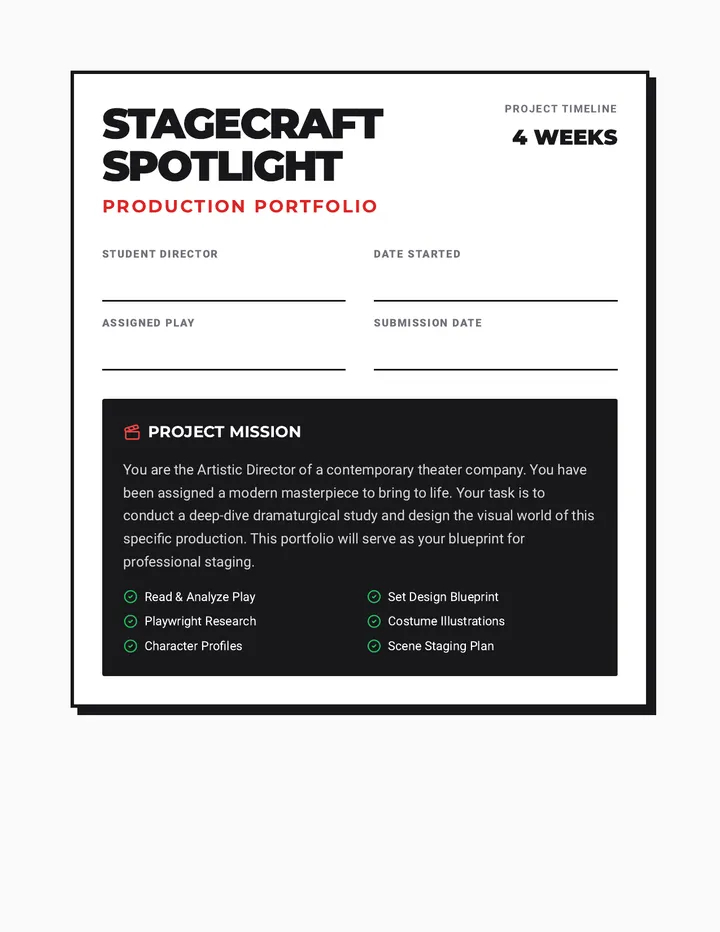
A comprehensive four-week unit and independent study guide for contemporary drama. Students analyze scripts, research playwrights, design technical elements, and stage scenes for a final production portfolio.
A comprehensive workshop where students in grades 5-8 master the art of digital storytelling by blending narrative structure, audio production, and visual composition into a final multimedia project.
This graduate-level sequence explores the intersection of labor law, fiscal strategy, safety protocols, and crisis management within professional theater production. Students develop the leadership skills necessary to navigate union environments and high-stakes technical environments.
An advanced technical theater sequence for graduate students exploring the intersection of light physics, human perception, and visual storytelling. Students move from the biological mechanics of the eye to high-level system integration and dramaturgy.
Students investigate how costumes and properties (props) function as tools for character development and storytelling. The sequence guides students through the process of distinguishing between prop types, exploring costume psychology, fabricating safe props, and mastering backstage organization.
A 5-lesson sequence for 5th graders exploring technical theater through lighting and sound engineering. Students learn how to manipulate mood and focus using physical properties of light and creative sound design, culminating in a technical rehearsal simulation.
This sequence introduces 5th-grade students to the world of technical theater through the lens of scenic design. Students progress from learning stage geography to analyzing scripts, drafting floor plans, and ultimately building a 3D scale model (maquette) of their own set design.
Students step into the role of the technical crew, learning stage management, costume organization, and backstage safety. This sequence culminates in students mastering the organizational and communication skills required to run a professional theater production.
A unit of humorous, educational lessons where students perform modern comedic plays about ancient pantheons. Students explore the domains, symbols, and myths of Greek and Egyptian deities while practicing reading fluency, character design, and critical analysis.
A collection of four readers theater scripts designed for fourth-grade students, focusing on science, literacy, and social-emotional learning themes. Each script is designed for six performers and is approximately five minutes in length.
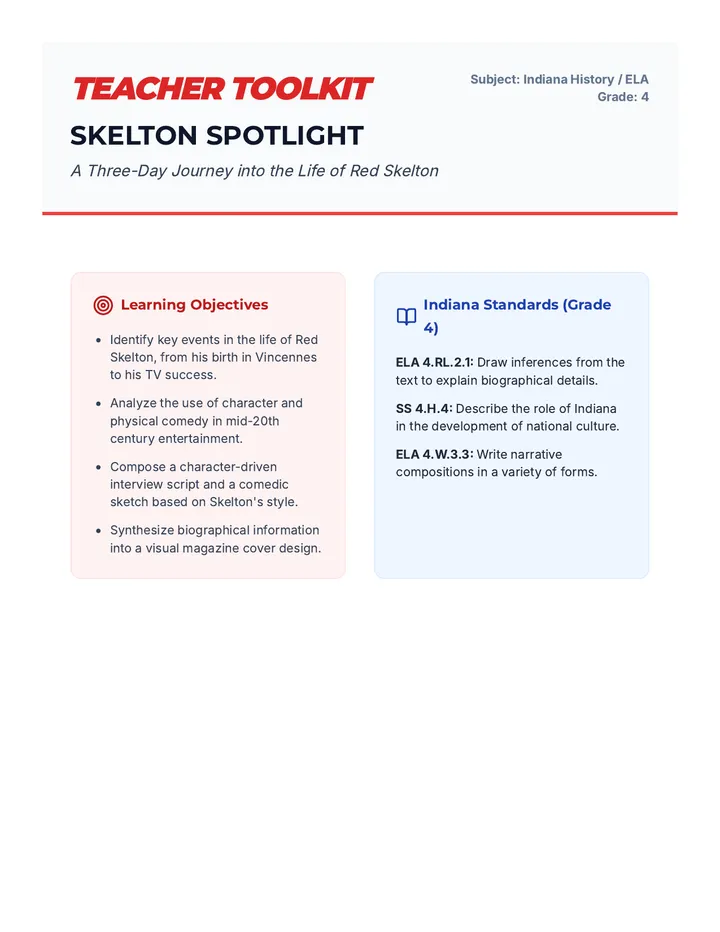
A three-day exploration of the life and legacy of Indiana-born comedian Red Skelton, presented in a vibrant magazine format. Students explore his early life in Vincennes, his iconic characters, and his lasting impact on American comedy through reading and creative performance activities.
An advanced literary sequence for high school sophomores exploring archetypal evolution, intertextuality, and the deconstruction of folklore across Victorian literature and modern musical theater. Students analyze the socio-cultural shifts that transform classic legends into modern subversive narratives.
A 12-lesson unit utilizing drama and enactment techniques to deepen reading comprehension, themed around Kuwaiti heritage, global travel, healthy lifestyles, and environmental science for grades 3-8. Focused on skills in action across Before, During, and After reading phases.
A comprehensive introduction to theater for elementary students, covering acting techniques, playwriting, stage types, theater history, and technical "behind the scenes" magic. Students move from basic expression to designing and performing with confidence.
A unit focused on play structure, fluency, and social-emotional problem solving through mystery-themed scripts. Students analyze plot elements while practicing performance skills.
A drama-focused sequence for 3rd grade that uses Mystery and Adventure plays to teach reading literature standards RL.3.1, RL.3.4, and RL.3.5. Students move from teacher modeling to independent practice using the gradual release of responsibility.
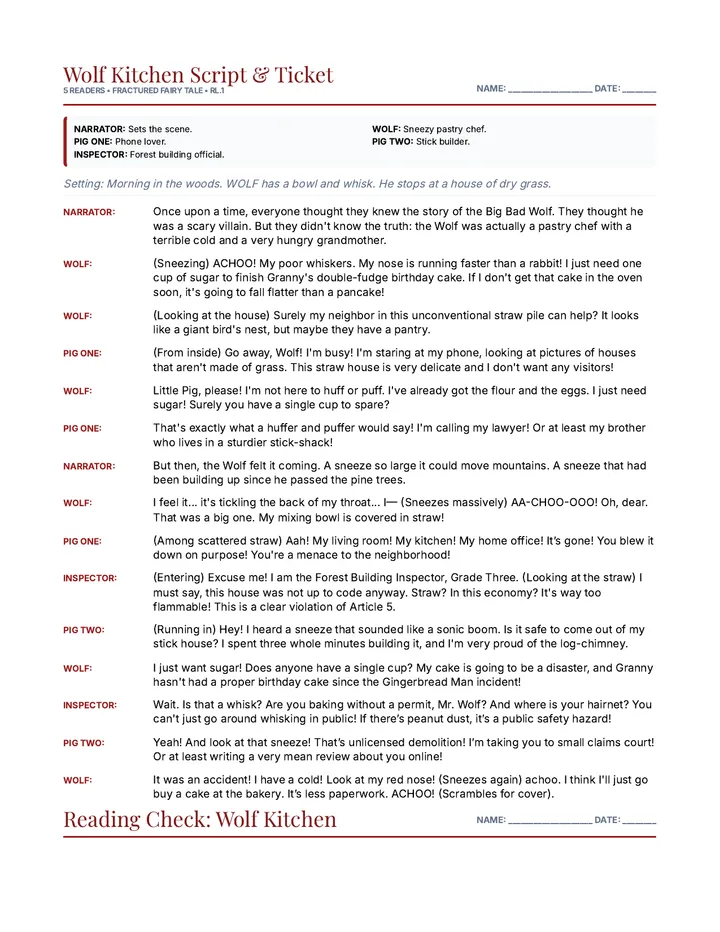
A collection of five fractured fairy tale reader's theater scripts designed for groups of five students, focusing on fluency, expression, and creative retelling.
A multi-day unit exploring Augusto Boal's Theatre of the Oppressed, focusing on the transition from spectator to 'spect-actor' through Image and Forum Theatre to address contemporary social issues.
Updated teacher's guide with optimized layouts for the answer key and project guidance. Includes specific instructions for the new Playbill Poster extension. Revised for better page cohesion.
A theater-style playbill poster worksheet that allows students to promote the character and story they created. It features space for a main illustration, title, credits, and a creative artist statement or tagline. Revised for better page fitting and lighter watermarks.
A condensed 1-page teacher-facing discussion guide and student notebook activity sheet designed to accompany the Red Review magazine reading. Includes oral discussion questions and creative diagramming tasks.
An expanded version of the peer interview worksheet, now updated to include space for three separate interviews. Each section includes decoding for Objective, Motivation, Emotional Memory, and 'The Magic If', with the context renamed from 'Scenario' to 'A Memory'. Optimized with higher contrast and student name fields on every page.
A modern, high-contrast slide deck exploring Stanislavski's core acting concepts: Given Circumstances, The Magic If, Objective, Motivation, and Emotional Memory. Designed for visual impact and instructional clarity.
A teacher-facing answer key optimized for black and white printing, featuring high-contrast borders and clear, high-legibility text layouts.
A 2-page note-taking guide for students optimized for high-contrast black and white printing. Includes clear, white work areas and bold borders for maximum legibility when photocopied.
A teacher-facing answer key for the Stanislavski Study Notes Worksheet, providing suggested answers and key concepts for the Moscow Art Theatre, Given Circumstances, and the Method of Physical Actions.
A 2-page note-taking guide for students to use during the Stanislavski presentation. Includes sections for the Moscow Art Theatre, Given Circumstances, and a comparison between Emotional Memory and the Method of Physical Actions.
A 12-slide presentation on the Stanislavski acting system, featuring a 'Director's Notebook' aesthetic. It covers the Moscow Art Theatre, Given Circumstances, the Magic If, and the transition from Emotional Memory to the Method of Physical Actions.
An answer key and grading rubric for the Red Skelton lesson sequence, covering reading comprehension and creative assignments.
A narrative writing prompt focused on slapstick comedy and physical humor, encouraging students to write their own comedic sketches in the style of Red Skelton.